
Understanding Two of the Army’s Most Elite Training Programs

Which is toughest Army ranger school or Green Beret is a question that sparks debate among military personnel, veterans, and aspiring special operators. The answer isn’t simple—these programs test soldiers in fundamentally different ways.
Quick Answer: Comparing Difficulty
| Factor | Ranger School | Green Beret (Q Course) |
|---|---|---|
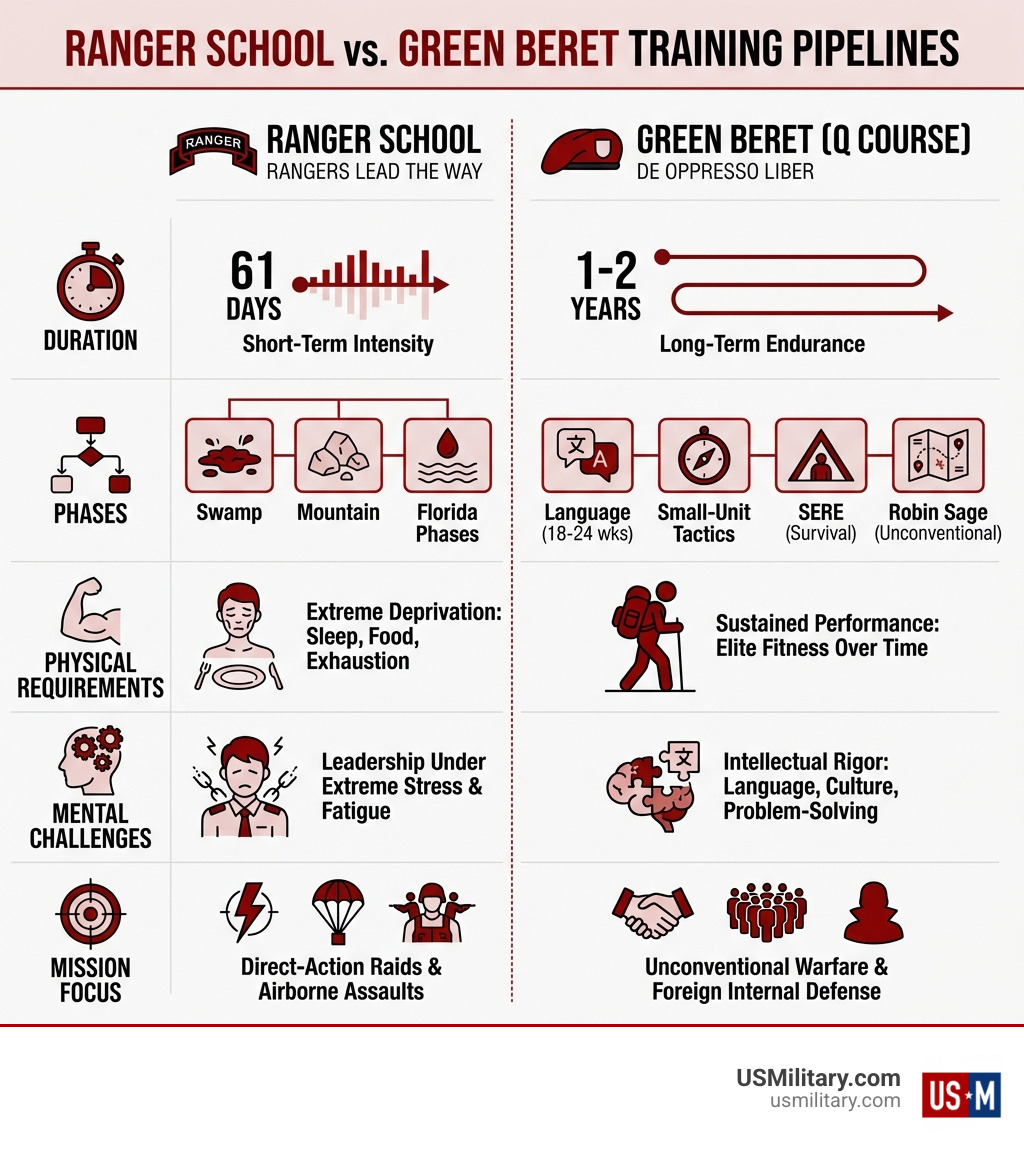
| Duration | 61 days | 1-2 years (up to 62 weeks) |
| Primary Challenge | Extreme physical deprivation (sleep, food) | Intellectual rigor and specialized skills |
| Attrition Rate | High (80% in some classes) | High (varies by phase) |
| Focus | Leadership under extreme stress | Problem-solving, language, cultural expertise |
| Typical Candidate | Young, physically fit soldiers | Mature, seasoned veterans (average age 31) |
| What Makes It Tough | Sleep deprivation, starvation, physical exhaustion | Long duration, language mastery, unconventional warfare training |
The verdict: Ranger School delivers intense short-term physical punishment, while the Green Beret Q Course demands sustained intellectual and physical performance over years.
Both programs push candidates to their absolute limits. Ranger School strips you down through starvation and sleep deprivation—candidates routinely lose 20-30 pounds, go days without sleep, and endure relentless physical challenges across swamps, mountains, and obstacle courses. One 1989 class saw 80% attrition from a group of 50 Infantry Second Lieutenants, with only 2 graduating.
The Green Beret Q Course takes a different approach. It’s a marathon, not a sprint—lasting up to two years with phases covering language training (18-24 weeks), small-unit tactics, survival school (SERE), and unconventional warfare exercises like Robin Sage. The intellectual demands are immense: mastering foreign languages, cultural expertise, and complex problem-solving while still maintaining elite physical standards.
What you need to know: Rangers specialize in direct-action raids and airborne assaults—think lightning-fast strikes and airfield seizures. Green Berets focus on unconventional warfare, training foreign militaries, and operating independently in small 12-man teams behind enemy lines. Their mottos capture this difference: Rangers say “Rangers Lead the Way,” while Green Berets live by “De Oppresso Liber” (To Free the Oppressed).
Many soldiers pursue both paths sequentially. It’s common for Rangers to later attempt Green Beret selection, using their Ranger experience as a foundation. Officers typically can’t enter the Ranger Regiment until reaching First Lieutenant, or Special Forces until approaching the Captain rank.
I’m Larry Fowler, publisher of the USMilitary.com Network since 2007, and I’ve spent years helping active-duty soldiers and veterans understand questions like which is toughest Army ranger school or Green Beret through our military career resources. I’ll break down the specific demands, attrition factors, and unique challenges of each program so you can understand what truly makes these selections among the world’s most difficult military training courses.
Primary Missions: Direct Action vs. Unconventional Warfare
When we look at the 75th Ranger Regiment and the Army Special Forces (Green Berets), we’re looking at two different tools in the military’s toolbox. They both fall under the United States Special Operations Command (USSOCOM), but their day-to-day jobs are worlds apart.
The Rangers: The Tip of the Spear
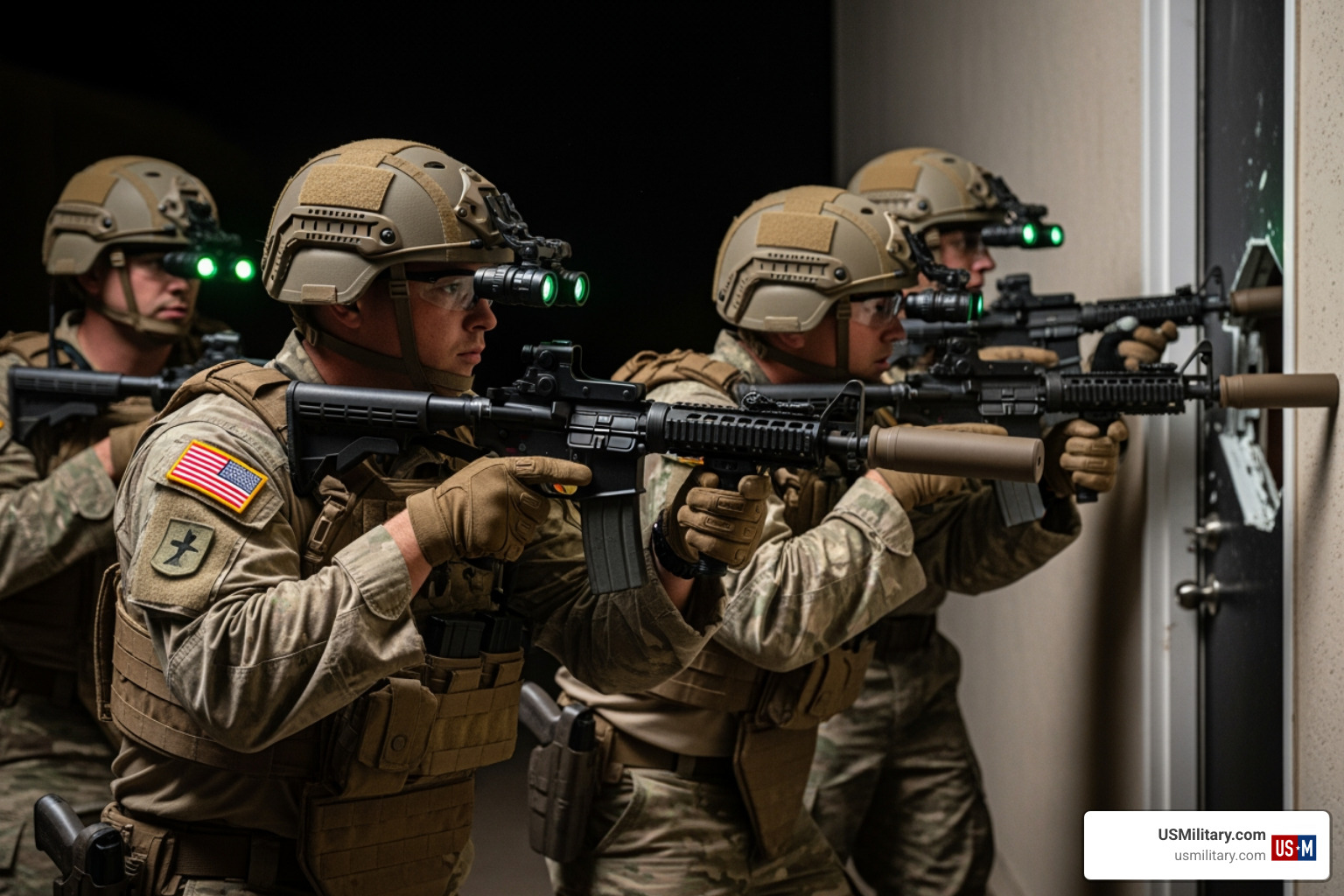
Rangers are the world’s premier light infantry force. Their bread and butter is “Direct Action.” If the military needs a door kicked in, an airfield seized in the middle of the night, or a high-value target captured with overwhelming speed and violence of action, they call the Rangers.
We often describe the 75th Ranger Regiment as a “sledgehammer.” They operate in larger groups than Green Berets and focus on precision, discipline, and high-intensity combat. Their lineage traces back to the French and Indian War, and their modern reputation was forged in missions like the D-Day landings at Pointe du Hoc and the high-tempo raids of the Global War on Terror.
The Green Berets: The Quiet Professionals
If the Rangers are a sledgehammer, the Green Berets are a “scalpel.” While they are certainly capable of direct action, their primary mission is Unconventional Warfare and Foreign Internal Defense.
Green Berets operate in 12-man units known as an Operational Detachment Alpha (ODA). Their job is often to slip into a country, link up with local rebel forces or the indigenous military, and train them to fight. This requires more than just being a good shot; it requires being a teacher, a diplomat, and a linguist. Their motto, “De Oppresso Liber” (To Free the Oppressed), reflects this unique role of empowering others.
For a deeper dive into these roles, check out our guide on the differences-army-ranger-vs-green-beret/.
Comparing the Pipelines: Ranger School vs. The Q Course
The path to wearing the Ranger Tab or the Green Beret is paved with sweat, grit, and a whole lot of rucking. However, the structure of these pipelines is very different.
The Ranger Pipeline
To become a member of the 75th Ranger Regiment, an enlisted soldier typically goes through:
- Basic Combat Training (BCT)
- Advanced Individual Training (AIT) or OSUT (Infantry)
- Basic Airborne Course (BAC)
- Ranger Assessment and Selection Program (RASP) – an 8-week course at Fort Moore (formerly Benning).
Ranger School itself is a separate 61-day leadership course that soldiers from all over the Army (and even other branches) attend to earn the prestigious Ranger Tab. It’s broken into three phases:
- Benning Phase: Focused on squad operations and the grueling “Darby Queen” obstacle course.
- Mountain Phase: Located in North Georgia, where students learn mountaineering and conduct patrols on steep terrain with little sleep.
- Swamp Phase: Held at Eglin Air Force Base in Florida, focusing on waterborne operations and survival in coastal swamps.
The Green Beret Pipeline
The Special Forces Qualification Course (SFQC), or “Q Course,” is much longer. Before a soldier even starts the Q Course, they must pass:
- Special Forces Preparation and Conditioning (SFPC)
- Special Forces Assessment and Selection (SFAS) – a brutal 3-week test of physical and mental stamina at Fort Liberty (formerly Bragg).
Once selected, the Q Course can last anywhere from 1 to 2 years, depending on the soldier’s Military Occupational Specialty (MOS). Phases include:
- Phase 1: Orientation and History: Learning the roots of Special Forces.
- Phase 2: Language and Culture: 18-24 weeks of intensive foreign language study.
- Phase 3: Small-Unit Tactics: 13 weeks of mastering combat fundamentals.
- Phase 4: MOS Training: Specialized training for Medics (18D), Weapons Sergeants (18B), Engineers (18C), or Communications (18E).
- Phase 5: Robin Sage: The legendary unconventional warfare culmination exercise.
- Phase 6: Graduation: Earning the Green Beret.
You can find more detailed breakdowns of these stages at green-berets-vs-army-rangers/.
Which is toughest Army ranger school or Green Beret?
The debate over which is toughest Army ranger school or Green Beret often comes down to how you define “tough.” Are you talking about the intensity of the misery or the duration of the stress?
Physical Attrition: The Sprint of Misery
Ranger School is widely considered the most physically demanding short-term course in the U.S. Army. The sheer level of deprivation is staggering. Candidates often get only 0 to 4 hours of sleep a night and are limited to one or two MREs (Meals, Ready-to-Eat) per day while burning thousands of calories on patrol.
In the 1989 Ranger class mentioned earlier, the 80% failure rate was largely due to the combination of extreme heat and physical exhaustion. Veterans of the course recall losing 25 pounds in two months, even if they started as lean triathletes. The physical toll is so high that some foreign courses modeled after it, like the Thai Ranger School, were actually banned for U.S. operators for over 40 years because the risk of death was deemed too high.
Retired Green Beret Steve Balestrieri has noted that the Colombian Lancero Course—established by U.S. Rangers—is perhaps the only course that rivals or exceeds the U.S. version in pure physical brutality, with students carrying 70-pound rucksacks up near-vertical mountains on almost zero sleep.
If you want to read more about the grit required, see army-ranger-vs-green-beret-who-is-tougher/.
Intellectual Rigor: The Marathon of the Mind
While Ranger School turns you into a “pack mule” focused on the next step, the Green Beret Q Course expects you to be a “PhD with a rucksack.”
The toughness of the Q Course lies in its duration and complexity. It is mentally exhausting to spend six months learning a difficult language like Arabic or Mandarin, then immediately go into the woods to lead a mock guerrilla force in a complex political scenario. Green Berets are expected to have a high level of intellectual autonomy. They are often “mature candidates” (the average age is 31) who must solve problems where there is no clear right answer.
In the Q Course, you aren’t just being tested on how many push-ups you can do; you’re being tested on your ability to influence people, understand foreign cultures, and maintain your composure over a two-year period where one mistake in a language test or a medical exam could send you back to the “regular” Army.
Physical and Mental Demands of Elite Selection
Whether you are aiming for the Tab or the Beret, the physical standards are well above the “Big Army” average.
The Physical Baseline
For RASP (Ranger selection), candidates are expected to perform:
- A 5-mile run in under 40 minutes.
- A 6-12 mile ruck march with a 35-pound pack (though in Ranger School, packs often exceed 65-100 lbs).
- A 15-meter swim in full gear.
For SFAS (Green Beret selection), the focus is on “long-range” durability. You’ll spend weeks rucking “the star” (land navigation) across the sandy pines of North Carolina. Grip strength and compound lifts (squats, deadlifts) are vital because you will be carrying heavy loads for dozens of miles.
The Mental Game
Ranger School tests your ability to lead when you are starving and hallucinating from sleep deprivation. If you can keep your squad moving toward an objective when you haven’t slept in four days, you’ve passed the leadership test.
Special Forces selection uses “Big Boy Rules.” There is often very little feedback from the instructors. You are expected to motivate yourself. The “intellectual rigor” comes into play during exercises like Robin Sage, where you are dropped into a fictional country (Pineland) and must navigate complex social and political rules to successfully train a “guerrilla” force.
Frequently Asked Questions about Special Operations
Is the Ranger Tab the same as being in the 75th Ranger Regiment?
No. This is a common point of confusion.
- The Ranger Tab: This is a “skill badge” earned by graduating from the 61-day Ranger School. Any soldier in the Army can attend.
- The 75th Ranger Regiment: This is a specific unit (Special Operations). To be a “Ranger” in the Regiment, you must pass RASP and wear the Tan Beret.
You can have a Ranger Tab but not be in the Regiment. However, every NCO and Officer in the Regiment is required to earn the Tab.
What are the age and rank requirements for Green Beret selection?
To apply for Special Forces (Green Beret) selection, you generally need to be at least 18 years old and have reached the rank of E-3 (Private First Class). Most active-duty soldiers have at least 3 years of service before they apply. However, the “18X” contract allows civilians to enlist specifically for a shot at Special Forces right after Basic Training and Airborne School.
Can a soldier attend both Ranger School and the Q Course?
Absolutely. In fact, it’s encouraged. Many soldiers start their careers in the 75th Ranger Regiment, earn their Ranger Tab, and then later “cross the street” to join Special Forces. The Ranger Regiment is often seen as the ultimate “finishing school” for small-unit tactics, which provides a massive advantage when entering the Q Course.
Conclusion
At the end of the day, asking which is toughest Army ranger school or Green Beret is like asking if a marathon is harder than a heavy weightlifting session. One is a brutal, concentrated burst of physical suffering (Ranger School), while the other is a long, complex, and intellectually taxing journey (Green Beret Q Course).
Both represent the absolute pinnacle of the U.S. Army. Whether you want to be the “sledgehammer” that leads the way on a direct-action raid or the “quiet professional” building alliances in a remote corner of the globe, you are choosing a path of extreme sacrifice and prestige.
At USMilitary.com, we are dedicated to providing the resources you need for these career transitions—from initial enlistment advice to navigating VA disability and veteran benefits after your service. If you’re ready to start your journey, check out our comprehensive guide: Ranger Ready: The Ultimate Guide to Joining the Army’s Toughest.
Whatever path you choose, remember: the hardest part is often just making the decision to show up at the starting line. Good luck.