
Why Join The Army vs Marines: Which Branch Is Right for You?

Why join The Army vs Marines is one of the most common questions for anyone considering military service — and the answer depends on your personal goals, lifestyle, and what you want out of your service.
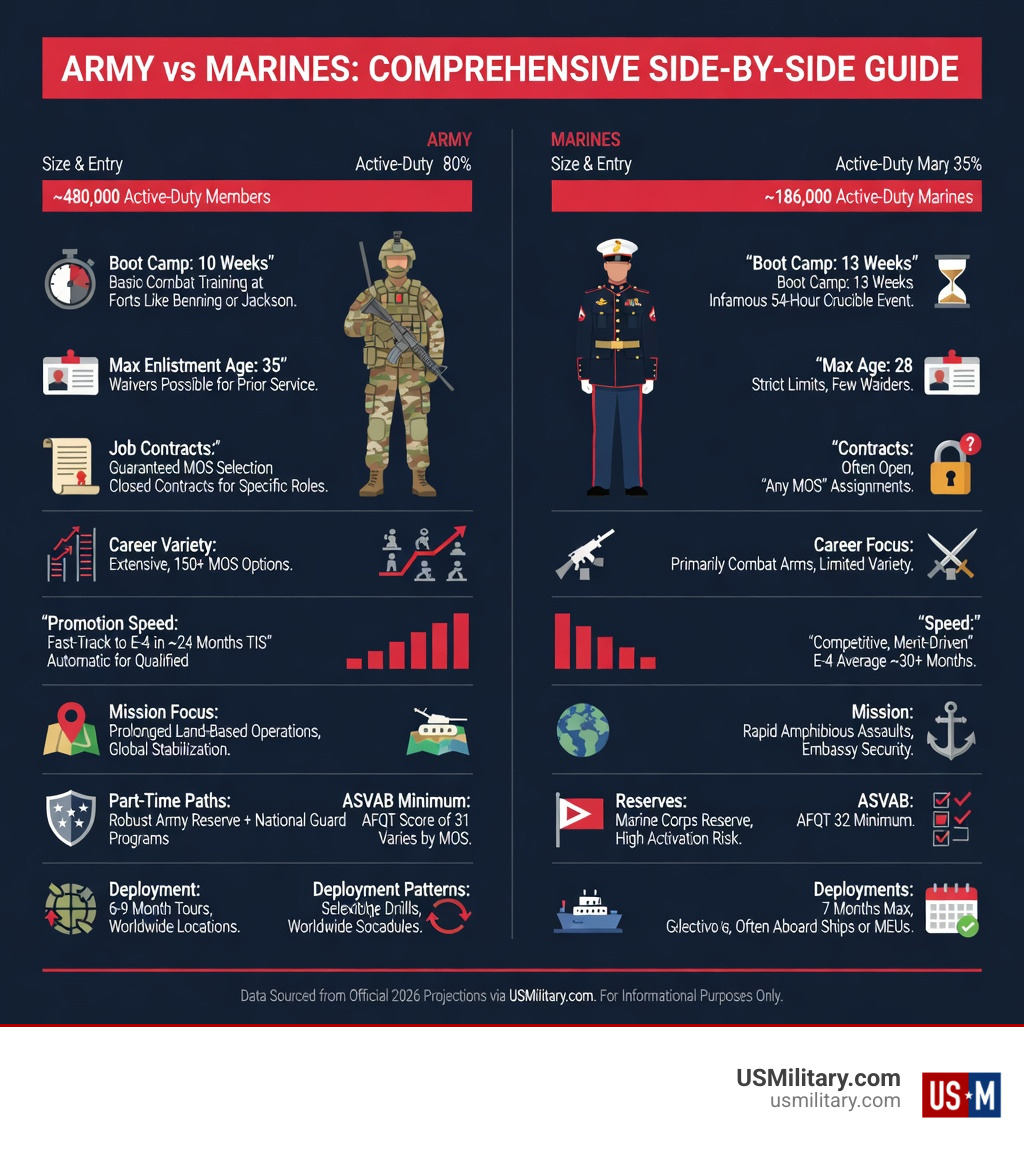
Here is a quick side-by-side breakdown:
| Factor | Army | Marines |
|---|---|---|
| Active-duty size | ~480,000 | ~186,000 |
| Boot camp length | 10 weeks | 13 weeks |
| Max enlistment age | 35 | 28 |
| Job contracts | Guaranteed (closed contract) | Often open contract |
| Promotion speed | Faster (auto E-4 in ~24 months) | More competitive |
| Mission focus | Long-term land operations | Rapid amphibious response |
| Career variety | Very broad | More combat-focused |
| Part-time options | Army Reserve + National Guard | Marine Corps Reserve |
In short:
- Choose the Army if you want more career options, faster promotions, and flexibility through the Reserve or National Guard.
- Choose the Marines if you want elite status, a stronger warrior culture, and shorter but more intense deployments.
Neither branch is objectively better — they serve different purposes and attract different people.
I’m Larry Fowler, publisher of USMilitary.com, and I’ve spent nearly two decades helping service members and recruits navigate decisions exactly like why join The Army vs Marines — connecting thousands of qualified candidates with the right branch for their goals. Read on for a complete, no-fluff breakdown of everything you need to make the right call.
Basic Why Join The Army vs Marines terms:
Primary Missions and Operational Roles
When we look at the fundamental reasons Why Join The Army vs Marines, we have to start with what these branches actually do. While both are elite fighting forces, their mandates from the Department of Defense are distinct.
The U.S. Army is the nation’s primary land-based defense force. Its mission is to preserve the peace, defend the nation, and handle large-scale, long-term land operations. If the United States needs to hold territory for years—as we saw in Germany, Korea, Iraq, or Afghanistan—the Army is the branch that provides the massive logistics and personnel required for sustained conflict. Their motto, “This We’ll Defend,” reflects this commitment to protecting American interests on the ground.
The U.S. Marine Corps, on the other hand, operates under the Department of the Navy but functions as its own unique service. They are the “Force in Readiness.” The Marines are designed to be a rapid response force, specialized in amphibious operations (moving from sea to land) and crisis response. Whether it’s a natural disaster, a sudden embassy evacuation, or a “tip of the spear” combat assault, the Marines are built to get in, accomplish the mission, and get out.
Their famous motto, Semper Fidelis (Always Faithful), underscores a culture of unwavering loyalty and elite standards. When asking Which military branch should I join?, you should consider if you prefer the broad, “big-picture” stability of the Army or the agile, naval-integrated nature of the Marines. For those interested in the official doctrine of the Corps, you can find more at the Official Marine Corps information site.
Why Join The Army vs Marines: Career Opportunities and Size
One of the most significant differences between the two branches is sheer scale. The Army is massive, with approximately 480,000 active-duty personnel, while the Marine Corps is much leaner, with about 186,000. This size difference directly impacts your career path.
MOS Variety and Job Guarantees
In the Army, there is a Military Occupational Specialty (MOS) for almost everything. Because the Army is a self-sustaining “city” on the move, they need everything from infantry and tank mechanics to veterinarians, human resources specialists, and even band members. You can explore the vast array of Army jobs to see just how diverse the options are.
Crucially, the Army typically offers “closed contracts.” This means that if you qualify for a job and it’s available, you get it in writing before you ever head to boot camp. If you want to be a medic, you sign for 68W.
The Marines, being smaller, have fewer MOS categories. While they have technical roles, the focus remains heavily on combat prowess—”Every Marine a Rifleman.” The Marines often use “open contracts” or occupational field guarantees. You might sign for “Communications,” but the Marine Corps decides during training whether you will be a radio operator or a technician based on the needs of the Corps.
Promotion Speed and Advancement
If you are motivated by rank and pay increases, the Army generally has the edge. Due to its size and higher turnover rates, the Army promotes much faster. In many cases, a “squared-away” soldier can reach the rank of E-4 (Corporal or Specialist) automatically within 18 to 24 months.
In the Marine Corps, promotions are notoriously competitive. Because there are fewer slots at the top, it is not uncommon for a Marine to remain an E-3 (Lance Corporal) for their entire four-year enlistment. When deciding Which military career is right for you?, you must weigh the Army’s faster advancement against the Marine Corps’ prestige.

Training Standards and Entry Requirements
The path to earning the uniform is different for both branches, starting with the very first day of training.
| Requirement | U.S. Army | U.S. Marine Corps |
|---|---|---|
| Boot Camp Duration | 10 Weeks | 13 Weeks |
| Location | Fort Moore, Fort Jackson, Fort Sill, Fort Leonard Wood | Parris Island, SC or San Diego, CA |
| Max Enlistment Age | 35 | 28 |
| ASVAB Minimum | Generally 31 | Generally 32 (higher for most jobs) |
| Physical Focus | Tactical land skills & endurance | Mental toughness & amphibious combat |
The Army’s 10-week Basic Combat Training (BCT) focuses on transforming civilians into soldiers through physical conditioning and technical skills. It is rigorous, but it is designed to build a foundation for a wide variety of roles.
The Marine Corps Recruit Training is the longest in the military at 13 weeks. It is widely considered the most mentally and physically grueling. The training culminates in The Crucible, a 54-hour simulated combat exercise with minimal food and sleep, where recruits must complete a 48-mile march to earn their Eagle, Globe, and Anchor.
There are also stricter eligibility rules for the Marines. For instance, the maximum age to join the Marines is 28, whereas the Army accepts recruits up to age 35. If you are concerned about your qualifications, checking Are you eligible for the US Marines? is a great first step. Regardless of the branch, there are at least 3 reasons to join the military that apply to everyone: service, education, and personal growth.
Physical Standards: Why Join The Army vs Marines for Fitness?
The physical requirements differ in both testing and culture. The Army recently moved to the Army Combat Fitness Test (ACFT), which includes six events like deadlifts, power throws, and a two-mile run, designed to measure “combat readiness.”
The Marines use the Physical Fitness Test (PFT) and the Combat Fitness Test (CFT). The PFT focuses on pull-ups, crunches, and a three-mile run. The Marines also emphasize the Marine Corps Martial Arts Program (MCMAP), a “warrior’s fire” program that teaches hand-to-hand combat and builds mental discipline.
If your goal is to push your body to the absolute limit in a “hardcore” environment, the Marines often win that debate. However, there are many 6 reasons to go Army that include access to elite schools like Airborne, Air Assault, and Ranger School, which provide their own extreme physical challenges.
Lifestyle, Culture, and Quality of Life
The “vibe” of each branch is perhaps the most significant factor in Why Join The Army vs Marines.
The Army culture is professional and varied. Because it is so large, your experience depends heavily on your unit. You might find yourself in a high-speed Airborne unit at Fort Bragg or a more relaxed technical unit in a hospital. The Army places a high value on camaraderie but also offers a slightly better work-life balance for families. You can read more about the Benefits to joining the U.S. Army to see how they support their soldiers.
The Marine Corps culture is intense and singular. There is a saying: “There are no ex-Marines.” Once you earn that title, it is a lifelong identity. The Corps emphasizes tradition, discipline, and a rigid lifestyle. While this creates an incredible sense of pride, it can also mean more time in the barracks and more “field time” than other branches. Still, for many, the 4 reasons to join the Marines—including the elite status and the tight-knit “Marine family”—outweigh the lifestyle sacrifices.
Quality of life factors like housing and family support are present in both. The Army, with its larger budget, often has more modern facilities and expansive family programs. However, both branches provide healthcare, housing allowances, and grocery savings through the commissary.
Deployment Patterns: Why Join The Army vs Marines for Travel?
Where will you go? That’s a major part of the Why Join The Army vs Marines decision.
The Army typically deploys in large unit rotations. These deployments are often land-based and can last anywhere from six to twelve months (though nine is common). You might be stationed in Europe, South Korea, or the Middle East. The Army offers a sense of stability; you will likely stay at one base for several years. There are at least 3 benefits of joining the Army related to these overseas assignments, including the chance to truly immerse yourself in a foreign culture.
The Marines are sea-based. Many Marines deploy as part of a Marine Expeditionary Unit (MEU) on Navy ships. These deployments are usually shorter (six to seven months) but more frequent. You’ll see a lot of “portholes” and visit various port cities around the world. It’s a faster operational tempo. If you want to see the world from the deck of a ship and engage in rapid-response missions, Enlisting in the Marine Corps benefits you with a highly mobile lifestyle.
Reserve and National Guard Options
Not everyone wants to serve full-time. If you have a civilian career or are a student, the part-time options are a huge factor in Why Join The Army vs Marines.
The Army offers two distinct part-time paths:
- Army Reserve: Federal service, usually focusing on support roles (logistics, medical, engineering).
- Army National Guard: State-based service. Guard members can be called by their Governor for state emergencies (like floods or riots) or by the President for federal missions. This is a unique “dual-mission” role.
The Marine Corps Reserve is the only part-time option for Marines. It is smaller and more combat-focused than the Army Reserve.
When choosing Which military branch Navy or Marines? or Army, consider that the Army National Guard often offers the best educational benefits, including state-specific tuition waivers that can make college nearly free.
Frequently Asked Questions about Army vs Marines
Which branch has a harder boot camp?
Marine Corps boot camp is 13 weeks compared to the Army’s 10 weeks and is widely considered more physically and mentally demanding due to the 54-hour Crucible event. While Army BCT is tough, the Marines’ focus on amphibious endurance and “dumbing down” to a core warrior ethos makes it a more grueling rite of passage.
Does the Army or Marines promote faster?
The Army generally promotes faster to the rank of E-4, often automatically within 24 months, whereas Marine Corps promotions are more competitive due to the smaller size of the branch. In the Army, you can often reach Sergeant (E-5) in your first enlistment, whereas many Marines finish their first four years as a Lance Corporal (E-3).
Can I choose my specific job in both branches?
The Army offers “closed contracts” that guarantee a specific MOS before you ship, while the Marines often use “open contracts” or occupational field guarantees where your specific job is assigned during training. If you have your heart set on being a “Combat Medic” or “Tank Mechanic,” the Army is the only branch that can guarantee that specific role in writing.
Conclusion
Choosing between the Army and the Marines isn’t about which branch is “better”—it’s about which branch is better for you.
If you want the widest variety of career paths, the fastest promotions, and the flexibility of the National Guard, the Army is likely your best bet. If you are driven by the challenge of becoming part of an elite, tight-knit warrior culture and want to be “first to fight” from the sea, the Marine Corps is calling.
Before you make a final decision, we highly recommend talking to recruiters from both branches. Ask about current enlistment bonuses, which can sometimes reach $20,000 or more for certain high-priority jobs.
At USMilitary.com, we are here to support you through every step of this journey, from your first ASVAB practice test to your transition back into civilian life.
Ready to take the next step?
- Explore the Requirements to join the Army
- Get in touch with a recruiter today to see what opportunities are waiting for you.