

Could there be a military draft in the event of a war with Iran is a question millions of Americans are searching right now — and the short answer is: almost certainly not.
Here’s why:
- No draft is currently active. The U.S. has relied on an all-volunteer military for over 50 years.
- Congress must act first. Only Congress can reinstate a draft by amending the Military Selective Service Act. The president cannot do it alone.
- No bills are on the table. As of now, there are zero active bills in Congress to bring back the draft.
- Public opposition is overwhelming. 77% of Americans oppose or are unsure about conscription, according to Rasmussen polling.
- The military has enough volunteers. There is no current troop shortage severe enough to trigger conscription.
Despite these facts, social media has been flooded with draft fears since U.S. and Israeli strikes targeted Iranian nuclear facilities in what was reported as Operation Midnight Hammer. Viral posts — many tied to false claims about Project 2025 — have caused real anxiety, especially among young men aged 18 to 25 who are required to be registered with the Selective Service System.
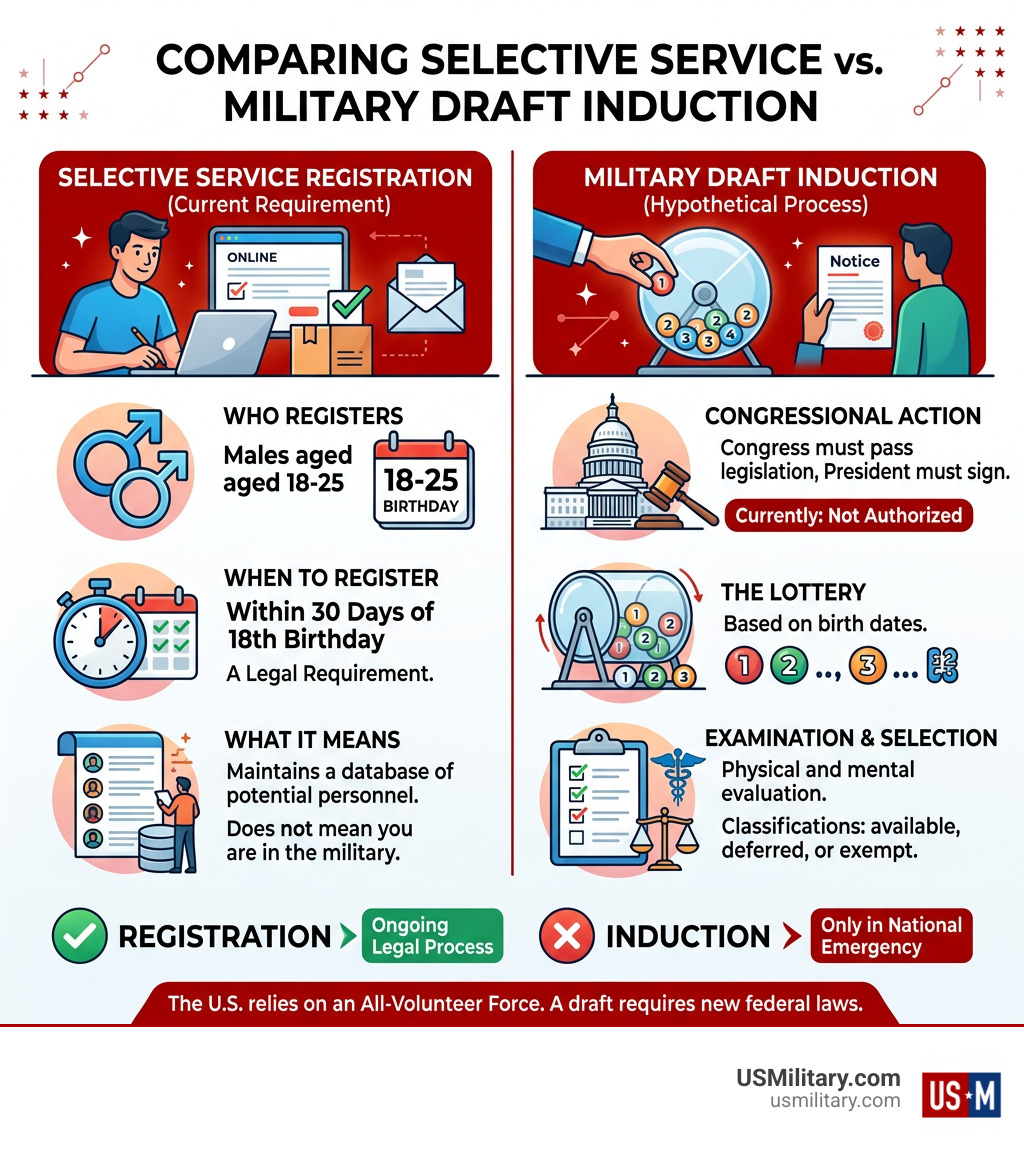
It’s important to separate registration from induction. Being registered does not mean you will be drafted. Registration is simply a legal requirement that keeps the system ready if Congress ever authorizes a draft.
I’m Larry Fowler, publisher of USMilitary.com and a longtime resource for active-duty service members and veterans navigating military service decisions — including questions about whether could there be a military draft with a war with Iran affects their future plans. In this guide, we’ll break down exactly how the draft process works, who would be affected, and just how realistic conscription is given today’s conflict.
Could There Be A Military Draft With A War With Iran terms at a glance:
- Does the US currently have a military draft
- What disqualifies you from the military draft
- age for military draft
The Current Status of the U.S. Military Draft
To understand the likelihood of a draft today, we have to look at when it went away. The United States officially ended mandatory conscription on June 30, 1973. The history of the U.S. draft shows that the last man ever drafted into the military was Dwight Elliott Stone, a 24-year-old apprentice plumber from Sacramento. Since then, we have maintained a 100% all-volunteer force.
For over 50 years, the U.S. military has operated on the principle that a professional, volunteer force is more effective and motivated than one composed of conscripts. However, while the draft is inactive, the “machinery” of the draft remains in place via the Selective Service System (SSS). This agency is responsible for maintaining a list of names should a national emergency ever require a return to conscription.
It is vital to distinguish between registration and induction. Registration is the act of providing your information to the government; induction is the actual process of being called into service. Currently, only registration is required by law. If you want to dive deeper into the mechanics, check out more info about the military draft on our platform.
Who is Required to Register for Selective Service?
Under current law, almost all male U.S. citizens and male immigrants living in the U.S. who are between the ages of 18 and 25 are required to register. This pool of Selective Service registration requirements includes approximately 15 to 20 million eligible individuals.
If you are wondering, “Can you be drafted?” the answer is no—not unless the law changes. However, failing to register can lead to serious legal consequences, including being barred from federal student loans, federal jobs, and, for immigrants, U.S. citizenship.
The registration requirement applies to:
- U.S. born and naturalized citizens.
- Parolees, undocumented immigrants, and legal permanent residents.
- Dual nationals (even if they live outside the U.S.).
- Those with disabilities who can move about independently in public.
Could There Be A Military Draft With A War With Iran?
The recent escalation in the Middle East has many people worried. With reports of the USS Abraham Lincoln and other assets moving into the region, the question of whether there could be a military draft in a war with Iran has moved from theoretical to a major public concern.
Legally, the path to a draft is steep. The legal process for reinstating a draft requires an act of Congress to amend the Military Selective Service Act. Both the House of Representatives and the Senate would have to pass the legislation, which would then require the President’s signature.
Given the current political climate, this is highly unlikely. While there are Israel-Iran conflict updates showing significant military activity, there are currently no bills before Congress to institute a draft. In fact, most political leaders view the draft as a “third rail” of politics—something that would be widely unpopular with voters.
Triggers and Realism of a Draft in the Iran Conflict
What would it actually take to trigger a draft? Historically, drafts occur when there is a massive troop shortage during a prolonged, large-scale conventional war. While the U.S. has faced some recruitment challenges recently, we are nowhere near the levels of desperation that would necessitate conscription.
Public opinion is a massive hurdle. According to Rasmussen public opinion polls, a staggering 77% of Americans oppose the draft or are unsure about it. Only 23% support the idea.
Modern warfare also plays a role. A conflict with Iran would likely involve asymmetric warfare, airstrikes, and naval engagements rather than a massive boots-on-the-ground invasion requiring millions of soldiers. The current volunteer force, backed by high-tech capabilities, is generally considered sufficient for the tactical goals currently being discussed by military leadership.
How a Modern Draft Lottery and Induction Would Work
If the unthinkable happened and Congress authorized a draft, it wouldn’t be a free-for-all. The Selective Service has a “193-day activation plan.” This means they must be able to deliver the first inductees to the military within 193 days of the authorization.
The process would center on a random birthdate selection, much like a lottery. To understand the granular details, you can read how the military draft works. Essentially, two drums would be used: one containing air-filled balls with every day of the year (1-365) and another with sequence numbers.
If your birthday is drawn alongside sequence number “1,” you are the first in line to be called. Once called, you would head to a Military Entrance Processing Station (MEPS) for a physical and mental fitness evaluation to ensure you are fit for service.
Age Priorities and Eligibility in a Potential Draft with Iran
In a draft scenario, the government doesn’t start with 18-year-olds. The first group to receive induction orders would be men who turn 20 during the calendar year of the lottery.
The age to be drafted follows a specific priority order:
- 20-year-olds: Those turning 20 in the lottery year.
- 21 to 25-year-olds: The older groups are called next, in descending order of age.
- 19-year-olds: These individuals are only called if the older brackets are exhausted.
- 18-year-olds: This is the last group to be touched.
Once a man turns 26, he is considered “over the age of liability” and can no longer be drafted under current Selective Service guidelines.
Exemptions, Deferments, and the Question of Women
Even if you were called in a draft, there are many reasons you might not serve. Knowing what disqualifies you from the military draft is essential for peace of mind.
Common exemptions and deferments include:
- Conscientious Objectors: Individuals who can prove that their deeply held moral, ethical, or religious beliefs prohibit them from participating in war. You can find more on Conscientious Objectors via the SSS website.
- Hardship Deferments: For those whose induction would cause extreme hardship to dependents.
- Ministerial Exemptions: Full-time ministers of religion.
- Student Postponements: College students can usually finish the current semester; seniors can often finish the full academic year.
- Institutionalization: Those in hospitals or correctional facilities are generally exempt.
Gender Inclusion and the Future of the Selective Service
One of the most frequent questions we get is: “Women and the draft: Will they have to register?”
Currently, only men are required to register. However, this has been a major point of legislative debate. Since the Pentagon decision on women in combat opened all military roles to women in 2015, many have argued that the Selective Service should be gender-neutral.
While there have been legal challenges and discussions in Congress about a “national service mandate” that would include everyone, no law has been passed to change the current male-only registration. For now, women remain exempt from Selective Service registration.
Frequently Asked Questions about a Potential Military Draft
Does Project 2025 mandate a military draft?
There has been a lot of misinformation circulating on TikTok and X (formerly Twitter) claiming that “Project 2025” calls for a mandatory military draft for high school students. This is false.
A careful analysis of the policy document shows that it does not mention or advocate for a military draft. While some former administration officials have mused about a “national service mandate” to fix recruitment issues, as noted in a Washington Post report on national service, these ideas have been dismissed by top political leaders—including Donald Trump—as “ridiculous.”
Could There Be A Military Draft With A War With Iran without Congress?
No. The President of the United States does not have the constitutional authority to unilaterally reinstate the draft. The Selective Service Agency guidelines are clear: Congress must pass a law, and the President must sign it. This provides a system of checks and balances that prevents a single person from forcing the nation into conscription. Even under the War Powers Act, the authority to draft citizens remains with the legislative branch.
What happens if someone refuses a draft order?
Refusing a draft order is a serious federal felony. Historically, those who refused to report for induction faced up to five years in prison and fines of up to $250,000. However, the system allows for several layers of appeals. If drafted, you have the right to appear before a local board to file a claim for a different classification (such as conscientious objector or hardship deferment).
Conclusion
At USMilitary.com, we understand that the headlines can be scary. However, the data shows that the likelihood of a draft is incredibly low. The U.S. military remains committed to its all-volunteer force, and the political hurdles to bringing back conscription are nearly insurmountable in the current era.
If you are interested in serving on your own terms rather than waiting for a hypothetical draft, the military offers incredible career paths, educational benefits, and financial planning resources. We encourage you to learn more about the U.S. military draft and other service options on our site to stay informed and prepared.