

What states automatically register you for Selective Service is a question that matters to every male U.S. citizen and eligible immigrant between ages 18 and 25.
Here’s the short answer:
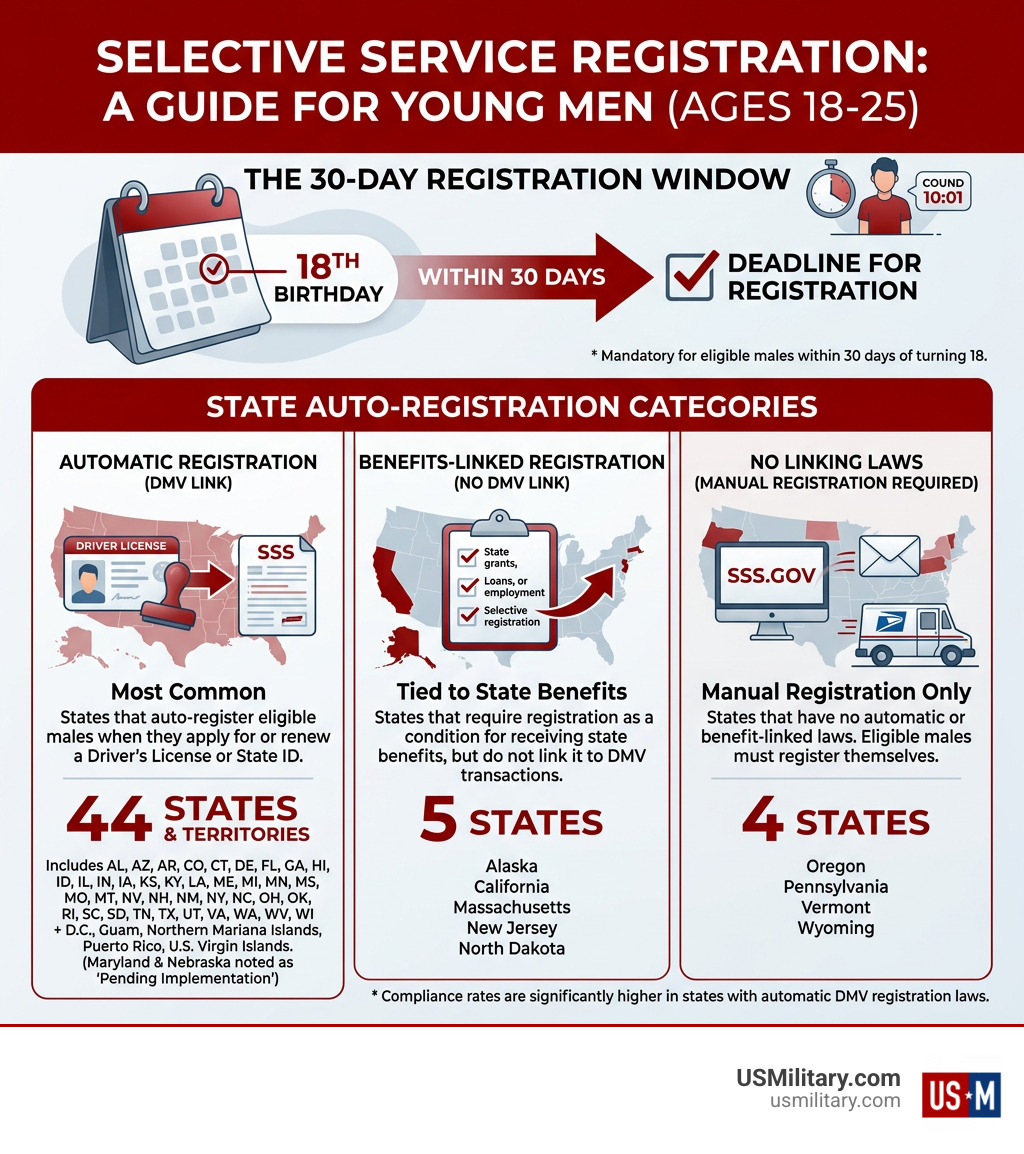
44 states and U.S. territories automatically register eligible males for Selective Service — most commonly when applying for a driver’s license or state ID at the DMV. A smaller group of states tie registration to state benefits instead, and a handful have no linking laws at all.
| Category | States / Territories |
|---|---|
| Auto-register via DMV | Alabama, Arizona, Arkansas, Colorado, Connecticut, Delaware, Florida, Georgia, Hawaii, Idaho, Illinois, Indiana, Iowa, Kansas, Kentucky, Louisiana, Maine, Michigan, Minnesota, Mississippi, Missouri, Montana, Nevada, New Hampshire, New Mexico, New York, North Carolina, Ohio, Oklahoma, Rhode Island, South Carolina, South Dakota, Tennessee, Texas, Utah, Virginia, Washington, West Virginia, Wisconsin, + D.C., Guam, Northern Mariana Islands, Puerto Rico, U.S. Virgin Islands |
| Benefits-linked only (no DMV link) | Alaska, California, Massachusetts, New Jersey, North Dakota |
| No linking laws | Oregon, Pennsylvania, Vermont, Wyoming |
Note: Maryland and Nebraska passed DMV-linking legislation but have not yet implemented it due to lack of Selective Service System funding.
If you live in one of the auto-register states, getting your license may register you without any extra steps. If you don’t, you’ll need to register manually — online, by mail, or at a post office — within 30 days of your 18th birthday.
In 2023, state driver’s license laws generated 62.3% of all Selective Service registrations nationwide. Without them, compliance would drop sharply — states without DMV linkage like California see registration rates as low as 56% at age 18, compared to the national average of 92%.
I’m Larry Fowler, publisher of USMilitary.com, and through nearly two decades of covering military service topics — including enlistment requirements, the draft, and VA benefits — I’ve seen how confusing what states automatically register you for Selective Service can be for young men and their families. Let’s break it all down clearly.
Basic What States Automatically Register You For Selective Service glossary:
- Everything You Need to Know About the Military Draft
- Does the US currently have a military draft
- Who gets pulled first in a draft?
What States Automatically Register You For Selective Service?
When we talk about What States Automatically Register You For Selective Service, we are looking at a massive data-sharing network between state governments and the federal Selective Service System (SSS). For decades, registration was a manual chore—you went to the post office, filled out a card, and mailed it. Today, the process is much more high-tech.
Currently, 44 states and territories have enacted legislation that links the Department of Motor Vehicles (DMV) or other state agencies directly to the SSS. This means that for the majority of young men in the U.S., the act of getting a driver’s license or state ID serves as their official registration.
However, the legal landscape is not uniform. Some states are “all-in” with automatic data transfers, while others have resisted these links for years. Understanding state-by-state legislative activity and regulations is vital because where you live determines whether you are already registered or if you are technically a “draft dodger” in the eyes of the law (even if there isn’t an active draft). Many people also wonder will there be a military draft in 2026? and how these registration lists might be used.
States with Automatic DMV Registration
In most states, “automatic” means that when a male between the ages of 18 and 25 applies for, renews, or updates a driver’s license, their information is electronically transmitted to the SSS. According to the 2023 Annual Report of the Selective Service System, this DMV integration is the single most effective way the government maintains its database.
States like Texas, Florida, Georgia, Alabama, and Arizona are prime examples of this “seamless” integration. In these jurisdictions, the application for a license usually includes a statement informing the applicant that by submitting the form, they are consenting to Selective Service registration.
This system has pushed the national compliance rate to roughly 92%. In these “linkage” states, it is very difficult to avoid registration if you want to drive legally. The SSS relies so heavily on these state laws that 62.3% of all new registrations in 2023 came directly from DMV data.
States with No Driver’s License Linkage
On the other end of the spectrum, we have the “holdouts.” These are states that have either refused to pass DMV-linkage laws or have passed them but not yet implemented the technology. The list of states currently without a driver’s license link includes:
- California
- Oregon
- Pennsylvania
- Vermont
- Wyoming
- Massachusetts
- New Jersey
In these states, compliance rates are significantly lower. For example, in California, only about 56% of 18-year-olds are registered, a figure that only rises to 70% by age 19. This is far below the 92% national average.
It is important to note that while these states don’t link to the DMV, some still tie registration to other benefits. Alaska, California, Massachusetts, New Jersey, and North Dakota have laws that tie registration to state-funded student aid or state government employment, even if they don’t use the DMV to gather the data. If you’re curious about the future of these requirements, you can read more about the us-military-draft-in-2026/.
How Automatic Registration Works at the DMV
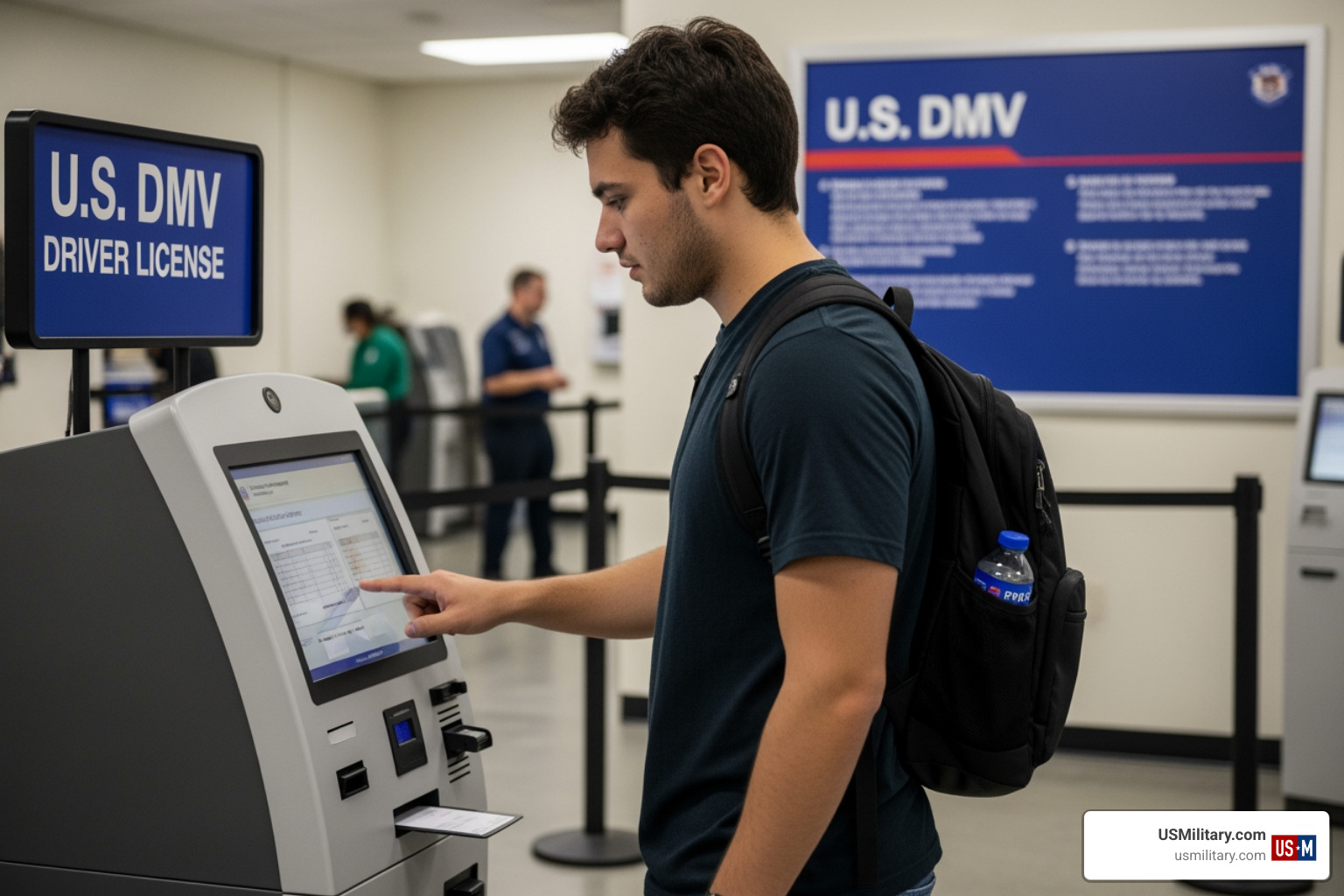
The process of how What States Automatically Register You For Selective Service works in practice is relatively straightforward. When you sit down at a DMV kiosk or fill out a paper form, you provide your name, date of birth, address, and Social Security number.
In states with linkage laws, the DMV software is programmed to identify any male applicant within the 18-25 age bracket. Once the license is processed, that data is bundled and sent via a secure electronic transmission to the Selective Service System headquarters.
This isn’t just happening in the 50 states; U.S. territories like Guam, Puerto Rico, the Northern Mariana Islands, and the U.S. Virgin Islands, along with the District of Columbia, all have similar automatic registration processes. If you are a young man in these areas, your DMV visit is essentially a “one-stop shop” for civic compliance. For more on the logistics of the system, check out our guide on the military-draft-2025-2/.
Who Will Be First To Be Drafted Into The Military?
Understanding What States Automatically Register You For Selective Service in Practice
There is a common misconception that “automatic” means “without your knowledge.” In reality, most state forms include a small-print disclosure. By signing your license application, you are legally “consenting” to the registration.
However, this creates some friction. Some states offer a checkbox to “opt-out,” but checking that box can be risky. Since registration is a federal requirement, opting out at the state level creates a paper trail of “knowing and willful” failure to register, which could theoretically be used in a prosecution (though no one has been prosecuted for this since 1986).
Another issue is database accuracy. DMV records are notoriously messy. Young adults move frequently, and many people don’t update their address with the DMV until their license expires years later. This means the SSS database often contains outdated addresses, which would make it incredibly difficult to actually find people if a draft were ever called. The Selective Service System Strategic Plan highlights these technological hurdles as the agency looks toward more modern data-matching solutions.
Gender Markers and Registration Exemptions
One of the more complex areas of who must register for Selective Service involves gender identity. Federal law currently requires registration based on “sex assigned at birth.”
This means:
- Transgender women (assigned male at birth) are required to register.
- Transgender men (assigned female at birth) are not required to register.
In recent years, several states have introduced “X” gender markers for non-binary individuals on driver’s licenses. Because the SSS computer systems are generally built on a binary (Male/Female) model, many states with “X” markers do not automatically transmit those records to the SSS. This has created a technical loophole where some individuals avoid automatic registration by selecting the “X” marker, though they may still be legally required to register manually if they were assigned male at birth.
For those with deep moral or religious objections, the GI Rights Hotline provides resources on conscientious objection. It is important to remember that even conscientious objectors are required to register; they simply indicate their status if and when a draft is actually activated.
Consequences of Failing to Register
While the chances of going to jail for not registering are virtually zero today, the “collateral consequences” are very real and can haunt you for decades. The federal government uses a “carrot and stick” approach—if you don’t register, they take away your access to the “carrots” of American civic life.
The most famous of these is the Solomon Amendment, which historically barred non-registrants from receiving federal student aid (Pell Grants and Stafford Loans). While recent changes to the FAFSA have decoupled registration from aid eligibility at the federal level, many states still require registration to qualify for state-based grants and scholarships.
Other consequences include:
- Federal Employment: You cannot work for the federal government (including the Postal Service) if you failed to register.
- Government Training: Programs like Job Corps are often off-limits.
- U.S. Citizenship: Immigrant men who fail to register between ages 18-25 may find their path to naturalization blocked or delayed.
If you’re wondering how this might escalate in a crisis, you should look into who-will-be-drafted-if-ww3-starts/.
Legal Penalties and What States Automatically Register You For Selective Service
Technically, failing to register is a felony. The law allows for a fine of up to $250,000 and up to 5 years in prison. As we mentioned, the Department of Justice stopped prosecuting these cases in the late 1980s because the trials were expensive and often turned the defendants into “martyrs” for the anti-war movement.
However, once you turn 26, the door to registration slams shut. You can no longer register, and you cannot “fix” the mistake. If you apply for a federal job at age 30 and weren’t registered, you’ll have to request a Status Information Letter (SIL) from the SSS. You will then have to prove to the hiring agency that your failure to register was not “knowing and willful”—a difficult legal hurdle to clear. If you want to know more about the possibility of the draft returning to active status, read about military-draft-coming-back/.
Future Changes: Federal Automatic Registration in 2026
The biggest news in Selective Service is the upcoming shift to Federal Automatic Registration. Under the FY2025 and FY2026 National Defense Authorization Acts (NDAA), the federal government is moving toward a system that bypasses the DMV entirely.
Starting December 18, 2026, the Selective Service System will begin matching records with other federal databases, such as the Social Security Administration. Instead of you having to “do” anything, the government will simply identify all eligible males and add them to the list automatically.
This change is designed to:
- Save Money: The SSS spends millions every year on advertising and outreach to remind 18-year-olds to register.
- Increase Accuracy: By using Social Security and IRS data, the lists will be more complete than current DMV records.
- End Penalties: If registration is automatic, no one can be penalized for “forgetting” to sign up.
You can read the full Text of S.1071 – National Defense Authorization Act for the legal details, or check out our analysis of the us-military-draft-2025-2/.
Frequently Asked Questions about Selective Service
We get a lot of questions at USMilitary.com about the draft and registration. Here are the most common ones we see regarding What States Automatically Register You For Selective Service.
Do women have to register for the Selective Service?
No. Under current federal law, only “male persons” are required to register. While there have been several attempts in Congress to make registration gender-neutral—and some federal judges have even ruled the male-only draft unconstitutional—the law has not yet changed. If the law is ever updated, it would likely require a massive overhaul of state DMV systems to begin collecting data on young women.
Can I opt out of automatic registration at the DMV?
It depends on the state. Some states have a mandatory link where the act of applying for the license is the registration. Other states have a checkbox. However, we strongly advise against opting out. Because registration is a federal requirement, checking an “opt-out” box on a state form essentially creates a signed confession that you are aware of the law and are choosing to break it. This makes it much harder to claim your failure to register was “non-willful” later in life.
What happens if I move to a state that doesn’t link to Selective Service?
Moving to a state like Oregon or Pennsylvania doesn’t “cancel” your registration. Selective Service is a federal requirement that follows you regardless of which state you live in. In fact, federal law requires you to notify the Selective Service System of any change of address within 10 days until you turn 26. Most people don’t do this, but it is technically the law!
Conclusion
At USMilitary.com, we believe in keeping our community informed about the realities of civic life and military service. While the draft has not been active since the end of the Vietnam War in 1973, the Selective Service System remains a vital “insurance policy” for national security.
Understanding What States Automatically Register You For Selective Service is the first step in ensuring you don’t accidentally close doors to your future. Whether you are automatically registered at the DMV or need to spend two minutes on the SSS.gov website, staying compliant ensures you keep your eligibility for student aid, government jobs, and the full benefits of U.S. citizenship.
For more information on the history and future of conscription, visit our guide on What is the US Military Draft?