

Can you join the army at 50 years old? In most cases, no — but the full picture is more nuanced than a flat rejection.
Here is a quick breakdown of what is actually possible:
| Situation | Eligible at 50? |
|---|---|
| Active Duty Army (no prior service) | No — max age is 35 |
| Army Reserve (no prior service) | No — max age is 35 |
| Army National Guard (no prior service) | Unlikely — max age is 45 |
| Prior service veteran (adjusted age) | Possibly — depends on years served |
| Direct commission (MD, JAG, Chaplain, Cyber) | Possibly — waivers exist |
| Re-enlistment in Army Reserve | Possibly — up to age 60 at end of service |
The short version: standard enlistment cuts off well before 50. But prior military service, specialized skills, and certain commission paths can open doors that most people assume are permanently closed.
It is rare. It is not easy. But it has happened.
In recent years, the U.S. Army has seen both a 55-year-old and a 59-year-old prior-service veteran complete basic training. These are exceptions — not the rule — but they prove the door is not always locked.
I’m Larry Fowler, publisher of USMilitary.com, and I’ve spent nearly two decades helping active military members and veterans navigate complex questions like can you join the army at 50 — connecting hundreds of thousands with the right resources, recruiters, and benefit information. Let’s walk through exactly what your options look like.
Similar topics to can you join the army at 50:
Standard Age Limits: Can You Join the Army at 50?
When we talk about the “standard” path to becoming a soldier, we are usually referring to someone walking into a recruiting office with no prior military experience. For these “non-prior service” applicants, the window of opportunity generally closes long before your 50th birthday.
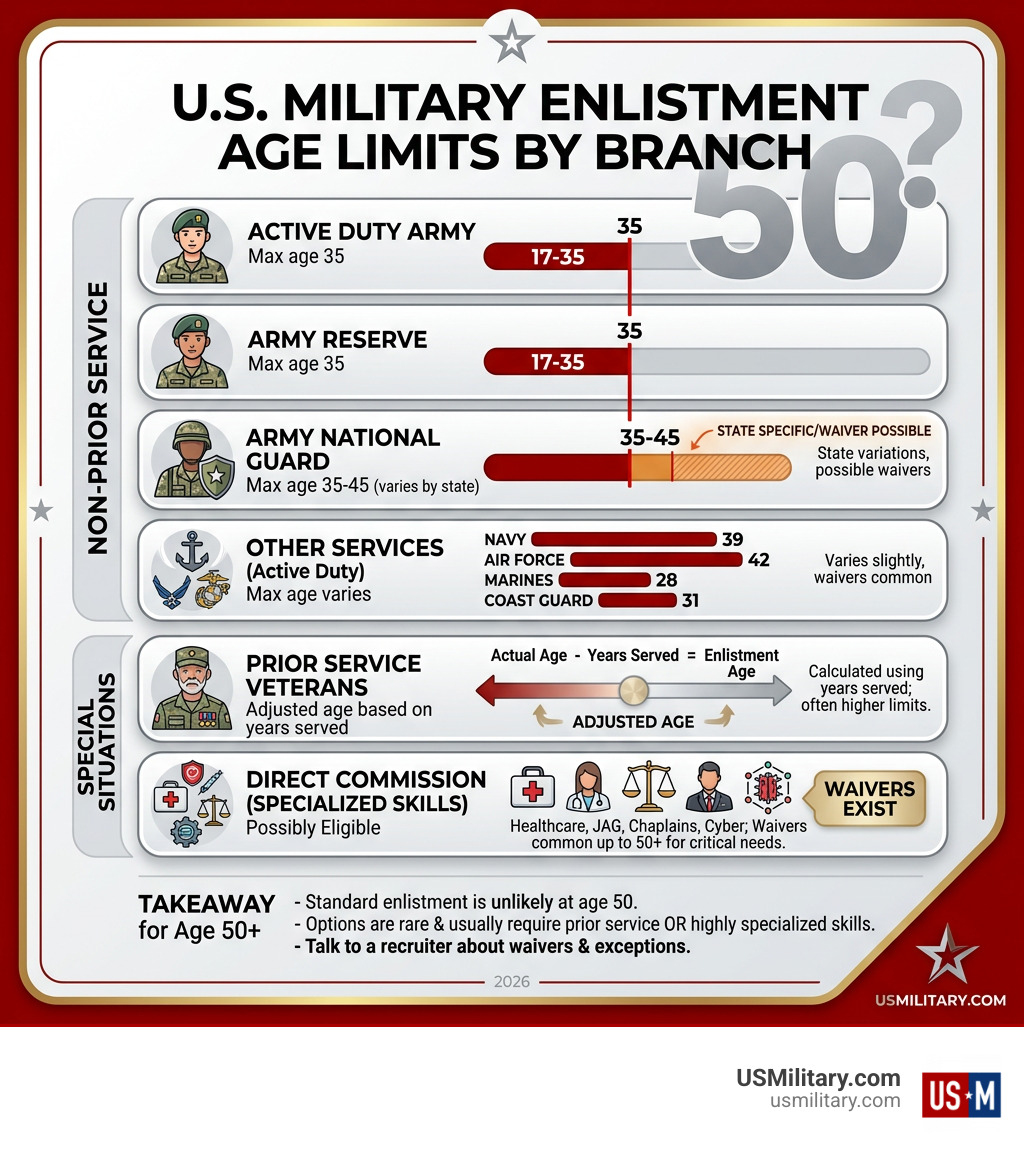
The U.S. Army Active Duty and Army Reserve currently set the maximum enlistment age at 35. This means you must typically raise your right hand and swear in before you turn 35. While the Army has occasionally raised this limit to 42 during times of high recruitment needs, the current baseline remains 35.

Comparing the Army to other branches shows that while the Army is relatively strict, some branches offer a bit more “wiggle room” for those in their late 30s or early 40s.
| Branch | Maximum Enlistment Age (Non-Prior Service) |
|---|---|
| U.S. Army | 35 |
| U.S. Navy | 41 |
| U.S. Air Force | 39 |
| U.S. Marine Corps | 28 |
| U.S. Coast Guard | 41 |
| U.S. Space Force | 39 |
As you can see, even the most “age-friendly” branches like the Navy and Coast Guard cap out at 41. So, if you are asking can you join the army at 50 without any prior service, the answer is a firm “no” for standard enlistment. However, for those with a military background or high-level professional degrees, the math changes significantly. For more specifics, check out our guide on the army age limit.
Joining the Army at 50 with Prior Service
This is where the “Age Math” gets interesting. If you served in the military previously, the Army uses what is called an “adjusted age” to determine your eligibility.
Under Army Regulation (AR) 601-210, prior service members can often subtract their years of active duty service from their current age. For example, if you are 50 years old but served 15 years in the military earlier in your life, your “enlistment age” for eligibility purposes might be considered 35 (50 – 15 = 35). This effectively brings you back under the maximum age cap.
This policy is designed to allow seasoned veterans to bring their leadership and experience back into the ranks. However, it isn’t just about the math; you must also be able to complete enough years of service to reach a total of 20 years for retirement before reaching the mandatory retirement age (usually 60 or 62 depending on the component). You can find more details on the cut-off age for the Army and how prior service impacts your status on our dedicated page.
Direct Commissioning and Specialized Skills
If you aren’t a veteran but you are a highly trained professional, you might bypass the standard enlistment age limits through the United States Army Recruiting Division – Direct Commission Program.
The Army has a constant and critical need for:
- Medical Professionals: Doctors, nurses, and dentists.
- Legal Experts: JAG (Judge Advocate General) officers.
- Chaplains: Religious leaders for all faiths.
- Cyber Specialists: High-level experts in cyberspace operations and electromagnetic warfare.
For these roles, the Army often grants age waivers well into the 40s and sometimes even at 50, provided the applicant is in excellent health and possesses a skill set the military cannot easily find elsewhere. For instance, a 50-year-old neurosurgeon or a high-level cybersecurity architect has a much higher chance of receiving an age waiver than someone looking to join the infantry.
Exceptions and Age Waivers for Older Applicants
In the military, there is a saying: “There is a waiver for everything.” While that isn’t strictly true, age waivers are a real tool used by recruiters to meet the “Needs of the Army.”
An age waiver is a formal request to allow an applicant to join despite being over the standard limit. These are reviewed on a case-by-case basis. To even be considered for a waiver at age 50, you generally need to check several boxes:
- Critical Shortage: You are applying for a job (MOS) that the Army is struggling to fill.
- Exceptional Fitness: You must prove you can handle the physical rigors of service.
- Clean Record: No significant legal or medical issues that would require additional waivers.
- Education/Certification: Having a PhD, MD, or high-level technical certifications makes you a much more attractive candidate for a waiver.
If you are looking at the Guard, our National Guard age limit guide explains how state-level needs can sometimes influence waiver approvals differently than the federal Active Duty force.
The Role of the Army Reserve and National Guard at 50
The Army Reserve and National Guard often provide the most flexibility for older applicants. While the standard non-prior service limit for the Guard is 45, they are frequently more willing to work with prior-service members up to age 59, as long as the member can reach 20 years of “good” service for retirement purposes by age 60.
The National Guard, being a state-based force, sometimes has different “manpower” requirements. If a state is severely under-strength in a specific unit, they may be more aggressive in pursuing age waivers for qualified individuals.
Furthermore, the warrant officer path is a viable option for those with technical expertise. The maximum age for the Army Reserve Warrant Officer program is 46, but waivers are authorized for those 46 or older if they possess the right technical background. Serving in these components allows you to earn retirement points, which eventually lead to a pension and healthcare benefits in your later years. You can find more info on National Guard age limits to see if your specific state has more flexible options.
Challenges of Joining the Army at 50: Basic Training and Fitness
Let’s get real for a moment. Even if you get the waiver and the “Age Math” works out, you still have to graduate from Basic Combat Training (BCT).
At 50, your body does not recover the same way it did at 18. You will be sleeping on hard bunks, carrying 60-pound rucksacks, and performing high-intensity drills alongside teenagers who might call you “Sir” or “Grandpa” (or “Pops”).
The Army Combat Fitness Test (ACFT) is the current standard. While the scoring is “age-normed” (meaning the requirements for a 50-year-old are different than for a 20-year-old), the physical toll of training is the same for everyone.
Key Challenges Include:
- Recovery Time: Older muscles and joints take longer to heal from the daily pounding of BCT.
- Injury Risk: Issues like stress fractures or chronic back pain are more prevalent in older recruits.
- Peer Dynamics: Being told what to do by a 22-year-old Drill Sergeant can be a mental hurdle for a 50-year-old with a lifetime of professional experience.
If you are serious about this path, we recommend looking into tips for surviving boot camp to start your physical preparation months in advance.
Real-World Examples of Late-Career Enlistment
Is it actually possible? Yes. History is full of “Pops” stories.
Take the case of David Morrison, who joined the Canadian Army as a private at age 53. Despite having arthritis and a former smoking habit, he completed the grueling 12-week basic training, including a 13-km march in deep snow. While this happened in Canada (which raised its mandatory retirement age to 60), similar stories exist in the U.S.
In the U.S., Master Sgt. Angela Wilson made headlines by graduating from basic training at age 40. More impressively, the U.S. Army has seen veterans as old as 59 re-enlist and complete basic training to return to active service. These individuals often find that while they aren’t the fastest runners, their mental toughness and life experience allow them to outlast younger recruits who may struggle with the psychological pressure of boot camp.
Alternative Ways to Serve if You Are Over the Age Limit
If you find that the door to wearing the uniform is closed, don’t lose heart. There are many ways to serve the U.S. Army and the Department of Defense (DoD) without being a sworn soldier.
The Army is supported by hundreds of thousands of civilian employees and contractors. These roles offer the chance to work directly with soldiers, often in the same environments, without the age restrictions of enlistment.
Alternative Paths Include:
- Civilian Federal Jobs: Look for GS (General Schedule) positions on USAJobs.gov. These range from administrative roles to engineering and logistics.
- Defense Contractors: Private companies provide everything from IT support to base security and equipment maintenance.
- Volunteer Opportunities: Organizations like the USO or the American Red Cross allow you to support service members and their families.
- State Defense Forces: Some states have “State Guards” that are separate from the National Guard and often have much higher age limits for volunteers.
Frequently Asked Questions about Joining the Army at 50
What is the absolute maximum age to join the Army without prior service?
For standard Active Duty and Army Reserve enlistment, the maximum age is 35. For the Army National Guard, the limit is 45. Without prior service or a direct commission in a specialized field, joining at 50 is generally not permitted.
Can I get an age waiver for the Army Reserve if I have a PhD or MD?
Yes. Highly qualified professionals in medical, legal, or religious fields are the most likely candidates for age waivers. The Army values your specialized knowledge and is often willing to overlook age to bring that expertise into the Reserve or Active Duty ranks.
How does prior service time affect my retirement eligibility if I join at 50?
To receive a military retirement, you generally need 20 years of qualifying service. If you join at 50, you would need to serve until age 70 to hit that mark, which is past the mandatory retirement age. However, if you already have 10 years of prior service and join at 50, you only need 10 more years to reach the 20-year milestone by age 60.
Conclusion
So, can you join the army at 50? The answer is a “maybe,” but only if you have the right background. If you are a prior-service veteran or a high-level professional like a doctor or cyber expert, the door might still be ajar. If you are a civilian with no prior service, the standard enlistment window has likely closed.
Regardless of your age, the desire to serve is honorable. Whether you find a way back into the uniform through a waiver or choose to serve as a civilian employee, your contribution to our nation’s defense is valuable.
If you believe you qualify for a waiver or have prior service to “buy back” your age, your next step is to speak with a recruiter. Be honest about your health, your goals, and your background. For more information on the official rules, you can find the official age limit to join the military here.
At USMilitary.com, we are dedicated to providing the most accurate and up-to-date information for our community. Whether you are 18 or 50, we thank you for your interest in serving our country.