
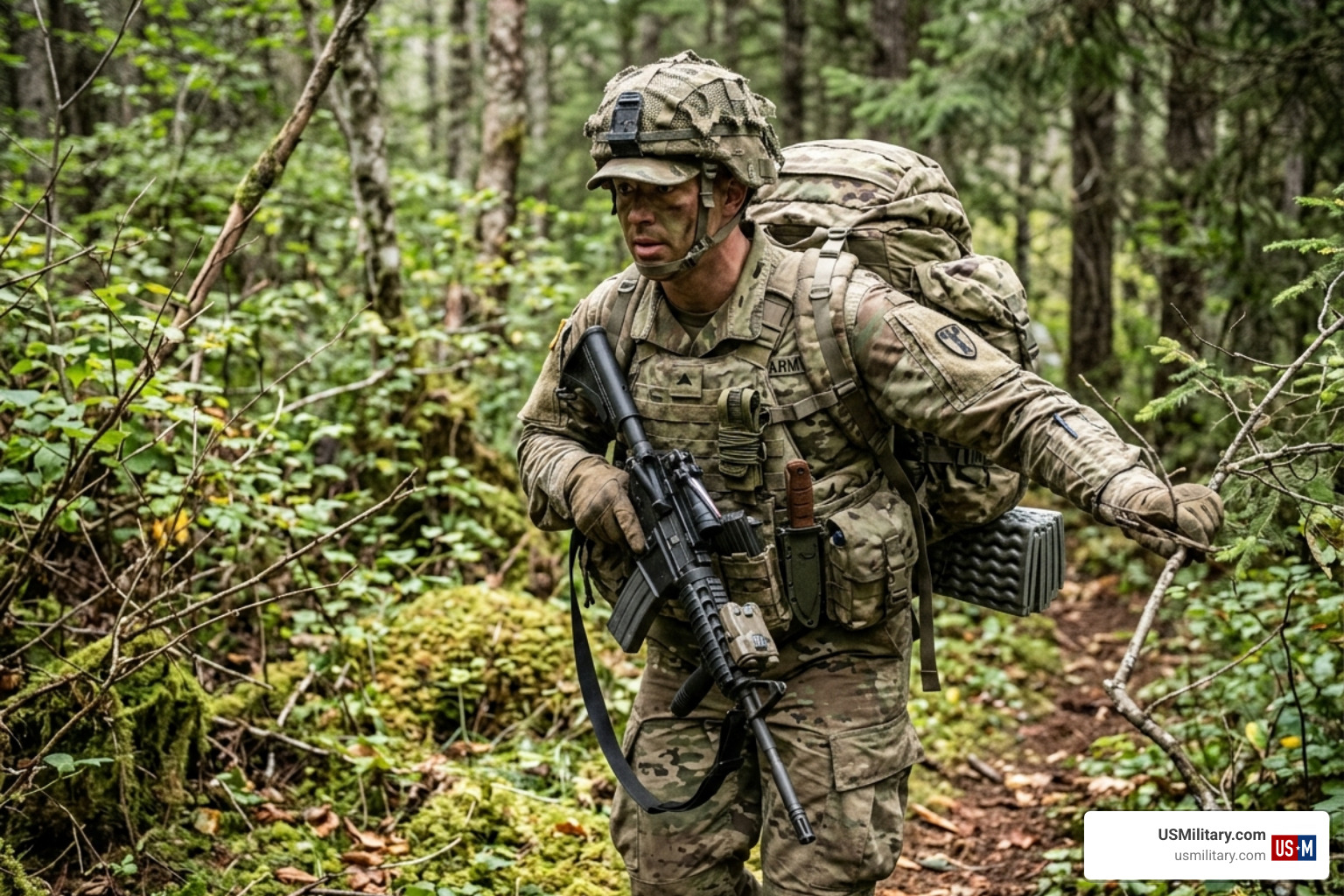
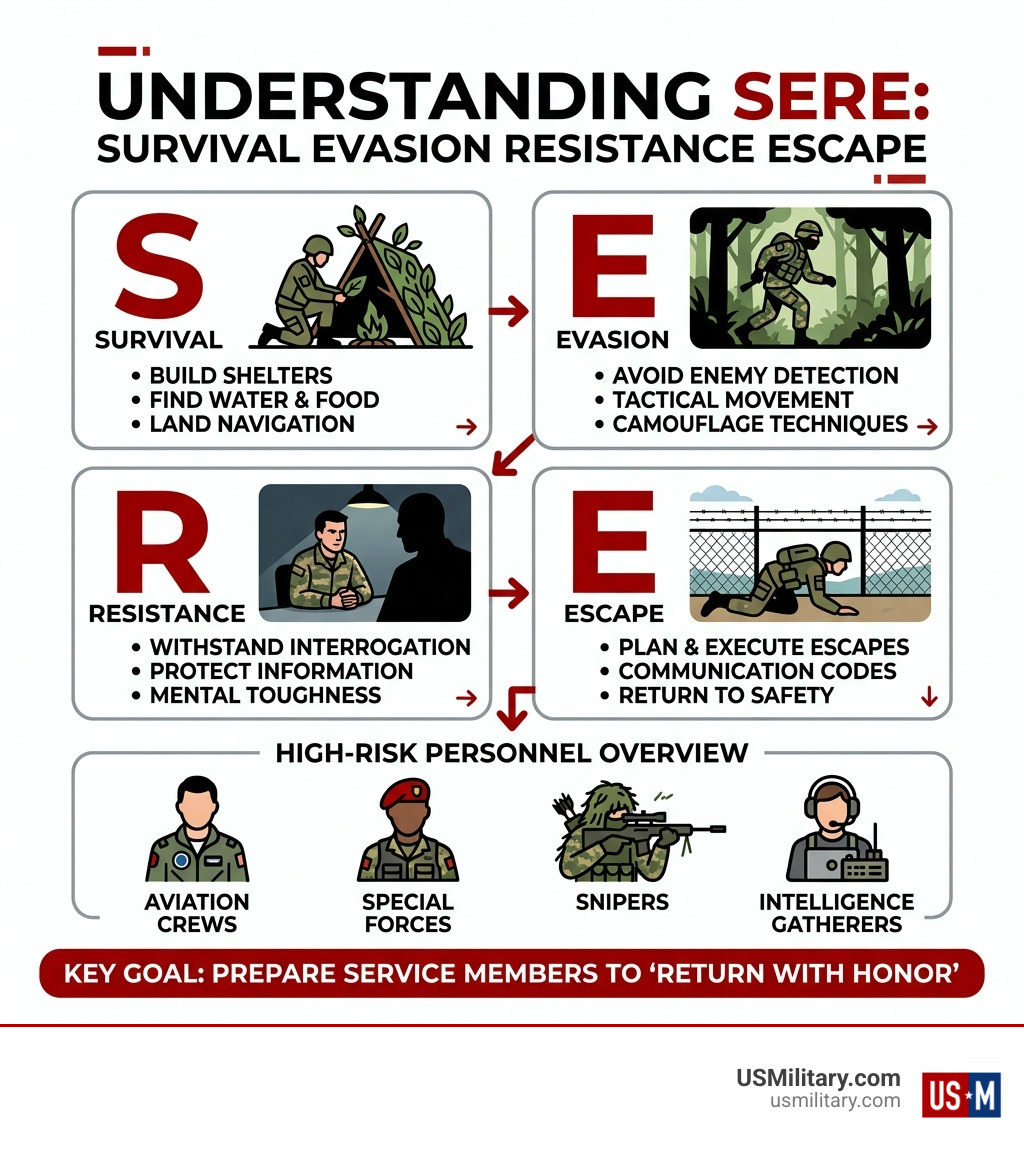
Army SERE training basics cover one of the most demanding preparation programs in the U.S. military. Here’s a quick summary of what it involves:
- S – Survival: Building shelters, finding water and food, land navigation
- E – Evasion: Avoiding enemy detection, tactical movement, camouflage
- R – Resistance: Withstanding interrogation, protecting information, mental toughness
- E – Escape: Planning and executing escapes, communication codes, returning to safety
Who it’s for: High-risk personnel including Special Forces, aviation crews, snipers, and intelligence gatherers.
Key goal: Prepare service members to “Return with Honor” — surviving captivity without compromising their mission or their fellow soldiers.
No military training program tests a soldier’s mind and body quite like SERE. The stakes behind it are real. During the Korean War, roughly 40% of more than 7,000 U.S. prisoners of war died in captivity — and between 88% and 96% of survivors experienced serious mental health conditions afterward. Those numbers drove the U.S. military to build a program designed to change those outcomes.
SERE training uses stress inoculation — controlled, realistic pressure — to prepare soldiers for what captivity actually feels like, before they ever face it in the field. It’s not just physical. It’s psychological. And for the soldiers who go through it, it can be the difference between breaking and enduring.
I’m Larry Fowler, publisher of USMilitary.com and a long-time resource for active military and veterans navigating service-related decisions — including understanding programs like army sere training basics. In the sections below, we’ll break down everything you need to know, from the history and levels of SERE to what actually happens during training.
The roots of SERE training are planted in the hard-learned lessons of the 20th century. While the British military had developed evasion programs during World War II, it was the brutal reality of the Korean War that fundamentally changed how the United States prepared its troops for captivity.
During the Korean War, American Prisoners of War (POWs) faced unprecedented levels of exploitation. Captors used physical torture and psychological “brainwashing” to force false confessions and propaganda statements. The high death rate—nearly 40%—and the mental health struggles of survivors made it clear that standard military training wasn’t enough.
In response, President Dwight D. Eisenhower issued Executive Order 10631 in 1955, establishing the Military Code of Conduct. This six-article pledge serves as the moral and legal compass for any soldier facing capture. It dictates that a soldier must never surrender of their own free will and must continue to resist by all means available.
As the Vietnam War unfolded, the need for specialized survival skills in jungle environments became even more pressing. Soldiers were being isolated behind enemy lines and needed to know how to navigate, find food, and evade capture for extended periods. This led to the formalization of SERE schools across the branches. The Army officially adopted its modern SERE program in the late 1980s, placing it under the guidance of the Joint Personnel Recovery Agency (JPRA) to ensure standardized training across the Department of Defense.
Today, the primary purpose of army sere training basics is personnel recovery. We want our soldiers to have the tools to stay alive, stay free, and, if captured, maintain their dignity and “Return with Honor.”

The Core Components of Army SERE Training Basics
To understand army sere training basics, you have to look at it as a four-part puzzle. Each phase builds on the last, taking a soldier from the “classroom” of the woods to the high-pressure environment of a simulated prisoner-of-war camp.
| Phase | Primary Focus | Key Skills Taught |
|---|---|---|
| Survival | Staying alive in the wild | Shelter, water, food, and fire starting |
| Evasion | Staying hidden from the enemy | Camouflage, stealth, and land navigation |
| Resistance | Maintaining integrity under pressure | Interrogation defense and psychological resilience |
| Escape | Getting back to friendly lines | Planning, lock manipulation, and signaling |
Survival and Evasion Tactics
The “S” and “E” in SERE are all about the field. This phase often begins with academic instruction followed by a grueling field exercise. Soldiers are taught how to survive with minimal equipment—sometimes just a knife and the clothes on their back.
- Land Navigation: Forget GPS. Soldiers must master the map and compass, moving through dense forests or swamps while staying on course.
- Water and Food Procurement: You’ll learn which plants are edible and how to purify water from questionable sources. You might even find yourself eating things you’d normally step on—like insects or small rodents—to keep your energy up.
- Shelter and Fire: Building a “lean-to” or a “spider hole” that keeps you warm but remains invisible to the enemy is an art form.
- Stealth and Camouflage: Evasion is about being a ghost. Soldiers practice tactical movement, learning how to move through brush without making a sound and how to use natural materials to break up their silhouette.
Resistance and Escape Protocols
The “R” and “E” phases are where the mental game truly begins. This is often described by veterans as the most challenging part of the course. In a simulated captivity environment, trainees are “captured” and placed in a mock POW camp.
- Interrogation Resistance: Instructors play the role of captors, using various interrogation techniques to try and break the trainee’s resolve. Soldiers practice providing only the required information: name, rank, service number, and date of birth.
- Information Control: You learn how to create “cover stories” and how to resist exploitation, such as being used for propaganda videos.
- Psychological Pressure: The training simulates isolation, sleep deprivation, and the loud, confusing environment of a real interrogation center.
- Escape Planning: Even in a cell, the mission continues. Trainees are taught how to observe guard patterns, identify weaknesses in security, and coordinate with fellow prisoners using secret communication codes like the “tap code.”
Training Levels and Eligibility
Not every soldier in the Army needs to go through the full, intensive SERE course. The level of training you receive depends on your “Risk of Capture.” If your job involves flying over enemy territory or operating deep behind lines, you’re going to need more than just the basics.
Understanding the Levels of Army SERE Training Basics
The Department of Defense categorizes SERE training into three distinct levels:
- Level A: This is the entry-level training provided to all recruits during Army basic training. It covers the fundamental principles of the Code of Conduct and basic survival theory.
- Level B: Designed for personnel with a “moderate risk” of capture, such as those operating in forward areas but not necessarily behind enemy lines. This level focuses more on survival and evasion.
- Level C: This is the “high-risk” course. It is required for Special Forces, aviation aircrews (pilots and crew chiefs), snipers, and certain intelligence collectors. Level C is the most intense, typically lasting about 19 to 21 days, and includes the full resistance and captivity simulation.
If you are looking for more details on how these schools differ across branches, you can read about how Training Soldiers To Survive Is The Goal Of Navy Sere School/ which highlights the joint nature of this elite training.
Locations and Psychological Preparation
The Army’s premier location for this training is the U.S. Army SERE School at Fort Novosel (formerly Fort Rucker), Alabama. This is where most aviation personnel receive their Level C certification. Another major hub is Camp Mackall, North Carolina, which is part of the U.S. Army SERE School :: Fort Rucker network and primarily serves the Special Forces community through the JFK Special Warfare Center and School.
These locations are chosen because they allow for realistic environment simulations. While Alabama provides a temperate forest and swamp environment, other specialized courses might take soldiers to the arctic, desert, or tropical jungles to master environment-specific survival.
Physical and Mental Prep for Army SERE Training Basics
You can’t just show up to SERE Level C and hope for the best. The physical requirements are strict. Trainees must have a current Army Combat Fitness Test (ACFT) score and be capable of rucking long distances with heavy gear.
However, the mental preparation is just as vital. This is where SERE psychologists come in. These professionals play a critical role in the school:
- Safety Observers: They monitor the simulations to ensure that while the stress is high, it remains “controlled.” They look for signs of “behavioral drift” in instructors—ensuring that the role-play never crosses the line into actual harm.
- Stress Management: They teach trainees how to handle the physiological effects of stress, such as dissociation or “tunnel vision.”
- Repatriation Protocols: Psychologists also help develop the “decompression” process for real-world POWs, helping them transition from captivity back to their families and military life.
Frequently Asked Questions about Army SERE Training Basics
What does SERE stand for?
SERE stands for Survival, Evasion, Resistance, and Escape. It is a comprehensive military program designed to give high-risk personnel the skills to survive isolation and captivity.
Who is required to take SERE Level C?
Level C is mandatory for soldiers in high-risk categories. This includes all Special Forces (Green Berets), Army Aviators (pilots), flight crews, snipers, and certain specialized intelligence and reconnaissance units.
How long does Army SERE training last?
While basic levels (A and B) can be shorter or computer-based, the intensive SERE Level C course typically lasts 19 to 21 days. This includes an academic phase, a field evasion phase, and a simulated captivity phase.
Conclusion
Mastering army sere training basics is a badge of honor for any soldier. It represents a level of mental toughness and physical resilience that few people ever have to discover within themselves. Whether you are an aspiring pilot, a Special Forces candidate, or just a soldier looking to understand the depths of military preparedness, SERE is the ultimate test of the human spirit.
At USMilitary.com, we are dedicated to providing you with the resources you need for your military career. From understanding advanced training pipelines to navigating your benefits, we serve as your central hub for military-related guidance. If you are just starting your journey, be sure to check out More info about Army basic training to see where it all begins.
The goal of SERE isn’t just to survive—it’s to return with your honor intact, knowing you did your duty even in the darkest of circumstances. Stay safe, stay prepared, and keep pushing forward.