

Army Delta Force SERE Training is the elite survival program that prepares Delta Force operators to survive, evade capture, resist interrogation, and escape if taken prisoner.
Here’s a quick breakdown of what it covers:
- S – Survival: Living off the land, finding water, building shelter, sourcing food
- E – Evasion: Moving through hostile territory without being detected
- R – Resistance: Withstanding interrogation, psychological pressure, and physical stress
- E – Escape: Planning and executing escape from captivity
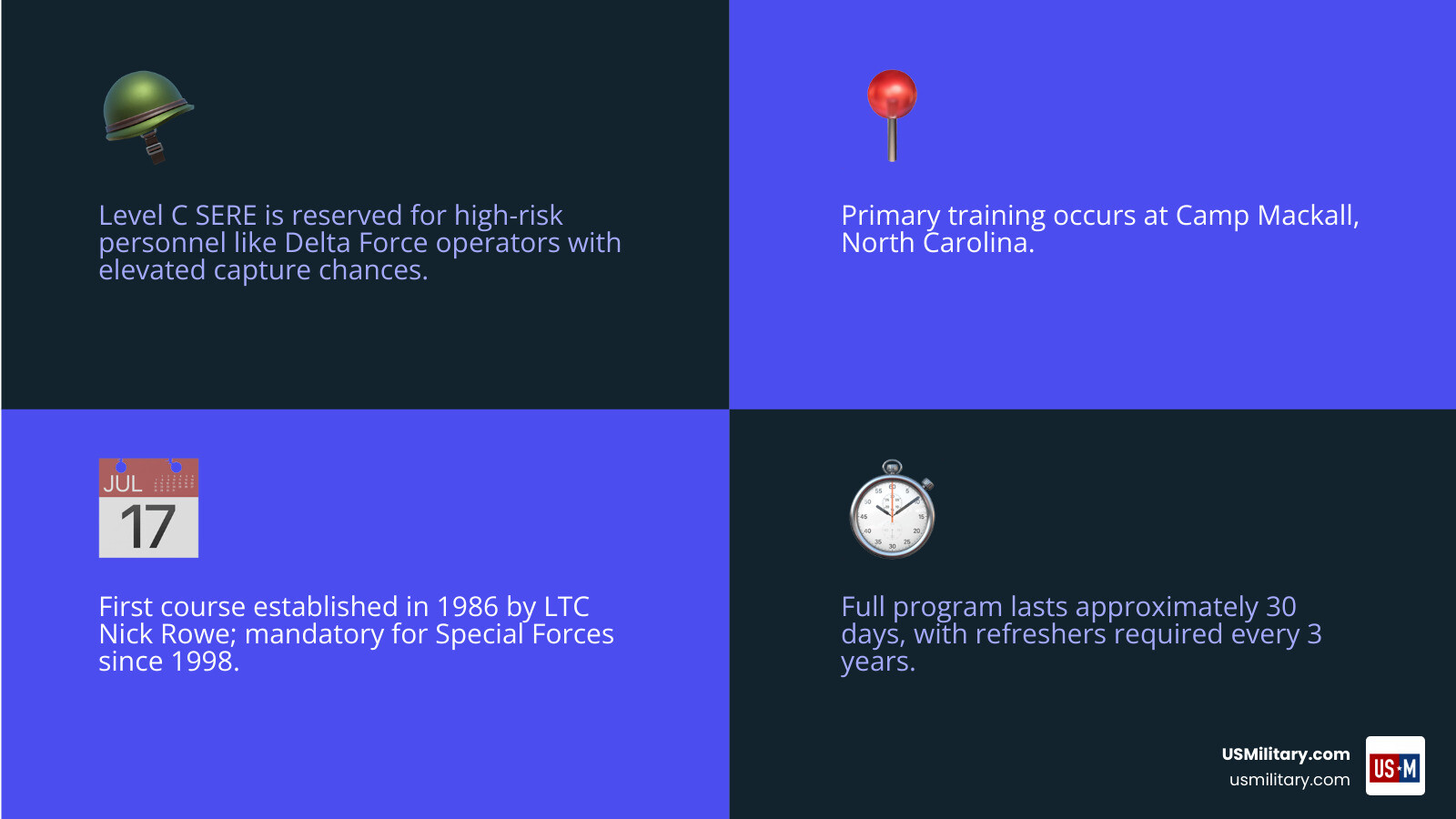
Who it’s for: Level C SERE is reserved for high-risk personnel — including Delta Force operators, Special Forces, snipers, and intelligence personnel — anyone with a high chance of being captured by enemy forces.
Key facts at a glance:
| Detail | Info |
|---|---|
| SERE Level | Level C (highest risk) |
| Primary location | Camp Mackall, North Carolina |
| Mandatory since | 1998 for Special Forces candidates |
| First course held | 1986, developed by LTC Nick Rowe |
| Duration | Approximately 30 days |
| Refresher required | Every 3 years |
Only 1% of Americans join the military — and only 1% of those make it into Special Operations. For the few who reach Delta Force, SERE training is a non-negotiable part of becoming mission-ready.
I’m Larry Fowler, publisher of USMilitary.com, and I’ve spent nearly two decades connecting military members and veterans with reliable, accurate information — including what it truly takes to navigate elite programs like Army Delta Force SERE Training. In the sections ahead, we’ll walk you through every phase of this training so you know exactly what to expect.
Easy Army Delta Force SERE Training word list:
What is Army Delta Force SERE Training?
At its core, Army Delta Force SERE Training is designed to take the nation’s most elite warriors and prepare them for the worst-case scenario: being alone behind enemy lines or falling into the hands of a hostile power. While many service members receive basic survival training, Delta operators undergo Level C SERE, the most advanced and grueling version authorized by the Department of Defense.
The training is built around the Military Code of Conduct. We aren’t just teaching soldiers how to build a fire; we are teaching them how to maintain their honor and protect sensitive information while under extreme duress. For a Delta operator, whose missions often involve high-stakes counterterrorism or hostage rescue, the risk of isolation is a constant reality.
This training integrates survival skills, evasion tactics, resistance techniques, and escape planning into a cohesive curriculum. It is conducted at only five authorized facilities across the DoD, with the Army’s primary efforts centered at Camp Mackall and Fort Rucker. You can learn more about the broader context of these operators in our guide on How Does Delta Force Selection Work/.
According to Survival, Evasion, Resistance and Escape – Wikipedia, the program has evolved from simple post-WWII survival schools into a sophisticated psychological and physical gauntlet. For Delta Force, this training is often woven into their six-month Operator Training Course (OTC), ensuring that by the time they reach a functional saber squadron, they are truly “unbreakable.”
The Historical Evolution of SERE and the Legacy of Nick Rowe
We cannot discuss Army Delta Force SERE Training without honoring the legacy of Colonel James “Nick” Rowe. The history of SERE is a story of lessons learned in blood, primarily from the experiences of American prisoners of war in Korea and Vietnam.
During the Korean War, the military realized that physical toughness wasn’t enough. Many POWs faced psychological exploitation and torture, leading to the creation of the Code of Conduct in 1955. However, it was the Vietnam War that truly shaped the modern curriculum. LTC Nick Rowe, a Special Forces officer, was captured by the Viet Cong in 1963. He spent five grueling years in captivity, surviving disease, starvation, and torture before executing a daring escape in 1968.
Rowe realized that the Army needed a school that simulated the psychological pressures of captivity. In 1986, he helped establish the first Army SERE Level C course at Camp Mackall, North Carolina. His knowledge of how captors try to “break” a soldier’s mind is the foundation of the resistance phase today. By 1998, this training became mandatory for all Special Forces candidates.
Today, the U.S. Army SERE School :: Fort Rucker and the complex at Camp Mackall continue this mission. The training has expanded to include Peacetime Government Detention (PGD) and Hostage Detention (HD) scenarios, acknowledging that modern threats aren’t always traditional uniformed militaries.
The Three Core Phases of the Delta Force Training Pipeline
The journey through Army Delta Force SERE Training is typically divided into three distinct phases. Each phase builds upon the last, moving from theoretical knowledge to the raw, visceral experience of captivity.

Phase 1: The Academic Phase
Before we send anyone into the woods, they spend time in the classroom. This isn’t just “death by PowerPoint.” Operators study the legalities of the Code of Conduct, the psychology of interrogation, and the biological realities of starvation and sleep deprivation. Understanding what the body and mind go through allows an operator to normalize their reactions when the stress hits.
Phase 2: The Field and Survival Phase
This is where the “S” and “E” of SERE come to life. Operators are dropped into harsh environments with minimal gear. They must master:
- Land Navigation: Moving through dense terrain at night using only a map and compass.
- Water Procurement: Finding and purifying water from unlikely sources.
- Shelter Building: Constructing primitive structures that provide protection from the elements while remaining camouflaged.
- Food Sourcing: Identifying edible plants and trapping small game.
As noted in Delta Force Training: What It Takes to Join Delta Force – USAMM, these skills are essential because a Delta operator may have to survive for days or weeks without resupply if a mission goes sideways.
Phase 3: The Resistance and Escape Phase
This is the most infamous part of the course. It involves a simulated prisoner-of-war camp where students are subjected to the physical and psychological rigors of captivity. It is designed to be as realistic as possible while remaining within strict safety guidelines.
Evasion and Survival in Hostile Territory
Evasion is a cat-and-mouse game. In Army Delta Force SERE Training, operators are often tasked with a long-distance movement—sometimes an 18-mile march—while “enemy” forces actively hunt them. This teaches tactical discipline: how to move without leaving a “sign,” how to manage light and noise, and how to use the terrain to hide in plain sight.
| Priority | Survival Focus | Evasion Focus |
|---|---|---|
| First Goal | Regulate body temperature (Shelter) | Remain undetected (Camouflage) |
| Movement | Conserve energy; stay near water | Move at night; avoid trails/roads |
| Signaling | Be as loud/visible as possible for rescue | Use “silent” signals only when safe |
| Nutrition | Sourcing calories to maintain strength | Discipline to move despite hunger |
Survival in this context isn’t just about staying alive; it’s about staying alive and free. An operator who builds a massive, smoky fire for warmth has failed the evasion portion of the mission. We teach them to use “Dakota fire pits” and other low-signature techniques to stay warm without alerting the neighborhood.
The Intensity of Army Delta Force SERE Training in the POW Phase
The transition from the evasion phase to the POW phase is often abrupt and “no-notice.” An operator might be moving toward a supposed extraction point only to be ambushed by a mock enemy force. This “capture” is violent, loud, and disorienting.
According to a veteran account on Prisoner of War: A Delta Operator Talks About His SERE… – SOFREP, the experience involves being hooded, stripped, and bound. The goal is to strip away the soldier’s sense of control. Once in the camp, the psychological warfare begins.
- Confinement: Operators may be placed in small wooden boxes where they cannot stand or sit comfortably.
- Sensory Overload: Captors use “noise torture”—constant loops of screaming babies, discordant music, or static—to prevent sleep and wear down mental defenses.
- Interrogation: Mock interrogators use repetitive questioning, “good cop/bad cop” routines, and physical handling (mock beatings) to try and extract information.
- Physical Stress: While actual bones aren’t broken, operators endure “slaps,” “gut slams,” and “wall slams” designed to simulate the rough handling of a real enemy.
The intensity is meant to find the “breaking point” of every student. For a Delta operator, knowing where that point is—and how to push past it—is a life-saving skill.
Psychological Resilience: Small Victories and Myth-Busting
The most important lesson we teach in Army Delta Force SERE Training isn’t how to eat a bug; it’s how to maintain your mind. Captivity is designed to make you feel helpless. To counter this, we teach the concept of “small victories.”
A small victory is any act of defiance that the captor doesn’t know about. For example, one Delta operator recounted sewing earplugs into his uniform cuffs before the training began. When he was placed in the isolation box with ear-splitting music playing, he was able to muffle the sound. The captors thought they were breaking him, but he knew he was “winning.”
This concept was championed by Nick Rowe, who famously used a piece of tire rubber to create smoke to keep mosquitoes away in his Viet Cong camp. These acts provide a “psychological charge” that keeps morale high. As US military SERE training – How service members are … – FOX 29 explains, the training uses these simulations to build a “stress inoculation,” making the operator more resilient to future trauma.
Debunking Myths About Army Delta Force SERE Training
Because of its secretive nature, SERE training is surrounded by tall tales. Let’s clear the air on a few of them:
- “They break one of your bones.”: This is 100% false. While the training is physically rough, the cadre are professionals. Safety observers and medical staff are always present. Breaking an operator’s bone would take them out of the fight and waste millions of dollars in training.
- “It causes permanent PTSD.”: Research shows that because SERE is “stress inoculation,” it actually helps prevent PTSD by giving operators a mental framework to handle trauma. There is a mandatory 24-hour decompression period after the course for sleep and food, but it isn’t a psychiatric ward.
- “It’s just a torture school.”: SERE is an educational environment. Every “beating” or “interrogation” has a specific learning objective. If a student isn’t learning, the cadre adjusts.
The goal is to produce a soldier who can “Return with Honor.” You can see how this compares to other elite units in our breakdown of Navy Seal Vs Delta Force/.
Frequently Asked Questions about SERE
Is Army Delta Force SERE Training mandatory for all operators?
Yes. Level C SERE is a requirement for all Special Forces candidates and Delta Force operators. It is usually completed during the Special Forces Qualification Course (Q-Course) or during the Delta Operator Training Course (OTC).
How long does the POW simulation phase last?
While the entire SERE course is roughly 30 days, the intensive “internment” or POW phase typically lasts several days. The exact duration is kept classified to maintain the “no-notice” stress for students.
Where is the Army’s Level C SERE training conducted?
The primary locations for Army Level C training are Camp Mackall (near Fort Bragg/Liberty), North Carolina, and Fort Rucker (now Fort Novosel), Alabama. Delta Force operators typically train at the Camp Mackall facility due to its proximity to their home base.
Conclusion
Army Delta Force SERE Training is the ultimate testament to the “Quiet Professional” ethos. It is a grueling, uncomfortable, and deeply personal journey that transforms a soldier into a resilient operator capable of facing the darkest conditions imaginable.
By mastering the skills of survival, evasion, resistance, and escape, Delta operators ensure they are never truly “captured” in spirit. They carry the lessons of Nick Rowe and the legacy of every POW who came before them, standing ready to face any environment and always planning their return.
At USMilitary.com, we are proud to provide these insights into elite military training. Whether you are an aspiring operator or a supporter of our troops, understanding the depth of this preparation helps us all appreciate the sacrifices made by those in the shadows. For more on these elite units, check out The Shadow Warriors Everything You Need To Know About Delta Force/ or Compare Army Delta Force vs Navy SEALs.
“Return with Honor” isn’t just a motto—it’s a promise kept by the men who survive the gauntlet of SERE.