
What You Need to Know About Automatic Registration for Draft Beginning December
Automatic registration for US military draft to begin in December 2026 is confirmed — here’s the short version:
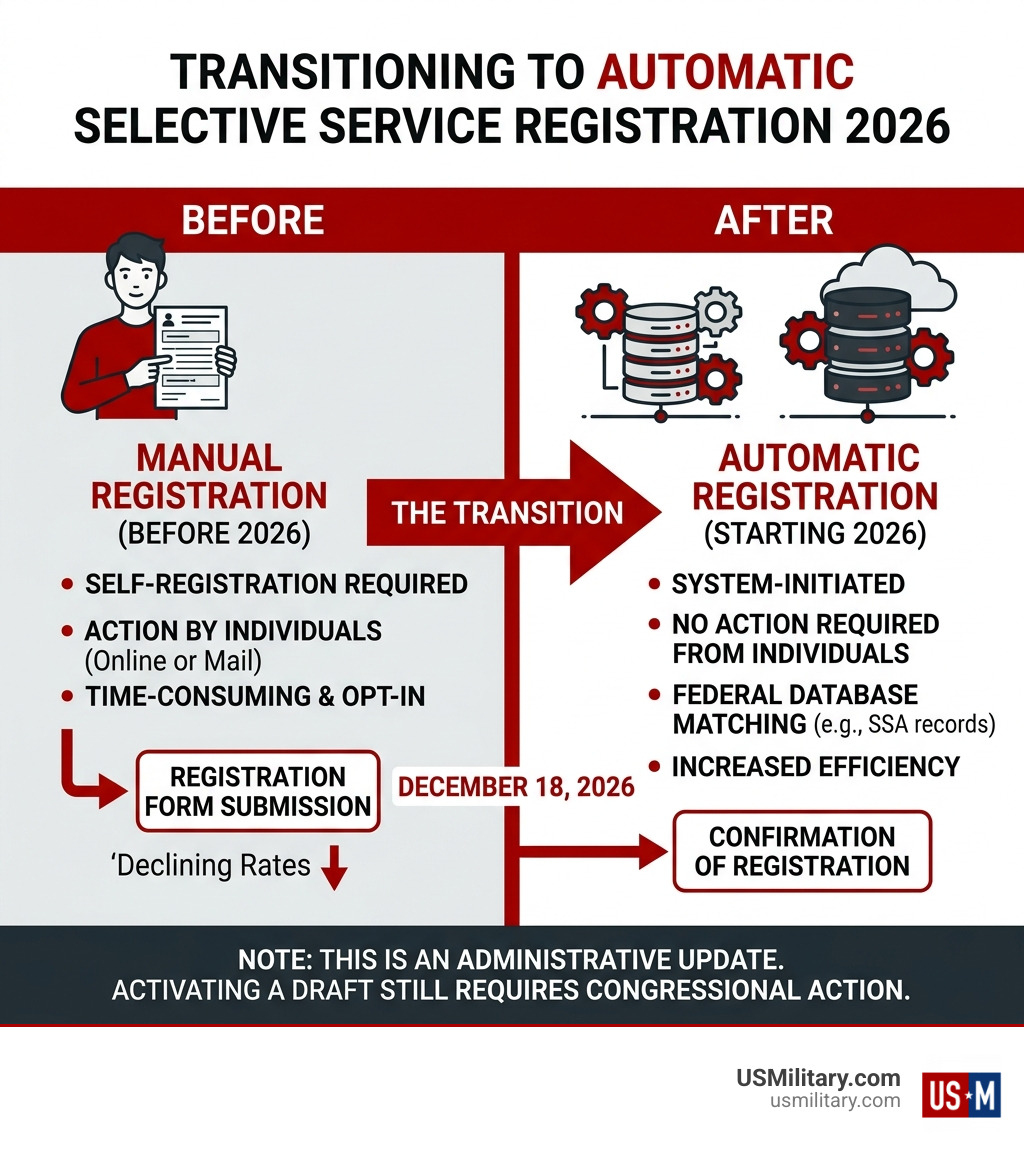
- What changed: Congress mandated automatic Selective Service registration in the FY2026 National Defense Authorization Act, signed in December 2025.
- When it starts: December 18, 2026.
- Who is affected: Most males ages 18–25, including US citizens and eligible immigrants.
- How it works: The Selective Service System will use federal databases (like Social Security Administration records) to register eligible men automatically — no action required on your part.
- Does this mean a draft is coming? No. This is an administrative update only. Activating a draft still requires a separate act of Congress.
- What if you haven’t registered yet? You can still self-register at sss.gov until the automatic system goes live.
This is a major shift from the current system, where men must register themselves within 30 days of turning 18. Declining registration rates — dropping from 84% in 2023 to 81% in 2024 — and the 2022 removal of the Selective Service registration option from federal student aid forms pushed lawmakers to act.
I’m Larry Fowler, publisher of the USMilitary.com Network since 2007, and I’ve spent nearly two decades helping service members, veterans, and military-eligible men navigate exactly these kinds of policy changes — including tracking how shifts like automatic registration for US military draft to begin in December affect real enlistment decisions and federal benefits. In this guide, I’ll break down everything you need to know clearly and simply.
Important Automatic registration for US military draft to begin in December terms:
- Current draft status
- Does the US currently have a military draft
- Everything You Need to Know About the Military Draft
Understanding the Selective Service System and the Shift to Automation
The Selective Service System (SSS) is a name that often brings up images of dusty history books and old grainy footage of lotteries. However, it remains a vital part of our national security infrastructure. Think of it as an “insurance policy” for the United States. While we have a highly professional, all-volunteer force, the SSS ensures that we are ready for a massive national emergency that would require a rapid increase in personnel.
The recent move toward automation isn’t about looking for a fight; it’s about modernizing a system that was starting to show its age. For decades, the burden was on the individual young man to remember to sign up. By shifting to an automatic model, the government is taking the administrative weight off your shoulders. This change, where Automatic registration for military draft to be implemented by December 2026 becomes the standard, ensures that the database is accurate and fair for everyone.
If you are wondering if you fall into the group that needs to be in this database, you can check out our guide on Who Is Eligible For The Us Draft/. Generally, if you were born male and are between 18 and 25, you’re on the list.
The Purpose of the Selective Service
The SSS was established back in 1917 by President Woodrow Wilson. Its primary job is to maintain a list of names of men who could be called upon to serve if a draft were ever authorized. It is a quasi-independent agency, meaning it isn’t part of the Department of Defense, though they work closely together.
The system performs what we call “administrative screening.” In the event of a draft, the SSS would be responsible for running the lottery and then sending those selected to the military for physical and mental evaluations. It is important to remember that the last time a name was actually called for service was in 1973. If you want to dive deeper into the timeline, read our article on When Was The Last Draft In The Us/.
Legislative Mandate of the FY2026 NDAA
The legal gears for this change started turning in late 2025. President Donald Trump signed the fiscal year 2026 National Defense Authorization Act (NDAA) into law in December 2025. Tucked inside this massive defense bill was Section 535, which specifically mandated the transition to automatic registration.
The goal was to have the system fully operational by the end of 2026. This legislative push was bipartisan, with many lawmakers arguing that the old manual system was becoming too expensive and inefficient. You can find more details on the policy specifics in this report on Automatic registration for US military draft to begin in ….
How Automatic registration for US military draft to begin in December Works
The beauty of the new system is its simplicity for the average citizen. Instead of you finding a form at the post office or remembering to check a box on a website, the government will use existing data. The SSS will integrate with federal and state databases to identify eligible men.
The primary sources of this information will be the Social Security Administration (SSA) and various Department of Motor Vehicles (DMV) records. When a young man hits his 18th birthday, the system will cross-reference these databases. If he’s in the system, he’s registered. This ensures that the list is as complete as possible without requiring millions of individual man-hours spent on manual entries. For more on the implementation, see Automatic registration for US military draft-eligible men to begin in December and check the Military Draft Age/ requirements.
Who is Required to Register Under the New System?
The rules for who must be in the system haven’t changed, only how they get there. The following groups are required to be registered:
- US Citizens: All young men born in the US or naturalized.
- Male Immigrants: This includes permanent residents (green card holders), refugees, and even undocumented men living in the US.
- Dual Nationals: If you hold US citizenship and citizenship in another country, you are still required to register.
The age range remains 18 through 25. Once you turn 26, you are no longer eligible to be drafted under current laws. For a full breakdown of the nuances, visit The Draft Age Who Is Eligible For Military Conscription/.
Key Differences: Automatic registration for US military draft to begin in December vs. Self-Registration
Before this change, registration was a “proactive” duty. If you forgot, you could face serious legal consequences. Now, it becomes a “passive” process.
| Feature | Old System (Pre-Dec 2026) | New System (Post-Dec 2026) |
|---|---|---|
| Responsibility | Individual young man | Selective Service System |
| Data Source | Manual forms/Online entry | SSA, DMV, and Federal Records |
| FAFSA Link | Removed in 2022 | Not needed (automatic) |
| Notification | Often none until a penalty | Automatic notification of registration |
| Compliance Rate | Declining (81% in 2024) | Expected near 100% |
One of the biggest drivers for this change was the decoupling of Selective Service from the FAFSA (student aid) forms in 2022. Previously, about 24% of registrations happened through those forms. When that was removed, compliance plummeted. Automation fixes this “gap” in the system. Read more about the Us Military Draft In 2026/.
Why the US Government is Automating Draft Registration
We often get asked, “Why now?” The answer is a mix of dollars and sense. The Selective Service System costs about $30 million a year to run. A huge chunk of that—about $11 million—was being spent on advertising and outreach campaigns just to remind people to register. By automating the process, the SSS can redirect those funds toward actual mobilization readiness.
Lawmakers like Rep. Chrissy Houlahan have been vocal supporters, noting that this shift saves taxpayer money and removes a legal “gotcha” for young men who simply forgot to sign up. You can read more about the efficiency arguments at Automatic registration for military draft to be implemented by December | RealClearDefense and our take on whether the Military Draft Coming Back/.
Addressing Declining Registration Rates
The numbers don’t lie. In 2023, there were 15.6 million men registered. By 2024, that number dropped to 15.2 million. While that might not seem like a huge drop, the percentage of compliance fell from 84% to 81%. In a system that relies on fairness and “universal” participation, having nearly 20% of the eligible population missing is a major problem. Automation ensures that everyone is treated equally and that no one accidentally loses out on federal benefits because of a missed form. More on these stats can be found at Automatic registration for US military draft-eligible men to ….
Impact of Automatic registration for US military draft to begin in December on Compliance
By moving to a database-matching system, the SSS expects compliance to hit nearly 100%. This allows the agency to stop acting like a marketing firm and start acting like a readiness agency. It also clears up the confusion for those who might be older. If you’re wondering if you can still be called up later in life, check out The Draft Age Debate Can You Be Called To Serve After 26 Or Even 40/.
Penalties, Exemptions, and the Reality of a Modern Draft
Even with automatic registration, the penalties for trying to “opt-out” or evade the system remain severe. Under the old system, failing to register was a felony. While prosecutions have been rare since the mid-1980s, the “collateral damage” is what really hurts.
If you aren’t in the system, you can be barred from:
- Federal student loans and grants.
- Federal job training programs.
- Jobs with the executive branch of the federal government and many state governments.
- US citizenship (for immigrants).
The fines can reach $250,000, and you could technically face up to five years in prison. Automation actually protects young men from these penalties by ensuring they are registered by default.
Who is Exempt from Registration?
Not everyone with a pulse has to register. There are specific exemptions:
- Women: Despite years of debate, women are currently not required to register. You can read the latest on that at Can Women Be Drafted 2/.
- Non-immigrants: Men on valid student or visitor visas.
- Incarcerated or Institutionalized: Men who are in hospitals or prisons (though they must register within 30 days of release if they are still under 26).
- Active Duty Military: Men currently serving in the armed forces are not required to register separately, though they must if they leave the service before age 26.
For a full list of who might be disqualified, see the Military Draft Disqualification List/.
Conscientious Objectors and the Induction Process
If a draft were ever activated, the SSS has a process for those whose deeply held moral or religious beliefs prevent them from participating in war. These are known as Conscientious Objectors (COs).
- 1-A-O Classification: You serve in the military but in a non-combatant role (like a medic).
- 1-O Classification: You do not serve in the military but perform “alternative service” in civilian roles that contribute to the national health or safety (like working in a hospital or conservation project).
The induction process follows a very specific lottery based on birthdates. The first group called would be those turning 20 in the year of the draft. For a guide on how to navigate this, check out The Essential Guide To Conscientious Objector And Avoiding Military Draft/.
Frequently Asked Questions about the 2026 Draft Registration
Does this mean a military draft is being reinstated?
We want to be very clear: No. Reinstating the actual draft (conscription) would require a separate act of Congress and the President’s signature. Automatic registration is simply an administrative update to make the existing “standby” system more efficient. The US remains committed to an all-volunteer force.
Are women now required to register for the Selective Service?
No. While there have been several legislative attempts to include women—especially since all combat roles were opened to women in 2016—the law currently specifies “male persons.” Until Congress amends the Military Selective Service Act, registration remains for men only.
How does the Iran conflict affect these registration changes?
National security discussions often mention the draft when tensions rise, such as during the recent Iran conflict and subsequent ceasefire. However, the move to automatic registration was planned long before current events. It is about administrative readiness, not an immediate plan for mobilization.
Conclusion
At USMilitary.com, we believe that transparency is the best way to support our military community. The transition to automatic registration for US military draft to begin in December 2026 is a significant step in modernizing our national defense infrastructure. It removes the stress of manual registration for young men while ensuring that the United States remains prepared for any contingency.
Whether you are a young man approaching 18, a parent, or a veteran, staying informed about these policy shifts is crucial. For more information on the history and mechanics of the draft, please visit our comprehensive guide: What is the US Military Draft?.
We are here to provide you with non-biased, up-to-date information on all things military. If you have questions about enlistment, benefits, or your registration status, USMilitary.com is your central hub for guidance.