

The best veteran benefits for spouses include a range of financial, healthcare, education, and housing programs that can make a real difference in your family’s security.
Here is a quick overview of the top benefits available in 2026:
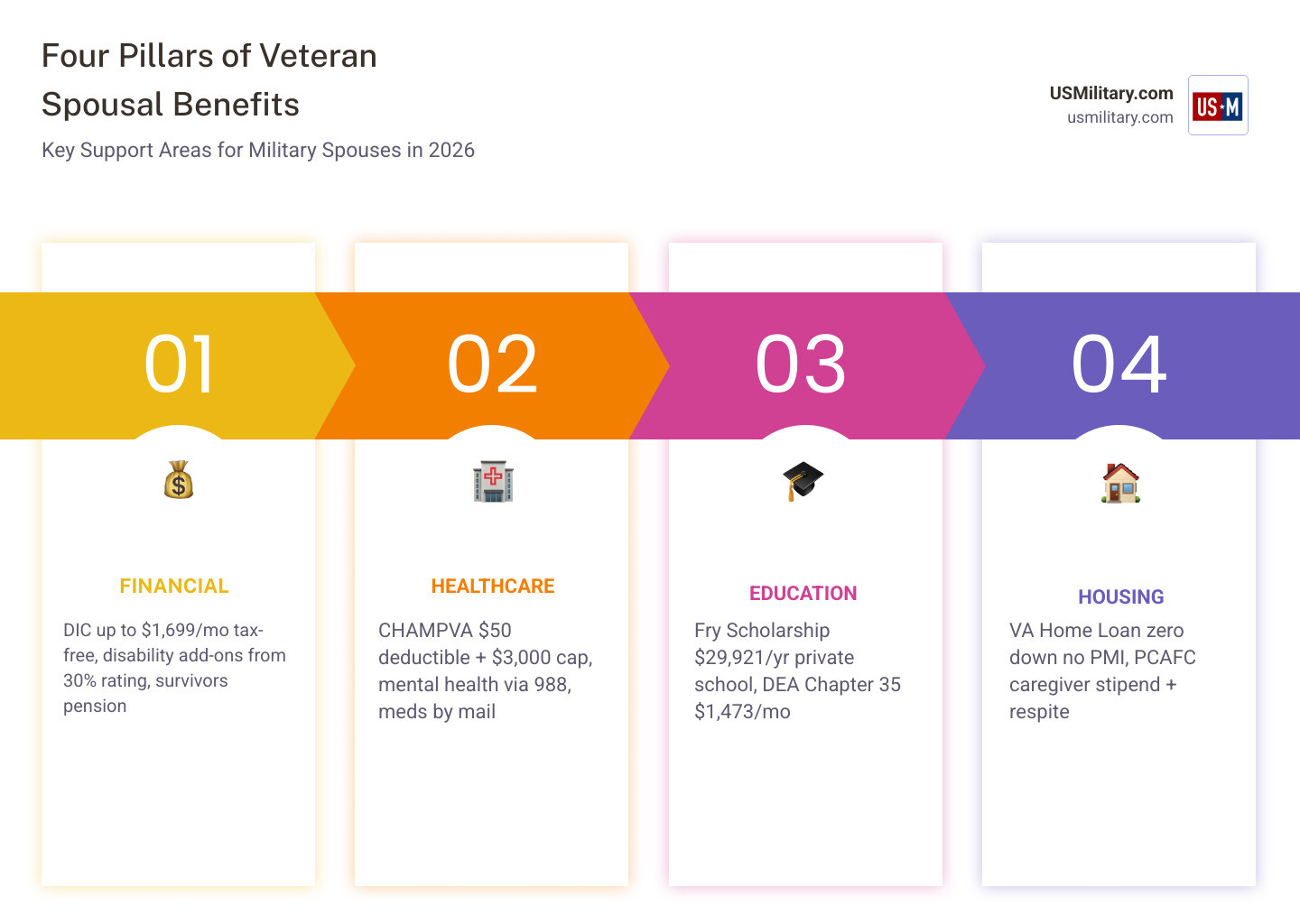
| Benefit | Who It’s For | Key Detail |
|---|---|---|
| Dependency and Indemnity Compensation (DIC) | Surviving spouses | $1,699.36/month tax-free base rate |
| CHAMPVA | Spouses of 100% P&T disabled veterans | $50 deductible, $3,000 catastrophic cap |
| VA Home Loan Guaranty | Surviving and eligible current spouses | Zero down payment, no PMI |
| Fry Scholarship | Surviving spouses (post-9/11 service death) | Up to $29,920.95/year for private school |
| Survivors Pension | Low-income surviving spouses of wartime veterans | Up to $974.92/month |
| Disability Dependency Add-On | Spouses of veterans rated 30%+ disabled | Extra $109.58+/month added to veteran’s pay |
| Caregiver Support (PCAFC) | Spouses caring for 70%+ disabled veterans | Monthly stipend, health insurance, respite care |
| DEA / Chapter 35 | Spouses and dependents of disabled veterans | Up to $1,473/month for school |
| Survivors’ and Dependents’ Education | Spouses of veterans who died in service | Up to 36 months of benefits |
| Burial and Memorial Benefits | Surviving spouses | National cemetery, headstone, flag |
Military spouses carry a heavy load. Deployments, relocations, career interruptions — the sacrifices are real and ongoing. The VA recognizes this, and in 2026, there are more spousal benefits available than ever before. Whether your veteran is living with a disability or has passed away, you may be entitled to significant support.
But the system is complex. Eligibility rules vary by disability rating, service dates, income, and marital status. Many spouses miss out simply because they don’t know what they qualify for.
That’s what this guide is for.
I’m Larry Fowler, publisher of the USMilitary.com Network — a resource I’ve grown since 2007 to help veterans and their families navigate exactly these kinds of decisions, including the best veteran benefits for spouses. Over nearly two decades, I’ve tracked benefit changes, disability trends, and VA policy shifts that directly affect military families like yours.
Best veteran benefits for spouses terminology:
Financial Compensation and Disability Dependency Increases

When a veteran receives a disability rating from the VA, it isn’t just the veteran who is recognized for their service and sacrifice. We know that as a spouse, you are often the primary support system, and the VA acknowledges this by offering additional monthly compensation once a veteran reaches a certain disability threshold.
If your veteran has a disability rating of at least 30%, they are eligible to receive an “add-on” for their spouse. This isn’t a separate check sent to you, but rather an increase in the veteran’s monthly payment. In 2026, the difference can be substantial. For example, a veteran with a 50% disability rating receives $1,132.90 per month if they are single. However, with a spouse, that rate jumps to $1,242.48 per month.
To secure this increase, the veteran must submit VA Form 21-686c (Declaration of Status of Dependents). It is vital to keep this information updated; if you get married or have a child, notify the VA immediately to ensure you are receiving the correct rate. You can learn more about these Family Member Benefits through official VA channels.
Dependency and Indemnity Compensation (DIC) for Survivors
One of the most critical financial safety nets for military families is Dependency and Indemnity Compensation (DIC). This is a tax-free monthly benefit paid to eligible surviving spouses of service members who died in the line of duty or veterans whose death resulted from a service-connected injury or illness.
In April 2026, the base monthly rate for DIC is $1,699.36. There are several ways this amount can increase:
- The 8-Year Provision: If the veteran was rated totally disabled for at least eight continuous years leading up to their death and you were married to them during those same eight years, you may qualify for an additional $360.85 per month.
- Aid & Attendance: If you require help with daily living activities, you could receive an extra $421.00 per month.
- Children: Additional amounts are provided for each dependent child under the age of 18.
A major update in recent years involves the PACT Act. This legislation expanded benefits for those exposed to toxins. For instance, hypertension is now a presumptive condition for Agent Orange exposure. If your spouse was a Vietnam-era veteran who passed away from heart-related issues, you might now be eligible for DIC even if you were previously denied. For a deeper dive into eligibility, check out About VA DIC For Spouses, Dependents, And Parents.
Survivors Pension and Net Worth Limits
For low-income surviving spouses of wartime veterans, the VA offers a needs-based benefit called the Survivors Pension. Unlike DIC, the veteran’s death does not have to be service-connected. However, the veteran must have met specific wartime service requirements (usually 90 days of active duty with at least one day during a wartime period).
This benefit is subject to strict income and net worth limits. For the period of December 1, 2025, to November 30, 2026, the net worth limit is $163,699. This includes both your annual income and your assets (excluding your primary home and car). The maximum annual rate for a surviving spouse without children is approximately $11,699 ($974.92 per month). If you are struggling to make ends meet, we recommend looking into How To Claim Your Va Surviving Spouse Pension Today.
Comprehensive Healthcare: CHAMPVA and TRICARE
Healthcare is often cited as one of the best veteran benefits for spouses. Depending on the veteran’s status, you may qualify for either TRICARE or CHAMPVA. While both provide excellent coverage, they operate differently.
| Feature | TRICARE (Select/Prime) | CHAMPVA |
|---|---|---|
| Eligibility | Active duty, retirees, and their families | Spouses of 100% P&T disabled veterans |
| Annual Deductible | Varies by plan | $50 per person / $100 per family |
| Catastrophic Cap | Varies by status | $3,000 per year |
| Pharmacy | TRICARE Pharmacy Home Delivery | Meds by Mail (0% cost share) |
CHAMPVA (Civilian Health and Medical Program of the Department of Veterans Affairs) is specifically for spouses and children of veterans who are rated 100% Permanently and Totally (P&T) disabled. It is a cost-sharing program where the VA typically pays 75% of the allowed amount for covered services. A fantastic perk of CHAMPVA is the CITI program (CHAMPVA In-house Treatment Initiative), which allows beneficiaries to receive care at participating VA medical centers with zero out-of-pocket costs. You can find more details on how to Get The Aid You Deserve.
Best Veteran Benefits for Spouses: Mental Health and Substance Abuse
We understand that military life and caregiving can take a toll on your mental well-being. The VA has significantly expanded its mental health resources for spouses. If you are in crisis, you can call the Veterans Crisis Line at 988 (press 1) or text 838255 for confidential support 24/7.
For those struggling with substance use disorders, both TRICARE and CHAMPVA provide coverage for rehabilitation. CHAMPVA allows for up to three benefit periods in a lifetime. This includes:
- Detoxification: Limited to 7 days per admission.
- Inpatient Rehab: One stay of up to 21 days per benefit period.
- Outpatient Care: Including individual and group therapy.
It is important to note that the VA generally does not revoke benefits due to substance use unless it is determined to be “willful misconduct,” which is a rare legal distinction. For more on navigating these resources, see our guide on Compass Links Spouse Benefits.
Education and Career Advancement Opportunities
Education is a powerful tool for rebuilding or advancing a career that may have been sidelined by military moves. In 2026, the VA provides several robust programs to help spouses pay for degrees, certificates, and even apprenticeships.
The Post-9/11 GI Bill is perhaps the most famous. Veterans can transfer their unused education benefits to their spouse while they are still on active duty (provided they meet service length requirements). This transfer provides up to 36 months of tuition, a monthly housing allowance, and a stipend for books. For those attending private schools in 2026, the annual tuition cap is $29,920.95. You can explore these Family Member Benefits online to see if your veteran has transferable months.
Maximizing the Best Veteran Benefits for Spouses in Education
If your veteran is 100% P&T disabled or died from a service-connected cause, you may qualify for Survivors’ and Dependents’ Educational Assistance (DEA), also known as Chapter 35.
- DEA Monthly Stipend: In 2026, full-time students can receive approximately $1,473 per month to help cover living expenses while in school.
- Fry Scholarship: This is specifically for surviving spouses of service members who died in the line of duty after September 10, 2001. It provides the full benefits of the Post-9/11 GI Bill at the 100% rate.
A key strategy is knowing when to use which benefit. For example, a surviving spouse might be eligible for both DEA and the Fry Scholarship, but they cannot use them at the same time. We often suggest consulting with a School Certifying Official or checking out Compass Navy Spouse Mentor Benefits to map out the best path for your specific goals.
Housing, Caregiver Support, and Burial Benefits
Homeownership is a cornerstone of financial stability. The VA Home Loan Guaranty is widely considered one of the best veteran benefits for spouses, especially for surviving spouses who have not remarried (or who remarried after age 57).
The main advantages of a VA-backed loan include:
- Zero Down Payment: No need to save tens of thousands of dollars for a down payment.
- No Private Mortgage Insurance (PMI): This can save you hundreds of dollars every month compared to a conventional loan.
- Competitive Interest Rates: Often lower than traditional market rates.
To apply, you will need a Certificate of Eligibility (COE). If you are a surviving spouse, you can often obtain this by showing you are in receipt of DIC. More information on these 100 Disabled Veteran Benefits For Spouse can help you get started on your home-buying journey.
Caregiver Support and Aid & Attendance
If you are the primary caregiver for a veteran with a serious service-connected disability (rated 70% or higher), you may qualify for the Program of Comprehensive Assistance for Family Caregivers (PCAFC). This program is a game-changer for many families.
Benefits of PCAFC include:
- Monthly Stipend: A direct payment to the spouse to compensate for the time spent providing care.
- Health Insurance: Access to CHAMPVA if the caregiver doesn’t already have insurance.
- Mental Health Counseling: Specifically for the caregiver.
- Respite Care: The VA will pay for a professional to step in for at least 30 days a year so you can take a much-needed break.
Does the VA pay a spouse for being a caregiver? The answer is a resounding yes, provided the eligibility criteria are met. You can find more details at Does Va Pay A Spouse For Being Caregiver.
Final Honors and Survivor Security
While it is a difficult topic to discuss, planning for the future is an act of love for your family. The VA provides comprehensive burial benefits for both the veteran and the spouse. Even if the spouse passes away before the veteran, they are usually eligible for burial in a VA national cemetery at no cost.
This includes:
- Burial in a National Cemetery: Opening and closing of the grave, perpetual care, and a government headstone or marker.
- Presidential Memorial Certificate: An engraved paper certificate signed by the current President to honor the veteran’s service.
- Survivor Benefit Plan (SBP): This is a DoD program (not VA) that functions like an insurance policy, allowing retirees to leave a portion of their retirement pay to their spouse.
We recommend reading about the Military Veteran Survivor Benefit Plan to understand how to secure your long-term financial future.
Frequently Asked Questions about Best Veteran Benefits for Spouses
Can a divorced or remarried spouse still receive VA benefits?
Divorce and remarriage complicate benefit eligibility, but they don’t always end it.
- TRICARE (20/20/20 Rule): A divorced spouse can keep TRICARE if they were married for 20 years, the veteran served for 20 years, and there was a 20-year overlap between the two.
- Remarriage and DIC: You can continue receiving DIC if you remarry after age 55 (if the remarriage occurred on or after January 5, 2021) or after age 57 (if it occurred on or after December 16, 2003).
- CHCBP: If you lose military benefits due to divorce, you can apply for the Continued Health Care Benefit Program within 60 days to maintain temporary coverage.
For more specifics, see our article on Military Surviving Spouse Benefits.
How does a veteran’s disability rating affect spousal benefits?
The rating is the “key” that unlocks different levels of support:
- 30% Rating: Qualifies for the monthly dependency add-on.
- 70% Rating: Minimum requirement for the Comprehensive Caregiver program (PCAFC).
- 100% P&T Rating: Unlocks CHAMPVA healthcare and DEA (Chapter 35) education benefits for the spouse.
If you aren’t sure where your veteran stands, check out Who Qualifies For Va Survivor Benefits.
What documentation is needed to apply for spousal benefits?
To avoid delays, we recommend keeping a “benefits folder” with the following:
- Marriage Certificate: Proof of the legal relationship.
- DD214: The veteran’s discharge papers showing the character of service.
- VA Award Letter: Showing the current disability rating.
- Death Certificate: Required for all survivor-based claims.
- Intent to File: Always submit this first! It “marks your place in line” and can lead to months of retroactive back pay once your claim is approved.
Conclusion
Navigating VA benefits can feel like a full-time job, but you don’t have to do it alone. At USMilitary.com, we are dedicated to providing the most up-to-date and unbiased information to help you claim the best veteran benefits for spouses.
As we move through 2026, keep an eye on new legislative updates. The PACT Act continues to offer new opportunities for retroactive reviews of previously denied claims, and pending bills like the Sharri Briley Act may soon provide even higher cost-of-living adjustments for DIC recipients.
We highly recommend working with a Veterans Service Officer (VSO) or an accredited representative to help you file your paperwork. These services are free and can significantly increase your chances of a successful claim.
Don’t leave your hard-earned benefits on the table. Whether it’s healthcare, a monthly stipend, or help with a home loan, these programs were created to honor your service alongside your veteran. Explore all military benefits today and take the first step toward securing your family’s future.