
If You Are Over 26 Can Be Drafted? Here’s the Quick Answer

If you are over 26 can be drafted is one of the most searched questions about U.S. military law right now — and the answer is straightforward:
No. Under current U.S. law, men over 26 cannot be drafted into the military.
Here is what you need to know at a glance:
| Question | Answer |
|---|---|
| Can men over 26 be drafted? | No, not under the standard draft |
| When does draft eligibility end? | On your 26th birthday |
| Can you register after 26? | No, the window closes permanently at 26 |
| Is there an active draft right now? | No, the last draft was in 1973 |
| Are there any exceptions? | Yes — healthcare professionals up to age 44-54 in rare emergencies |
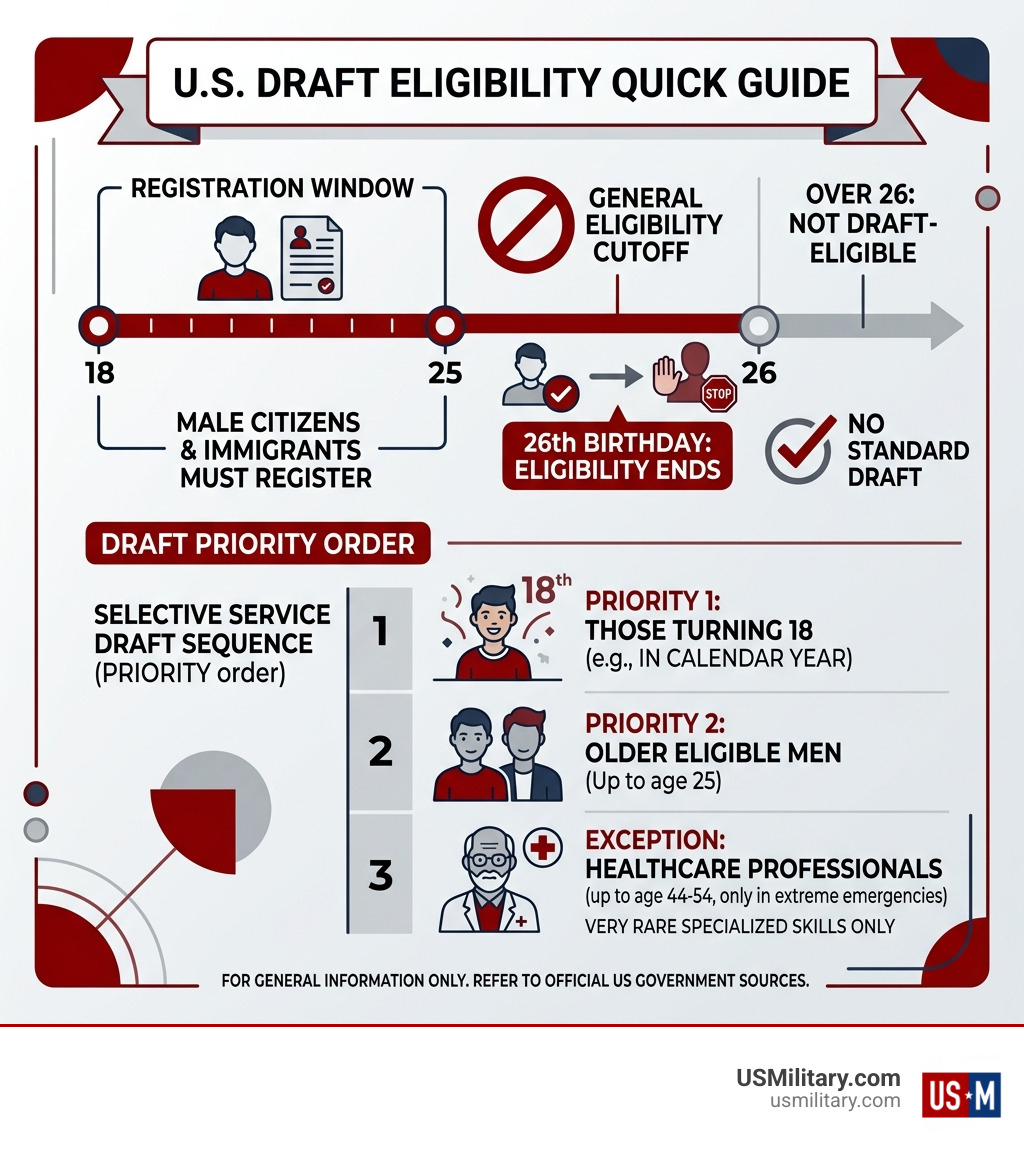
The U.S. Selective Service System requires male citizens and immigrants to register between ages 18 and 25. Once you turn 26, that window closes permanently — and so does your general draft liability.
That said, there are important nuances worth understanding: historical precedents, upcoming changes to automatic registration, and rare exceptions for specialized professionals. This guide covers all of it.
I’m Larry Fowler, publisher of the USArmy.com Network since 2007, where I’ve helped millions of active-duty members and veterans navigate complex military topics — including if you are over 26 can be drafted and what the rules mean for your future benefits and eligibility. Let’s break it all down clearly.
Similar topics to if you are over 26 can be drafted:
Current U.S. Law: If You Are Over 26 Can Be Drafted?
As of April 2026, the legal framework governing conscription remains the Military Selective Service Act. Under this federal law, the “window of liability” is very specific. We often get asked by concerned parents and young men about the exact moment they are “safe” from a potential call to service.
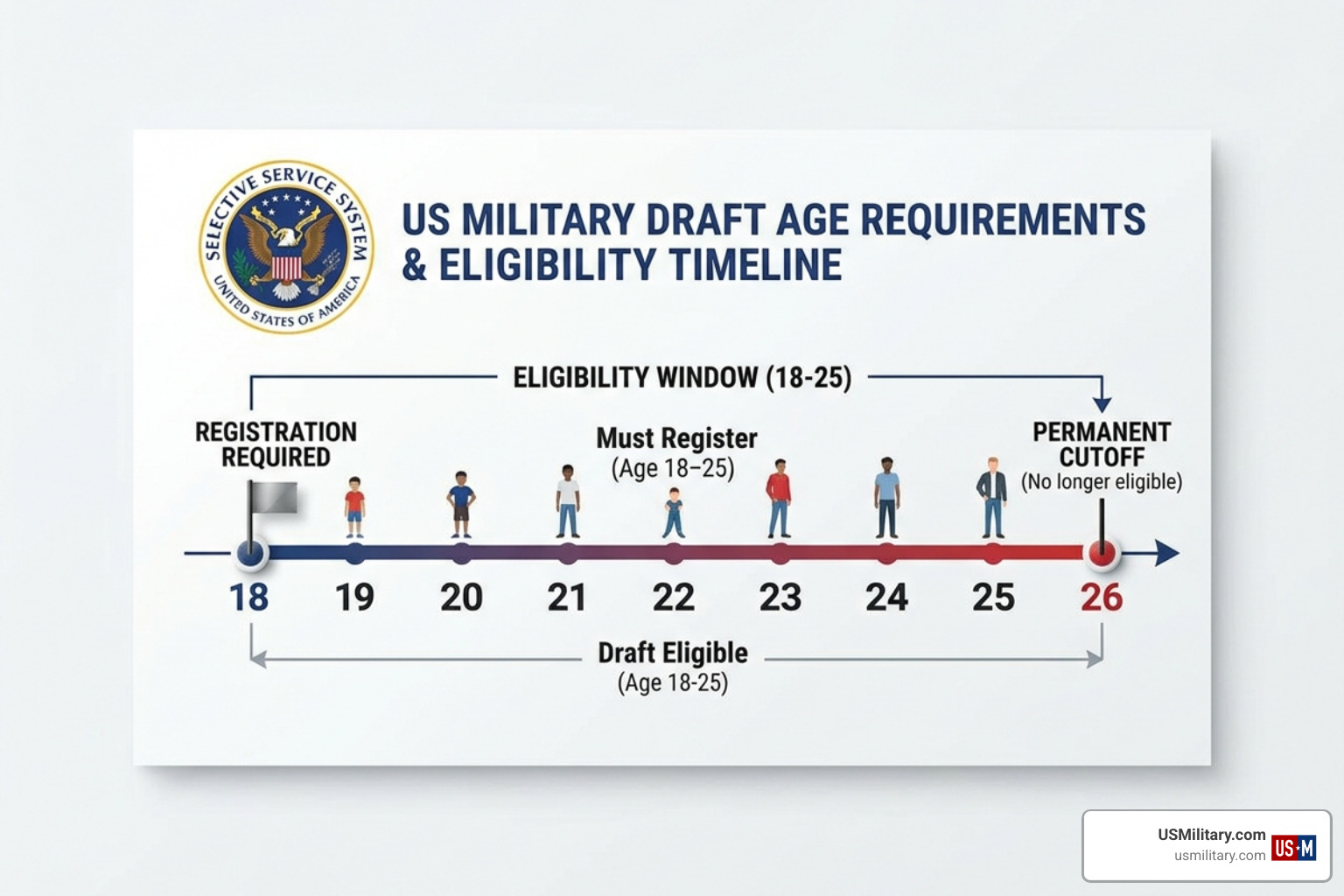
The law states that almost all male U.S. citizens and male immigrants living in the U.S. aged 18 through 25 must register with the Selective Service System (SSS). This registration is a prerequisite for being “draft-eligible.” However, once a man reaches his 26th birthday, he is no longer required to register, and his legal liability for the standard military draft ends.
According to the Selective Service System, the agency cannot even accept a registration from someone who has already turned 26. This means if you haven’t registered by then, you can’t go back and do it later. More importantly, it means that in the event of a national emergency where Congress reinstates the draft, the current pool of potential draftees would be drawn exclusively from those aged 18 to 25.
If you are wondering who is eligible for military conscription, the answer is consistently tied to that 18–25 age bracket. Even if you are currently 25 and worried, you can read more about whether you will be drafted at age 25 to understand that your liability is rapidly coming to a close.
Historical Precedents for If You Are Over 26 Can Be Drafted
While the current cap is 26, history shows us that these numbers aren’t set in stone if a truly massive conflict arises. During World War II, the U.S. conducted what was colloquially known as the “Old Man’s Draft.” In 1942, the government required men between the ages of 45 and 64 to register.
While the primary goal of the “Old Man’s Draft” was to survey the nation’s industrial manpower rather than send 60-year-olds into foxholes, it proved that the government could expand registration requirements if needed. During that same era, combat liability actually extended up to age 45.
Conscription in the United States has fluctuated wildly depending on the needs of the era. For example:
- Civil War: Draft ages were 20 to 45.
- World War I: Initially 21–31, later expanded to 18–45.
- Vietnam War: The age range was 18–25, which mirrors our current military draft age standards.
How Automatic Enrollment Affects If You Are Over 26 Can Be Drafted Status
A major shift is coming to how the U.S. handles these records. Under the National Defense Authorization Act (NDAA) for Fiscal Year 2026, which was signed into law in late 2025, the Selective Service System is moving toward an automatic registration model.
By the deadline of December 18, 2026, the government plans to use federal databases—such as Social Security records and DMV data—to automatically register eligible men. This removes the “I forgot” or “I didn’t know” excuse for failing to register.
Does this change the age limit? No. The automatic registration still only applies to those in the 18–25 age range. If you are already 27 or 30 when this system goes live in late 2026, you will not be retroactively “sucked into” the draft pool. The system is designed to streamline the process for young men entering the eligibility window, not to expand the window to older age groups. For more on the timeline of these changes, check our analysis on whether there will be a military draft in 2026.
Exceptions to the Rule: Specialized Drafts for Older Professionals
While we’ve established that the general answer to if you are over 26 can be drafted is “no,” there is a giant asterisk when it comes to specialized skills—specifically in the medical field.
The Health Care Personnel Delivery System (HCPDS) is a standby plan that would allow the military to draft doctors, nurses, and other medical specialists if a national emergency created a severe shortage of medical staff. In this specific scenario, the age limits are much higher than the standard 26.
| Draft Type | Age Limit | Who is Included? |
|---|---|---|
| General Draft | Up to 26 | All registered males 18-25 |
| Healthcare Draft (Standby) | Up to 44 (standard) | Doctors, Nurses, Specialists |
| Emergency Skill Draft | Up to 54 (proposed) | 57 different medical categories |
Under current contingency plans, healthcare professionals could be liable for service up to age 44. In extreme circumstances, historical proposals have even suggested ages as high as 54 for those with highly specialized surgical or trauma skills. This is separate from the general “combat” draft and is intended to ensure our service members have the medical support they need. You can find more details on these specialized rules in our Military Draft 2025-2026 guide.
Consequences of Failing to Register Before Age 26
Even though you can’t be drafted after 26, failing to register before that birthday can haunt you for the rest of your life. In the eyes of the law, failing to register is a felony. While the government hasn’t actively prosecuted anyone for non-registration since 1986, they use a different tactic: “collateral penalties.”
If you are over 26 and did not register, you may face the following:
- Loss of Federal Student Aid: You will be ineligible for Pell Grants and federal student loans.
- Federal Employment Bans: You cannot work for the Executive Branch of the federal government or the U.S. Postal Service.
- State-Level Penalties: 31 states deny state-based student aid or even driver’s licenses to non-registrants.
- Citizenship Delays: For immigrants, failing to register can be viewed as a lack of “good moral character,” potentially blocking or delaying U.S. citizenship.
If you are in this situation, you cannot “fix” it by registering late once you turn 26. Instead, you must request a Status Information Letter from the Selective Service. This letter doesn’t excuse you, but it explains your status to hiring managers or loan officers. You will then have to prove by a “preponderance of evidence” that your failure to register was not “knowing and willful.”
Students and parents often worry about these administrative hurdles, especially with the new 2026 rules regarding high school and college eligibility.
The Draft Lottery: Priority Order and Induction
If a draft were actually activated by Congress and the President, they wouldn’t just grab every 18-to-25-year-old at once. There is a very specific “Order of Call” determined by a lottery system.
The lottery is based on birthdates. For example, if “September 14” is drawn as the #1 priority, every registered man born on that day within the eligible age range would be called first. However, the age groups are prioritized as follows:
- 20-Year-Olds: This group is always called first. They are considered at the peak of physical maturity while having fewer established life ties (like careers or families) than 25-year-olds.
- 21 to 25-Year-Olds: Once the pool of 20-year-olds is exhausted, the draft moves up the age ladder in descending order.
- 19-Year-Olds: If more personnel are still needed, they look to the 19-year-olds.
- 18.5-Year-Olds: This group is the absolute last to be called.
18-year-olds are generally not drafted until they are at least 18 and a half. During this process, individuals can apply for deferments or exemptions. While some might look for a certificate of incompetency to avoid service, most exemptions are based on medical issues, hardship, or religious conscientious objection.
Frequently Asked Questions About Draft Eligibility
Are women over 26 subject to the draft?
Currently, no. Under the Military Selective Service Act, only those assigned male at birth are required to register. While there has been significant debate in Congress and several court challenges regarding women in the draft—especially since all combat roles were opened to women in 2016—the law has not yet been changed. Therefore, women of any age are currently exempt from draft registration and liability.
Can Congress change the draft age limits in the future?
Yes. Congress has the constitutional authority to raise or lower the draft age at any time by amending the Military Selective Service Act. While the age has been capped at 26 for decades, a massive global conflict could see that age raised to 30, 35, or even 45, as seen in World War II. However, such a move would require a new law to be passed by both the House and Senate and signed by the President.
What happens if I am a non-citizen over 26?
If you are a male non-citizen (including undocumented immigrants and green card holders) who arrived in the U.S. before age 26, you were legally required to register. If you are now over 26 and didn’t register, you may face the same “collateral penalties” as citizens, most notably a significant delay or denial in your path to U.S. citizenship. If you arrived in the U.S. for the first time after your 26th birthday, you were never required to register and are not penalized.
Conclusion
At USArmy.com, we believe that staying informed is the best way to handle your civic responsibilities. To summarize the big question: if you are over 26 can be drafted, the current answer is a firm no for the general population. The U.S. military has remained an all-volunteer force since 1973, and the Selective Service exists primarily as a “break glass in case of emergency” insurance policy.
However, the age of 26 is a critical milestone. It marks the end of your draft liability, but it also marks the end of your opportunity to register. If you are under 26, we highly recommend ensuring your registration is current—either through the manual system or the upcoming automatic enrollment in late 2026—to protect your future access to student loans, federal jobs, and citizenship.
Understanding the draft isn’t just about military service; it’s about understanding the laws that shape your rights and responsibilities as an American. Whether you are interested in voluntary enlistment or just want to know where you stand, we are here to provide the unbiased guidance you need.
For more information on the draft and how it works, visit our pillar guide: What Is The U.S. Military Draft?