
What Army Delta Force Fears Most (And Why It Matters)

The 10 Things That Army Delta Force Fears The Most may surprise you — because for the world’s most elite soldiers, the biggest threats aren’t always the ones you’d expect.
Here’s a quick answer:
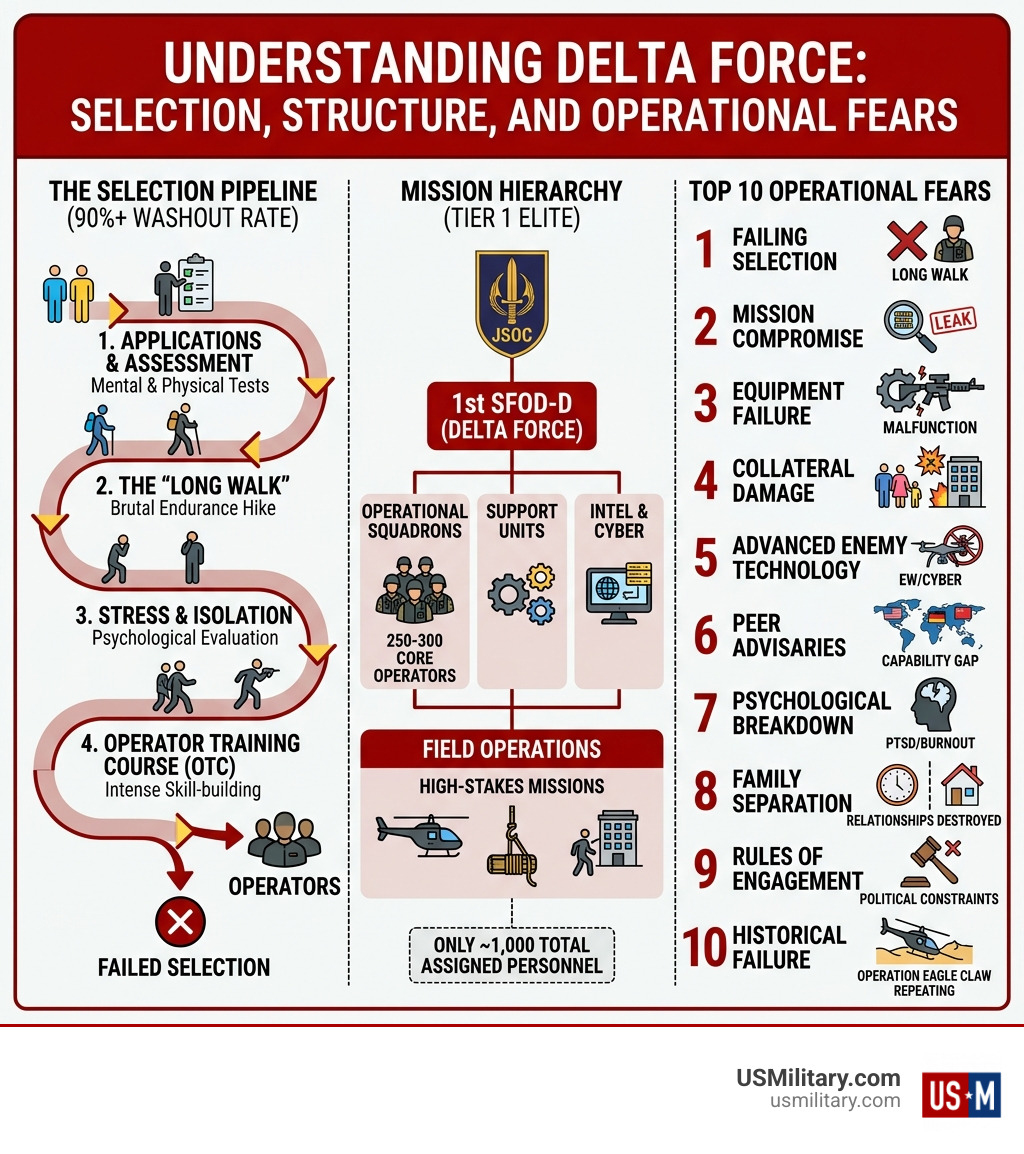
- Failing selection — the brutal “Long Walk” and 90%+ washout rate
- Mission compromise — a leak that burns an entire operation
- Equipment failure — gear malfunctions at the worst possible moment
- Collateral damage — killing civilians during a high-stakes raid
- Advanced enemy technology — drones, cyber attacks, and electronic warfare
- Peer adversaries — Russia and China closing the capability gap
- Psychological breakdown — PTSD, isolation, and mental burnout
- Family separation — relationships destroyed by years of secrecy
- Rules of engagement — political constraints that tie hands in combat
- Historical failure repeating — another Operation Eagle Claw-style disaster
Delta Force — officially the 1st Special Forces Operational Detachment-Delta (1st SFOD-D) — operates under JSOC as America’s most secretive Tier 1 counter-terrorism unit. With only 250–300 core operators out of roughly 1,000 assigned personnel, every single one of them has survived one of the most punishing selection processes on earth.
But even the best soldiers in the world have vulnerabilities. And understanding those vulnerabilities tells you a lot about what modern special operations actually looks like.
I’m Larry Fowler, publisher of the USMilitary.com Network since 2007, where I’ve spent nearly two decades covering elite military units, veteran benefits, and special operations careers — including deep dives into the 10 Things That Army Delta Force Fears The Most. Let’s break down each one so you know exactly what these operators are up against.
10 Things That Army Delta Force Fears The Most terms to learn:
The Selection Crucible: Fearing the “Long Walk”

Before a soldier can even call themselves a Delta operator, they have to face the ultimate gatekeeper: the Assessment and Selection (A&S) course. For many of the Army’s top performers, the greatest fear isn’t the enemy—it’s the “Long Walk.”
Held twice a year at Camp Dawson, West Virginia, this selection process is designed to find the 5% to 10% of candidates who possess the perfect blend of physical stamina and mental grit. Most candidates are already elite; they come from the 75th Ranger Regiment or the Green Berets. Yet, even with that pedigree, the failure rate remains north of 90%.
The “Long Walk” is a 40-mile timed rucksack march across brutal, mountainous terrain. Candidates carry a 45-pound pack and have no idea where the finish line is. They are given coordinates, a map, and a compass. If they arrive at a checkpoint even a minute late, they are often dropped without a word. This uncertainty is intentional. Delta wants to see how you perform when you are exhausted, alone, and have no idea when the pain will end.
To understand how this compares to other elite units, you can read more info about Delta Force vs SEAL Team 6. While both are Tier 1 units, Delta’s selection focuses heavily on individual land navigation and solo endurance, modeled after the British SAS.
Physical and Mental Breaking Points
It isn’t just the rucking that breaks people. The psychological evaluation is often what ends a candidate’s dream. During selection, candidates are subjected to the “silent treatment” by instructors. There is no “Good job, soldier” or “Keep going.” You operate in a vacuum of feedback.
After the physical torture, candidates face a board of senior operators and psychologists. They might be grilled for hours on their life choices, their ethics, and their mental stability. This is where the unit weeds out the “cowboys” and “lone wolves.” Delta isn’t looking for the loudest person in the room; they are looking for the “quiet professional” who can adapt to any situation.
| Test Component | Delta Force Selection | SAS Selection (UK) |
|---|---|---|
| Duration | ~4 weeks | ~4 weeks (Selection phase) |
| Final Ruck | “The Long Walk” (40 miles) | “The Endurance” (40 miles) |
| Navigation | Individual land nav, heavy brush | Individual land nav, moorlands |
| Psychological | Board interview & silent treatment | Direct observation & interrogation |
| Success Rate | ~5-10% | ~10% |
For more on the requirements, check out Wanna Join the U.S. Army’s Delta Force? Here’s What It Takes – 19FortyFive.
10 Things That Army Delta Force Fears The Most

When we talk about the 10 Things That Army Delta Force Fears The Most, we are looking at the tactical, psychological, and global threats that keep Tier 1 operators on high alert in 2026.
According to Inside Delta Force: America’s Most Elite Special Mission Unit | SOFREP, the unit has evolved significantly since its founding in 1977. However, the core fears remain centered on mission success and the safety of the team.
Tactical Vulnerabilities and 10 Things That Army Delta Force Fears The Most
In the modern era, “ground truth” has changed. One of the primary tactical fears is Mission Compromise. In the age of 24/7 social media and ubiquitous surveillance, staying “black” (unseen) is harder than ever. A single civilian with a smartphone or a leaked photo can burn a multi-million dollar operation in seconds.
Another major fear is Advanced Enemy Technology. In 2026, Delta operators aren’t just fighting insurgents with AK-47s. They are facing “peer adversaries” like Russia and China who utilize:
- Drones and Loitering Munitions: A small, cheap drone can take out an elite team before they even reach the target.
- Electronic Warfare (EW): Jamming communications or GPS can leave a team blind and deaf in hostile territory.
- Cyber Threats: The unit’s “Digital Devils” (Computer Network Operations Squadron) work tirelessly to prevent the hacking of mission-critical data.
We also have to consider the Rules of Engagement (ROE). Operators often fear that political constraints will prevent them from taking the necessary action to save their lives or complete the mission. This was a major factor in historical missions like the Timeline of the F-15 Rescue mission, where coordination between Rangers, Delta, and PJs was critical but hampered by logistical and political hurdles.
Psychological Pressures: 10 Things That Army Delta Force Fears The Most
The “Quiet Professional” lifestyle comes with a heavy price tag. Operational Isolation is a real fear. Operators often spend months in “deep recon” or undercover roles where they cannot contact their families or even their own unit. This leads to a unique kind of mental strain.
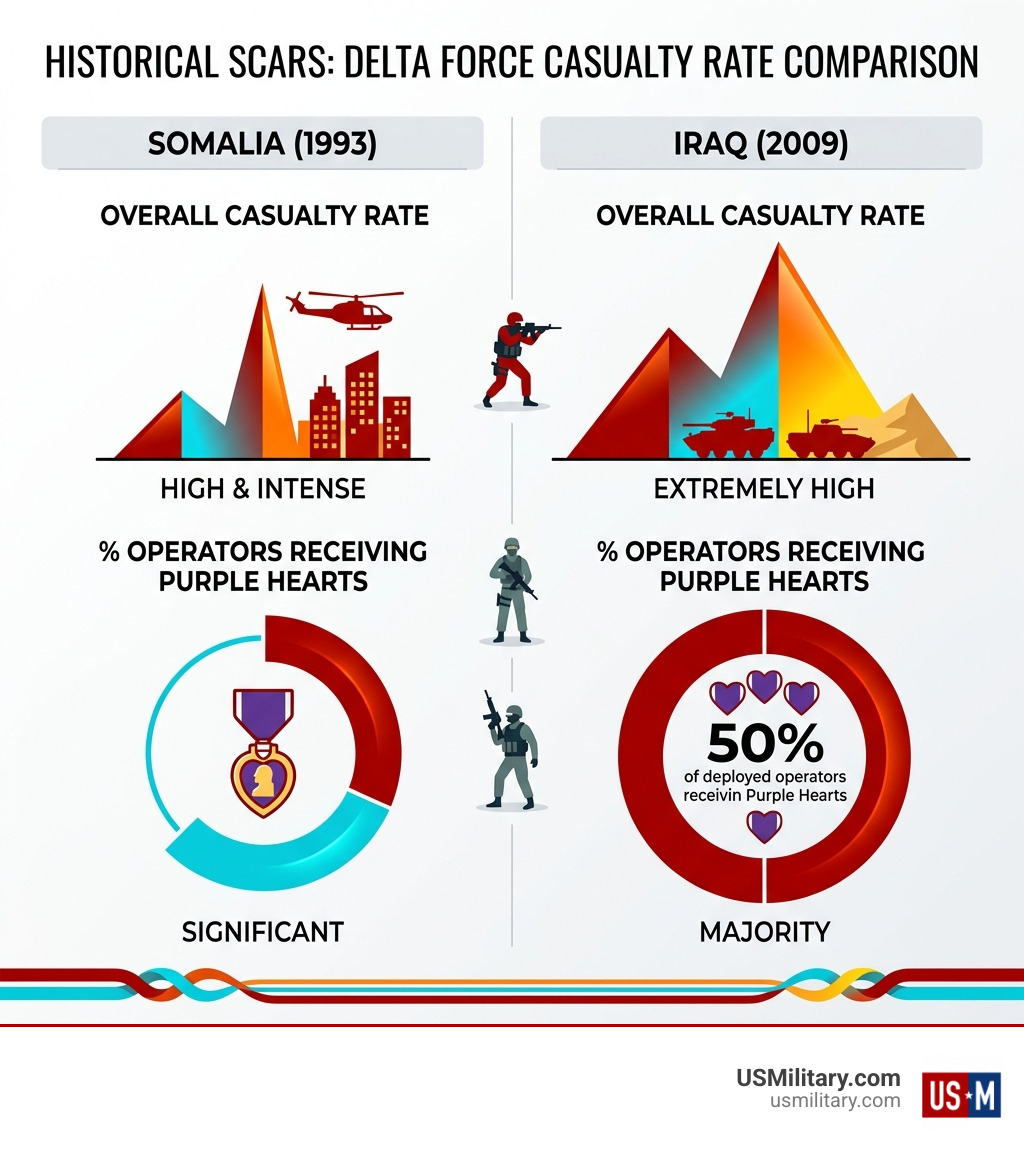
PTSD and Mental Burnout are also top-tier concerns. By 2009 in Iraq, Delta operators had suffered a 20% casualty rate, with 50% of deployed operators receiving Purple Hearts. Seeing that much combat takes a toll. Many operators fear the day they can no longer “stay in the fight” because their mind or body has simply had enough.
Financially, the stakes are also different. While these are the best soldiers in the world, their pay doesn’t always reflect the risk compared to the private sector. You can see the breakdown in our Navy Seals Vs Delta Force Pay Guide.
Historical Scars and Modern Operational Risks
Every Delta operator is a student of history, and that history is written in blood. The unit was born out of the failure of Operation Eagle Claw in 1980. The attempt to rescue American hostages in Iran ended in a disastrous collision at “Desert One,” killing eight service members. This failure haunts the unit’s planning to this day, ensuring that redundancy and “what-if” scenarios are baked into every mission.
Lessons from Mogadishu and Beyond
The 1993 Battle of Mogadishu (popularized by Black Hawk Down) is another foundational memory. Five Delta operators were killed in that urban meat grinder. It taught the unit the dangers of “mission creep” and the extreme risks of daylight operations in densely populated urban environments.
Today, Delta focuses on high-value targets (HVTs) with surgical precision. The 2019 raid that killed ISIS leader Abu Bakr al-Baghdadi (Operation Kayla Mueller) showed how far the unit has come. However, the fear of Collateral Damage remains. When every mistake is televised, a single stray bullet that hits a civilian can have global political consequences and “haunt” an operator for the rest of their life.
The Personal Toll: Secrecy and Sacrifice
The final category of the 10 Things That Army Delta Force Fears The Most is the personal cost. Delta operators are “wiped” from regular Army records. They use separate systems for everything from pay to medical files to maintain their cover.
They are allowed “relaxed grooming standards”—meaning beards and long hair—to blend into civilian populations. While this sounds cool, it means they can never truly “switch off.” They are always undercover, even when they are home.
The Cost of Secrecy
The secrecy creates a wall between the operator and the outside world.
- Family Divorce Rates: The divorce rate in the Tier 1 community is notoriously high. Years of “blacked out” deployments and the inability to talk about work destroy many marriages.
- Social Media Bans: Operators and their families are strictly forbidden from posting anything that could compromise their identity. In 2023, a White House photo leak accidentally revealed the faces of several Delta operators, a nightmare scenario for the unit.
- Internal Tension: Because everyone in the unit is an “Alpha,” internal competition can be fierce. The fear of letting down your “brothers” is often more intense than the fear of the enemy.
As noted in Strict Rules Delta Force Has To Follow, violence among operators is strictly forbidden. If you lay an angry hand on a teammate, you are out of the unit immediately. No questions asked.
Frequently Asked Questions about Delta Force
What is the failure rate for Delta Force selection in 2026?
The failure rate remains incredibly high, typically over 90%. Out of a class of 120 elite candidates, it is common for only 12 to 15 to graduate. The “Long Walk” and the psychological board are the two primary points where candidates wash out.
How does Delta Force differ from the Green Berets?
While many Delta operators come from the Green Berets (Army Special Forces), their missions are different. Green Berets focus on “unconventional warfare”—training and leading foreign partner forces. Delta Force is a “Special Missions Unit” focused on direct action, counter-terrorism, and hostage rescue. Think of Green Berets as the teachers and Delta as the surgeons.
What are the primary missions of the “Digital Devils” CNOS?
The Computer Network Operations Squadron (CNOS), known as the “Digital Devils,” focuses on cyber warfare. Their job is to protect Delta’s communications, hack into enemy networks to gather intelligence, and disrupt the electronic capabilities of adversaries like Russia or China during active operations.
Conclusion
At USMilitary.com, we understand that the elite legacy of the 1st SFOD-D is built on more than just high-tech gear and “cool” missions. It is built on the ability to face the 10 Things That Army Delta Force Fears The Most and move forward anyway.
As we look toward the rest of 2026 and beyond, the threats are evolving. The shift from counter-insurgency to “Great Power Competition” means Delta is preparing for high-end conflict against peer adversaries. Whether it’s the physical toll of the “Long Walk” or the psychological weight of a secret life, these operators remain the tip of the spear.
If you want to see how the Army’s best stacks up against the Navy’s finest, you can Compare Army Delta Force vs Navy SEALs to see which path might be right for you—or simply to appreciate the incredible sacrifice these men make for our country.
For more information on military careers, veteran benefits like Aid & Attendance, or the latest defense news, stay tuned to USMilitary.com.