
Primary Missions: Unconventional Warfare vs. Direct Action
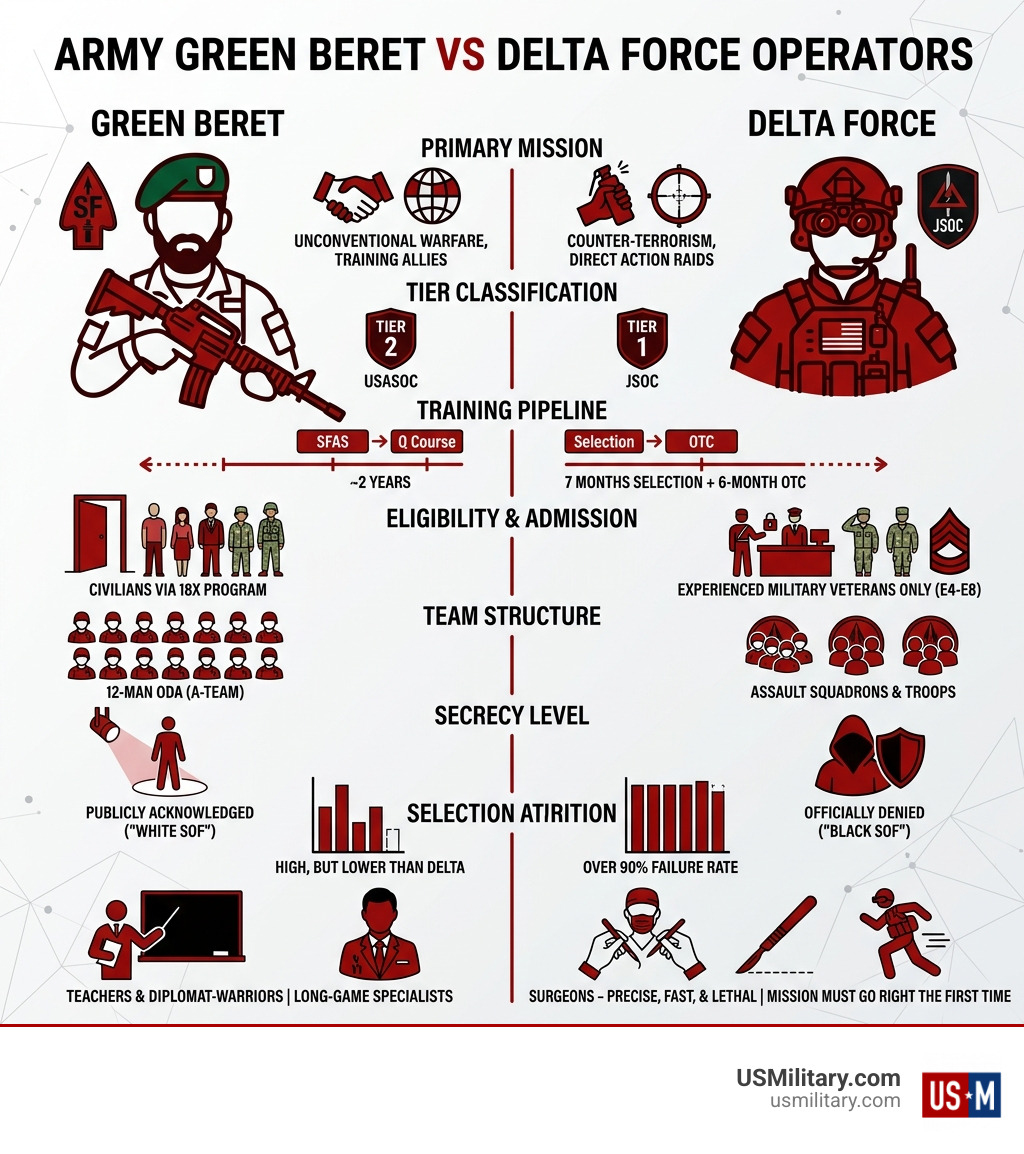
Army Green Beret vs Delta Force Operators are two of the most elite fighting forces the U.S. military has ever produced — but they are built for very different jobs.
Here is a quick breakdown of the key differences:
| Factor | Green Berets | Delta Force |
|---|---|---|
| Primary Mission | Unconventional warfare, training allies | Counter-terrorism, direct action raids |
| Tier Classification | Tier 2 (USASOC) | Tier 1 (JSOC) |
| Team Structure | 12-man ODAs (A-Teams) | Assault squadrons and troops |
| Secrecy Level | Publicly acknowledged (“White SOF”) | Officially denied (“Black SOF”) |
| Who Can Join | Civilians via 18X program | Experienced military veterans only (E4-E8) |
| Training Pipeline | ~2 years (SFAS + Q Course) | ~7 months selection + 6-month OTC |
| Selection Attrition | High, but lower than Delta | Over 90% failure rate |
Green Berets are the long-game specialists — building relationships, training foreign forces, and operating in over 70 countries at any given time. Delta Force operators are the ones called in when the mission has to go right the first time, with no second chances.
Think of it this way: Green Berets are teachers and diplomat-warriors. Delta Force operators are surgeons — precise, fast, and lethal.
I’m Larry Fowler, publisher of USMilitary.com, and I’ve spent nearly two decades helping active-duty service members and veterans navigate career decisions — including the differences between elite units like those in the Army Green Beret vs Delta Force Operators comparison. Whether you’re exploring enlistment paths or just want to understand how these units fit into the bigger picture, this guide breaks it all down clearly. Let’s dive in.
Army Green Beret vs Delta Force Operators helpful reading:
- delta special forces
- army ranger vs green beret
- Family Life Dyanmites of Army Delta Force and Ranger Families
When we look at Army Green Beret vs Delta Force Operators, the first thing to understand is their “why.” Why does the Army need both? The answer lies in their primary mission sets.
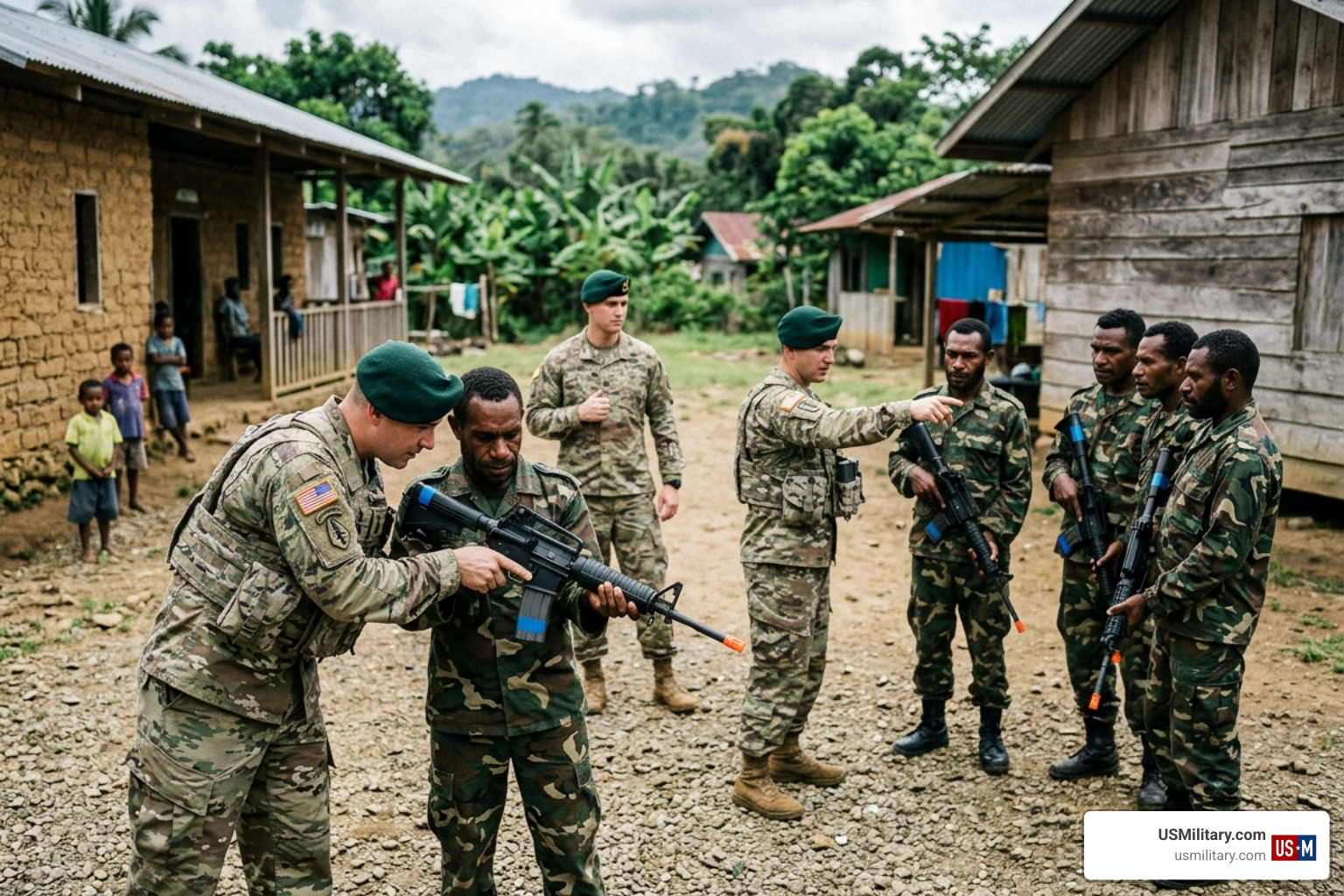
Green Berets are the masters of Unconventional Warfare (UW) and Foreign Internal Defense (FID). Their bread and butter is working with indigenous populations. Instead of just kicking in the door themselves, a Green Beret’s job is often to teach a local militia how to kick in the door. They are “soldier-diplomats” who must understand local cultures, speak the language, and build rapport over months or even years. As noted in Understanding the Differences Between Delta Force and Green Berets, they focus on long-term stability and regional influence.
Delta Force, officially known as the 1st Special Forces Operational Detachment-Delta (1st SFOD-D), has a much narrower, sharper focus. They are the nation’s premier Counter-terrorism and Hostage Rescue unit. While a Green Beret team might spend six months training a battalion in Africa, a Delta Force troop might spend six months planning a 30-minute raid to capture a high-value target (HVT) or rescue a kidnapped official.
Delta specializes in Direct Action and “surgical strikes”—missions characterized by speed, surprise, and overwhelming violence of action. According to our resources on Army Delta Force, they are the unit the President calls when a specific person needs to be found or a specific room needs to be cleared in the middle of the night.
Organizational Structure of Army Green Beret vs Delta Force Operators
The way these units are organized reflects their missions. Green Berets operate in small, highly versatile 12-man teams known as an Operational Detachment Alpha (ODA), or “A-Team.” Each member of the ODA is a specialist. You’ll have two medics, two weapons sergeants, two communications experts, and two engineers, all led by a Captain and a Team Sergeant. This structure allows the team to split into two 6-man elements if needed, making them incredibly flexible for training foreign troops. If you are interested in these roles, you can explore Special Forces Enlisted Army Careers to see how these specialties work.
For example, an Army Special Forces Weapons Sergeant isn’t just an expert on U.S. guns; they have to know how to maintain and teach every Soviet-era rifle or light machine gun their indigenous partners might be carrying.
Delta Force is structured more like a traditional (though highly secretive) military organization, but on a smaller scale. It is divided into Assault Squadrons (A, B, C, and D). Each squadron contains several “troops” which are further broken down into small teams. While Green Berets are regionally aligned—meaning a specific group focuses on the Middle East while another focuses on South America—Delta Force is a global asset. They don’t belong to a specific region; they belong to the mission.
| Structure Component | Green Berets (SF) | Delta Force (The Unit) |
|---|---|---|
| Primary Unit | 12-man ODA | Assault Squadron |
| Command | USASOC (Tier 2) | JSOC (Tier 1) |
| Regional Alignment | Yes (e.g., 5th Group = CENTCOM) | No (Global deployment) |
| Leadership | Captain (O-3) leads ODA | Major (O-4) typically leads Troop |
Selection and Training: The Pipeline to Elite Status

Becoming one of these operators is a journey through what many call “the house of pain.” However, the entry points and the hurdles differ significantly.
For the Green Berets, the journey usually starts with Special Forces Assessment and Selection (SFAS), a 24-day test of physical and mental endurance. If they pass, they move into the Q-Course (Special Forces Qualification Course), which can last anywhere from 55 to 95 weeks. This includes MOS training, language school, and the famous Robin Sage exercise—a massive unconventional warfare simulation where candidates must lead a “guerrilla” force in the fictional country of Pineland.
Delta Force selection is a different beast entirely. You cannot join Delta Force as a civilian. You must already be a seasoned soldier, usually at the rank of E-4 to E-8 or O-3 to O-4. The selection process takes place twice a year in the rugged mountains of West Virginia. It is famous for “The Long Walk,” a 40-mile solo land navigation ruck march that breaks even the toughest Rangers and Green Berets.
As discussed in Green Beret vs Delta Force: Who’s More “Elite”?, the attrition rate for Delta selection is upwards of 90 percent. These are candidates who are already elite soldiers. After selection, survivors enter the 6-month Operator Training Course (OTC), where they master advanced marksmanship, breaching, and specialized tradecraft.
Tier Classification, Command, and Funding
In Special Operations, you will often hear the terms “Tier 1” and “Tier 2.” This is a common point of confusion in the Army Green Beret vs Delta Force Operators debate.
Delta Force is a Tier 1 unit. This means they fall under the Joint Special Operations Command (JSOC) and are considered a “National Mission Force.” They receive the highest priority for funding, the most advanced equipment, and their missions are often directed by the highest levels of the U.S. government. They are frequently referred to as “Black SOF” because their operations are highly classified and officially denied.
Green Berets are Tier 2 (though this is a funding and administrative term, not a comment on their bravery). They fall under U.S. Army Special Operations Command (USASOC). They are “White SOF,” meaning the public knows where they are and what they are doing (mostly). While Delta gets the “shiny toys” first, the Green Berets have a much larger footprint, operating in dozens of countries simultaneously to prevent wars before they start.
The difference in The Biggest Differences Between The Green Berets And Delta Force often comes down to the budget. Delta Force is a small, surgical tool that is very expensive to maintain. Green Berets are a larger, more versatile force that handles the “heavy lifting” of global military partnerships.
Recruitment, Eligibility, and Public Visibility
How do you get your foot in the door? For the Green Berets, the Army offers the 18X program, which allows civilians to enlist with a guaranteed shot at Special Forces selection (provided they meet the prerequisites). This is a popular route for high-achieving young men who want to jump straight into the deep end.
Delta Force has no such program. To even apply for Delta, you usually need to have several years of combat experience. Most candidates come from the 75th Ranger Regiment or the Green Berets themselves. You can also learn about how other branches compare in Everything You Need To Know About Marines Vs Army Special Forces.
Eligibility Requirements for Army Green Beret vs Delta Force Operators
- Green Berets: Must be a U.S. citizen, age 20-32, eligible for a Secret clearance, and have an ASVAB GT score of 110 or higher. Candidates must be Airborne qualified or volunteer for it.
- Delta Force: Must be at least an E-4 (with at least 2.5 years of service remaining) or an O-3/O-4. They must pass a rigorous psychological screening that is much more intense than standard Special Forces requirements.
Public Visibility of Army Green Beret vs Delta Force Operators
The Green Berets are the “Quiet Professionals,” but they aren’t invisible. You’ll see them in recruitment videos, and they often engage with the media to explain their missions.
Delta Force is “Officially Invisible.” The Department of Defense rarely acknowledges their existence by name. Operators are allowed—and often encouraged—to grow long hair and beards to blend into civilian populations. They sign strict non-disclosure agreements that risk prison time if they reveal unit secrets. While we know about famous missions like Operation Red Dawn (the capture of Saddam Hussein) or the Battle of Mogadishu (Black Hawk Down), many of their daily successes will never be declassified.
Frequently Asked Questions about Army Special Operations
Which unit is considered more “elite” or “Tier 1”?
As the Green Beret vs Delta Force: Who’s More “Elite”? article points out, “elite” is a matter of perspective. Delta Force is Tier 1 because of its funding and direct line to JSOC, and its operators are generally more experienced because they are recruited from other elite units. However, a Delta operator might not have the language skills or the patience to spend a year living in a remote village training a foreign army—something a Green Beret excels at. It’s the classic Scalpel vs. Hammer analogy. You don’t use a scalpel to drive a nail, and you don’t use a hammer for heart surgery.
Do Delta Force and Green Berets ever work together?
Absolutely. In the early days of the war in Afghanistan (2001), Green Berets were on the ground with the Northern Alliance, while Delta Force was conducting high-altitude raids and hunting HVTs in the mountains of Tora Bora. They often form “Task Forces” (like Task Force 121) where Delta provides the “door-kicking” capability and Green Berets provide the regional expertise and support.
Does Delta Force recruit more from the Rangers or Green Berets?
Historically, Delta Force draws heavily from both. Estimates suggest that about 60% of Delta operators come from the Green Berets, while roughly 39% come from the 75th Ranger Regiment. The remaining 1% comes from other parts of the Army or even other branches like the Marines. Because Green Berets already have a high level of independent training and “The Unit” values maturity, they are a natural feeder for Delta.
Conclusion
Whether you’re looking at the Army Green Beret vs Delta Force Operators comparison for a potential career or just out of a respect for our nation’s defenders, it’s clear that both units are vital. One wins the “hearts and minds” and builds the armies of our allies, while the other operates in the shadows to eliminate the world’s most dangerous threats.
At USMilitary.com, we are dedicated to providing the most accurate resources for our veteran and active-duty community. If you’re interested in how the Army’s top units stack up against other branches, be sure to Compare Army Delta Force Vs Navy Seals. We are here to help you understand your benefits, your career options, and the incredible history of the U.S. military.