
Most Army Veterans Are Missing Out on Benefits They’ve Already Earned

Here are the 15 popular VA benefits that most Army veterans forget about:
- Aid and Attendance / Housebound Benefits – monthly payments for help with daily activities
- SCRA Interest Rate Reductions – caps pre-service loan interest at 6%
- Caregiver Support (PCAFC) – monthly stipend plus CHAMPVA health coverage
- Free Tax Preparation (VITA) – no-cost filing for qualifying income levels
- National Park and Museum Access – lifetime pass plus ~2,000 Blue Star Museum locations
- MWR Recreational Rentals – RVs, cabins, party equipment at low cost
- Non-College Degree Training – vocational school and apprenticeships via GI Bill
- VA Home Loan Fee Waivers – funding fee eliminated at 10%+ disability rating
- Clothing Allowance – annual tax-free payment when prosthetics damage clothing
- Traumatic Injury Protection (TSGLI) – one-time tax-free lump sum for severe injuries
- Unclaimed Insurance and Funds – forgotten accounts searchable via NAUPA
- Long-Term Care Options – respite, hospice, adult day health, and home health
- Dependent Education Benefits (Chapter 35) – education assistance for spouses and children
- Small Business Preferences – federal contracts targeting veteran-owned businesses
- Burial and Death Benefits – free national cemetery plot, headstone, and flag
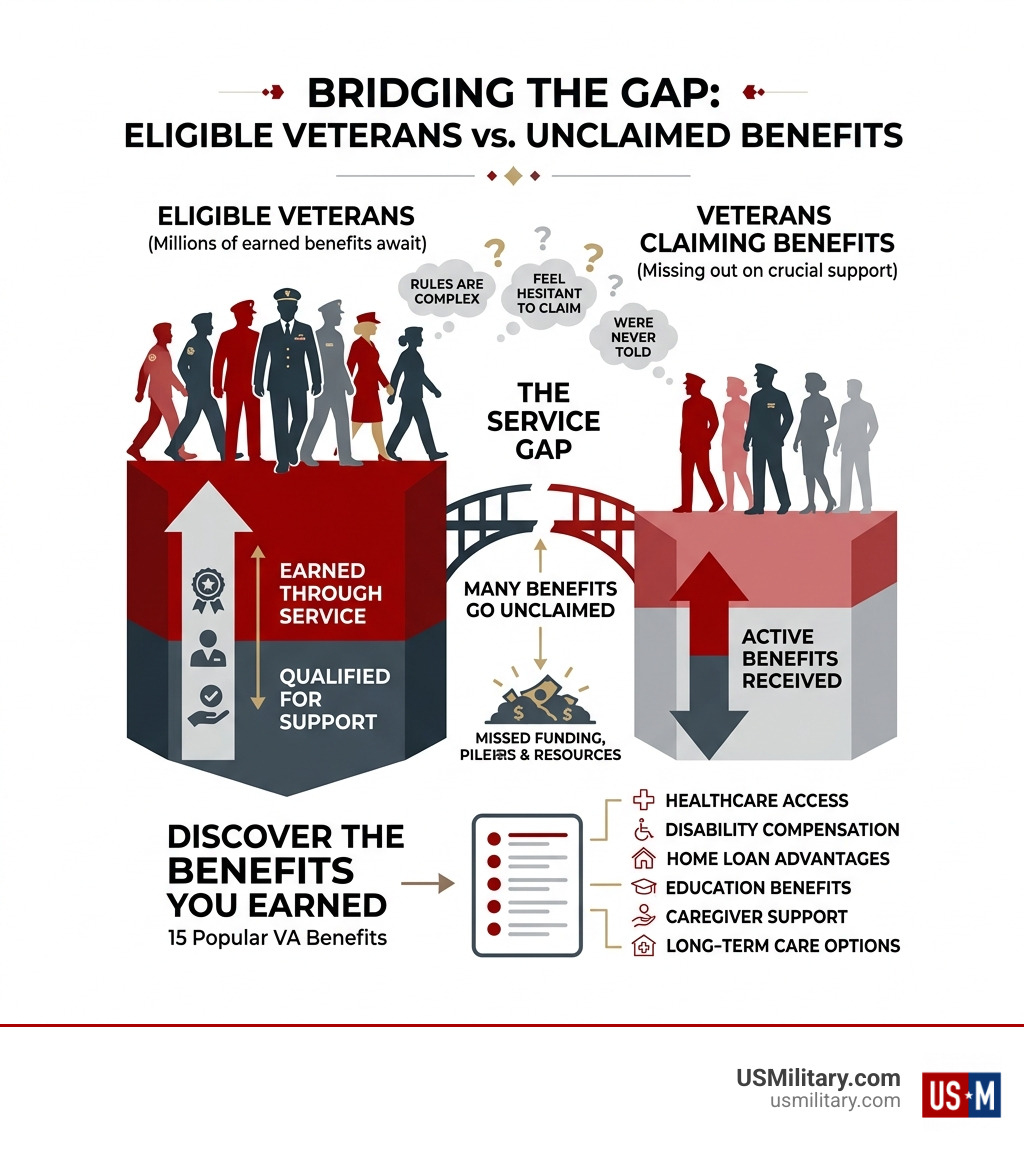
Most Army veterans know about the GI Bill and VA health care. But millions of dollars in earned benefits go unclaimed every year — not because veterans don’t qualify, but because nobody told them these programs exist.
The reasons are straightforward. Veterans tend to be selfless. The rules are complex. And the VA system is large enough that even well-informed veterans miss entire categories of support.
As one VFW deputy director put it, veterans should never feel hesitant about claiming benefits — they earned them through their service.
Whether you separated last year or decades ago, there’s a good chance at least one benefit on this list applies to you right now.
I’m Larry Fowler, publisher of the USArmy.com & USMilitary.com Network since 2007 and a longtime resource on VA disability trends, Aid and Attendance, and the full spectrum of 15 popular VA benefits that most Army veterans forget about. Over nearly two decades, this network has helped hundreds of thousands of veterans and service members cut through the confusion and claim what they’ve earned.
Basic 15 Popular VA Benefits That Most Army Veterans Forget About glossary:
- Veteran Benefits
- In Home Health Care For Viet Nam Vets Paid For By VA
- Will The VA Cover The In Home Care Costs For Wartime Veterans
15 Popular VA Benefits That Most Army Veterans Forget About

Navigating veteran support can feel like reading a manual written in a foreign language. While the Top 10 Va Benefits Worth Joining The Military/ often focus on the big hitters like the GI Bill, there are dozens of smaller, high-impact perks that go unnoticed. These range from financial protections to lifestyle upgrades that can save a family thousands of dollars annually.
According to research, many 7 VA Benefits Often Overlooked by Veterans are missed simply because the “onboarding” process at the time of discharge is overwhelming. By the time an Army veteran is ready to use these perks, they’ve often forgotten the briefing they received in a crowded auditorium years ago.
| Benefit Category | Federal Level | State Level (Examples) |
|---|---|---|
| Recreation | Free National Park Pass | Reduced-fee Fishing Licenses |
| Financial | SCRA Interest Caps | Property Tax Deductions |
| Education | Vocational Training | State Tuition Waivers |
| Family | Caregiver Stipends | Dependent Scholarships |
Why the 15 Popular VA Benefits That Most Army Veterans Forget About Go Unclaimed
The primary culprit is a mix of humility and complexity. Many Army veterans feel that if they weren’t “wounded in combat,” they aren’t entitled to certain perks. This “someone else needs it more” mentality is noble but often results in veterans leaving money on the table that was specifically budgeted for them.
Additionally, the 9 Lesser Known Money-Saving Veteran Benefits You Need to Know often require specific forms that aren’t part of the standard disability claim. If you don’t ask for it specifically, the VA won’t always offer it automatically.
1. Aid and Attendance and Housebound Benefits
This is perhaps the most significant financial benefit for aging veterans or those with chronic conditions. Aid and Attendance (A&A) provides an increased monthly pension amount for veterans who require the assistance of another person to perform activities of daily living (ADLs), such as bathing, dressing, or protecting themselves from the hazards of their daily environment.
For those who are “housebound,” meaning they are substantially confined to their immediate premises due to a permanent disability, a similar pension increase is available. We often see that Top 10 Va Aid And Attendance Benefits/ are overlooked because families assume they only apply to nursing homes. In reality, this money can often be used to pay for in-home care, including care provided by family members in some cases. Understanding How Much Does Va Give For Aid And Attendance/ is crucial for long-term financial planning, as it can provide thousands of dollars in tax-free monthly income.
2. SCRA Interest Rate Reductions
The Servicemembers Civil Relief Act (SCRA) isn’t just for those currently in boots. If you took out a loan before entering active duty, you are entitled to have that interest rate capped at 6% for the duration of your service and, in some cases, for a period shortly after. This applies to credit cards, mortgages, and even student loans. Many Army veterans forget they can retroactively apply for these reductions if they weren’t aware of them while serving.
3. Caregiver Support (PCAFC)
The Program of Comprehensive Assistance for Family Caregivers (PCAFC) is a lifesaver for families. If an Army veteran has a serious injury (a 70% or higher service-connected rating), their primary family caregiver may be eligible for a monthly stipend, training, and mental health counseling.
One of the most valuable parts of this program is that the caregiver may also qualify for CHAMPVA health insurance if they don’t already have coverage. This is a key part of Veterans Aid And Attendance Benefits/ that supports the entire household, not just the veteran.
4. Free Tax Preparation (VITA)
Why pay a commercial tax preparer when the Volunteer Income Tax Assistance (VITA) program offers free help? The Armed Forces Tax Council oversees this program, ensuring that preparers are trained in military-specific tax issues, such as combat zone exclusions and the tax-free status of disability compensation. This service is generally available to those making $75,000 or less, as well as the elderly and those with disabilities.
5. National Park and Museum Access
As of April 2026, all veterans are eligible for a free lifetime “Military Pass” to more than 2,000 federal recreation sites, including National Parks. Additionally, the Blue Star Museums program offers free admission to roughly 2,000 museums, zoos, and aquariums across the United States from Memorial Day through Labor Day. It’s a fantastic way for Army families to reconnect and enjoy the country they served to protect.
6. MWR Recreational Rentals
The Morale, Welfare, and Recreation (MWR) offices on Army installations aren’t just for active-duty soldiers. Many Army veterans retain access to MWR rentals. Need a bouncy castle for a kid’s birthday party? A boat for the weekend? An RV for a cross-country trip? MWR prices are almost always lower than civilian commercial rates. Locations like Pointes West Army Resort offer cabins and camping that provide high-end vacation experiences at a fraction of the cost.
7. Non-College Degree Training
The GI Bill is famous for four-year degrees, but it also covers vocational schools, apprenticeships, and on-the-job training. If you want to become a commercial pilot, a licensed plumber, or an IT specialist through a coding bootcamp (like VET TEC), your benefits can often cover the tuition and provide a housing allowance. There are Five Important Facts About Your Gi Bill/ that every veteran should know, and the flexibility of non-degree training is at the top of that list.
8. VA Home Loan Fee Waivers

Most veterans know about the 0% down payment feature of VA loans. However, many forget that if they have a service-connected disability rating of 10% or higher, the “VA Funding Fee” is completely waived. On a $400,000 home, this can save you over $8,000 upfront. This is one of the most immediate financial wins for any veteran with even a minor service-connected condition.
9. Clothing Allowance
If you use a prosthetic limb, a wheelchair, or take certain skin medications for a service-connected condition that causes wear and tear or permanent stains on your clothing, you may be eligible for an annual clothing allowance. As of 2026, this is a tax-free payment intended to offset the cost of replacing damaged garments. You must submit VA Form 10-8678 by August 1st each year to claim it.
10. Traumatic Injury Protection (TSGLI)
TSGLI provides a one-time, tax-free lump-sum payment to soldiers who suffer a traumatic injury while in service. What many forget is that this is not just for combat injuries. If you were injured in a car accident or a training exercise while on active duty and suffered a severe loss (like sight, hearing, or limb function), you may be entitled to payments ranging from $25,000 to $100,000.
11. Unclaimed Insurance and Funds
Because military families move so often, billions of dollars in “unclaimed funds” sit in state treasuries. This can include forgotten utility deposits, uncashed dividend checks from VA life insurance, or old bank accounts. We recommend checking the National Association of Unclaimed Property Administrators (NAUPA) website and the VA’s own insurance fund database to see if there is money waiting for you.
12. Long-Term Care Options
The VA provides a spectrum of long-term care that many aging Army veterans overlook. This includes:
- Respite Care: Giving family caregivers a much-needed break.
- Adult Day Health Care: A safe place for veterans to socialize during the day.
- Hospice and Palliative Care: Comfort-focused care for those with terminal illnesses.
- Home Health Care: Professional nursing or therapy provided in your own living room.
13. Dependent Education (Chapter 35)
The Survivors’ and Dependents’ Educational Assistance (DEA) program provides monthly stipends to the children and spouses of veterans who are permanently and totally disabled due to a service-connected condition or who died on active duty. This is often used alongside state-specific tuition waivers to make college virtually free for the children of disabled Army veterans.
14. Small Business Preferences
The Office of Small & Disadvantaged Business Utilization (OSDBU) works to ensure that at least 3% of all federal contracting dollars are awarded to veteran-owned small businesses. If you are starting a business, getting certified as a Veteran-Owned Small Business (VOSB) or Service-Disabled Veteran-Owned Small Business (SDVOSB) can give you a massive “leg up” when bidding on government work.
15. Burial and Death Benefits
While not a pleasant topic, the VA offers significant support at the end of life. This includes a free burial in a national cemetery, a government-provided headstone or marker, a burial flag, and a Presidential Memorial Certificate. These benefits can save a grieving family thousands of dollars in funeral expenses.
Common Disability Claims and Presumptive Conditions
Many veterans fail to claim the 15 popular VA benefits that most Army veterans forget about because they don’t realize their current health issues are actually service-connected. Filing for the Top 10 Va Disability Claims 3/ is the first step to unlocking many of the perks listed above.
Tinnitus and Hearing Loss
Tinnitus—a persistent ringing in the ears—is the #1 most claimed VA disability. Because Army life involves constant exposure to gunfire, engines, and explosions, the VA often grants a presumptive 10% rating for recurrent tinnitus. Even if you think your hearing is “fine,” that ringing is a compensable condition. Hearing loss itself is the #3 claim, and the two are often paired together. For more info, see the Top 10 Va Disability Claims 2/.
PACT Act and Toxic Exposures
The PACT Act has fundamentally changed how the VA handles toxic exposures. If you served in certain locations during the Gulf War or post-9/11 eras, conditions like asthma, rhinitis, and many types of cancer are now “presumptive.” This means you don’t have to prove your service caused the illness; you only need to prove you were there. This is one of the 12 Easiest Va Disability Claims Guide 2026/ because the burden of proof has been shifted to the VA.
Secondary Service Connections
If you have a rated disability, it often causes other problems. For example, many veterans with Ptsd Va Disability Rating/ develop sleep apnea. Or, taking NSAIDs for service-connected back pain can lead to GERD (acid reflux). These are called “secondary conditions,” and they can significantly increase your total rating and potentially lead to Tdiu Benefits/ if you are unable to work.
State-Level Perks and Financial Assistance
Beyond federal support, individual states offer incredible benefits that Army veterans often ignore.
Property Tax Deductions and Land Discounts
- Indiana: Offers property tax deductions of up to $38,960 for qualifying wartime veterans aged 62+ with at least a 10% disability.
- Alaska: Provides a one-time 20% discount on the purchase price of state residential or recreational land.
- Texas and Florida: Many veterans with a 100% P&T rating pay zero property taxes on their primary residence.
Check your Va Disability Conditions List 2/ to see how your rating might trigger these state-level savings.
Reduced-Fee Licensing and Emergency Grants
- California: Disabled veterans (50%+) can get hunting and fishing licenses for just $8.13.
- Arizona: The Military Family Relief Fund provides up to $3,000 in emergency assistance for financial hardships.
- New Mexico: Offers free state park passes to veterans with a 50% or higher disability rating.
Filing Success: Overcoming Denials and Using Free Resources
If your Va Claim Denied/, don’t give up. Over 70% of initial claims are often denied or under-rated simply due to missing paperwork. Knowing What To Do If Your Va Disability Claim Is Denied/ is half the battle.
Step-by-Step Guide to the 15 Popular VA Benefits That Most Army Veterans Forget About
- Gather your DD-214: This is the “golden ticket” for all benefits.
- Contact a VSO: Veteran Service Officers (VSOs) provide free assistance. Never pay for someone to file your initial claim.
- Get a Nexus Letter: A medical professional must link your current condition to your service.
- Follow the Va Aid And Attendance Approval Guide/: For pension-based benefits, the paperwork is specific and requires medical evidence of your need for daily help.
- Use 12 Easiest Va Disability Claims Tips/: Focus on well-documented conditions first to establish your “foot in the door” with the VA.
Frequently Asked Questions about 15 Popular VA Benefits That Most Army Veterans Forget About
Can I use my VA Home Loan benefit more than once?
Yes! You can use it multiple times throughout your life. You can even have more than one VA loan at the same time if you have remaining “entitlement.” Additionally, if you have a 10% disability rating, the funding fee is waived every single time you use the benefit.
What is the difference between Aid and Attendance and Housebound benefits?
You cannot receive both at the same time. Aid and Attendance is for those who need help with daily tasks (bathing, dressing). Housebound is for those who are largely confined to their home due to a permanent disability. Generally, Aid and Attendance provides a higher monthly payment.
How do I find unclaimed veteran funds?
Start with the NAUPA website to search for state-level unclaimed property. Then, visit the VA’s Life Insurance search page to see if there are undistributed dividends or policy payments in your name.
Conclusion
At USMilitary.com, our mission is to ensure that no Army veteran leaves their hard-earned benefits behind. Whether it’s securing a higher disability rating or simply grabbing a free pass to a National Park, these programs exist because you stepped up to serve.
As of April 2026, the VA has more resources than ever before to support your transition and your long-term health. Don’t let these 15 popular VA benefits that most Army veterans forget about stay hidden. Take the first step, reach out to a service officer, and Claim Your Earned Benefits Today.