
What the 2027 Military Pay Chart Could Look Like Right Now
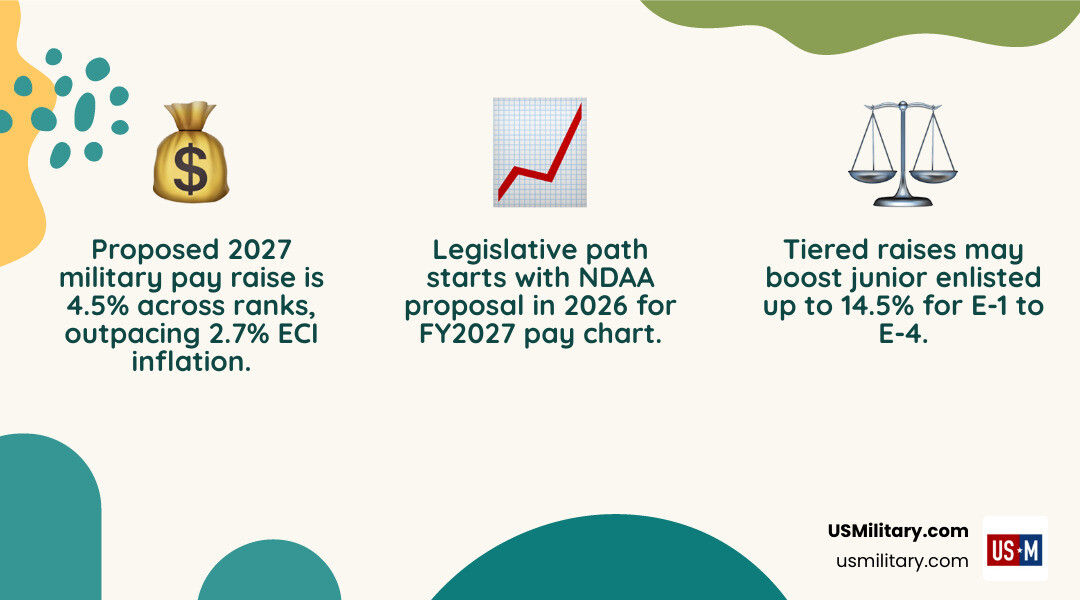
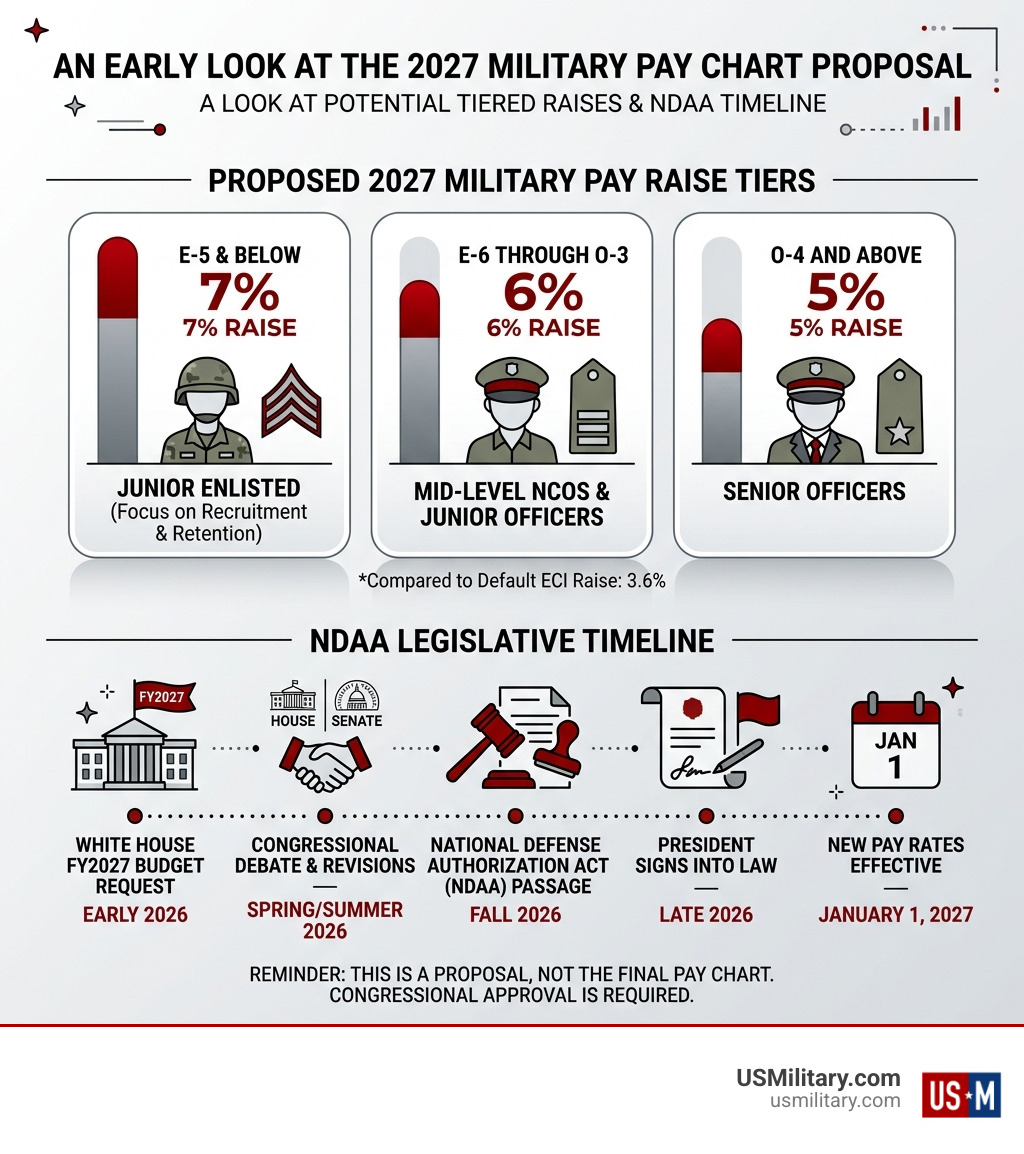
An early look at the 2027 military pay chart shows a proposed tiered raise ranging from 5% to 7%, depending on your rank — and for junior enlisted members, this could be one of the biggest single-year pay increases in over two decades.
Here’s a quick snapshot of what’s on the table:
| Pay Grade | Proposed 2027 Raise | 2026 Monthly Pay (Example) | Projected 2027 Monthly Pay |
|---|---|---|---|
| E-5 and below | 7% | $3,947 (E-5, 4 yrs) | $4,223 (+$276) |
| E-6 through O-3 | 6% | $7,383 (O-3, 4 yrs) | $7,826 (+$443) |
| O-4 and above | 5% | $10,783 (O-6, 12 yrs) | $11,323 (+$540) |
Important: These are proposed figures from the White House FY2027 budget request — not final numbers. Congress must approve the raise through the National Defense Authorization Act (NDAA) before it takes effect on January 1, 2027.
If Congress does not pass a different rate, the default raise based on Employment Cost Index (ECI) data would be 3.6% for all ranks.
The White House proposal is part of a massive $1.5 trillion defense budget request — a 42% increase over current levels — with the higher raises for junior troops aimed directly at improving recruitment and retention.
I’m Larry Fowler, publisher of the USMilitary.com Network since 2007, and I’ve spent nearly two decades tracking military pay trends, VA benefits, and compensation changes that affect active-duty members and veterans alike — including every early look at the military pay chart that has come through Washington. In this guide, I’ll break down everything we know so far about the 2027 pay proposal so you can plan ahead with confidence.
**An Early Look At Thw 2027 Military Pay Chart ** terms at a glance:
The Proposed 2027 Military Pay Raise: Tiered vs. ECI
When we talk about military pay raises, there are usually two competing numbers: the “automatic” raise and the “proposed” raise. For 2027, the gap between these two is significant, and how it settles will determine the thickness of your wallet come next January.
The ECI Baseline: 3.6%
By law (U.S.C. Title 37, §1009), military pay raises are tied to the Employment Cost Index (ECI), which measures the growth of private-sector wages. Based on data released by the Bureau of Labor Statistics on December 10, 2025, the ECI indicates a 3.6% default raise for 2027. This is the “floor”—the raise you would get if the President and Congress did absolutely nothing.
The White House Tiered Proposal: 5% to 7%
However, the White House has released a “skinny” budget proposal that aims much higher. Recognizing the ongoing challenges in recruitment and the rising cost of living for young military families, the administration is proposing a tiered pay raise structure. This is a major shift from the flat-rate increases we’ve seen for most of the last 20 years.
Under this plan:
- 7% Raise: For E-5 and below (Junior Enlisted).
- 6% Raise: For E-6 through O-3 (Mid-level Enlisted and Junior Officers).
- 5% Raise: For O-4 and above (Senior Officers).
Comparison Tables
To see the difference, let’s look at how the 3.6% default compares to the proposed tiered structure.
[TABLE] Projected 3.6% ECI Increase (The “Default” Scenario)
| Pay Grade | 2026 Base Pay (Est.) | 2027 Pay (3.6% Raise) | Monthly Increase |
|---|---|---|---|
| E-2 (<2 yrs) | $2,407 | $2,494 | +$87 |
| E-5 (4 yrs) | $3,947 | $4,089 | +$142 |
| O-3 (4 yrs) | $7,383 | $7,649 | +$266 |
[TABLE] Proposed 5-7% Tiered Raise Scenarios (The White House Plan)
| Pay Grade | 2026 Base Pay (Est.) | 2027 Pay (Tiered %) | Monthly Increase |
|---|---|---|---|
| E-2 (<2 yrs) | $2,407 | $2,575 (7%) | +$168 |
| E-5 (4 yrs) | $3,947 | $4,223 (7%) | +$276 |
| O-3 (4 yrs) | $7,383 | $7,826 (6%) | +$443 |
| O-6 (12 yrs) | $10,783 | $11,322 (5%) | +$539 |
As you can see, the tiered proposal offers a substantial boost over the standard ECI-based increase, especially for those at the start of their careers.
An Early Look At Thw 2027 Military Pay Chart by Rank
Taking an early look at the 2027 military pay chart requires us to project forward from the Military Pay Scale 2025/ and the 3.8% increase approved for 2026. If the tiered 5-7% raise is approved, the jump in basic pay will be the largest single-year increase since 2002.
Junior Enlisted (E-1 to E-5)
This group is the primary focus of the 2027 budget. An E-1 with less than two years of service would see their pay go from approximately $2,407 in 2026 to $2,576 in 2027. For an E-5 with 4 years of service, the monthly paycheck would climb by $276. This is designed to ensure that the lowest-ranking members of the “all-volunteer force” are not living near the poverty line, a concern that has been at the forefront of recent Congressional hearings.
Mid-Level and Junior Officers (E-6 to O-3)
The 6% tier covers the backbone of the military—senior NCOs and company-grade officers. An O-3 (Captain/Lieutenant) with 4 years of service is looking at a significant bump of $443 per month. This tier recognizes that while these members are more financially stable than junior enlisted, they are also the most likely to be “headhunted” by the private sector, making retention raises critical.
Senior Leadership (O-4 and Above)
Senior officers would receive a 5% raise. While this is the lowest percentage of the three tiers, it is still significantly higher than the 3.6% ECI baseline. It’s important to note that very senior officers (O-7 to O-10) may find their raises capped by the Level II Executive Schedule, meaning their actual take-home increase might be lower than 5% if they hit the legal pay limit.
For those planning for the long term, it is also worth checking how these changes might eventually reflect in retirement or disability compensation, such as the Va 100 Disability Pay 2026/ rates, which are adjusted based on similar economic factors.
Understanding the Legislative Path for the 2027 Military Pay Chart
While the White House budget request makes for great headlines, it is only the first step in a long journey. The 2027 military pay chart isn’t official until the President signs the National Defense Authorization Act (NDAA) for Fiscal Year 2027.

The NDAA Timeline
- Spring 2026: The White House submits its formal budget request to Congress.
- Summer 2026: The House and Senate Armed Services Committees draft their own versions of the NDAA. They may agree with the 5-7% tiered raise, or they may propose something different. In 2025, for example, Congress actually pushed for a 14.5% raise for junior enlisted even when the White House proposed a flat rate.
- Fall 2026: The House and Senate must reconcile their differences in a “conference” version of the bill.
- December 2026: The final bill is usually passed and sent to the President’s desk.
- January 1, 2027: The new pay rates officially take effect.
We’ve seen this play out before, such as during the 2024 Military Pay Raise/ cycle, where bipartisan support for troops often leads to the NDAA being one of the few major bills that passes on time every year.
Why an Early Look At Thw 2027 Military Pay Chart Focuses on Junior Enlisted
You might wonder why the administration is suddenly so focused on E-5s and below. The answer is simple: Recruitment. The military has faced one of its toughest recruiting environments in decades. By offering a 7% raise—the highest since the early 2000s—the DoD is trying to make military service more competitive with entry-level civilian jobs.
This focus on financial stability for the “total force” also mirrors trends we see in veteran support, such as the 2025 Va Disability Rates/, which have seen steady increases to keep up with inflation and ensure that those who served are not left behind.
Total Compensation: BAH, BAS, and Beyond
When taking an early look at the 2027 military pay chart, it is easy to focus only on “Base Pay.” However, your base pay is only one part of your total compensation. To get the full picture of your 2027 earnings, you have to look at allowances.
Basic Allowance for Housing (BAH)
BAH is designed to cover 95% of housing costs in your specific geographic area. While the basic pay raise is set by the NDAA, BAH rates are determined by the DoD based on local rental market data. Even if the basic pay raise is 7%, your BAH might go up more or less depending on where you are stationed. One piece of good news: BAH has “rate protection,” meaning if you are already at a duty station and the local rates drop, your allowance stays the same as long as you don’t lose rank or change zip codes.
Basic Allowance for Subsistence (BAS)
BAS is the monthly allowance for food. This rate is adjusted annually based on the USDA’s food cost index. It is separate from the basic pay raise and usually increases by a few percentage points each year to combat grocery store inflation.
The Tax Advantage
While Basic Pay is taxable, BAH and BAS are tax-free. This means a 7% raise in basic pay actually feels like a larger increase in your “civilian equivalent” salary because a huge chunk of your total compensation isn’t touched by the IRS. This is a concept we often discuss when looking at the 2024 Cola Increase Va Disability/ and how non-taxable benefits provide a safety net for the military community.

Calculating Your Take-Home with an Early Look At Thw 2027 Military Pay Chart
Let’s look at a real-world example of how these tiers translate into annual money.
- E-3 (3 years of service): Under the 7% proposal, an E-3 would see an extra $180.90 per month. Over the course of the year, that is $2,170.80 in additional basic pay.
- O-3 (4 years of service): With a 6% raise, this officer would gain $443 per month, or $5,316 annually.
When you add in the projected Va Disability Rates 2026 2/ for those transitioning or in the reserves, the total financial package for the military community in 2027 is looking robust.
Frequently Asked Questions about the 2027 Military Pay Raise
When will the 2027 military pay raise be finalized?
The pay raise is typically finalized in late December 2026. This happens when the President signs the National Defense Authorization Act (NDAA). Once signed, the new rates appear on the Leave and Earnings Statement (LES) for the mid-January 2027 pay period.
How does the 7% raise for junior enlisted compare to previous years?
A 7% raise would be historic. For context, the 2024 raise was 5.2%, and the 2023 raise was 4.6%. You would have to go back to 2002 to find a single-year increase of this magnitude. This aggressive “tiered” approach was first tested in 2025, when junior enlisted received a combined 14.5% boost (a 4.5% general raise plus a 10% targeted increase). The 2027 proposal shows that the government is doubling down on this strategy to solve the recruitment crisis.
Will VA disability rates increase alongside the 2027 pay raise?
VA disability rates do not automatically move with military pay raises, but they are both influenced by the same economic data. VA rates are tied to the Cost of Living Adjustment (COLA), which is based on the Consumer Price Index (CPI-W) and is the same adjustment used for Social Security. While the military pay raise (ECI) and VA COLA are different numbers, they usually trend in the same direction. You can see how this worked in the past by reviewing the 2024 Va Disability Rates/ and comparing them to that year’s active-duty raise.
Conclusion
Taking an early look at the 2027 military pay chart provides a reason for optimism for many service members. With a proposed $1.5 trillion defense budget and a clear focus on the financial well-being of junior troops, the 2027 fiscal year is shaping up to be a landmark year for military compensation.
At USMilitary.com, we are committed to providing you with the most accurate, up-to-date information to help you manage your career and your family’s future. Whether you are active duty, a reservist, or a veteran, understanding these shifts in pay and benefits is the first step toward long-term financial security.
As the NDAA moves through Congress this year, we will be here to update these charts with the final, approved numbers. In the meantime, make sure you know exactly what you’re earning now and how to interpret your benefits. A great place to start is our guide on How to Read the National Guard Pay Chart Without a Secret Decoder Ring.
Stay tuned to USMilitary.com for more updates on the 2027 budget and what it means for your paycheck.