

Military weight standards set the minimum and maximum body composition requirements every service member must meet — both to enlist and to stay in uniform.
Here’s a quick snapshot of the key standards across branches:
| Branch | Male Max Body Fat (17-20) | Female Max Body Fat (17-20) | Key Method |
|---|---|---|---|
| Army | 20% | 28% | Tape test (neck + abdomen) |
| Marine Corps | 18% | 26% | Tape test + PFT/CFT exemption |
| Air Force | 20% | 28% | Height-weight table + tape |
| Navy | 29% (disqualification) | 34% (disqualification) | Height-weight screening + tape |
A few fast facts:
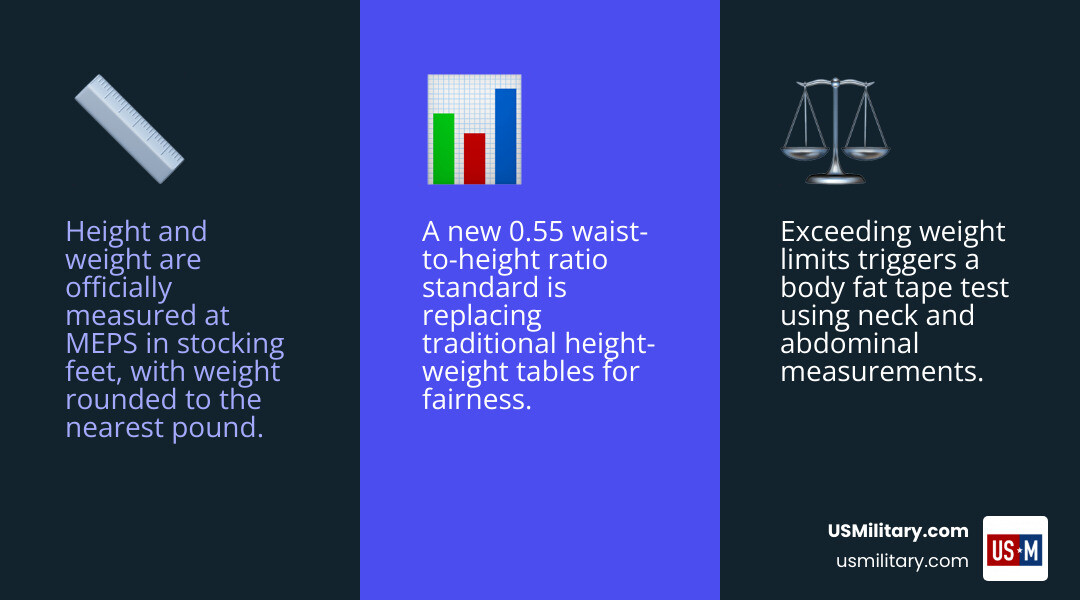
- Height and weight are officially measured at MEPS (Military Entrance Processing Station)
- Weight is recorded to the nearest pound; height is measured in stocking feet
- Exceeding weight limits triggers a body fat tape test — you don’t automatically fail
- Failing body fat standards can mean withheld promotions, transfer blocks, or separation
- A new waist-to-height ratio standard of 0.55 is being introduced to replace traditional height-weight tables
Whether you’re considering enlistment or trying to stay within retention limits, understanding these standards is essential for your military career.
I’m Larry Fowler, publisher of USMilitary.com and a long-time resource for active-duty service members, recruits, and veterans navigating everything from enlistment requirements to VA benefits. Over nearly two decades covering military weight standards and physical readiness policies, I’ve seen how confusing — and career-critical — these rules can be. In this guide, I’ll break it all down in plain language so you know exactly where you stand.
Current Military Weight Standards Across All Branches

When we talk about military weight standards, we aren’t just talking about a number on a scale. We are talking about a fundamental pillar of physical readiness. Each branch of the U.S. Armed Forces—the Army, Navy, Air Force, Marine Corps, and Space Force—maintains its own specific set of rules to ensure that every service member is capable of meeting the intense demands of combat and daily duty.
These standards are generally divided into two categories: accession standards (for joining) and retention standards (for staying in). While the goal is the same—maintaining a fit, capable force—the specific numbers and methods can vary significantly. For example, the Army Height and Weight Standards have historically relied heavily on height-weight tables, whereas the Marine Corps places a massive emphasis on physical performance scores to offset body weight.
According to Scientific research on accession standards, excess body fat is viewed as a detriment to longevity, stamina, and military appearance. However, the military is also evolving. As of May 2026, we are seeing a significant shift toward more scientifically accurate measurements that account for muscle mass and diverse body types.
Army and Air Force Enlistment Requirements
For those looking to join the Army or Air Force, the first hurdle is the initial procurement table. These tables provide the maximum allowable weights based on your height and age.
In the Army, a male recruit aged 17-20 who stands 70 inches tall has a maximum enlistment weight of 180 lbs. For a female recruit in the same age bracket at 65 inches tall, the maximum is 150 lbs. It is important to note that these requirements are strictly enforced at MEPS. When you step on that scale, your height is measured in stocking feet with your chin parallel to the floor.
The Air Force has moved toward gender-neutral weight tables for enlistment. For instance, regardless of gender, a recruit standing 60 inches tall has a minimum weight of 97 lbs and a maximum of 141 lbs. If you exceed these numbers, don’t panic—you’ll likely move to a body fat measurement to see if you still qualify. You can find more details on Army Weight Standards to see where you fall on the current charts.
Navy and Marine Corps Body Composition Standards
The Navy and Marine Corps operate with a “screen then tape” philosophy. The Navy uses screening tables that, if exceeded, trigger a body fat measurement. For Navy applicants, the disqualification thresholds are generally 29% body fat for males and 34% for females.
The Marine Corps is widely considered to have the strictest military weight standards. Under MCO 6110.3A Directives, Marines must stay within very tight body fat percentages (18-21% for males and 26-29% for females, depending on age). However, the Corps offers a unique “performance exemption.” If you are a powerhouse on your Physical Fitness Test (PFT) and Combat Fitness Test (CFT), the Marine Corps is much more forgiving of what the scale says.
How Body Composition and Body Fat Percentages are Measured
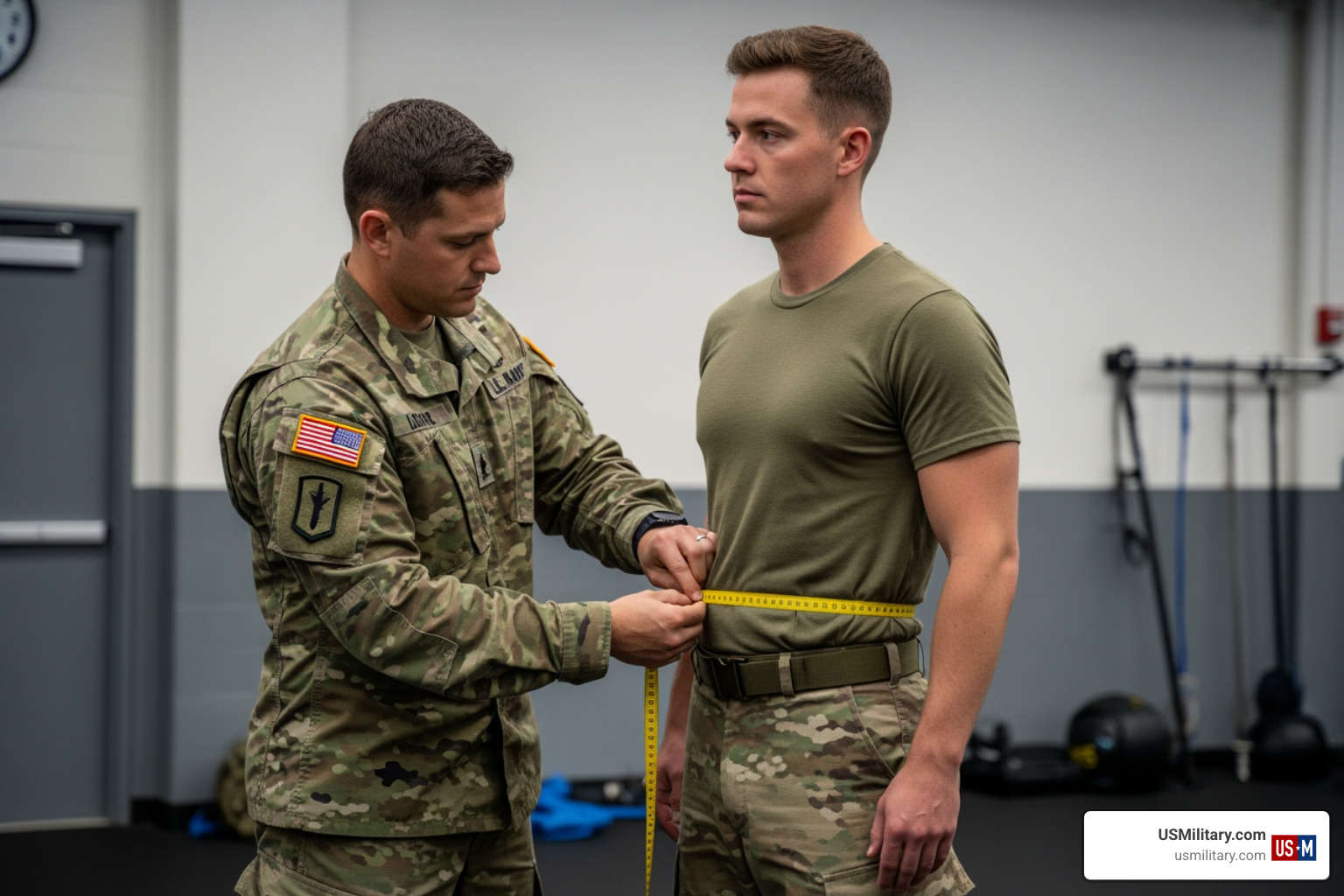
If you exceed the weight on the height-weight table, the military uses the “tape test” to estimate your body fat percentage. While there are more high-tech ways to measure body fat (like DEXA scans or water displacement), the circumference method remains the standard because it is fast, inexpensive, and can be done anywhere in the world.
The tape test uses specific anatomical landmarks. For males, the focus is usually on the neck and the abdomen (at the navel). For females, measurements traditionally include the neck, waist, and hips. These measurements are then plugged into a formula to estimate body fat. According to Research on retention standards, the Army’s goal for retention is to ensure soldiers present a “trim military appearance” and can handle the rigors of the field.
| Age Group | Male Max Body Fat | Female Max Body Fat |
|---|---|---|
| 17-20 | 20% | 30% |
| 21-27 | 22% | 32% |
| 28-39 | 24% | 34% |
| 40+ | 26% | 36% |
(Note: These percentages are for Army retention; enlistment standards allow for slightly higher percentages in some cases.)
The Shift to the 0.55 Waist-to-Height Ratio
As we move through 2026, a major change is taking hold across the services. Many experts argued that the old tape test penalized muscular individuals (the “bodybuilder” problem) or those with certain ethnic body types. To fix this, the military is transitioning toward a waist-to-height ratio.
The new standard is simple: your waist circumference divided by your height should be less than 0.55. This method is seen as much fairer because it focuses on central adiposity (belly fat), which is the primary indicator of health risks, rather than just overall bulk. This shift, highlighted in the US Army Height and Weight Standards (2026), aims to remove the “BMI bias” that has frustrated many high-performing soldiers for years.
Official Measurement Procedures at MEPS
When you go to MEPS, the environment is formal and the rules are precise. Here is how we ensure the measurements are accurate:
- Height: Taken in stocking feet on a flat surface. You must stand straight but not rigid, with your chin parallel to the floor. Measurements are typically rounded to the nearest half-inch or inch depending on the specific branch rule.
- Weight: Recorded to the nearest pound. Most MEPS stations prefer morning measurements before you’ve had a heavy meal.
- Tape: If you are taped, the measurer uses a non-stretchable fiberglass tape. They will take three measurements and average them to ensure accuracy.
Consequences of Failing to Meet Military Weight Standards
Failing to meet military weight standards isn’t just a blow to your pride; it can have serious career consequences. In the Army, if you exceed body fat standards, you are placed in the Army Body Composition Program (ABCP).
Once enrolled in ABCP, you aren’t just left to figure it out on your own. You receive nutrition counseling and a structured physical fitness plan. The goal is a safe, sustainable weight loss of 3 to 8 pounds per month. You are measured every 30 days to track your progress. As noted in the Army Height and Weight Standards 2025, failure to show progress can lead to serious administrative action.
Impact on Career and Promotion
Being “flagged” for weight is a major roadblock. While you are in a weight control program:
- Promotions are withheld: You cannot pick up your next rank until you are back in standards.
- Schooling is restricted: You are ineligible for professional military education (PME) or specialized schools like Airborne or Air Assault.
- Transfer blocks: You may be barred from certain assignments or reenlistment.
- Administrative Separation: If you fail to meet the standards over a set period (usually several months of no progress), the military may initiate a “Chapter” to separate you from service.
Waivers and the Future Soldier Preparatory Course
We know that not everyone is at their peak fitness level the day they decide to join. To help, the Army launched the Future Soldier Preparatory Course. This is a 90-day “pre-basic” track that allows recruits who are slightly over the body fat limit to focus on nutrition and fitness before they start Basic Combat Training.
There are also medical waivers available on a case-by-case basis. If a soldier has a documented medical condition or is on medication that affects weight, temporary exceptions can be granted. However, these are rarely permanent. For those in ROTC, the stakes are also high; scholarship cadets risk losing their funding if they consistently fail to meet Eligibility & Requirements to Join.
Integration of Fitness Testing and Military Weight Standards
In the modern military, weight is no longer looked at in a vacuum. It is increasingly tied to how well you can actually perform your job. We call this “functional fitness.” The Army Combat Fitness Test (ACFT) and the Marine Corps PFT/CFT are now central to how body composition is judged.
The logic is simple: if you can carry a 100-pound ruck for 12 miles and max out your deadlift, does it really matter if your BMI is a little high? The military is starting to say “no.”
Performance-Based Exemptions
The Marine Corps leads the way here. If a Marine scores a 285 or higher on both the PFT and CFT, they are completely exempt from weight and body fat standards. They are essentially “too fit to fail.” Even a score of 250+ grants a 1% body fat “buffer.” This rewards the “tactical athlete” and ensures that muscular, high-performing Marines aren’t penalized for having a thick build.
The Role of the ACFT and PT Tests
The Army is also looking at how ACFT scores can influence body composition assessments. There have been ongoing discussions about allowing high ACFT scores to waive the need for a tape test. This acknowledges that the strength-to-weight ratio is a better predictor of combat readiness than a simple waist measurement. If you want to dive deeper into how these scores interact, check out more info about Army weight standards.
Frequently Asked Questions about Military Weight Standards
What happens if I fail the tape test?
If you fail the tape test, you will be officially “flagged.” This means you’ll be enrolled in a weight control program (like the ABCP). You’ll receive mandatory counseling, meet with a nutritionist, and have monthly weigh-ins to track your progress. Your career stays on hold until you meet the standards for two consecutive months.
Can I join the military if I am over the maximum weight?
Yes, potentially. If you are over the weight on the chart but pass the body fat tape test, you can enlist. If you fail both, you may be eligible for the Future Soldier Preparatory Course, which gives you 90 days to get within standards. Recruiter waivers are also possible for exceptional candidates, though they are harder to get for weight than for other issues.
How often are military weight measurements taken?
At a minimum, you will be measured twice a year, usually in conjunction with your physical fitness test. However, commanders have the authority to direct a weigh-in at any time if a service member’s appearance suggests they are out of standards.
Conclusion
At USMilitary.com, we believe that staying informed is the best way to protect your career. Military weight standards are not meant to be a punishment; they are a tool to ensure physical excellence and long-term health for the men and women who defend our nation.
Whether you are a recruit preparing for MEPS or a seasoned NCO looking to stay within the 0.55 waist-to-height ratio, maintaining your fitness is a full-time job. By understanding these rules—and the performance-based exemptions available to you—you can ensure that you remain “Fit to Fight.” For more resources on navigating your service, visit our Army weight standards page for the latest updates and guidance.