
Is There an Age Limit to Join the U.S. Army?

If you’re researching the army apply age requirements, here’s the quick answer:
| Path | Minimum Age | Maximum Age |
|---|---|---|
| Enlisted Soldier | 17 (parental consent) / 18 | 42 |
| Army Officer | 18 | Under 31 at commissioning |
| Army National Guard / Reserve | 17 | 42 |
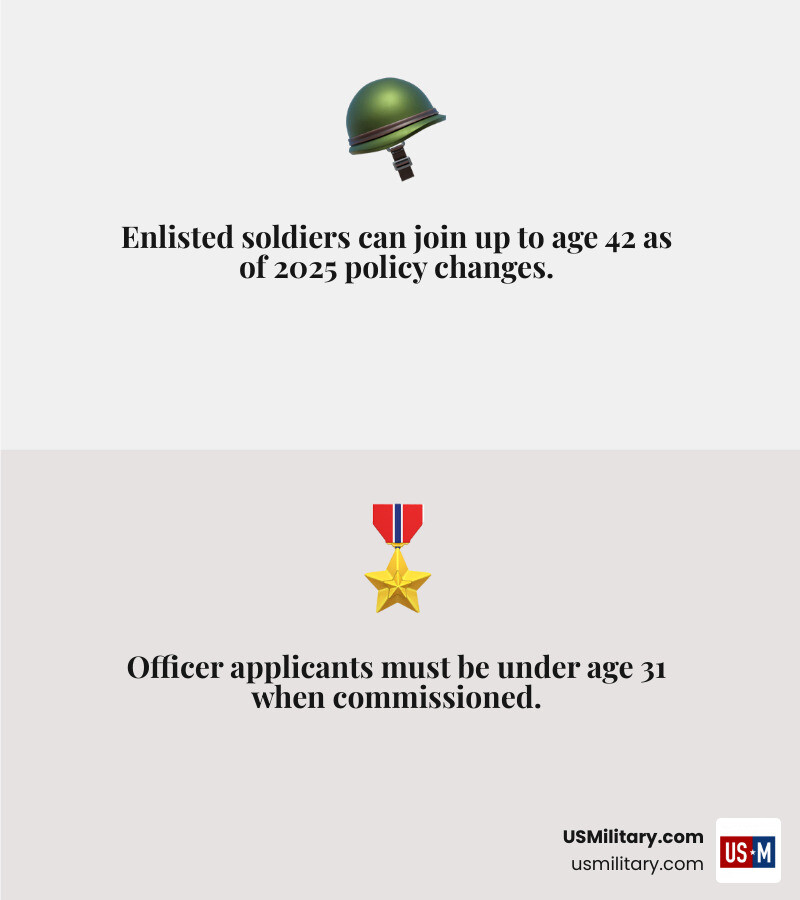
As of 2025, the U.S. Army raised its maximum enlistment age from 35 to 42, bringing it in line with the Air Force and Space Force.
Thinking you might be too old to serve is one of the most common reasons people never talk to a recruiter. But the window is wider than most people think.
Whether you’re 19 or 41, there’s a real path into the Army — if you know the rules. This guide breaks down every age limit, recent policy change, waiver option, and supporting requirement you need to understand before you apply in 2026.
I’m Larry Fowler, publisher of the USMilitary.com Network since 2007, and I’ve spent nearly two decades helping thousands of potential recruits understand exactly where they stand on army apply age requirements. If you’re wondering whether your age disqualifies you, keep reading — the answer may surprise you.
Army apply age word list:
Current Army Application Age Limits for 2026
For 2026, the Army’s age rules are clearer than they were a few years ago:
- Enlisted Army applicants can generally join from age 17 to 42
- Applicants who are 17 need parental consent
- Applicants who are 18 or older can apply on their own
- Officer candidates must generally accept their commission before age 31
That means if you are 42 and otherwise qualified, you may still be eligible to enlist. If you are 43 and have no qualifying exception, the answer is usually no for standard enlisted entry.
The biggest recent change is the increase in the enlisted age cap. The Army moved from a long-standing maximum of 35 to 42, a policy shift covered in this report on the Army’s age increase and discussed further in our own An Essential Guide to Military Age Limits.

A simple way to think about army’s application age is this:
- 17 to 42 for enlisted service
- under 31 for most new officers
- same general enlisted cap of 42 for Army Reserve and Army National Guard paths
Age alone does not qualify you, of course. It just gets you through the first gate. The Army will still look at your citizenship or residency, education, test scores, medical history, fitness, conduct record, and job eligibility.
Understanding the Army Application Age for Officers
Officer age rules are stricter than enlisted rules.
For most Army officer paths, you must be able to accept your commission before age 31. That is the key phrase: before age 31 at commissioning, not just when you first speak to a recruiter.
So if you are 30 and exploring Officer Candidate School, ROTC, or another commissioning path, timing matters a lot. You may still be eligible, but your paperwork, selection, and commissioning timeline have to line up correctly.
This is one area where applicants get tripped up. Someone may technically be eligible when they start the process, then age out before commissioning if they wait too long. That is why it helps to review our related guide, Beyond the Birthday: Unpacking Military Enlistment Age Requirements.
In practical terms:
- Enlisted entry has a wider age window
- Officer entry usually closes much earlier
- Specialized officer fields may have different rules, but those are case-specific and should be discussed directly with a recruiter
If your goal is simply to serve in uniform, enlisted service often gives older applicants the more realistic entry path.
Recent Policy Changes and Rationale
The Army’s age cap did not always sit at 42.
Historically, the Army previously raised the age cap during the Iraq and Afghanistan era, then later lowered it back to 35. The modern change came back in 2025, with the update taking effect for the current recruiting environment. Reporting on the change made clear that the move was tied to recruiting needs and labor-market realities, not to short-term overseas events. See this coverage of the policy rationale.
Why raise the cap?
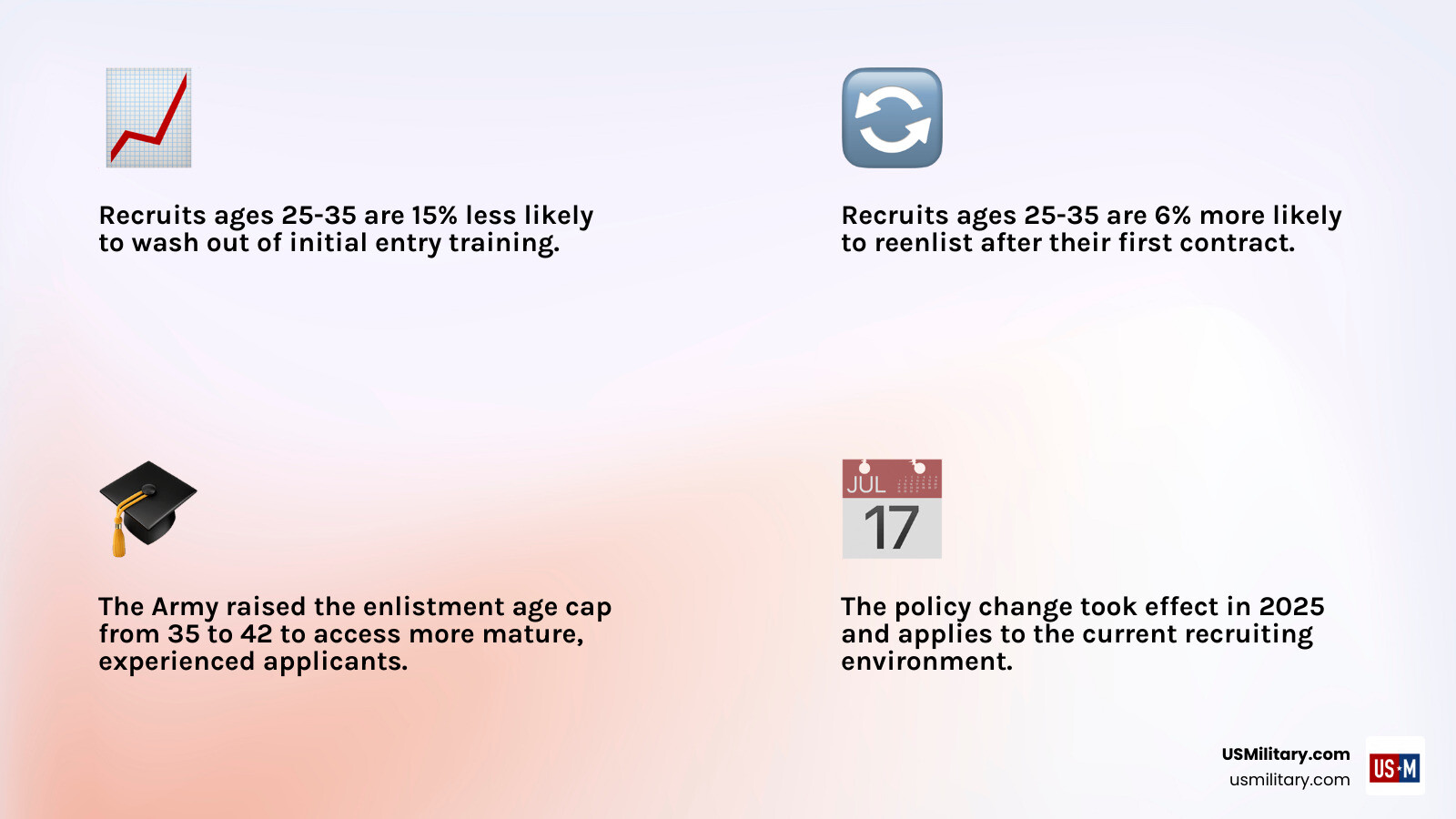
Research cited in reporting found that recruits ages 25 to 35 were:
- about 15% less likely to wash out of initial entry training
- about 6% more likely to reenlist after their first contract
Older recruits also tend to bring more work experience, maturity, and often stronger enlistment test performance. In other words, the Army did not just open the door wider for kindness points. It did so because older applicants can be good bets.
Comparing the Army to Other Military Branches
If you’re trying to decide whether the Army is your best fit, it helps to compare branch age limits side by side.
| Branch | Minimum Age | Maximum Enlisted Age |
|---|---|---|
| Army | 17 | 42 |
| Air Force | 17 | 42 |
| Space Force | 17 | 42 |
| Navy | 17 | 41 |
| Marine Corps | 17 | 28 |
As of 2026, that puts the Army near the top of the pack for older enlisted applicants. Only the Air Force and Space Force match the Army’s 42-year cap based on the research provided here. The Navy sits just behind at 41, and the Marine Corps remains much lower at 28.
If you are comparing options, these related guides may help:
What this means in plain English:
- If you’re in your late 30s or early 40s, the Army is one of the best active-duty options
- If you’re 29 or older, the Marine Corps is usually the toughest fit
- If you’re 42, your choices are much narrower, but the Army remains in play
How the Army Apply Age Compares to the British Army
For U.S. readers, foreign military rules are mostly just interesting comparison points, but they help show how different age policies can be.
Based on the research provided:
- British Army Regular Soldiers can join at 16
- British Army Regular Officers must be at least 18
- British Army Regular Soldier applicants generally must enlist before their 36th birthday
- British Army Reservist Soldiers can apply up to 42 years and 6 months, and join by age 43
Compared with the U.S. Army:
- The U.S. Army starts enlisted service later at 17
- The U.S. Army allows active-duty enlisted service up to 42, which is notably more generous than the British Army’s regular soldier cap
- The British Army reserve side is closer to the U.S. Army Reserve age window
The British system also allows applications to begin younger and uses different assessment and parental consent rules. For our purposes, though, the key takeaway is simple: the current U.S. Army is relatively open to older enlisted applicants.
Waivers and Exceptions for Older Applicants
The next question people ask is usually: “What if I’m older than the listed maximum?”
Sometimes there are exceptions, but you should treat them as exceptions, not guarantees.
The Army notes that some restrictions may be lifted based on service needs, and age waivers are especially relevant in certain situations, including prior service. The official regulatory framework in AR 601-210 governs enlistment standards for the Regular Army and reserve components.
In real life, waivers are more likely when:
- you have prior military service
- you bring a needed skill set
- your age can be reconciled with service timelines
- you otherwise meet all physical, medical, and conduct requirements
What waivers do not mean:
- they do not erase every rule
- they do not guarantee acceptance
- they do not override retirement and training realities
If you are close to the age cap or slightly over, talk to a recruiter early. Waiting until your next birthday is not a winning strategy. Birthdays are fun, but not when they close your application window.
For more context, see our guide on Army Reserve age waivers and reporting on the Army’s broader recruiting changes.
Prior Service vs. Non-Prior Service Rules
Prior service applicants often get a little more flexibility than non-prior service applicants.
That is because the Army may consider factors such as:
- total years already served
- length of break in service
- the applicant’s adjusted age for eligibility purposes
- how much time remains before mandatory retirement thresholds
The regulation specifically distinguishes between non-prior service and prior service age eligibility. In practice, this means a former service member may have options that a first-time applicant of the same age does not.
Examples of how this can matter:
- A 41-year-old non-prior service applicant might still be eligible under the current cap, but time is tight
- A 43-year-old prior service applicant might be considered differently depending on prior service history and current Army needs
- An applicant with a long service break may face different treatment than someone leaving another component more recently
The main point is this: prior service is not a magic key, but it can improve the odds of an exception.
National Guard and Army Reserve Age Limits
For the Army National Guard and Army Reserve, the general age range in this article’s research is 17 to 42.
That makes these part-time or component-based paths attractive for applicants who:
- want to serve while keeping a civilian career
- need more geographic stability
- are exploring service later in life
- may be better suited to reserve component opportunities than full active duty
The same age cap does not mean the process is identical. Component needs, job openings, prior service history, and waiver practices can vary. Still, the broad answer for 2026 is that the Army National Guard and Army Reserve generally use the same top-end age benchmark of 42 for new enlisted applicants.
For broader reading, see:
- Beyond Active Duty: Age Limits for Joining the National Guard & Reserves
- Can You Join the Army Reserve After 35? The Age Breakdown
- National Guard Age Limit Guide
Beyond Age: Other Eligibility Requirements
Age is only one piece of the puzzle. You can be 28, 38, or 42 and still be disqualified for reasons that have nothing to do with your birthday.
The Army also looks at:
- citizenship or lawful permanent residency
- education level
- ASVAB performance
- medical status
- height and weight standards
- physical fitness readiness
- criminal and moral history
- dependency and administrative factors in some cases
At a high level, the Army states that applicants generally must be U.S. citizens or permanent residents with a valid Green Card. Serving can also help eligible permanent residents move faster toward citizenship. The government’s broader summary page, Requirements to join the U.S. military, gives a useful overview, while the Army’s own page, Eligibility & Requirements to Join, provides the Army-specific baseline.
Physical and Medical Standards
Even with the higher army apply age cap, older applicants still must meet the same basic accession standards.
That includes medical screening and body-composition requirements. The Army reviews height and weight by age and gender, and if an applicant is over screening weight, body-fat standards may apply instead. The research provided includes examples showing how these charts work by age group, such as maximum listed weights at certain heights for younger men and women.
Medical issues that often come up include:
- asthma
- hearing loss
- vision problems
- ADHD
- prior injuries
- body composition concerns
Some conditions may be disqualifying only in specific circumstances. For example:
- asthma is generally a bigger issue if diagnosed after your 13th birthday
- ADHD may still be compatible with service depending on recent treatment history and current functioning
- some vision or hearing issues may be waiverable
- obesity by itself is not always the end of the road if standards can be met before shipping
Useful related reading:
- Can You Join the Military if I am Obese?
- Can You Join the Military if I Suffer from ADHD?
- Eligibility & Requirements to Join | U.S. Army
Tattoo policy is another common worry. The Army allows many tattoos, but there are still restrictions on certain locations and visibility. Some highly visible placements are limited, while tattoos on places like the eyelids, inside the mouth, or ears are generally not allowed.
Bottom line: being older does not lower the standard. It just means you need to arrive prepared.
Education and Conduct Standards
The Army also expects basic educational qualification.
In general:
- a high school diploma is the cleanest path
- GED holders may still qualify, sometimes with additional conditions
- ASVAB performance matters for eligibility and job selection
The research indicates that the Army may consider waivers in some academic cases and that the Future Soldier Preparatory Course can help some applicants who are close but not yet ready. For example, those with lower qualifying scores may have an academic track available if they meet minimum thresholds.
Conduct standards matter too. Serious legal issues can disqualify applicants, and some offenses are far harder to waive than others. The Army has also recently relaxed one small part of its policy: a single marijuana possession conviction or a single drug paraphernalia possession conviction may no longer require the same waiver treatment that used to apply. More serious drug or criminal histories can still create major barriers.
That means the smart move is to be upfront with a recruiter. Hidden issues almost always age worse than fine milk left in a hot car.
Frequently Asked Questions about Army Apply Age
Can I join the Army at age 42?
Yes, in many cases you can, as long as you meet all other requirements and are able to complete enlistment processing within the eligibility window. The current enlisted cap is 42. If you are already past 42, you would usually need a valid exception or waiver scenario, most commonly involving prior service.
What is the maximum age to become an Army Officer?
For most standard officer accession paths, you must accept your commission before age 31. If you are close to that age, start immediately because the timeline matters just as much as the number.
For more on officer-specific age rules, see Too Old to Lead? Decoding Officer Age Requirements.
Are age waivers available for the Army National Guard?
They can be, depending on the applicant’s background, component needs, and whether the person has prior service. However, waivers are not automatic. The general National Guard enlisted age cap in the research is 42, and exceptions beyond that should be discussed directly with a recruiter.
Conclusion
The short answer to the army’s application age is reassuring: for enlisted service in 2026, it is not “too late” until you pass the current Army window, which now reaches 42 for many applicants. For officers, the timeline is tighter, with commissioning generally required before age 31.
Just remember that age is only the start. You still need to satisfy citizenship, education, medical, physical, and conduct standards. If you are close to the cutoff or think you may need a waiver, the best next step is to talk with a recruiter sooner rather than later.
At USMilitary.com, we help break down military requirements in plain English so you can make smart decisions about service, benefits, and long-term career planning. If you’re ready to go deeper, start your journey by reviewing the full requirements to join the Army.