
Why Comparing Veterans United VA Loans to Other Leading VA Loan Lenders Matters for Your Home Purchase

Comparing Veterans United VA Loans to other leading VA loan lenders is one of the most important steps any eligible veteran, service member, or military spouse can take before applying for a home loan. The right lender can save you thousands of dollars — and the wrong one can cost you approvals, time, and money.
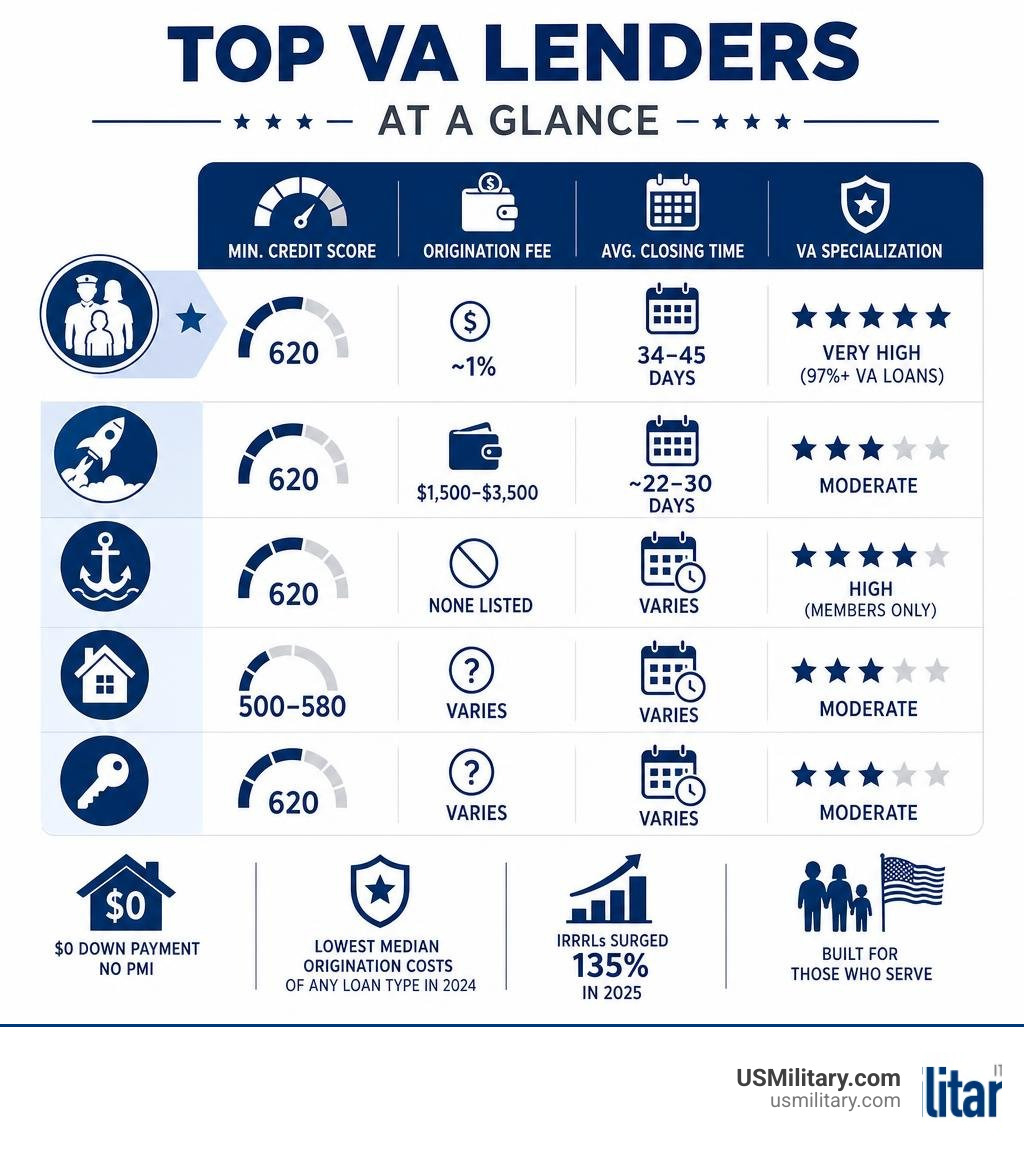
Here is a quick side-by-side snapshot of the top VA lenders to address what most people want to know right away:
| Lender | Min. Credit Score | Origination Fee | Avg. Closing Time | VA Specialization |
|---|---|---|---|---|
| Veterans United | 620 | ~1% | 34-45 days | Very High (97%+ VA loans) |
| Rocket Mortgage | 620 | $1,500-$3,500 | ~22-30 days | Moderate |
| Navy Federal CU | 620 | None listed | Varies | High (members only) |
| New American Funding | 500-580 | Varies | Varies | Moderate |
| loanDepot | 620 | Varies | Varies | Moderate |
Key facts at a glance:
- VA loans require $0 down payment and no private mortgage insurance (PMI)
- Veterans United has been the #1 VA purchase lender for 10 consecutive years (2016-2025)
- VA loans had the lowest median origination costs of any loan type in 2024
- IRRRLs (VA streamline refinances) surged 135% in 2025, making lender selection more critical than ever
The lender you choose affects your interest rate, how smoothly the process goes, and whether edge cases — like deployment status or credit challenges — get handled properly.
I’m Larry Fowler, publisher of the USMilitary.com Network since 2007, and I’ve spent nearly two decades helping active-duty members and veterans navigate VA benefits, including comparing Veterans United VA Loans to other leading VA loan lenders. In this guide, I’ll walk you through everything you need to make a confident, informed decision.
Comparing Veteran United VA Loans To Other Leading VA Loan Lenders: Key Differences
When we look at the broader landscape of military home financing, the differences between top lenders come down to business structure, target audience, and underwriting philosophy.
Veterans United operates primarily as a retail lender specializing almost exclusively in VA loans. Over 97% of the mortgages they close are VA loans. This focus allows their loan officers to understand the complex rules of the Department of Veterans Affairs inside and out.
On the other hand, a giant like Rocket Mortgage is a generalist. They originated over 464,000 loans worth $127.58 billion in 2022, making them the largest mortgage lender overall. However, because they handle FHA, conventional, USDA, and jumbo loans in massive quantities, their staff may not have the same singular focus on military-specific guidelines.
Navy Federal Credit Union operates as a member-owned financial institution. They offer highly competitive rates but restrict membership to military members, veterans, and their families. Meanwhile, lenders like New American Funding and loanDepot offer flexible credit guidelines but feature varying fee structures that require careful comparison.
To see how these options stack up and to explore more choices, you can Find & Compare the Nation’s Top 10 VA Lenders for 2026 – VA Loans to find the right match for your financial situation.
Underwriting Expertise and Military-Focused Support
Because VA loans are government-backed, they involve unique underwriting guidelines. For instance, the VA requires a “residual income” calculation to ensure veterans have enough money left over after paying their mortgage for daily living expenses like food and utilities.
A specialized lender like Veterans United excels here. They employ former senior enlisted members from every branch of the military to act as advisors. These advisors understand military pay structures, including Basic Allowance for Housing (BAH), Basic Allowance for Subsistence (BAS), and how hazard pay or upcoming deployments impact a borrower’s file.
Generalist lenders often run into bottlenecks when analyzing military income or handling complex property issues, such as VA-specific appraisal requirements. To learn more about how their customer service team operates, read our detailed Veterans United Home Loans Review.
Comparing Veteran United VA Loans To Other Leading VA Loan Lenders on Rates and Fees
VA loans generally offer the lowest average interest rates on the market compared to conventional, USDA, and FHA loans. However, individual lenders still set their own interest rates and fee structures.
For example, Veterans United typically charges a standard 1% origination fee. Rocket Mortgage may charge flat fees ranging from $1,500 to $3,500 depending on the size of the loan, while Navy Federal Credit Union is known for offering zero-lender-fee options to its members.
According to 2024 HMDA data, VA loans had the lowest median origination cost on the market, with conventional loans coming in 91.53% higher and FHA loans a staggering 204% higher. However, to maximize these savings, you must shop around. If you want to understand how minor interest rate fluctuations impact your long-term wealth, check out our guide on Rate Your Ride What to Know About VA Loan Interest.
Comparing Veteran United VA Loans To Other Leading VA Loan Lenders on Credit and Closing Timelines
The Department of Veterans Affairs does not set a minimum credit score requirement for VA loans. Instead, individual lenders set their own “overlays” (internal rules).
- Veterans United and Rocket Mortgage both enforce a minimum credit score of 620.
- New American Funding offers more flexibility, occasionally accepting credit scores as low as 500 to 580.
- Wholesale Brokers working with lenders like United Wholesale Mortgage (UWM) can often secure approvals down to 580 or even 500 with automated underwriting.
Closing times also vary. Rocket Mortgage averages a fast 22 to 30 days to close due to its highly digitized platform. Veterans United averages 34 to 45 days, which is standard for the industry but slightly slower than pure digital players. For a complete breakdown of what you need to qualify this year, see the 2026 VA Home Loan Requirements.
Special Programs and Unique Lender Features

Beyond interest rates and fees, some lenders offer proprietary programs that can make or break your homebuying experience. When comparing Veteran United VA Loans to other leading VA loan lenders, these value-added programs are where Veterans United separates itself from the pack.
To see a direct comparison of how these specialized programs stack up against a digital giant, check out Rocket Mortgage vs. Veterans United: Which One Is Best? – HSH.com. To explore these tools directly on the lender’s portal, visit Veterans United Home Loans | #1 VA Lender for Homebuyers.
Credit Counseling and Score Improvement
One of Veterans United’s standout features is the Lighthouse Credit Counseling Program. If you apply for a loan and your credit score falls below their 620 requirement, they do not simply deny your application. Instead, they refer you to a free, one-on-one credit specialist.
The Lighthouse team works with you to develop a personalized plan to dispute errors, pay down debts, and improve your credit. On average, graduates of the Lighthouse program see their credit scores increase by 40 to 60 points within three to six months. This service is completely free, with no obligation to use Veterans United for your mortgage once you qualify. To see how these requirements fit into your overall eligibility, read up on VA Home Loan Qualifications.
Specialized VA Loan Products
Veterans United also offers specialized loan types that general lenders often avoid due to underwriting complexity:
- VA Energy-Efficient Mortgages (EEMs): This program allows you to add up to $6,000 to your home purchase loan to fund energy-efficient upgrades, such as solar panels, insulation, or storm windows.
- VA Jumbo Loans: For high-cost areas, Veterans United offers jumbo VA loans with competitive terms and no down payment, even for loan amounts exceeding conforming limits.
- Alternative Properties: While many general lenders refuse to finance manufactured or mobile homes with a VA loan, specialized lenders are much more equipped to handle them. For details on how to finance these properties, check out our guide on the VA Loan for Mobile Home.
Pros and Cons of Veterans United vs. Competitors

No single lender is perfect for every military borrower. To help you weigh your options objectively, let’s look at the advantages and disadvantages of choosing Veterans United over other top-tier options. For a broader look at the market, visit our comprehensive review of the Best VA Home Loan Lenders.
Advantages of Veterans United
- Unmatched Specialization: Because nearly their entire business is dedicated to VA loans, their team handles complicated files with ease.
- 24/7 Support: They offer round-the-clock phone support, which is a massive benefit for active-duty service members stationed overseas or in different time zones.
- Dedicated Service Teams: Every borrower is assigned a three-person team (a loan officer, a real estate agent from their partner network, and a transaction coordinator) to guide them from pre-approval to closing.
- Strong Customer Satisfaction: They maintain a 4.9/5 rating on Trustpilot and high J.D. Power customer satisfaction scores. For real-world feedback from other military families, read our Honest Unpaid Top 7 VA Home Loan Lender Reviews.
Disadvantages and Alternatives
- Strict Credit Overlays: Their hard 620 minimum credit score limit can block borrowers who might otherwise qualify with a more flexible lender like New American Funding or through a wholesale broker.
- Higher Origination Fees: Their standard 1% origination fee can make their closing costs higher than lenders like Navy Federal, which does not charge lender fees.
- Fewer Non-VA Products: If you decide a VA loan isn’t right for you and want a HELOC or a specialized conventional product, Veterans United has limited options compared to a full-service bank. To compare other top-rated specialists, check out the Top 7 VA Home Loan Lenders.
Choosing the Best Lender for Your Borrower Profile
Your ideal lender depends heavily on your financial profile, your location, and your service status. To help you choose, we have broken down the best options for different borrower profiles. For active-duty members looking for tailored solutions, start with our guide on the Top 5 Military Home Loans for Active Duty Service Members.
Best for First-Time Buyers and Credit-Challenged Veterans
If you are buying a home for the first time or struggling with a credit score below 620, Veterans United is an excellent starting point. Their educational resources, like the Homefront Academy, and their free Lighthouse credit program provide a supportive environment for those navigating the mortgage process for the first time. For a complete roadmap, see Your Guide to VA Home Loans from Service to Homeownership.
Best for Active-Duty and Tech-Savvy Borrowers
If you have pristine credit, a low debt-to-income (DTI) ratio, and prefer a fast, fully digital experience, Rocket Mortgage is a strong competitor. Their platform allows you to upload documents and track your application seamlessly, often leading to faster closing times. To see how they compare to other modern platforms, read about The Best VA Home Loan Lenders Today.
Frequently Asked Questions About VA Lenders
What is the minimum credit score for a VA loan with Veterans United?
Veterans United requires a minimum credit score of 620. However, if your score is lower, they will help you improve it for free through their Lighthouse program. For more details on qualifications, read the 2026 VA Home Loan Requirements.
How does the VA funding fee work across different lenders?
The VA funding fee is a government-mandated fee that goes directly to the Department of Veterans Affairs to keep the program running. It ranges from 0.5% to 3.3% depending on your loan type and down payment. This fee is identical across all lenders, though you can choose to roll it into your loan balance. Veterans with service-connected disabilities are typically exempt. Learn more in our guide: How Do VA Loans Work A Simple Guide to Home Buying.
Can I refinance my VA loan with a different lender?
Yes! You are never locked into your original lender. You can refinance your current VA loan into a lower rate using an Interest Rate Reduction Refinance Loan (IRRRL) or a Cash-Out Refinance with any VA-approved lender of your choice. To understand your refinancing options, read Can You Refinance a VA Loan.
Conclusion
When comparing Veteran United VA Loans to other leading VA loan lenders, there is no single “best” answer — only the lender that is best for your unique financial situation.
Veterans United stands out as the nation’s top VA purchase lender due to its deep military expertise, 24/7 support, and life-changing credit counseling programs. However, if you want the absolute lowest rates or need a faster closing timeline, shopping around with competitors like Navy Federal or digital-first lenders is highly recommended.
At USMilitary.com, we are committed to helping you maximize your hard-earned military benefits. Take the first step toward homeownership today and Apply for a VA Home Loan to secure the zero-down, no-PMI financing you deserve.