
What U.S. Army Soldiers Actually Earn in 2026
How much do U.S. Army soldiers get paid? Here’s a quick answer by rank:
| Rank | Pay Grade | Monthly Basic Pay (2026) |
|---|---|---|
| Private | E-1 | ~$2,226/month |
| Private | E-2 | ~$2,363/month |
| Specialist | E-4 | ~$2,756/month |
| Sergeant | E-5 | ~$3,500/month |
| Staff Sergeant | E-6 | ~$4,069/month |
| Second Lieutenant | O-1 | ~$4,320/month |
| Captain | O-3 | ~$6,500/month |
| Major | O-4 | ~$8,816/month |
Note: These are base pay figures only. Most soldiers also receive tax-free housing (BAH) and food (BAS) allowances that significantly increase total take-home pay.
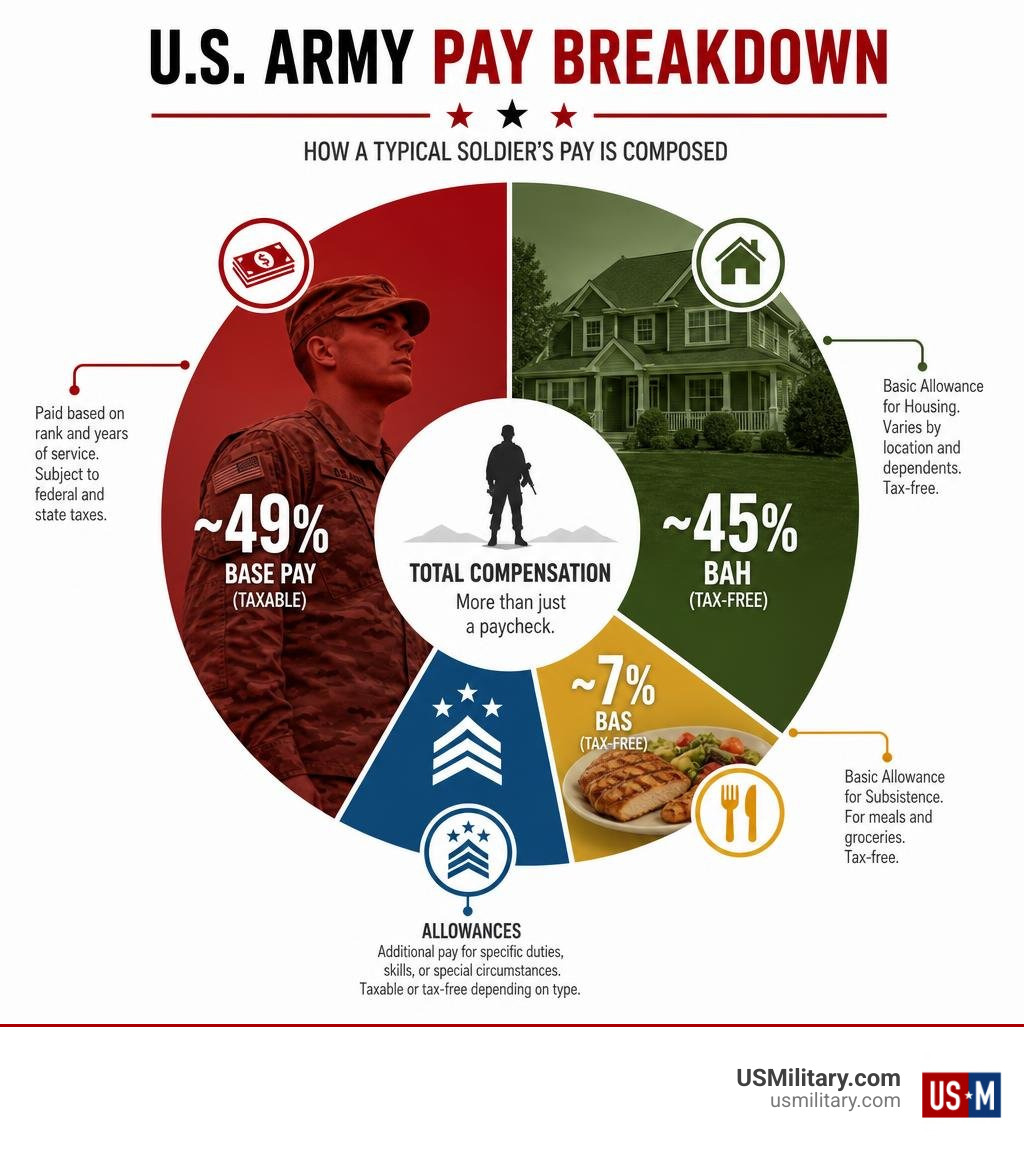
Army pay is more than just a base salary. A typical active-duty soldier’s total compensation breaks down like this:
- ~49% Basic Pay (taxable)
- ~45% Basic Allowance for Housing — BAH (tax-free)
- ~7% Basic Allowance for Subsistence — BAS (tax-free)
For example, a married E-4 with three years of service at Fort Hood, TX takes home roughly $5,930 per month — combining $3,500 in base pay, $2,100 in BAH, and $330 in BAS. During deployment, that entire amount can become tax-free.
In 2026, all soldiers received a 3.8% pay raise under the National Defense Authorization Act (NDAA), along with a 4.2% increase to BAH and a 2.4% bump to BAS.
I’m Larry Fowler, publisher of USMilitary.com, and since 2007 I’ve helped hundreds of thousands of service members and veterans navigate questions exactly like how much do U.S. Army soldiers get paid — from enlistment through retirement. In this guide, I’ll walk you through every layer of Army compensation so you know exactly what to expect.
How Much Do U.S. Army Soldiers Get Paid?
To understand how military compensation works, we must first look at the foundation of every soldier’s paycheck: Basic Pay. This is the core salary a soldier receives before adding any allowances, special pays, or bonuses.
The federal government structures military basic pay using two primary criteria: rank (pay grade) and years of service (longevity). As you climb the ranks and gain experience, your paycheck increases. Additionally, Congress evaluates and adjusts these rates annually to keep pace with the rising cost of living and private-sector wage growth.
For the calendar year 2026, the National Defense Authorization Act (NDAA) finalized a 3.8% across-the-board basic pay raise for all service members. This is a uniform adjustment designed to support our troops and ensure their financial stability. To get a comprehensive view of how these annual adjustments have evolved, you can explore the Military Pay Chart 2026 or look back at the official U.S. Army Basic Pay Charts for 2024 to see the historical progression.
To understand exactly how basic pay is managed and distributed, the Army Basic Pay | The Official Army Benefits Website remains the most authoritative government resource for eligibility guidelines. Additionally, our comprehensive breakdown in The Ultimate Guide to 2026 Military Pay Chart highlights how these new rates affect your monthly take-home pay.
How Much Do U.S. Army Soldiers Get Paid as Enlisted Personnel?
Enlisted soldiers are the backbone of the U.S. Army, spanning pay grades E-1 through E-9. Most new recruits enter the service at the E-1 grade as Privates, but they can quickly advance.
Under the 2026 pay scales, an active-duty Private (E1) with less than two years of service earns $25,297.20 per year in basic pay. A married Private (E2) with less than two years of service stationed at Fort Campbell, KY earns a base salary of $28,353.60 per year.
As enlisted soldiers promote and gain experience, their earnings rise significantly. For example, a Staff Sergeant (E6) with 8 years of service earns $53,326.80 per year in basic pay alone.
It is also worth noting that the military compensation landscape has seen historic adjustments recently. In early 2025, a substantial 14.5% targeted pay raise was implemented specifically for grades E-1 through E-4 to ensure junior enlisted soldiers earn a competitive starting wage. This massive baseline increase, combined with the 2026 raise, has dramatically improved the quality of life for young service members. You can view these baseline figures in the official 2025 Basic Pay: Enlisted tables or read our detailed analysis in All About 2026 Military Pay Chart for Enlisted Officers.
How Much Do U.S. Army Soldiers Get Paid as Commissioned Officers?
Commissioned officers enter the Army with a college degree, typically through ROTC, West Point, or Officer Candidate School (OCS). Because they carry higher levels of leadership and administrative responsibility, officer pay grades (O-1 through O-10) are substantially higher than enlisted scales.
A brand-new Second Lieutenant (O1) with less than two years of service starts with a basic pay of $47,980.80 per year. Within a few years, promotions and longevity pay bumps kick in. A Major (O4) with 8 years of service earns $101,923.20 per year in basic pay.
However, officer basic pay is not unlimited. The federal government imposes strict statutory pay caps linked to the Executive Schedule. For 2026, basic pay for senior officers in grades O-7 through O-10 is capped at $18,999.90 per month, while basic pay for officers in grade O-6 and below is capped at $15,408.30 per month.
For a complete breakdown of how officer pay scales compare to enlisted paths, check out From E-1 to O-4: A Deep Dive into Active Duty Military Pay and Benefits.
Active Duty vs. Reserve and National Guard Pay Differences

One of the most common questions we receive is how pay differs between full-time active-duty soldiers and part-time service members in the Army Reserve or National Guard.
Active-duty soldiers work full-time and receive a complete monthly salary along with standard allowances. Reserve and National Guard soldiers, on the other hand, are paid using a system called Drill Pay.
Drill pay is calculated using a simple “1/30th rule.” For every single drill period completed (which typically lasts four hours), a part-time soldier receives 1/30th of the monthly active-duty basic pay for their rank and experience. Because a standard drill weekend consists of four drill periods (two on Saturday, two on Sunday), a part-time soldier earns four days’ worth of active-duty basic pay in just one weekend.
During their mandatory 15-day Annual Training (AT) periods, or if they are mobilized to active duty, Reserve and Guard soldiers transition to the active-duty pay system, earning full active-duty pay and allowances.
To put this into perspective, a part-time Private (E2) with less than two years of service earns $4,568.08 per year based on standard drill weekends and annual training. Meanwhile, a part-time Major (O4) with several years of service can earn over $11,000 per year just for their weekend drill commitments.
Here is a quick comparison of active-duty monthly basic pay versus a standard part-time drill weekend pay structure:
| Rank & Experience | Active Duty Monthly Basic Pay (2026) | Reserve/Guard Drill Weekend Pay (4 Drill Periods) |
|---|---|---|
| Private (E-2) < 2 Years | $2,362.80 | $315.04 |
| Specialist (E-4) 4 Years | $2,912.40 | $388.32 |
| Staff Sergeant (E-6) 8 Years | $4,443.90 | $592.52 |
| Captain (O-3) 6 Years | $6,800.00 | $906.67 |
If you are considering serving part-time, you can explore the National Guard Pay Chart 2026 and the general National Guard Pay Chart to calculate your potential part-time income.
Allowances and Benefits That Supplement Base Pay
As we mentioned earlier, basic pay is only about half of what an active-duty soldier actually brings home. The rest of the total compensation package comes from tax-free allowances designed to cover living expenses.
The two most important allowances are:
- Basic Allowance for Housing (BAH): This tax-free allowance is designed to cover your rent or mortgage. Your BAH rate is determined by three factors: your rank, your duty station’s ZIP code, and whether you have dependents. In 2026, BAH rates received an average national increase of 4.2% to keep pace with housing markets. If you live in government-provided barracks or family housing on base, you forfeit your BAH.
- Basic Allowance for Subsistence (BAS): This is a tax-free allowance meant to offset the cost of the soldier’s meals. In 2026, BAS rates went up by 2.4%, making the allowance approximately $330 per month for enlisted soldiers and $255 per month for officers.
Because BAH and BAS are completely tax-free, they keep more money in your pocket than an equivalent civilian salary would.
Beyond housing and food, the Army provides incredible benefits that save soldiers thousands of dollars annually:
- Healthcare: Active-duty soldiers receive 100% free healthcare and dental coverage through TRICARE, with low-to-no-cost options for their families.
- Education: Through the Post-9/11 GI Bill, soldiers can earn a college degree completely debt-free, or even transfer those education benefits to their children.
- Paid Leave: All soldiers receive 30 days of paid vacation every year.
To see how these allowances combine with basic pay to form your total compensation, check out our Army Pay Calculator 2026 | Base Pay + BAH + BAS + Drill Pay or read How Much You Will Earn on Active Duty in 2026. For a broader look at how the Department of Defense structures these programs, you can consult the official guide on Military Salary and Compensation .
Special Pays, Incentives, and Deployment Compensation
The Army also offers various “special pays” and incentives to compensate soldiers who take on extra risk, perform highly specialized duties, or serve in challenging locations. These additional monthly entitlements can quickly boost a soldier’s bottom line:
- Special Duty Pay: Awarded to soldiers serving in demanding roles, such as recruiters, drill sergeants, or special operations forces.
- Hazardous Duty Pay (HDIP): Paid at a flat rate of $160 per month for duties like parachuting, flight operations, or working with demolition materials.
- Hostile Fire / Imminent Danger Pay: Paid at $240 per month when a soldier is deployed to a designated combat zone.
- Enlistment and Reenlistment Bonuses: To attract and retain talent in critical Military Occupational Specialties (MOS), the Army offers cash bonuses that can reach up to $20,000 or more.
- Warrior Dividend: In late 2025, all active and reserve service members received a unique, one-time tax-free payment of $1,776 as an extra token of appreciation.
One of the greatest financial advantages of an Army career occurs during a combat deployment. When serving in a designated combat zone, an enlisted soldier’s entire income—including basic pay, allowances, and bonuses—is 100% tax-free. Officers also enjoy this tax exclusion, though it is capped at the maximum enlisted pay rate.
To see a real-world breakdown of how these special pays and combat tax exclusions affect a paycheck, read Your Ranger Paycheck: Breaking Down Active Duty Compensation. You can also browse the official Money & Pay Charts – US Army page to learn about current MOS-specific incentives.
Frequently Asked Questions About Army Salary and Compensation
How does Army pay compare to similar civilian jobs?
When looking strictly at “base salary” figures on civilian job boards, it is easy to get the wrong impression. For example, a civilian data report on Us Army Soldier Salary in the United States lists the average Army soldier salary at $42,314 per year, with a typical range between $39,157 and $49,023. Similarly, Soldier yearly salaries in the United States at US Army – Indeed shows a starting base pay of $21,420 for an E-1 and up to $61,621 for a Major.
However, these civilian salary figures often fail to account for the total military compensation package. When you add tax-free housing (BAH), free meals (BAS), 100% free healthcare, tax advantages, and debt-free college education, an Army soldier’s purchasing power is significantly higher than a civilian earning the same “base” salary. In fact, when benefits are factored in, Army compensation is highly competitive with—and often exceeds—similar civilian roles in the private sector.
Are military allowances and bonuses taxed?
The tax rules for military compensation are highly favorable, but they depend on the specific type of pay:
- Taxable: Basic pay, drill pay, and cash bonuses are subject to federal and state income taxes. Taxes on bonuses are typically withheld at a flat federal rate when paid out.
- Non-Taxable: Major allowances like BAH, BAS, and Overseas Housing Allowance (OHA) are completely tax-free. This tax-exempt status saves soldiers thousands of dollars in tax liabilities each year.
- Combat Exclusion: As mentioned, all pay earned while serving in a designated combat zone is completely exempt from federal income taxes.
How often do Army soldiers get paid?
U.S. Army soldiers are paid twice a month, typically on the 1st and the 15th. If a pay date falls on a weekend or a federal holiday, the funds are deposited on the business day immediately preceding it.
The Defense Finance and Accounting Service (DFAS) distributes these payments via electronic direct deposit. Soldiers can view their detailed monthly paycheck breakdown, known as the Leave and Earnings Statement (LES), online through the MyPay portal. Many military-friendly banks, such as USAA, offer early direct deposit, allowing soldiers to access their funds a day or two early. For details on upcoming pay schedules, check out our guide on USAA Military Pay Dates 2026 or review general USAA Pay Dates.
Conclusion
So, how much do U.S. Army soldiers get paid? As we have shown, the answer goes far beyond the numbers on a basic pay chart. While base salaries provide a steady, guaranteed foundation that increases with rank and experience, the addition of tax-free allowances, comprehensive medical care, education benefits, and special incentive pays creates a highly secure and lucrative financial future.
Whether you are looking to serve full-time on active duty or part-time in the Reserve or National Guard, the Army offers unparalleled financial stability and career progression.
If you want to maximize your earning potential and discover which military career paths offer the highest return on your investment, explore our guide to the highest-paying careers in the US military.
Here at USMilitary.com, we are dedicated to helping you navigate every step of your military journey—from understanding your first paycheck to qualifying for your VA home loan benefits. When you are ready to take the next step, we are here to guide you.