
What Is the Army Minimum Age Limit?
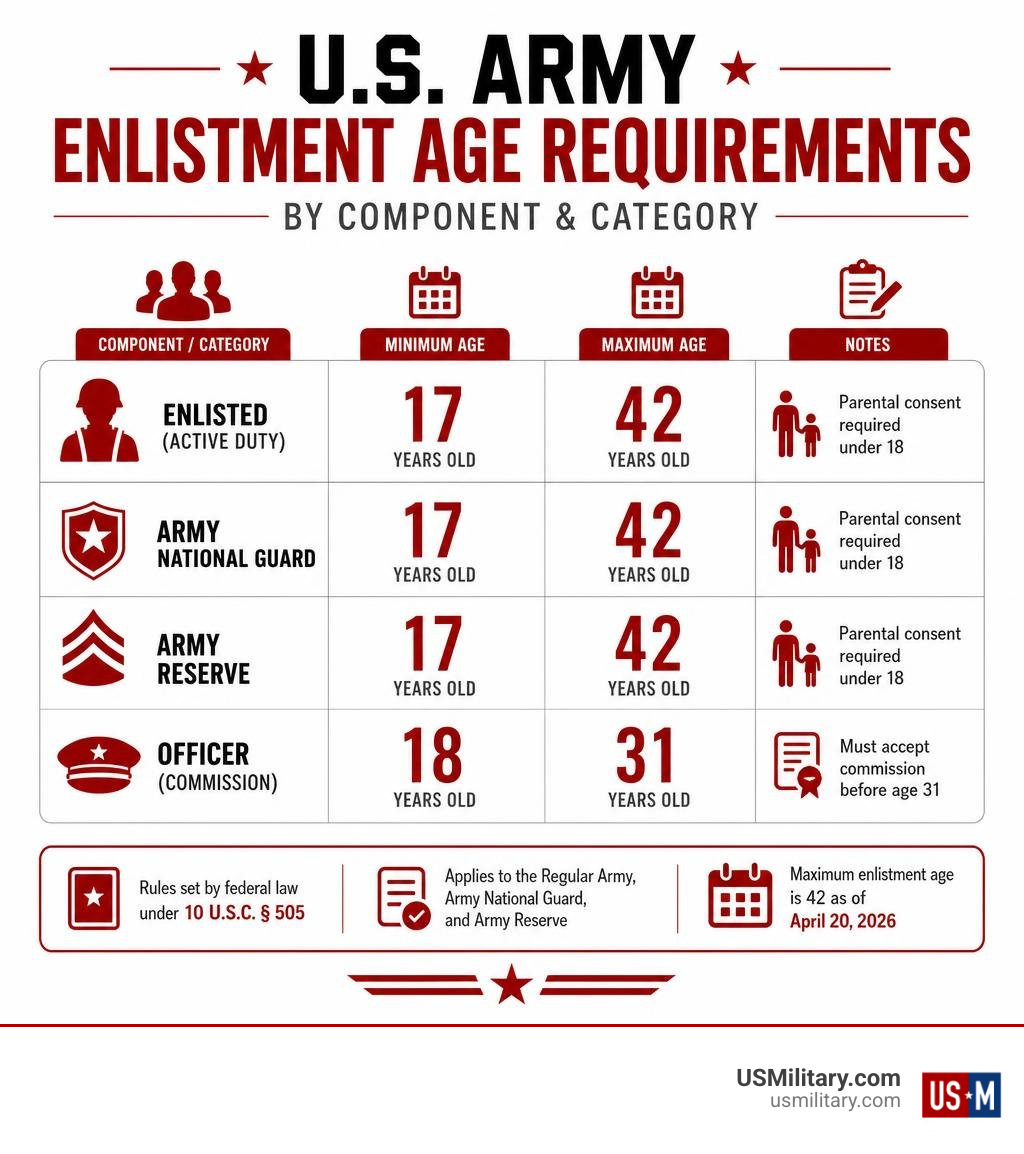
The army minimum age limit for enlistment in the U.S. Army is 17 years old. Here’s a quick breakdown:
| Category | Minimum Age | Maximum Age | Notes |
|---|---|---|---|
| Enlisted (Active Duty) | 17 | 42 | Parental consent required under 18 |
| Army National Guard | 17 | 42 | Parental consent required under 18 |
| Army Reserve | 17 | 42 | Parental consent required under 18 |
| Officer (Commission) | 18 | 31 | Must accept commission before age 31 |
These rules are set by federal law under 10 U.S.C. § 505 and apply to the Regular Army, Army National Guard, and Army Reserve.
If you’re 17, you can enlist — but your parent or legal guardian must give written consent. If you’re 18 or older, you can enlist on your own. And as of April 20, 2026, the Army raised its maximum enlistment age from 35 to 42, opening the door for many older Americans who previously didn’t qualify.
This guide walks you through every age-related rule you need to know before you talk to a recruiter — minimum age, parental consent, waivers, officer vs. enlisted rules, and more.
I’m Larry Fowler, publisher of the USMilitary.com Network since 2007, and I’ve spent nearly two decades helping recruits, active duty members, and veterans navigate enlistment questions — including the army minimum age limit — so you get accurate answers without the runaround. Let’s break it all down.
Simple army minimum age limit word guide:
Understanding the Army Minimum Age Limit for Enlistment
When we look at the legal framework of military service, the army minimum age limit is not just an arbitrary policy; it is codified in United States law. According to U.S.C. Title 10 – ARMED FORCES, the absolute statutory minimum age for original enlistment in any regular component of the U.S. Armed Forces is 17 years old.
For non-prior service applicants—those who have never served in the military before—this age represents the earliest opportunity to raise their right hand and take the oath of enlistment. However, there is a major legal threshold between being 17 and 18 years old. Under the law, 17-year-olds are still minors, meaning they cannot make the legal commitment to join the military entirely on their own.
Once an applicant celebrates their 18th birthday, they are legally recognized as adults and can sign their enlistment contracts without needing anyone else’s permission. To explore more about how these age boundaries affect your entry into the service, you can check out our detailed guide on U.S. Army Enlistment Age Requirements for New Recruits.
Parental Consent Rules for 17-Year-Olds
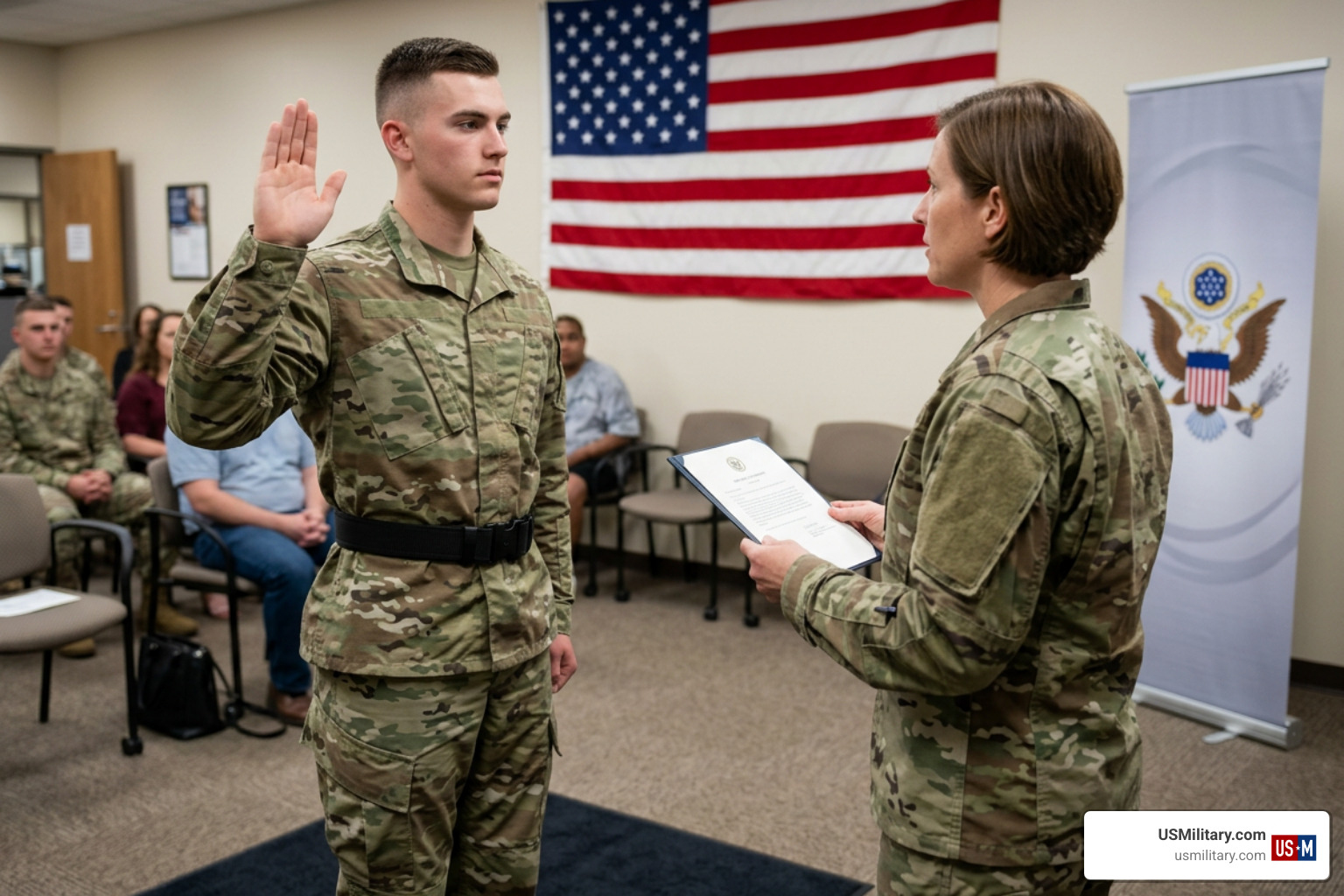
Enlisting at 17 is a fantastic way to jumpstart a military career, but it requires jumping through a few specific legal hoops. The most critical of these is obtaining official written consent from a parent or legal guardian.
The Army does not accept a simple handwritten note on a piece of paper. The consent must be documented on official Department of Defense forms, specifically DD Form 1966, which is completed at the Military Entrance Processing Station (MEPS) or with your recruiter. If both parents have legal custody, both must generally sign, though rules can vary if one parent has sole legal custody or if a legal guardian is the sole custodian.
In our modern recruiting environment, the Army has adapted to make this process easier. If a parent or guardian is unable to physically accompany the 17-year-old recruit to the recruiting office or MEPS, regulations now allow for video call verification. A recruiter can witness the parent signing the consent form via a secure video call, ensuring that distance or busy schedules do not stand in the way of a young applicant’s dreams. For a deeper dive into how this process works and what to expect, read Your Age and the Army What You Need to Know to Enlist.
Documentation Required to Verify the Army Minimum Age Limit
Before the Army can officially accept you, we have to verify exactly how old you are. The Military Entrance Processing Command (MEPCOM) enforces strict rules regarding identity and age verification. You cannot simply tell your recruiter your birthdate; you must back it up with legally binding documentation.
Under federal regulations, specifically 32 CFR § 66.6, the primary documents required to verify your age and eligibility include:
- An Original or Certified Birth Certificate: This must be issued by a state, county, municipal authority, or outlying possession of the United States, bearing an official seal.
- A Valid U.S. Passport: This can also serve as proof of both citizenship and age.
- A Permanent Resident Card (Green Card): If you are a non-citizen enlisting in the Army, you must present a valid, unexpired Green Card to prove your lawful permanent residency, alongside your foreign passport or birth certificate.
- Social Security Card: To verify your identity and tax records, an original, unlaminated Social Security card is mandatory.
Without these documents, your enlistment process will grind to a halt. We always recommend gathering these essential papers early in your planning stages so you are ready when you first meet with an Army recruiter.
How the Army’s Age Requirements Compare to Other Branches
Every branch of the U.S. military has the authority to set its own standards for enlistment within the maximum limits allowed by federal law. While the army minimum age limit is uniform across the board at 17 (with consent), the maximum ages vary significantly.
To help you compare your options, we’ve put together a comprehensive breakdown of the age limits across all branches based on the latest data from Requirements to join the U.S. military – USAGov:
| Military Branch | Minimum Age (With Consent) | Minimum Age (Without Consent) | Maximum Enlistment Age |
|---|---|---|---|
| U.S. Army | 17 | 18 | 42 |
| U.S. Navy | 17 | 18 | 41 |
| U.S. Air Force | 17 | 18 | 42 |
| U.S. Marine Corps | 17 | 18 | 28 |
| U.S. Space Force | 17 | 18 | 42 |
| U.S. Coast Guard | 17 | 18 | 41 |
For a broader perspective on how these limits function across the entire Department of Defense, check out our guide on Age Limits Join the Military by Branch.
Marine Corps and Air Force Age Cutoffs
The differences between the branches become highly apparent when you compare the Marine Corps and the Air Force. The Marine Corps has traditionally maintained the youngest force in the military. Because of the intense physical demands of Marine recruit training and infantry operations, the Marine Corps caps its enlistment age at a strict 28 years old. While age waivers are technically possible for exceptional candidates, they are rarely granted. If you are interested in the details of this young cutoff, read Marine Corps Enlistment Whats the Age Cutoff.
On the other end of the spectrum, the Air Force has recognized the value of older, highly skilled recruits, particularly in technical, cyber, and administrative roles. The Air Force accepts enlistments up to age 42. This generous cutoff allows older professionals to bring their civilian expertise into military service. To learn more about how the Air Force handles older recruits, take a look at Your Guide to Air Force Age Requirements.
Navy, Space Force, and Coast Guard Limits
The remaining branches also offer flexible age windows. The Navy allows enlistments up to age 41, which matches the Coast Guard’s active duty limit of 41. The Space Force, the newest branch of the armed forces, aligns closely with the Air Force, allowing recruits to join up to age 42.
These limits are subject to change based on recruiting needs, but they highlight a growing trend across the military: a willingness to accept older, more mature recruits who bring life experience and stability to the ranks. If you are looking to serve part-time on the water, you can also explore the Serving Part Time Age Requirements for the Coast Guard Reserve to see how the reserve component handles age limits.
Active Duty vs. Reserve and National Guard Age Rules
When deciding how to serve, many applicants look closely at the differences between Active Duty (full-time) and the Reserve components (part-time), which include the Army Reserve and the Army National Guard. Fortunately, the army minimum age limit remains exactly the same across all three components: you must be at least 17 years old with parental consent, or 18 years old without it.
The maximum ages are also aligned. Whether you want to jump out of airplanes on active duty, serve one weekend a month in the Army Reserve, or respond to state emergencies with the National Guard, you can enlist up to age 42. To learn more about Guard eligibility, visit the official Eligibility – Army National Guard page. If you are worried that you might be cutting it close to the upper limit, we have a helpful resource titled Dont Let Your Birthday Stop You Army Reserve Age Waivers that explains your options.
Delayed Entry Program (DEP) and the Army Minimum Age Limit
If you are a high school senior who is 17 years old, you don’t have to wait until graduation to start your enlistment process. The Army offers the Delayed Entry Program (DEP)—also known as the Delayed Training Program (DTP) for the National Guard and Reserve—which allows you to enlist while you are still completing your high school diploma.
Under the DEP, you can sign your enlistment contract, lock in your Military Occupational Specialty (MOS), and secure your ship date for Basic Combat Training (BCT) up to a year before you actually leave. This is incredibly popular for 17-year-olds because it allows them to transition smoothly from high school graduation straight into the military.
While you are in the DEP, you will attend regular meetings with your recruiter to prepare physically and mentally for basic training. This head start is an excellent way to ensure success. For a comprehensive overview of how this program fits into your timeline, check out The Ultimate Guide to Military Enlistment Ages Are You Eligible.
Officer Commissioning vs. Enlisted Age Requirements
There is a major difference in age requirements depending on whether you want to enlist as a Soldier or commission as an Officer. Enlisted Soldiers perform the hands-on, tactical work of the Army, while Officers serve as the managers, planners, and leaders. Because of these leadership responsibilities, the standards for becoming an officer are different.
To join as an enlisted Soldier, you only need a high school diploma or GED, and you can join between the ages of 17 and 42. However, to become an Officer, you must have a four-year college degree and be at least 18 years old. Furthermore, the maximum age to commission is much younger. According to the official Eligibility & Requirements to Join | U.S. Army portal, an applicant must accept their commission before their 31st birthday.
This means that while a 40-year-old can easily enlist as a private, they cannot attend Officer Candidate School (OCS) without an extremely rare and highly competitive age waiver.
Maximum Age Limits, Waivers, and Prior Service Rules
The most significant recent update to military recruiting policies occurred on April 20, 2026, when the U.S. Army officially raised its maximum enlistment age to 42 for the Regular Army, Army National Guard, and Army Reserve. This policy change, reported in detail by US Army Increases Max Enlistment Age, was designed to expand the recruiting pool and bring in mature, highly qualified applicants.
But what if you are over 42, or if you need an exception to other age policies? That is where age waivers come in. The Army evaluates age waivers on a case-by-case basis, looking at the “whole person.” Here are the general requirements the Army considers when reviewing an age waiver:
- High ASVAB Scores: Older applicants must demonstrate strong academic and technical aptitude.
- Excellent Physical Fitness: You must pass the standard military medical exam at MEPS and show that your body can handle the rigors of basic training.
- Clean Conduct Record: A history of legal or financial trouble can quickly sink a waiver request.
- Critical Skills: If you possess a highly sought-after civilian skill (such as medical, cyber, or linguistic expertise), your waiver is much more likely to be approved.
For more details on how the Army handles older recruits and the waiver process, read our article on the Age Limit for Military.
Prior Service Age Adjustments and Re-enlistment
If you have prior military service, the rules change completely in your favor. The Army highly values experienced veterans and uses a calculation to adjust your “enlistment age” based on your active duty time.
Under Army Regulation 601-210, prior service applicants can subtract their years of active duty service from their current biological age to determine if they meet the enlistment standard. For example, if you are 45 years old but served 5 years of active duty in the Navy, your “adjusted age” for enlistment purposes is 40. Since 40 is below the maximum age limit of 42, you are fully eligible to enlist without needing an age waiver!
This policy makes it incredibly easy for veterans to return to service, switch branches, or transition into the National Guard or Reserve. If you are a veteran looking to put the uniform back on, check out our guide on Re-Enlistment Age Limits Your Path Back to Military Service.
Military Service Obligation (MSO) and Age
Every person who joins the U.S. military for the first time incurs an eight-year Military Service Obligation (MSO). This is a legal requirement established by federal law.
This eight-year commitment does not mean you have to spend eight years on active duty. Instead, it is typically split. For example, you might serve four years on active duty, followed by four years in the Individual Ready Reserve (IRR), where you do not drill or wear the uniform but can be recalled to active service in the event of a major national emergency.
How does this relate to age? Because of the MSO, the Selective Service System and the military track service eligibility closely. If you enlist at the army minimum age limit of 17, your MSO will be complete by the time you are 25. If you enlist at the maximum age of 42, your obligation will continue until you are 50. To learn more about how age obligations and service requirements interact with national defense policies, read Age to Be Drafted.
Frequently Asked Questions about Army Age Limits
Can you join the Army at 16?
No, you cannot join the United States Army at 16 years old. The absolute legal minimum age to enlist in any branch of the U.S. military is 17, and that requires written parental consent.
By comparison, the British Army does allow regular soldiers to enlist at age 16 (with parental consent), but they cannot serve on front-line operations until they turn 18. In the United States, however, you must wait until your 17th birthday to begin your military journey.
What is the absolute oldest age you can join the Army?
The absolute oldest age to enlist in the U.S. Army as a non-prior service applicant is 42 years old. This limit applies to the Regular Army, Army Reserve, and Army National Guard.
While age waivers can occasionally extend this limit for individuals with critical medical or technical skills, 42 is the standard regulatory cap.
Does the draft apply to older individuals?
No, the draft does not apply to older individuals. Under current United States law, the Selective Service registration requirement only applies to male U.S. citizens and male immigrants living in the U.S. between the ages of 18 and 25.
Once a man reaches his 26th birthday, he is no longer eligible to be drafted, and the Selective Service system no longer tracks him for conscription. If you want to read a detailed breakdown of how this applies to older adults, take a look at Can You Be Drafted Age 40.
Conclusion
Whether you are a 17-year-old high school student looking to kickstart your life at the army minimum age limit or an experienced 40-year-old professional looking to give back to your country, the U.S. Army has a path forward for you. The historic policy changes of 2026 have made the Army more accessible than ever, allowing a diverse range of Americans to serve.
At USMilitary.com, we are committed to helping you navigate every step of your military journey—from understanding the Requirements to Join the Army to planning your retirement benefits. If you are ready to take the next step, we encourage you to visit USMilitary.com to connect with a recruiter, explore career paths, and find the resources you need to succeed.
For those looking for inspiration on their journey, we also highly recommend checking out the powerful book Dare to Live Greatly, which offers deep insights into leadership, resilience, and faith. Your future in the military starts today—make the most of it!