
What Is Army Basic Training? A Quick Overview
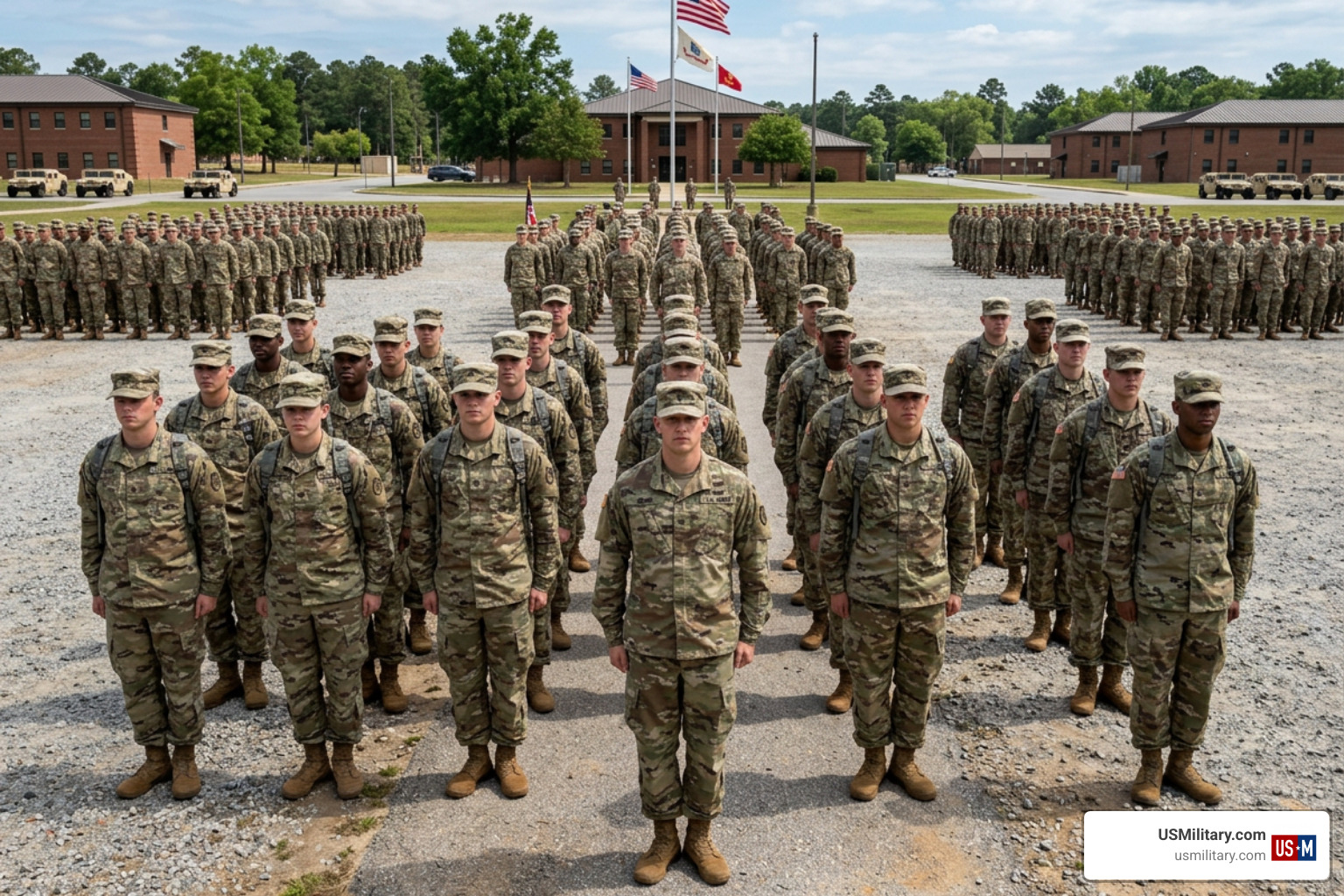
Army Basic Training — also called Basic Combat Training (BCT) or “boot camp” — is the mandatory 10-week program that transforms civilians into U.S. Army Soldiers.
Here’s what you need to know at a glance:
| Topic | Key Facts |
|---|---|
| Duration | ~10 weeks of BCT + Reception (Week Zero) |
| Phases | Yellow (Wks 1-2), Red (Wks 3-4), White (Wks 5-7), Blue (Wks 8-10) |
| Locations | Fort Moore (GA), Fort Jackson (SC), Fort Leonard Wood (MO), Fort Sill (OK) |
| Fitness Test | Army Combat Fitness Test (ACFT) — 360 points minimum to graduate |
| Graduation Requirement | Pass ACFT, throw 2 live grenades, complete The Forge |
| Completion Rate | ~90% of recruits graduate |
| Pay | Yes — on the 1st and 15th of every month |
| What Comes Next | Advanced Individual Training (AIT) or One Station Unit Training (OSUT) |
BCT is required for every new enlisted Soldier — no exceptions. It covers physical fitness, weapons handling, Army values, land navigation, combat skills, and field exercises. By the end, you’re no longer a civilian. You’re a Soldier.
As Sgt. 1st Class Jean-Noel Howell put it: “In Basic Training, you’re going to learn discipline… and you’re doing it alongside people you will know the rest of your Army career.”
I’m Larry Fowler, publisher of USMilitary.com — a resource I’ve built since 2007 to help people navigate the military journey, from enlistment through Army Basic Training and beyond. Whether you’re considering signing up or just shipped your orders, this guide covers everything you need to know, start to finish.
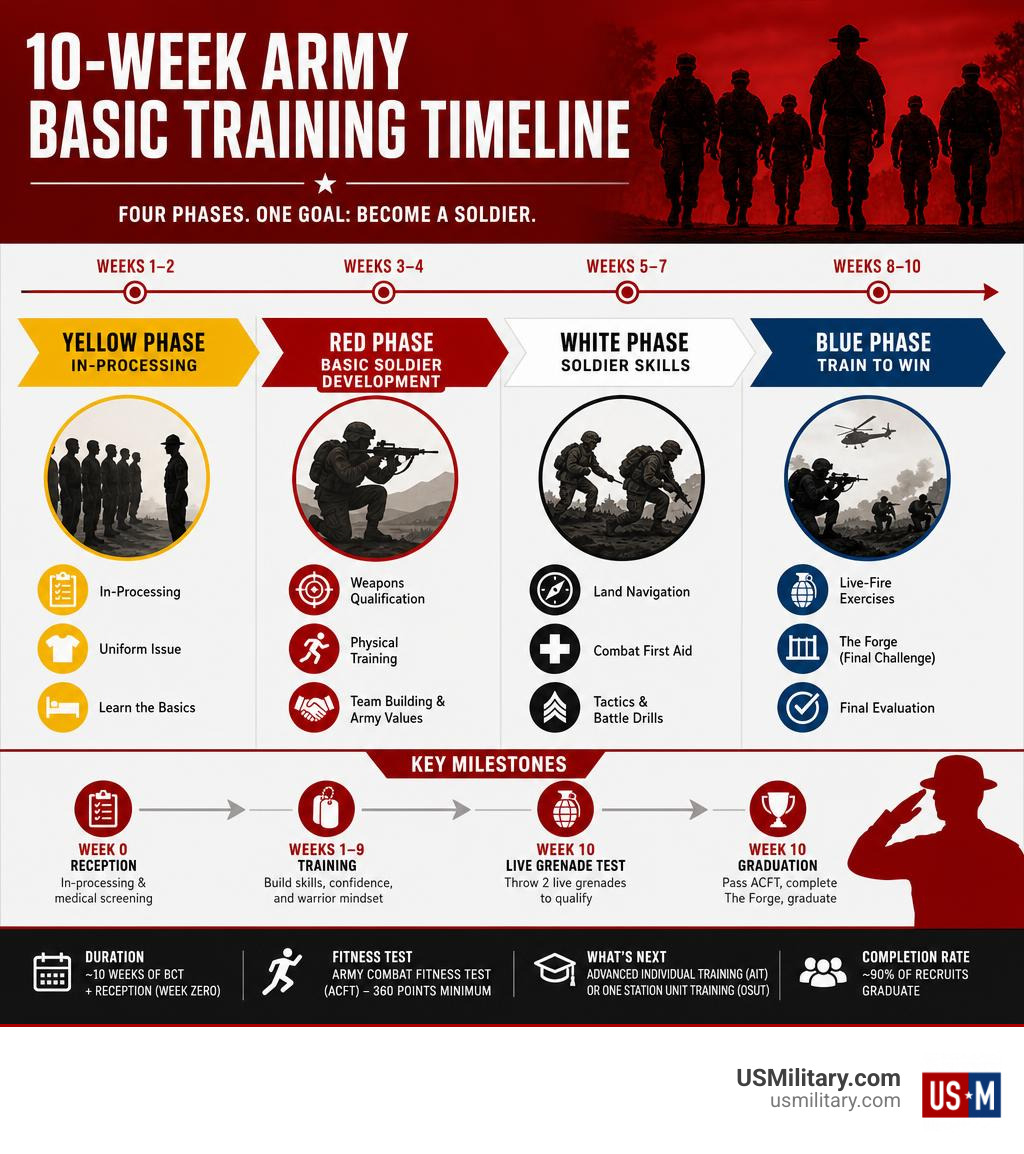
The Four Phases of Army Basic Training
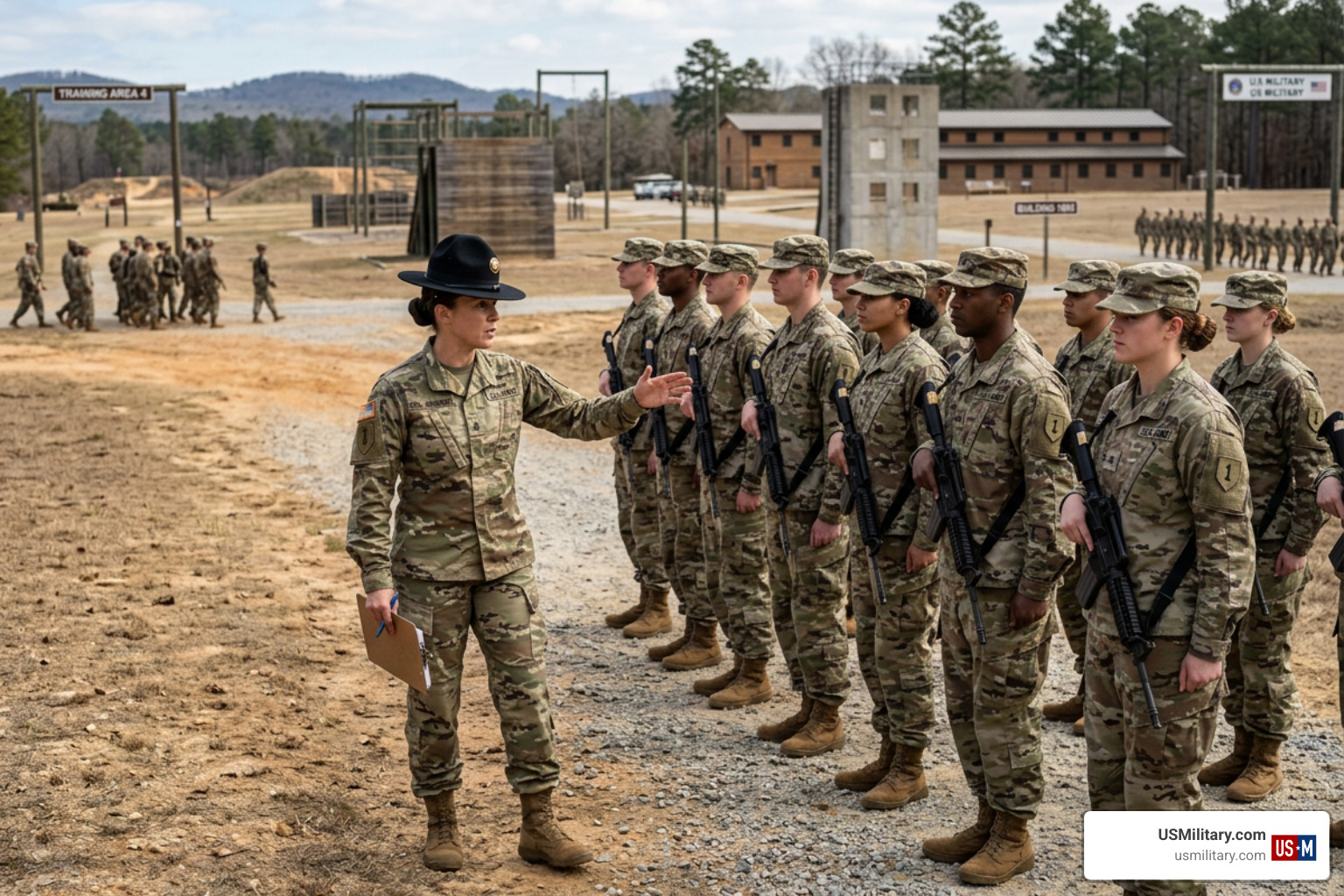
To build a civilian into a highly disciplined combat-ready Soldier, the Army utilizes a highly structured, progressive training model. This model is governed by the U.S. Army Training and Doctrine Command (TRADOC) and is broken down into four distinct, color-coded phases over a 10-week period.
Each phase is designed to build on the lessons of the previous one, slowly increasing your physical stamina, tactical competence, and mental resilience. While the transition can feel jarring at first, the system is designed to build you up rather than break you down.
For more details on how the Army structures initial entry training, you can explore the official Basic Combat Training | U.S. Army resource.
Let’s look at how these phases break down chronologically.
Yellow and Red Phases: The Foundation of Army Basic Training
Before you officially begin training, you must pass through the Reception Battalion (often referred to as “Week Zero”). This is where the initial transformation begins.
During your 3 to 10 days at Reception, you won’t see your primary Drill Sergeants yet, but you will undergo intensive administrative in-processing. We will issue your uniforms, execute medical and dental exams, administer immunizations, set up your military pay, and give male recruits their initial buzz cuts.
One of the first tests of discipline is the “shakedown.” When you arrive, you will be ordered to line up and completely empty your personal bags. Any prohibited contraband — such as snacks, tobacco, nonprescription drugs, or weapons — will be confiscated immediately. This is often a recruit’s very first introduction to a Drill Sergeant raising their voice to enforce strict attention to detail.
Yellow Phase (Weeks 1–2): Orientation and Integration
Once you clear Reception and ship to your training unit, the Yellow Phase begins. This phase is all about learning the basics of military life:
- The “First 100 Yards”: Replacing the old-school “shark attack,” this event is a highly physical, introduction designed to teach platoon history, build immediate camaraderie, and establish the chain of command.
- Army Values: You will memorize and begin to live by the seven core Army Values, easily remembered by the acronym LDRSHIP: Loyalty, Duty, Respect, Selfless Service, Honor, Integrity, and Personal Courage.
- Fundamentals: You will practice basic drill and ceremony (marching), learn military customs and courtesies, and begin structured Physical Readiness Training (PRT).
To prepare yourself for what lies ahead, we highly recommend reading our guide on what to expect Youll Be Shock To What To Expect At Army Boot Camp/.
Red Phase (Weeks 3–4): The Crucible of Discipline
The Red Phase is where the physical and psychological demands ramp up significantly. Drill Sergeants enforce maximum discipline as you learn basic survival and combat skills:
- The Gas Chamber (NBC Defense): You will learn to properly clear and seal your protective mask before being exposed to CS (tear) gas. Recruits are often asked to briefly remove their masks and state their name or Social Security number to prove they can remain calm under stress.
- Combatives: You will learn unarmed hand-to-hand combat techniques.
- Weapon Maintenance: You will master the assembly, disassembly, and care of the standard-issue M4 carbine or M16 rifle using “rubber ducks” (inert training models) before moving to live weapons.
- The Warrior Tower: Conquering fear by rappelling down a multi-story wall.
The presence of the Drill Sergeant is felt most during this phase. If you want to understand the strategic shift back to high-discipline instruction, check out Army Looking To Bring Back Drill Sergeants For More Disciplined New Soldiers/.
White and Blue Phases: Advanced Skills in Army Basic Training
Once you have mastered basic discipline and the core values, you transition into the hands-on combat application phases.
White Phase (Weeks 5–7): The Rifleman Phase
Also known as the “Gunfighter Phase,” the White Phase focuses on marksmanship and field craft:
- Basic Rifle Marksmanship (BRM): You will learn how to “zero” your rifle to align the sights with your eye, practice trigger control (often using a wooden dowel and a coin balanced on the barrel), and qualify on the firing range.
- Target Engagement: You will practice firing at targets at varying distances (up to 300 meters) from prone, kneeling, and standing positions.
- Land Navigation: Recruits learn to read military maps and use a lensatic compass to find specific coordinates in the wilderness during both day and night.
- Tactical Training: You will practice setting up perimeters, patrolled movements, and basic first aid (Combat Lifesaver skills).
Blue Phase (Weeks 8–10): The Warrior Phase
The Blue Phase is the culmination of your 10 weeks of training, where you prove you have what it takes to be a Soldier:
- Advanced Weapons: You will train with crew-served weapons, machine guns, and grenade launchers. Under strict supervision, all trainees must throw two live hand grenades to graduate.
- Urban Operations (MOUT): You will practice maneuvering through mock cities, clearing rooms, and defeating simulated Improvised Explosive Devices (IEDs).
- The Forge: This is a grueling 96-hour field training exercise (FTX) that serves as your final exam. It includes night tactical movements, combat scenarios, and a massive 15-kilometer (9.3-mile) road march while carrying a full rucksack.
- The Reward: Upon completing The Forge, you receive your official U.S. Army patch and black beret in a private Soldier Induction Ceremony.
For a deep dive into physical and tactical preparation, check out our guide on Enlisted Basic Combat Training Prep/.
Locations and Requirements for Enlistment
The U.S. Army conducts Army Basic Training at four primary installations across the United States. Your training location is determined primarily by your chosen Military Occupational Specialty (MOS) and gender, as some locations host specialized One Station Unit Training (OSUT).
| Installation | Location | Primary Focus / MOS Specialties |
|---|---|---|
| Fort Moore (formerly Fort Benning) | Columbus, Georgia | Infantry, Armor, Cavalry Scouts (OSUT heavy) |
| Fort Jackson | Columbia, South Carolina | Human Resources, Finance, Adjutant General (largest BCT site; trains ~50% of all recruits and 60% of female recruits) |
| Fort Leonard Wood | Waynesville, Missouri | Combat Engineers, Military Police, Chemical Corps |
| Fort Sill | Lawton, Oklahoma | Field Artillery, Air Defense Artillery |
To enlist and attend BCT as of May 2026, you must meet several baseline requirements:
- Age: Enlisted recruits must be between 17 and 35 years old (17-year-olds require parental consent).
- Citizenship: Must be a U.S. citizen or a legally admitted permanent resident alien.
- Education: A high school diploma or equivalent (GED) is standard.
- Testing: Must achieve a minimum score of 31 on the Armed Services Vocational Aptitude Battery (ASVAB) Armed Forces Qualification Test (AFQT).
- Medical: Must pass a comprehensive physical exam at a Military Entrance Processing Station (MEPS).
Read more about these installations and qualification criteria in our guide: Army Boot Camp Requirements And Locations/.
Physical Fitness and the ACFT
Physical fitness is a cornerstone of military readiness. To graduate from Army Basic Training, every recruit must pass the Army Combat Fitness Test (ACFT) with a minimum score of 360 points (with at least 60 points scored in each of the six events).

The ACFT consists of the following six events:
- Three-Rep Max Deadlift (MDL): Tests lower body and core strength.
- Standing Power Throw (SPT): Tests explosive power by throwing a 10-pound medicine ball backward over your head.
- Hand-Release Push-Ups (HRP): Tests upper body endurance.
- Sprint-Drag-Carry (SDC): A high-intensity shuttle run involving sprinting, dragging a 90-pound sled, and carrying two 40-pound kettlebells.
- Plank (PLK): Tests core stability and endurance.
- Two-Mile Run (2MR): Tests aerobic endurance.
What happens if you struggle physically?
The Army does not expect you to arrive in peak athletic condition, but you must put in maximum effort. If you are struggling, Drill Sergeants will group you with peers of similar abilities to build progressive strength.
If a recruit is severely injured or repeatedly fails to pass the physical standards, they may be sent to the Fitness Training Company (FTC). In the FTC, recruits receive dedicated physical therapy and training. Trainees get two opportunities each week to pass the physical assessment test. However, if a recruit fails to pass after four weeks (eight attempts), they may face an administrative discharge for failure to adapt.
To make sure you don’t end up struggling on day one, read our guide Ready For Your Military Boot Camp Think Again/. If you are curious how the Army’s physical prep compares to other branches, you can read Which Military Branch Have The Easist Bootcamp/ or check out Enlisted Basic Training Uscg Style/ for a different perspective.
Daily Life and Communication During Boot Camp
Daily life during BCT is highly structured, leaving very little room for idle time. You will live in a large open barracks bay with up to 40 other recruits, sharing responsibility for maintaining cleanliness and order.
A Typical Daily Schedule
- 0430: Wake-up and personal hygiene.
- 0500–0630: Physical Training (PT) and formations.
- 0630–0730: Breakfast at the Dining Facility (DFAC).
- 0800–1200: Morning training (marksmanship, classroom instruction, or tactical drills).
- 1200–1300: Lunch (DFAC or Meals, Ready-to-Eat [MREs] in the field). You will quickly learn to eat efficiently — recruits often have less than 10 minutes to finish a meal.
- 1300–1700: Afternoon training.
- 1700–1800: Dinner.
- 1800–2100: Mail call, hygiene, barracks maintenance, and personal time.
- 2100: Lights out (guaranteeing 7 to 8 hours of sleep, barring guard duty).
Accountability and Teamwork
To instill a sense of shared responsibility, the Army utilizes two key systems:
- The Battle Buddy System: You are prohibited from walking anywhere alone. You must always travel with a designated “battle buddy” for safety and accountability.
- Fire Guard and Charge of Quarters (CQ): Every night, recruits take turns standing watch in the barracks in shifts. While historically used to watch wood-burning stoves for fire hazards, today it serves as an exercise in accountability for personnel and equipment.
Contacting Your Family
Communication with the outside world is limited but highly valued.
- Letters: Traditional mail is the primary way to stay in touch. Mail call occurs daily (except Sundays).
- Phone Calls: Recruits are typically allowed to use their cell phones for a few minutes upon arriving at Reception to notify family of their safe arrival. Afterward, phone privileges are earned at the discretion of the Drill Sergeants — usually on Sundays or upon transitioning to a new phase.
- Emergency Contact: In the event of a family emergency, loved ones can contact the American Red Cross or call the centralized Army basic training contact directory at (877) 272-7337.
For official government guidelines on staying in touch, check out the Military Basic Training Resources page. To prepare your family for the communication gap, review our Basic Training Preparation Tips/.
What Happens After Graduation: AIT and OSUT
Graduation week (Week 10) is a time of immense pride. It features a Family Day, where loved ones can visit the base and see your transformation firsthand, followed by a formal graduation ceremony. But graduation from BCT is only the first step of Initial Entry Training (IET).
What happens next depends on your enlistment contract:
- Advanced Individual Training (AIT): If your MOS requires specialized technical training, you will ship to a different location to attend AIT. AIT can last anywhere from 4 weeks to over 7 months (or longer for foreign language specialties). For example, a Human Intelligence Collector will head to Fort Huachuca, Arizona, while an Army Medic will train at Fort Sam Houston, Texas.
- One Station Unit Training (OSUT): For combat-arms specialties like Infantry, Armor, or Cavalry Scouts, BCT and AIT are combined into a single continuous program at the same location. Infantry recruits, for example, complete a 22-week OSUT program at Fort Moore, remaining with the same Drill Sergeants and platoon members from day one through graduation.
Once you complete your specialized training, you will receive orders for your first permanent duty station, where you will join your operational unit.
To learn more about life after boot camp, read What Comes After Military Boot Camp/ and explore how advanced training works in Military Training Much More Than Boot Camp/.
Frequently Asked Questions about Army BCT
Do recruits get paid during Basic Training?
Yes. You are a fully active-duty Soldier from the day you report to Reception. You will receive a salary based on your enlistment rank (e.g., E-1, E-2, or E-3).
Payments are distributed on the 1st and 15th of every month via direct deposit. In addition to base pay, the Army covers all housing, meals, and medical care costs while you are in training.
What items are prohibited at Basic Training?
The Army strictly regulates what you can bring to BCT. Bringing prohibited items (contraband) can result in immediate disciplinary action.
- Prohibited Items: Weapons (including pocketknives), tobacco products, vapes, alcohol, nonprescription drugs, expensive electronics (laptops, tablets), cameras, playing cards, dice, civilian food (candy, chips, gum), and obscene or pornographic materials.
- What You Should Pack: A small sum of cash, a single change of civilian clothes, running shoes, a combination lock, travel-sized toiletries (TSA-compliant), and all essential recruiter/MEPS paperwork carried securely by hand.
For a comprehensive historical overview of Army training standards and regulations, you can read the United States Army Basic Training page on Wikipedia.
What is the success rate for Army recruits?
Approximately 90% of candidates successfully complete Army Basic Training and graduate as Soldiers.
The 10% attrition rate is typically driven by acute physical injuries, pre-existing medical conditions that flare up, or a psychological “failure to adapt” to the high-stress military lifestyle. The Army’s goal is to train and retain you; administrative discharges are reserved for those who are genuinely incompatible with service.
Conclusion
Completing Army Basic Training is a life-changing milestone. It takes grit, physical effort, and mental toughness to earn the title of U.S. Army Soldier, but the rewards — from professional development and college tuition assistance to VA home loans and healthcare benefits — will serve you for a lifetime.
At USMilitary.com, we are dedicated to supporting our active-duty service members, National Guard, Reserves, and veterans. From explaining VA loan benefits to comparing career paths across all branches, we are your central hub for military guidance.
Ready to take the first step toward your future? Start your journey with Army Basic Training today.