
The 15 Army Careers That Recruits Do Not Regret — and Why They Matter
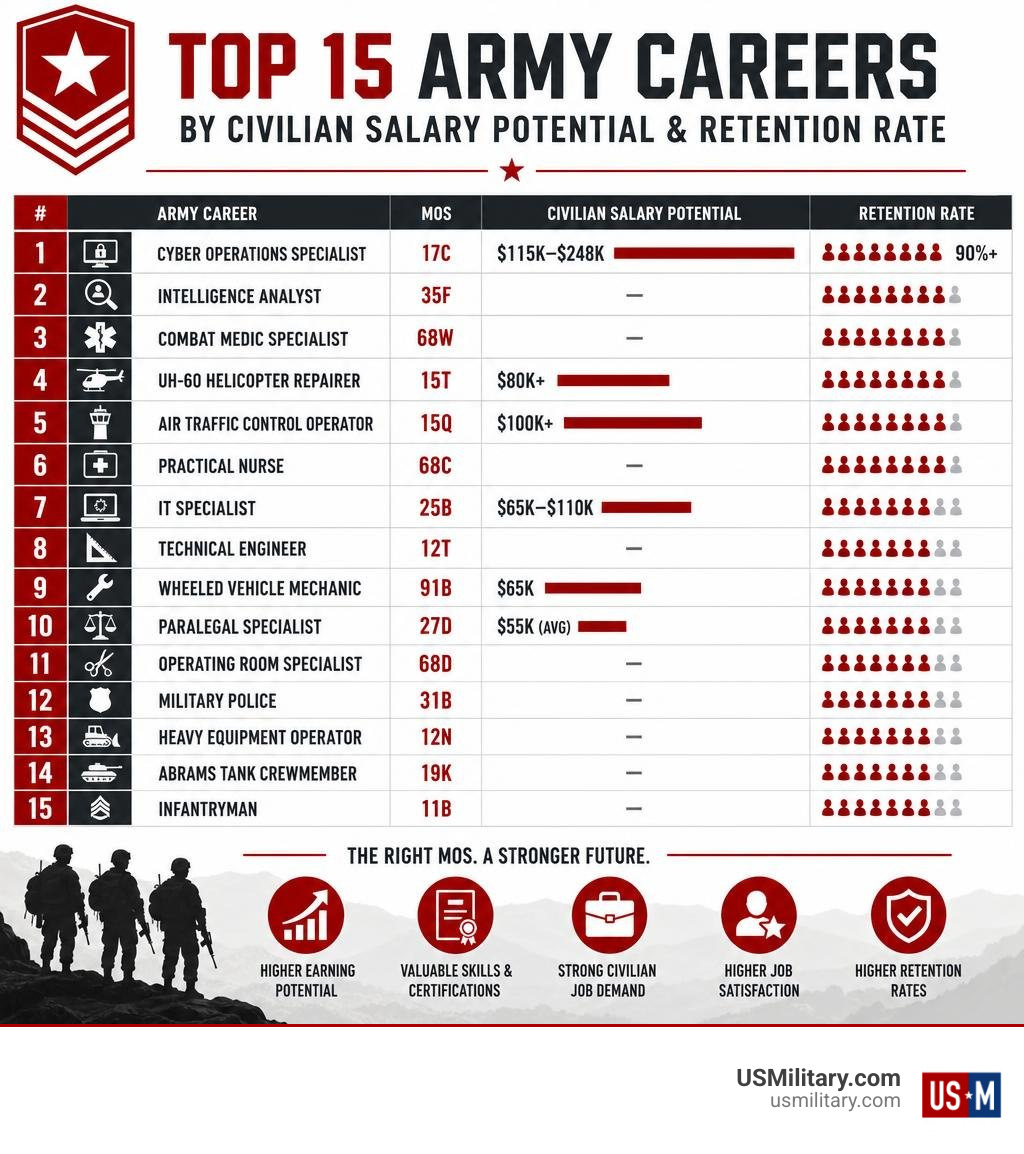
Here are 15 Army careers that recruits do not regret, based on civilian salary potential, skills transferability, job satisfaction, and retention rates:
| # | Army Career | MOS | Why Recruits Love It |
|---|---|---|---|
| 1 | Cyber Operations Specialist | 17C | $115K–$248K civilian salary, 90%+ retention |
| 2 | Intelligence Analyst | 35F | TS/SCI clearance, defense contractor demand |
| 3 | Combat Medic Specialist | 68W | NREMT cert, direct path to RN or PA |
| 4 | UH-60 Helicopter Repairer | 15T | Factory-level aviation training, $80K+ civilian |
| 5 | Air Traffic Control Operator | 15Q | FAA certification, $100K+ post-service |
| 6 | Practical Nurse | 68C | 15% job growth, strong civilian demand |
| 7 | IT Specialist | 25B | CompTIA certs, $65K–$110K civilian roles |
| 8 | Technical Engineer | 12T | Surveying and drafting skills, construction sector |
| 9 | Wheeled Vehicle Mechanic | 91B | $65K civilian, broad mechanic demand |
| 10 | Paralegal Specialist | 27D | Direct path to civilian paralegal ($55K avg) |
| 11 | Operating Room Specialist | 68D | Surgical skills, sterile processing careers |
| 12 | Military Police | 31B | Law enforcement experience worldwide |
| 13 | Heavy Equipment Operator | 12N | High-demand construction and infrastructure skills |
| 14 | Abrams Tank Crewmember | 19K | Combat leadership, armor operations |
| 15 | Infantryman | 11B | Leadership under pressure, management and security careers |
Choosing the wrong Army job can lead to years of frustration. Choosing the right one can set you up for life.
That’s not an exaggeration. Data from peer-reviewed research shows that Army service closes nearly all of the Black/White earnings gap and increases homeownership, education rates, and marriage rates for veterans. The Army also met 104% of its retention goal in fiscal year 2022 — a sign that soldiers who find the right career path tend to stay.
But not every military job pays off the same way. Some roles give you industry-standard certifications, six-figure civilian career potential, and skills that employers are actively hunting for. Others leave veterans starting over with little to show for their service.
This guide cuts through the noise and focuses on the 15 Army careers that recruits consistently do not regret — the ones with strong pay, real civilian value, and high satisfaction rates.
I’m Larry Fowler, publisher of USMilitary.com, and after nearly two decades of helping active-duty soldiers and veterans navigate career decisions, I’ve seen which MOS choices lead to long-term success — exactly what’s covered in this guide on the 15 Army careers that recruits do not regret. Read on and I’ll walk you through each one.
Why These 15 Army Careers That Recruits Do Not Regret Offer the Best Paths
When enlisting in the Army, it is easy to get swept up in the excitement of combat arms or recruiter-promoted roles that may not align with your long-term goals. However, the smartest recruits focus on the horizon: the transition back to civilian life.
The careers we highlight here represent the perfect intersection of military fulfillment and post-service marketability. These roles offer robust career growth, job security, and high retention rates because soldiers feel valued during their service and empowered when they transition out. To explore the broader landscape of military opportunities, check out our guide on the Best Military Jobs in 2026: Highest Pay, Satisfaction, Low Risk & Elite Careers.
What Makes These 15 Army Careers That Recruits Do Not Regret So Rewarding?
The secret to a regret-free Army career lies in three key elements: job satisfaction, quality of life, and low deployment risk. While every soldier is prepared to deploy, support and technical roles often operate in climate-controlled environments with more predictable schedules.
These office-based or technical specialties boast retention rates exceeding 90% because they minimize burnout. Soldiers in these fields enjoy a better work-life balance, giving them time to pursue off-duty education and spend time with their families. For a closer look at how these roles stack up against other military specialties, read our detailed analysis of the Best Jobs in the Army.
High-Value Skills and Civilian Transferability
Civilian employers highly value military service, but only if you can translate your duties into business value. The jobs on our list provide direct, industry-recognized credentials—such as CompTIA Security+ or NREMT certifications—and hands-on experience that civilian companies actively seek.
Veterans from these fields bypass entry-level struggles because they pair technical proficiency with the intangible leadership and teamwork skills forged in the military. As many veterans share on community platforms like What are some good jobs/careers to go for in the US Army … – Quora, choosing an MOS with high civilian transferability is the single best financial decision a recruit can make.

The 15 Best Army Careers to Pursue in 2026
To help you make an informed decision, we have analyzed the top Military Occupational Specialties (MOS) based on current 2026 pay scales, civilian transition success, and quality-of-life metrics. For a deeper dive into these rankings, you can consult the Best Army Jobs in 2026: Top US Army MOS Rankings for Pay, Quality of Life & Civilian Success.
Below is our detailed breakdown of the 15 Army careers that recruits consistently report loving.
1. Cyber Operations Specialist (17C)
If you have a passion for technology and problem-solving, the 17C MOS is the crown jewel of modern military careers. The Army invests over $300,000 in training each Cyber Operations Specialist, teaching them both offensive and defensive cyber warfare tactics.
This role is highly coveted because it operates almost entirely in office settings with virtually zero physical combat risk. Upon transitioning, veterans with 17C experience and the certifications earned during service easily qualify for high-paying civilian roles. To learn more about how this path compares to other lucrative fields, check out the Top 6 Figure Military Jobs.
2. Intelligence Analyst (35F)
Intelligence Analysts are responsible for analyzing raw battlefield data, satellite imagery, and human intelligence to help commanders make critical strategic decisions. The primary benefit of this MOS is the Top Secret/SCI security clearance that comes with it.
This clearance, combined with analytical skills, makes 35F veterans highly sought after by defense contractors like Lockheed Martin and Raytheon, as well as federal agencies like the CIA and NSA. To explore the enlistment requirements for these sensitive roles, read about Army Jobs That Require Security Clearance.
3. Combat Medic Specialist (68W)
As the second-largest MOS in the Army, the Combat Medic Specialist is a highly respected and deeply rewarding career. 68Ws receive top-tier medical training, graduating with their National Registry of Emergency Medical Technicians (NREMT) certification.
Many recruits do not regret this choice because of the sheer volume of hands-on medical experience they gain in a short period—often more than a civilian EMT would acquire in a decade. This serves as an incredible springboard to becoming a Registered Nurse (RN) or Physician Assistant (PA). Discover how this medical path fits into the broader military pay scale by reading about the Highest Paying Military Jobs 2024.
4. UH-60 Helicopter Repairer (15T)
For those who love working with their hands, maintaining the Army’s fleet of Black Hawk helicopters is an unmatched experience. 15T soldiers receive factory-level aviation training that is highly respected in the private sector.
Veterans frequently transition directly into well-paying roles with major commercial airlines or defense aerospace companies. Recruits consistently rate this as one of the most exciting and fulfilling maintenance roles. See why this career is highly regarded by checking out Which Jobs Are the Coolest Jobs in the Military.
5. Air Traffic Control Operator (15Q)
Air Traffic Control Operators manage the flow of military aircraft across bases and tactical airfields worldwide. This high-stakes role requires intense focus and quick decision-making, which is why the training is so rigorous.
The payoff is massive: the FAA-equivalent certifications and real-world experience gained as a 15Q translate directly to civilian air traffic control positions, which routinely pay six-figure salaries without requiring a college degree.
6. Practical Nurse (68C)
A 68C Practical Nurse provides essential medical care under the supervision of physicians and registered nurses. The Army’s nursing program is exceptionally thorough, preparing soldiers to pass the NCLEX-PN exam to become licensed practical nurses (LPNs).
With the civilian healthcare sector experiencing rapid growth, 68C veterans face zero shortage of job opportunities upon separation. This makes it an ideal pathway, especially for those looking to advance their medical careers. For more on how this role serves as an empowering option, read about Army Jobs for Women.
7. Information Technology Specialist (25B)
From maintaining local networks to troubleshooting hardware, 25B IT Specialists keep the Army’s communication systems running smoothly. This role is a favorite among recruits because the Army pays for valuable civilian certifications like CompTIA A+, Network+, and Security+.
Having these credentials alongside a Secret security clearance allows veterans to transition seamlessly into systems administration and network engineering roles in the civilian corporate world.
8. Technical Engineer (12T)
Technical Engineers are the surveyors, draftsmen, and estimators of the Army’s construction teams. They utilize advanced software like CAD to design military installations, airfields, and bridges.
Recruits love this role because it offers a highly technical, low-risk career path that transfers perfectly to the civilian civil engineering and construction management sectors, where qualified technical engineers are always in high demand.
9. Wheeled Vehicle Mechanic (91B)
As a 91B, you keep the Army’s massive fleet of tactical and support vehicles moving. While the work is physically demanding, recruits do not regret this career because of the invaluable mechanical troubleshooting and diagnostic skills they acquire.
Civilian transit authorities, trucking logistics companies, and heavy equipment manufacturers actively recruit 91B veterans for their discipline and technical expertise.
10. Paralegal Specialist (27D)
Paralegal Specialists provide crucial administrative support to unit commanders and military lawyers (JAGs) in areas like military justice, international law, and administrative law.
This MOS offers a quiet, professional office environment and teaches complex legal research and drafting skills. It serves as an outstanding stepping stone for veterans who plan to attend law school or work as high-earning civilian paralegals.
11. Operating Room Specialist (68D)
Operating Room Specialists assist surgical teams during complex medical procedures, ensuring sterile conditions and preparing surgical instruments.
The highly specialized nature of this training means 68D veterans can step directly into civilian hospital operating rooms as surgical technologists, enjoying strong salaries and excellent job stability from day one.
12. Military Police (31B)
Military Police officers secure installations, enforce military laws, and conduct tactical law enforcement operations worldwide.
Recruits choose 31B because it provides a structured, active career path with direct transferability to federal, state, and local law enforcement agencies. The leadership and crisis-management skills developed as an MP are highly valued by police departments across the country.
13. Heavy Equipment Construction Operator (12N)
If you want to operate bulldozers, excavators, and graders to shape the battlefield and build infrastructure, 12N is the perfect fit.
This career is deeply satisfying because you see the physical results of your labor every day. It also translates directly to high-paying union construction jobs and heavy equipment operator roles in the private sector. Learn more about this building-block career path by visiting Army Heavy Equipment Construction Operator Careers.
14. Abrams M1 Tank Crewmember (19K)
While some might worry about the civilian transferability of combat roles, 19K Armor crewmembers consistently report high satisfaction. Operating a 70-ton main battle tank builds unparalleled teamwork, mechanical adaptability, and decisive leadership.
Veterans find that the extreme responsibility placed on young tank commanders translates beautifully to logistics, operations management, and heavy industrial careers. Read more about this elite field at Army Abrams M1 Tank Careers.
15. Infantryman (11B)
The Infantry is the backbone of the Army. While it is physically demanding, veterans rarely regret their service. The bonds forged in the infantry are legendary, and the leadership development under extreme pressure is unmatched.
Corporate recruiters and law enforcement agencies heavily favor former infantrymen for management, security, and operations roles because they know these veterans can handle any crisis with poise. Explore the realities and rewards of this path at the Army Infantryman.
How to Secure One of the 15 Army Careers That Recruits Do Not Regret
Securing your dream MOS requires preparation before you ever speak to a recruiter. Your primary goal is to score well on the Armed Services Vocational Aptitude Battery (ASVAB), specifically aiming for a high General Technical (GT) score of 110 or higher, which unlocks elite technical and intelligence roles.
Do not settle for whatever job is currently open if it does not align with your goals; instead, work with your recruiter, study hard, and be prepared to wait for the right slot to open up. To map out your testing strategy, read our comprehensive guide on ASVAB Scores and Army Jobs: Your Path to Enlistment Starts Here.
Maximizing Your Benefits and Transitioning to Civilian Life
The benefits of an Army career extend far beyond your active-duty contract. By choosing one of these high-satisfaction careers, you position yourself to maximize enlistment incentives, stack up valuable credentials, and leverage federal transition programs designed to launch you into civilian success. For expert insights on navigating this transition smoothly, read Surviving the U.S. Army: Your Job? | Leadership in Action.
Education and Financial Incentives
The Army offers powerful tools to build your future, including up to $50,000 in combined enlistment bonuses for high-demand specialties. Additionally, programs like the Post-9/11 GI Bill cover full college tuition, housing allowances, and textbook stipends.
While serving, you can also take advantage of Tuition Assistance (TA) and Credentialing Assistance (CA) to earn degrees and professional certifications at no cost. Simultaneously, contributing to the military’s Thrift Savings Plan (TSP)—which functions like a civilian 401(k) with government matching—helps you build a robust financial foundation for life after the uniform.
The Soldier for Life Transition Program
Transitioning out of the military can feel daunting, but the Army’s Soldier for Life – Transition Assistance Program (SFL-TAP) is designed to make it seamless. Starting up to 24 months before your separation date, SFL-TAP helps you draft civilian resumes, practice job interviews, and navigate VA benefits.
Crucially, the DoD SkillBridge program allows you to spend your final 180 days of service participating in a civilian internship with approved corporate partners—gaining direct industry experience while continuing to receive full military pay and allowances.
Frequently Asked Questions About Army Careers
What do civilian employers look for in former military applicants?
Civilian employers highly value veterans for their discipline, punctuality, and ability to work under pressure. However, they look for applicants who can clearly articulate how their military experience solves civilian business problems. Translating your military duties into civilian terms—such as framing squad leadership as project management—and highlighting industry-standard certifications on your resume are key to standing out.
Should I get a college degree while serving?
Absolutely. Utilizing Tuition Assistance while on active duty allows you to earn your associate or bachelor’s degree online without touching your GI Bill benefits. This strategy allows you to save your GI Bill to pursue a master’s degree, pass it on to your dependents, or use it for specialized post-service technical training.
What are the safest military jobs with low deployment risk?
Generally, support, administrative, and technical roles have the lowest deployment risk and the safest day-to-day working environments. Careers in cyber operations (17C), intelligence analysis (35F), and information technology (25B) are typically based in secure, climate-controlled facilities, offering a highly stable and low-risk career path. To learn more about these secure roles, read our article on the Safest Military Jobs.
Conclusion
Enlisting in the Army is a life-changing decision, and choosing the right career path is the single most important step in ensuring you look back on your service with pride and zero regrets. Whether you choose to defend networks as a Cyber Operations Specialist, save lives as a Combat Medic, or lead teams in the Infantry, the Army offers a wealth of pathways designed to set you up for lifelong personal and financial success.
At USMilitary.com, we are committed to helping you navigate every step of your military journey—from selecting your MOS to maximizing your VA benefits and transitioning into a high-paying civilian career. If you are ready to take the first step toward a rewarding future, prepare yourself by learning what to expect: Prepare for your future with Army Basic Training.