

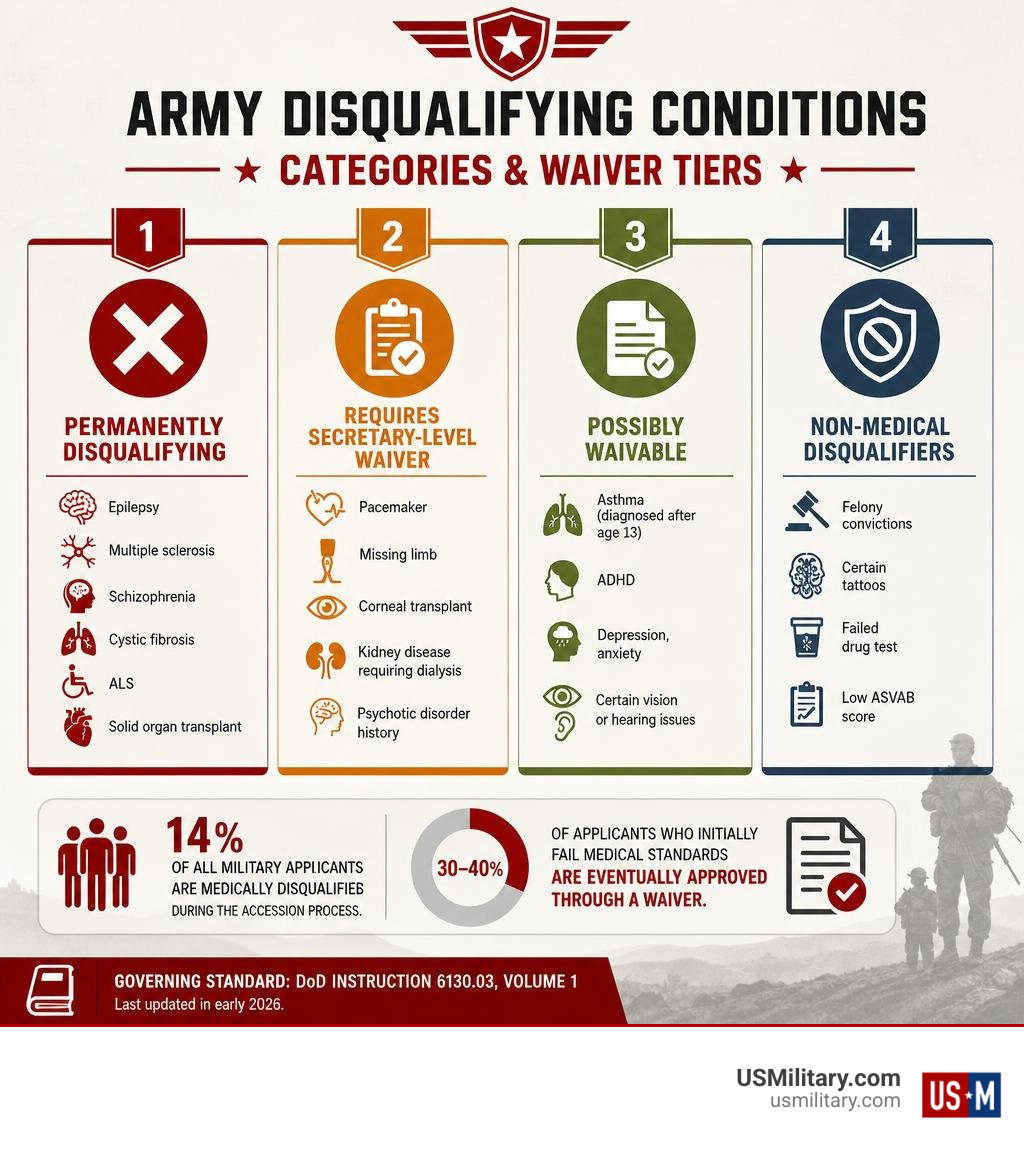
Army disqualifying conditions are specific medical, physical, mental health, and non-medical factors that can prevent someone from enlisting in the U.S. Army. Here is a quick overview of the most common categories:
| Category | Common Examples |
|---|---|
| Permanently disqualifying | Epilepsy, multiple sclerosis, schizophrenia, cystic fibrosis, ALS, solid organ transplant |
| Requires Secretary-level waiver | Pacemaker, missing limb, corneal transplant, kidney disease requiring dialysis, psychotic disorder history |
| Possibly waivable | Asthma (diagnosed after age 13), ADHD, depression, anxiety, certain vision or hearing issues |
| Non-medical disqualifiers | Felony convictions, certain tattoos, failed drug test, low ASVAB score |
About 14% of all military applicants are medically disqualified during the accession process. But not every disqualification is permanent — roughly 30–40% of applicants who initially fail medical standards are eventually approved through a waiver.
The key governing document is DoD Instruction 6130.03, Volume 1, last updated in early 2026. It sets the baseline medical standards for every branch, including the Army.
Failing to disclose a known condition can result in discharge for fraudulent enlistment — so full transparency matters.
I’m Larry Fowler, publisher of the USMilitary.com Network since 2007, and I’ve spent nearly two decades helping recruits and veterans navigate complex topics like Army disqualifying conditions across every branch of service. In this guide, I’ll walk you through exactly what can keep you out — and what options you may still have.
Similar topics to Army disqualifying conditions:
Understanding Army Disqualifying Conditions and Medical Standards
To understand how Army disqualifying conditions are evaluated, we have to look at the process potential recruits undergo. America’s warfighters must be physically and mentally capable of performing highly demanding duties in the harshest environments on Earth. Severe underlying medical conditions introduce significant risks on the battlefield, not just to the individual soldier but to their entire unit.
The baseline medical standards for military service are established by the Department of Defense under DoD Instruction 6130.03, Volume 1. This instruction standardizes the physical and medical requirements across all branches. However, the Army applies these guidelines through its own specific lens using Army Regulation 40-501 (Standards of Medical Fitness).
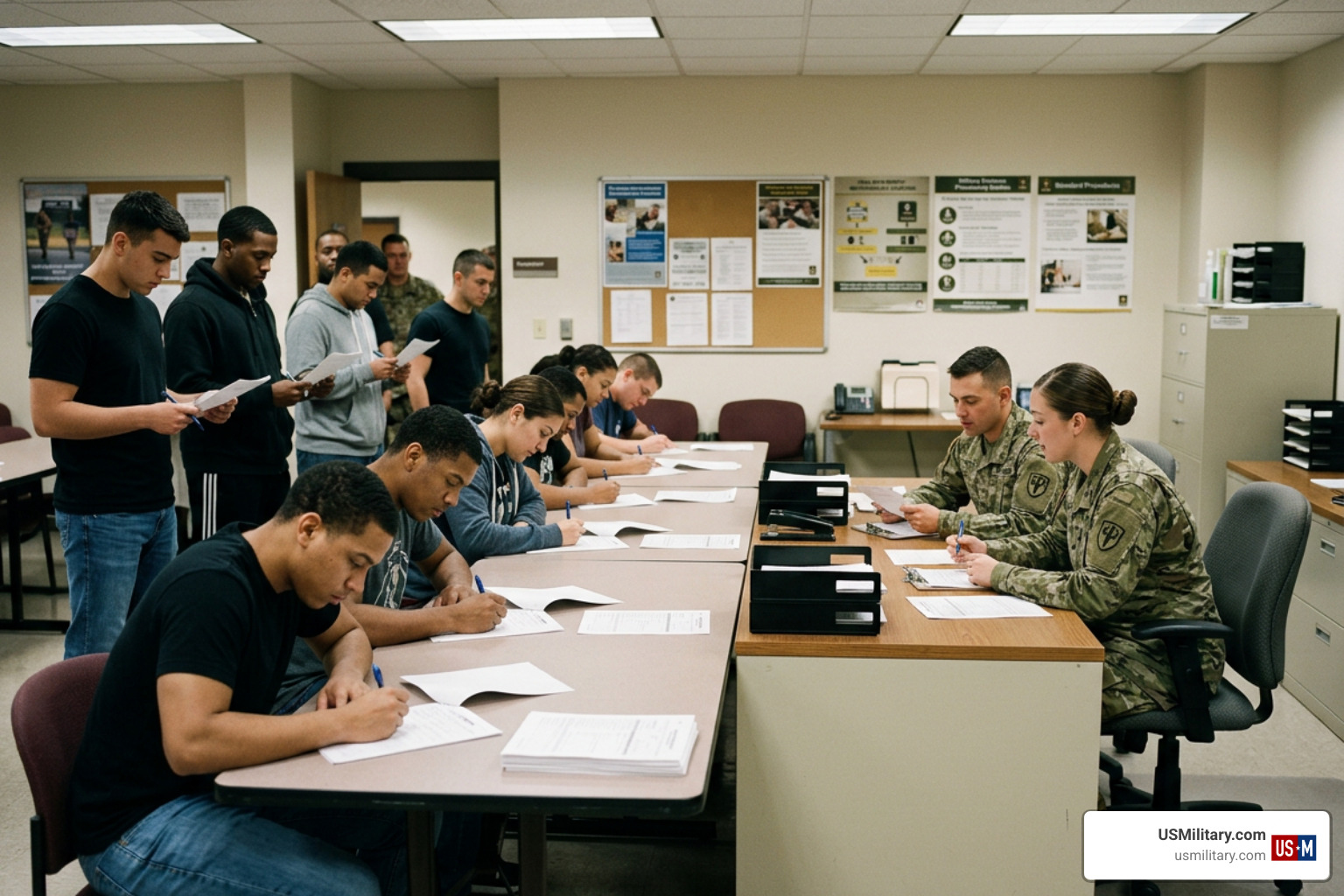
When you apply to join, you will visit a Military Entrance Processing Station (MEPS). There, medical professionals will review your complete medical history and perform a comprehensive physical examination. They will test your vision, hearing, joint mobility, cardiovascular health, and look for any signs of chronic illness.
During this accession process, MEPS doctors are not authorized to grant waivers; they simply record whether you meet the standards. If you do not, you are flagged with a disqualifying condition. To move forward, you must meet the general Army eligibility requirements and successfully navigate the medical waiver process.
Waivable vs. Permanently Disqualifying Medical Conditions
When MEPS flags an applicant with a medical disqualification, it falls into one of two primary categories: waivable or permanently disqualifying.
A waivable condition is a medical issue that does not meet standard entry requirements but is deemed manageable or fully resolved. The Army can choose to overlook the condition on a case-by-case basis if a medical authority determines it will not interfere with your ability to serve.
A permanently disqualifying condition, on the other hand, is a medical issue that presents an unacceptable risk to troop safety and operational readiness. Recent Pentagon policy updates have tightened these rules significantly to ensure force readiness.
Here is a comparison of how different types of conditions are handled under current standards:
| Medical Category | Waivable Status | Key Considerations & Requirements |
|---|---|---|
| Mild Eczema / Atopic Dermatitis | Highly Waivable | Must not require active systemic treatment or cause severe limitations. |
| Healed Sports Injuries (e.g., ACL) | Highly Waivable | Usually requires 12 months post-surgery healing and full range of motion. |
| Asthma (Post-Age 13) | Moderately Waivable | Requires a clear pulmonary function test and no recent hospitalizations. |
| ADHD / ADD | Moderately Waivable | Typically requires being off medication for 12 to 24 months with stable performance. |
| Implanted Pacemaker | Secretary-Level Only | Extremely rare; requires direct sign-off from the Secretary of the Army. |
| Active Schizophrenia | Permanently Disqualifying | Completely ineligible for a waiver under current DoD guidelines. |
| Multiple Sclerosis (MS) | Permanently Disqualifying | Considered a progressive systemic disease and is entirely ineligible. |
Secretary-Level Waivers for Army Disqualifying Conditions
Under the latest DoD guidelines, certain severe medical conditions are disqualified by default but have a tiny sliver of hope: they can be approved, but only if the waiver is signed directly by the Secretary of the Army (or a designated high-level authority).
According to the official DoD Medical Accession Standards, the conditions requiring this elevated level of approval include:
- Presence of an implantable pacemaker or defibrillator
- History of myocardial infarction (heart attack)
- History of corneal transplant or severe vision loss in one eye
- History of chronic kidney disease requiring dialysis
- History of chronic hepatic (liver) failure
- Absence of an eye, foot, or hand
- History of neurodegenerative disorders or central nervous system (CNS) shunts
- History of disorders with psychotic features (unless fully resolved and meeting strict criteria)
- History of scleroderma
Obtaining a Secretary-level waiver is incredibly difficult and requires extensive, indisputable medical documentation proving that the condition will not impact military readiness.
Conditions Ineligible for Any Medical Waiver
The Pentagon has drawn a hard line on several conditions. If you have any of the following, you are completely ineligible for a medical accession waiver to join any military branch:
- Amyotrophic Lateral Sclerosis (ALS) or other rapidly progressive motor neuron diseases
- Active epilepsy or a history of recurrent seizures diagnosed after age 6
- Multiple Sclerosis (MS)
- History of cystic fibrosis
- Current chronic supplemental oxygen use
- Current congestive heart failure
- Current treatment for schizophrenia
- History of paraphilic disorders
- History of receiving a solid organ transplant
- Trisomy 21 (Down Syndrome) or Osteogenesis Imperfecta
- Any suicide attempt or homicidality within the previous 12 months
These rules are strictly enforced to protect both the applicant’s health and the safety of the unit.
Common Medical Hurdles: Asthma, ADHD, and Mental Health
Mental health, respiratory issues, and learning disorders represent the most common medical hurdles for modern recruits. In fact, mental health conditions—including depression, anxiety, or ADHD requiring medication within the past 24 months—account for roughly 20% of all medical disqualifications.
When applying, you must provide a full medical history disclosure. Attempting to hide these conditions is highly risky. With the military’s modern electronic health record system, hiding past prescriptions or diagnoses is nearly impossible, and getting caught can lead to a discharge for fraudulent enlistment.
Navigating ADHD as one of the Army Disqualifying Conditions
Attention-Deficit/Hyperactivity Disorder (ADHD) is incredibly common, and having a history of it does not automatically end your military dreams.
To join the Army with a history of ADHD, you must meet specific criteria. Generally, you must demonstrate that you have been off all ADHD medication (such as Adderall or Ritalin) for at least 12 to 24 months. Furthermore, you must show a history of successful academic or work performance without accommodations during that medication-free period. If you meet these standards, your recruiter can submit a request for a medical waiver. For more details, read our complete guide on how to Join the military with ADHD.
Asthma and Respiratory Standards
Asthma is another major hurdle, affecting an estimated 8% to 10% of military hopefuls. The military standard is clear: any diagnosis of asthma, or treatment with an inhaler, after your 13th birthday is disqualifying.
If you had childhood asthma that completely resolved before you turned 13, you do not need a waiver. However, if you used an inhaler or had symptoms after age 13, you will need to apply for a waiver. This process typically involves undergoing a Pulmonary Function Test (PFT) or a Methacholine Challenge Test to prove your lungs can handle high-intensity physical training without constricting. To learn more about the testing and waiver process, check out our guide to Join the military with asthma.
Mental Health and Psychiatric History
The Army takes psychiatric health very seriously. Conditions like depression, anxiety, mood disorders, or a history of self-harm are heavily scrutinized.
Under Army Directive 2018-12, the Army centralized waiver authority for behavioral health issues to ensure consistent standards. If you have a history of self-mutilation (cutting), a waiver may only be considered if:
- It was a single, isolated episode that occurred before age 14.
- There has been no incident within the 5 years prior to your application.
- A formal psychiatric evaluation confirms there is no ongoing behavioral health condition and that you have healthy coping mechanisms.
Any suicide attempt, gesture, or hospitalization for mental health within the previous 12 months is an absolute, non-waivable disqualifier. For older incidents, you must show a prolonged period of stability off medication and receive a favorable psychiatric evaluation.
Physical, Weight, and Non-Medical Standards for Enlistment
Beyond internal medical issues, the Army enforces strict physical, aesthetic, and behavioral standards.
Height, Weight, and Body Fat
To enlist, you must meet the Army’s height and weight tables. The acceptable height range for both men and women is 58 to 80 inches. If your weight does not fall within the approved range for your height, you will undergo a body fat percentage calculation (the “tape test”).
If you exceed the body fat limits, you may be disqualified. However, the Army offers the Future Soldier Preparatory Course, which provides a dedicated fitness track to help motivated applicants lose body fat and meet the standards before starting Basic Combat Training.
Tattoos and Body Modification
The Army has updated its tattoo policy to be more accommodating, but strict rules remain:
- No tattoos on your face, head, neck (above the collar line), or hands (with the exception of one ring tattoo per hand).
- Absolutely no tattoos that represent extremist, racist, sexist, or indecent concepts.
Legal Records and Conduct
Non-medical standards also include your criminal history. While minor traffic tickets are easily cleared, serious legal issues can prevent enlistment:
- Felonies: A history of felony convictions is generally disqualifying. However, conduct waivers are occasionally available for single, non-violent offenses, provided you have completed all court-ordered conditions. If you have a criminal record, you should read our guide on how to Join the military with a felony.
- Unwaivable Offenses: Convictions for sexual assault, rape, child abuse, drug trafficking, or multiple DUIs are permanently disqualifying and cannot be waived.
You must also achieve a passing score on the Armed Services Vocational Aptitude Battery (ASVAB) to meet the basic cognitive Requirements to join the Army.
Frequently Asked Questions About Army Medical Eligibility
Can you join the Army with diabetes?
Generally, no. Insulin-dependent diabetes (Type 1) is a permanent medical disqualifier. Because active-duty soldiers must deploy to remote areas where access to insulin, refrigeration, and regular meals is highly unpredictable, the risk of diabetic ketoacidosis is too severe.
Type 2 diabetes that requires daily medication is also disqualifying. However, if you have a history of pre-diabetes or Type 2 diabetes that is fully controlled through diet and exercise alone, you may be eligible to apply for a medical waiver. Learn more about the exact regulations in our guide: Join the military with diabetes.
What happens if you fail to disclose a medical condition?
In the past, some applicants tried to hide their medical history. Today, that is nearly impossible due to MHS GENESIS. This is the military’s electronic health record system, which links directly to civilian healthcare networks, pharmacies, and insurance databases. When you sign your enlistment paperwork, you authorize the DoD to pull your medical records. GENESIS will flag past prescriptions, surgeries, and diagnoses.
If you fail to disclose a condition and the Army discovers it later, you can be discharged under “fraudulent enlistment.” This is a serious administrative action that can strip you of your military benefits and leave a permanent stain on your record.
How long does the medical waiver process take?
The timeline for a medical waiver varies wildly based on the complexity of your condition.
- Recruiter Submission: Your recruiter gathers all your medical records, doctor’s notes, and clearance letters.
- Review: The paperwork is sent to the Service Medical Waiver Review Authority (SMWRA).
- Timeline: For simple issues (like a fully healed bone fracture), a waiver might be approved in 2 to 4 weeks. For complex behavioral health, asthma, or neurological reviews, the process can take 3 to 6 months and may require you to pay for independent medical evaluations.
Conclusion
Navigating the list of Army disqualifying conditions can feel overwhelming, but a medical disqualification at MEPS is rarely the end of the road. With 30% to 40% of medical waivers being approved, your dream of serving in the military is often still within reach.
The most important step you can take is to be completely honest with your recruiter. Gather every scrap of medical documentation, coordinate closely with your doctors, and be prepared to be patient.
At USMilitary.com, we are dedicated to helping you navigate your path to service. For more help planning your military career, check out our comprehensive guide on the Requirements to Join the Army or visit USMilitary.com for up-to-date resources on benefits, career paths, and enlistment standards.