
The Army Jobs That Set You Up for the Highest-Paying Civilian Careers

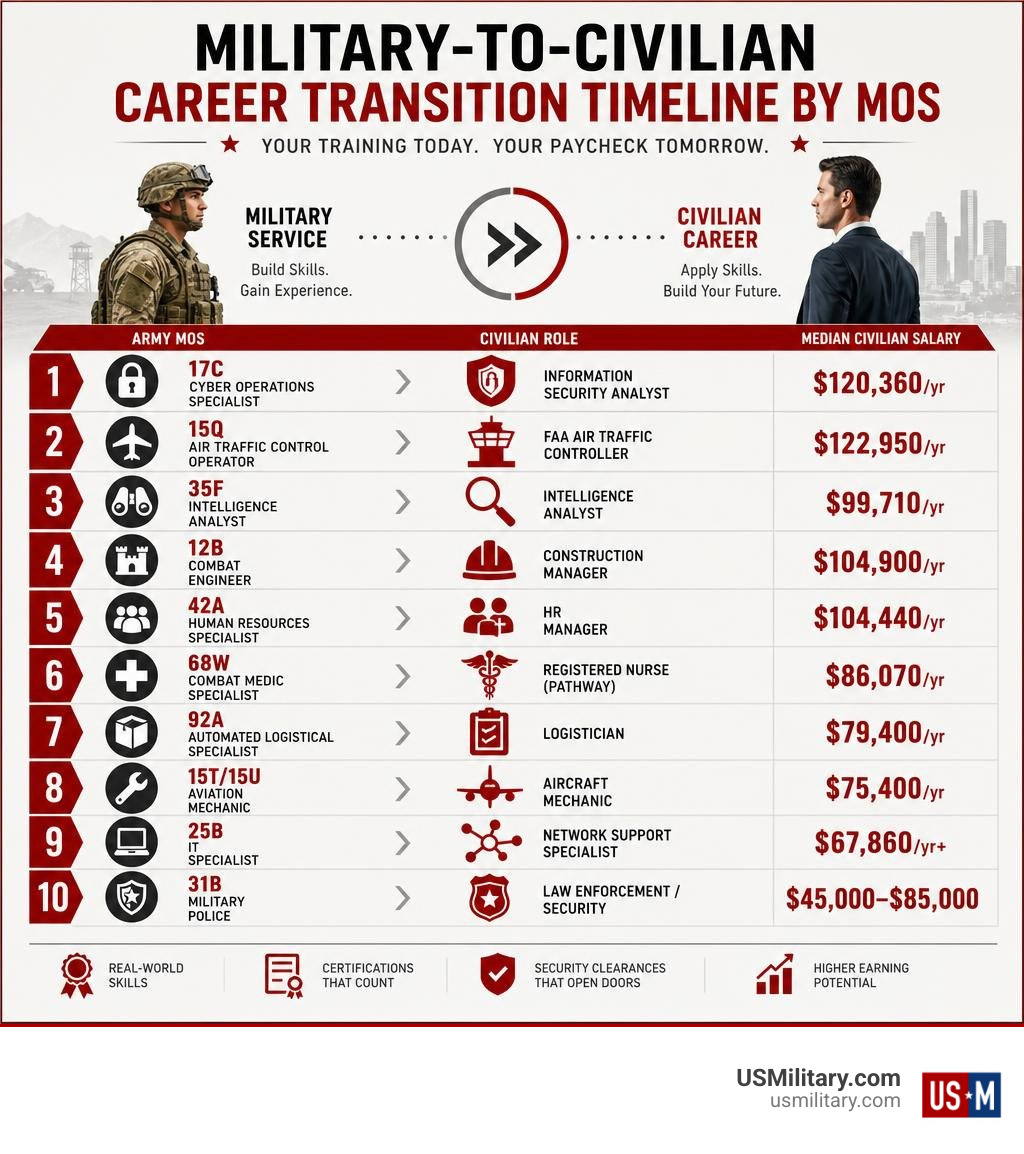
If you want to know what Army jobs provide the highest paying training for civilian careers, here’s the short answer:
| Army MOS | Civilian Role | Median Civilian Salary |
|---|---|---|
| 17C – Cyber Operations Specialist | Information Security Analyst | $120,360/yr |
| 15Q – Air Traffic Control Operator | FAA Air Traffic Controller | $122,950/yr |
| 35F – Intelligence Analyst | Intelligence Analyst | $99,710/yr |
| 12B – Combat Engineer | Construction Manager | $104,900/yr |
| 42A – Human Resources Specialist | HR Manager | $104,440/yr |
| 68W – Combat Medic Specialist | Registered Nurse (pathway) | $86,070/yr |
| 92A – Automated Logistical Specialist | Logistician | $79,400/yr |
| 15T/15U – Aviation Mechanic | Aircraft Mechanic | $75,400/yr |
| 25B – IT Specialist | Network Support Specialist | $67,860/yr+ |
| 31B – Military Police | Law Enforcement / Security | $45,000–$85,000 |
The MOS you choose doesn’t just shape your time in uniform — it can define your earning power for decades after you separate. Some Army jobs come with certifications, security clearances, and hands-on training that civilian employers actively compete for. Others require more deliberate translation to land a high-paying role.
The gap between a $45,000 starting civilian salary and a $120,000+ offer often comes down to one thing: which MOS you served in — and what you did with it.
I’m Larry Fowler, publisher of the USMilitary.com Network since 2007, and I’ve spent nearly two decades helping active-duty soldiers, veterans, and their families understand exactly what Army jobs provide the highest paying training for civilian careers and how to act on that information. In the sections below, I’ll walk you through the top 10 MOSs, the certifications and clearances that multiply your value, and the exact steps to plan your transition.
Related content about What Army Jobs Provide The Highest Paying Training For Civilian Careers:
- Army vs Marines: Whose Boot Camp Is Tougher
- Is The Quality Of Army Soldiers The Same As 50 Years Ago?
- Army basic training length
What Army Jobs Provide The Highest Paying Training For Civilian Careers?

When we look at military service as a stepping stone, we must recognize that not all Military Occupational Specialties (MOSs) are created equal in the eyes of corporate recruiters. The Army spends hundreds of thousands of dollars training individual soldiers in highly technical fields. If you play your cards right, you can walk out of your enlistment with zero student debt, several years of hands-on experience, and a resume that commands six figures.
But what actually drives these high post-service salaries? It isn’t just the military title. The magic formula for maximizing your civilian earning potential relies on three pillars:
- High-Demand Technical Skills: Industries like cybersecurity, aviation, and advanced logistics are facing massive talent shortages.
- Industry-Standard Certifications: Credentials that are universally recognized outside the military gate.
- Active Federal Security Clearances: A golden ticket that saves civilian defense contractors thousands of dollars and months of administrative waiting.
To see how these elements compare across different specialties, check out the Highest Paying Jobs in the US Army 2026: Complete Pay Guide with Charts and Bonuses to understand how military pay structures lay the foundation for civilian success.
How Security Clearances Boost Post-Service Salaries
If you want an immediate raise without changing your job description, get a job that requires a Secret or Top Secret / Sensitive Compartmented Information (TS/SCI) clearance.
In the defense contracting, intelligence, and aerospace sectors, an active clearance is a premium asset. It can easily add $15,000 to $30,000+ to a civilian salary offer. Why? Because sponsoring a civilian for a TS/SCI clearance is an incredibly slow and expensive process for a company. By hiring a veteran who already holds an active clearance, employers bypass the background checks and wait times, allowing you to walk into secure facilities and start working on day one.
MOSs in intelligence (35-series), cyber (17-series), and advanced communications (25-series) are the most reliable gateways to these cleared, high-paying roles.
The Value of Military Certifications in the 2026 Job Market
While the Army’s internal schoolhouses are world-class, corporate hiring managers do not always understand what an Army “AIT” or “ALC” graduate actually knows. That is why civilian certifications are the ultimate translator.
- CompTIA Security+ / CISSP: Mandatory for almost any IT or cybersecurity role in both the federal government and private sectors.
- Project Management Professional (PMP): The gold standard for turning leadership of “platoons and motor pools” into “corporate operations.”
- FAA Airframe & Powerplant (A&P) License: The mandatory legal credential required to work on commercial aircraft.
- National Registry of Emergency Medical Technicians (NREMT): The absolute baseline for any transition into civilian healthcare.
By pairing your daily Army duties with targeted credentialing, you ensure that your resume passes through corporate Applicant Tracking Systems (ATS) and lands directly on a hiring manager’s desk. For more on this, explore the 6 Best MOS in the Army for Civilian Jobs – MedCerts program pathways.
Top 10 Army Jobs for High-Paying Civilian Careers

Let’s dive into the specific Army jobs that provide the most lucrative training pipelines for your post-military life. These roles span technology, healthcare, aviation, and leadership, offering clear pathways to high-demand civilian sectors.
1. Cyber Operations Specialist (17C): What Army Jobs Provide The Highest Paying Training For Civilian Careers
The absolute gold standard for technical enlistments in 2026 is the Cyber Operations Specialist (17C). The Army invests upwards of $300,000 to train a single cyber soldier, teaching them both defensive and offensive cyber operations.
- Civilian Equivalent: Cybersecurity Analyst, Penetration Tester, Cloud Security Engineer
- Median Civilian Salary: $120,360 per year (with top performers reaching $130,000 to $150,000 within two years of separation)
- Why It Pays: The Bureau of Labor Statistics (BLS) projects a massive 33% job growth through 2033 for information security analysts. When you combine this demand with the TS/SCI clearance you receive during training, you become one of the most sought-after professionals in the tech sector.
For those interested in this pathway, you can read more about Military Jobs Requiring a High IQ to see how the Army screens for these elite technical roles.
2. Information Technology Specialist (25B): What Army Jobs Provide The Highest Paying Training For Civilian Careers
If you want a highly versatile tech background, the Information Technology Specialist (25B) is an incredible choice. This role focuses on operating and maintaining local area networks, hardware, and software systems.
- Civilian Equivalent: Network Support Specialist, Systems Administrator, IT Project Manager
- Median Civilian Salary: $67,860 to $100,000+ (highly dependent on certifications)
- Why It Pays: While the base military training is excellent, the real value of a 25B lies in the opportunity to stack certifications like CompTIA A+, Network+, and Security+ while on active duty.
To see how you can qualify for this MOS, check out our guide on Army Jobs Based on ASVAB Scores as well as the ASVAB Scores and Army Jobs: Your Path to Enlistment Starts Here resource.
3. Intelligence Analyst (35F)
Intelligence Analysts are trained to put together complex puzzles, analyzing raw data to identify threats and advise commanders on battle strategies.
- Civilian Equivalent: Intelligence Analyst, Threat Intelligence Specialist, Business Intelligence Consultant
- Median Civilian Salary: $99,710 per year
- Why It Pays: The intelligence community, federal agencies (like the FBI, CIA, and NSA), and defense contractors are constantly recruiting 35F veterans. The combination of analytical training and an active TS/SCI clearance makes you an immediate candidate for high-paying federal contracting roles.
Discover how this fits into the broader military landscape in our article on the Best Jobs in the Army.
4. Combat Engineer (12B)
If you prefer a hands-on career that combines leadership with physical infrastructure, Combat Engineers manage construction, demolitions, and structural rigging under pressure.
- Civilian Equivalent: Construction Manager, Field Operations Lead
- Median Civilian Salary: $104,900 per year
- Why It Pays: Combat Engineers manage massive projects, heavy machinery, and diverse teams. By adding civilian safety credentials like OSHA-30 or a Certified Construction Manager (CCM) designation during your service, you can easily step into six-figure corporate construction management roles.
For more details on engineering and technical fields, check out the Top Military Careers 2025 guide.
5. Aviation Mechanics (15T/15U)
The Army’s helicopters—such as the UH-60 Black Hawk (15T) and the CH-47 Chinook (15U)—require meticulous maintenance. The soldiers who keep them flying are trained to the highest technical standards.
- Civilian Equivalent: Aircraft Mechanic, Airframe and Powerplant (A&P) Technician
- Median Civilian Salary: $75,400 per year
- Why It Pays: There is a severe, nationwide shortage of certified aviation mechanics. The Army’s aviation training is directly recognized by the FAA, allowing transitioning soldiers to bypass civilian school requirements and take their A&P exams quickly.
6. Combat Medic Specialist (68W)
As the second-largest MOS in the Army, Combat Medics are trained in both emergency trauma care and primary clinical medicine.
- Civilian Equivalent: Registered Nurse (RN), Paramedic, Physician Assistant (PA)
- Median Civilian Salary: $86,070 per year (RN pathway)
- Why It Pays: While a starting EMT salary can be modest, the clinical hours and emergency trauma experience you gain as a 68W give you a massive head start. Many medics use their GI Bill to complete accelerated nursing (BSN) or Physician Assistant programs, stepping rapidly into high-paying medical careers.
7. Automated Logistical Specialist (92A)
The military is, at its core, a massive global logistics machine. Automated Logistical Specialists manage the supply chains, warehouse operations, and database systems that keep the Army moving.
- Civilian Equivalent: Supply Chain Manager, Logistics Analyst, Warehouse Operations Director
- Median Civilian Salary: $79,400 per year
- Why It Pays: Global companies like Amazon, DHL, and Walmart actively recruit military logisticians. If you pair your 92A experience with a civilian supply chain certification like CSCP (Certified Supply Chain Professional), you will be highly competitive for senior corporate roles.
Read more about logistical opportunities in our breakdown of Military Careers and Opportunities.
8. Air Traffic Control Operator (15Q)
Air Traffic Controllers direct the flow of aircraft in tactical and airfield environments, making split-second decisions where safety is paramount.
- Civilian Equivalent: FAA Air Traffic Controller
- Median Civilian Salary: $122,950 per year
- Why It Pays: This is one of the highest-paying civilian careers you can land without a four-year college degree. The FAA frequently hires military-trained controllers through specialized prior-experience tracks, allowing you to transition seamlessly into high-paying civilian tower roles.
To learn more about high-responsibility, high-aptitude fields, read our guide on Military Jobs Requiring a High IQ.
9. Human Resources Specialist (42A)
Human Resources Specialists manage administrative support, personnel records, and career development systems for thousands of soldiers.
- Civilian Equivalent: Human Resources Manager, Talent Acquisition Director
- Median Civilian Salary: $104,440 per year
- Why It Pays: Corporate HR is about compliance, leadership, and system management—all of which are baked into 42A training. Transitioning HR specialists who obtain a civilian SHRM (Society for Human Resource Management) certification are highly valued in the corporate sector.
For those looking for administrative or non-combat options, explore our resource on Military Jobs No Fighting.
10. Military Police (31B)
Military Police officers protect lives and property on military installations while enforcing military laws and regulations.
- Civilian Equivalent: Law Enforcement Officer, Physical Security Manager, Corporate Investigator
- Median Civilian Salary: $45,000 to $85,000+ per year
- Why It Pays: MP training translates directly to federal, state, and local law enforcement agencies. Additionally, many corporate companies hire former MPs to run their physical security infrastructure, asset protection, and loss prevention departments.
You can learn more about security-oriented roles in our analysis of the Safest Military Jobs.
Transition Resources and Career Pathways for Veterans
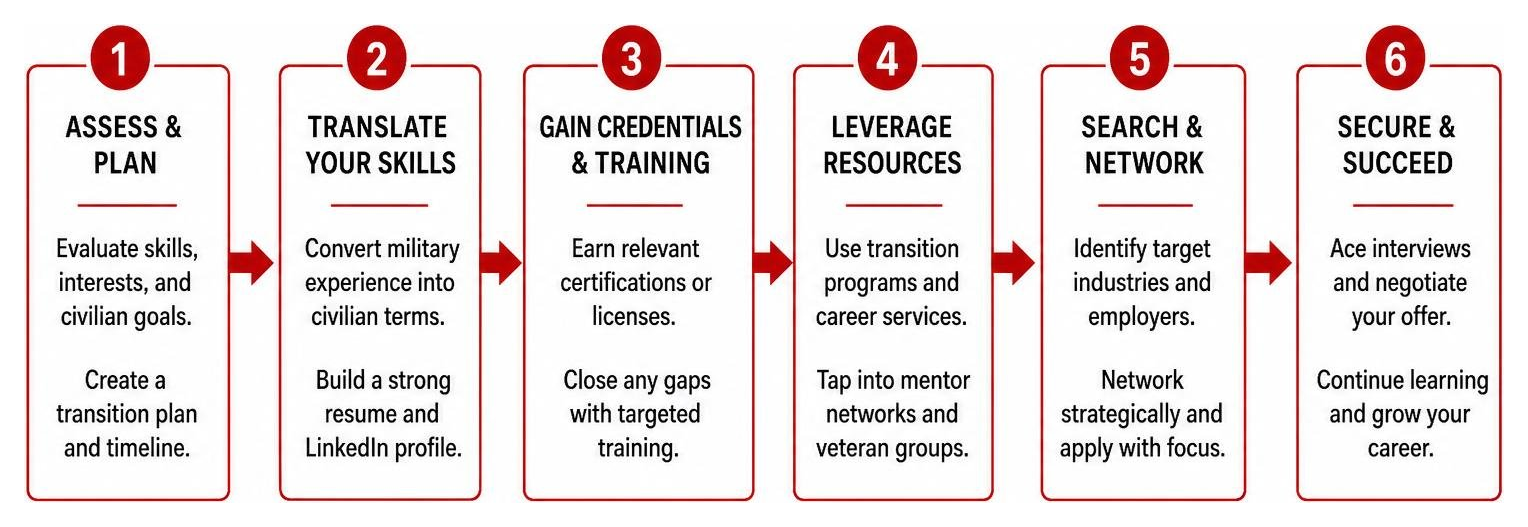
Leaving the military is a process, not an event. Successfully translating your technical or combat training into a high-paying civilian career requires utilizing the structured transition programs provided by the Department of Defense.
To help visualize how different military backgrounds map to civilian success, let’s compare the pathways of technical and combat-oriented roles:
| Military Background | Primary Transition Challenge | Recommended Certification | Target Civilian Industry |
|---|---|---|---|
| Technical MOS (e.g., 17C, 25B, 15T) | Translating military jargon to corporate terms | CompTIA Security+, FAA A&P, CISSP | Defense Contracting, Aerospace, Tech |
| Combat Arms (e.g., 11B, 19D, 13B) | Finding direct job equivalents | PMP, OSHA-30, Lean Six Sigma | Project Management, Logistics, Operations |
To maximize your transition, we highly recommend reading the Best Army Jobs in 2026: Top US Army MOS Rankings for Pay, Quality of Life & Civilian Success to see how post-service outcomes are trending this year.
How Combat Arms Veterans Can Leverage Leadership for Six-Figure Roles
If you served in a combat arms role like Infantry (11B) or Cavalry Scout (19D), you might worry that your skills don’t translate to a corporate office. After all, “expert marksmanship” and “tactical movement” aren’t standard corporate requirements.
However, combat arms veterans possess incredible leadership, stress tolerance, and operational planning skills. The key to hitting six figures is translating this experience. By earning a Project Management Professional (PMP) certification, you can reframe your military experience:
- “Platoon Sergeant” becomes “Senior Operations Manager.”
- “Managing a company field exercise” becomes “Directing cross-functional projects under strict budget and timeline constraints.”
For a step-by-step roadmap on how to make this leap, refer to our Top 10 Military Jobs Six Figures Guide.
Leveraging Army COOL and Credentialing Assistance
The Army Credentialing Opportunities On-Line (COOL) program is an incredible resource that funds civilian certifications while you are still on active duty.
- Funding Update: As of March 2026, the annual Credentialing Assistance (CA) cap is $2,000 per year, with a lifetime limit of one credential per year and a maximum of three credentials within a ten-year period.
- How to Use It: Do not wait until your transition window. Use your CA funds early in your enlistment to earn certifications like Security+ or PMP so they are already active on your resume when you begin job hunting.
For official guidance on utilizing these benefits, visit Army Civilian Careers | U.S. Army to explore how civilian roles align with your military training.
Planning Your Transition Timeline 12 to 18 Months Before ETS
Your transition planning should begin at least 12 to 18 months before your End of Active Service (ETS) date. Here is a quick checklist to keep you on track:
- 18 Months Out: Attend your initial Transition Assistance Program (TAP) briefing and identify your target civilian industry.
- 12 Months Out: Research companies and start utilizing DoD SkillBridge—a program that allows you to spend your last 180 days of active duty doing an internship with a civilian employer while still receiving your military pay and benefits.
- 6 Months Out: Translate your resume into civilian terms, build a professional LinkedIn profile, and connect with veteran-friendly employers like Lockheed Martin, Amazon, Booz Allen Hamilton, and Deloitte.
For more information on career options with projected fast growth, read the BLS report on From military to civilian: Career options with projected fast growth ….
Frequently Asked Questions About High-Paying Army Jobs
Can you make six figures in a civilian career without a college degree?
Absolutely. Fields like cybersecurity, cloud engineering, and air traffic control heavily prioritize hands-on experience, active security clearances, and industry certifications over a traditional four-year degree. A veteran with a 17C or 15Q background and the right credentials can easily secure a six-figure salary without ever stepping into a college classroom.
How much does an active security clearance increase your civilian salary?
An active Secret or Top Secret/SCI clearance is highly valued by defense contractors and federal agencies. Holding an active clearance typically adds a $15,000 to $30,000+ premium to civilian salary offers because it saves employers the immense time and cost of sponsoring a new clearance from scratch.
What are the fastest Army MOSs to get a civilian job after separation?
Aviation Mechanics (15T/15U) with their FAA A&P licenses, IT Specialists (25B) with CompTIA certifications, and Combat Medics (68W) with active NREMT credentials generally experience the fastest transitions. These roles have direct civilian equivalents with immediate, high-volume hiring needs.
Conclusion
Choosing the right Army job is one of the most impactful financial decisions you will ever make. By aligning your military service with high-paying civilian industries, taking advantage of Army COOL to earn industry-standard certifications, and protecting your security clearance, you can set yourself up for a highly lucrative post-military career.
At USMilitary.com, we are dedicated to helping you navigate every stage of your military journey—from understanding Army Basic Training requirements to optimizing your VA home loans, disability benefits, and transition strategies.
Ready to take the next step in planning your career? Explore our comprehensive resources at USMilitary.com to find the perfect path for your future.