
The Stories Behind 10 Army Medal of Honor Recipients You Should Know
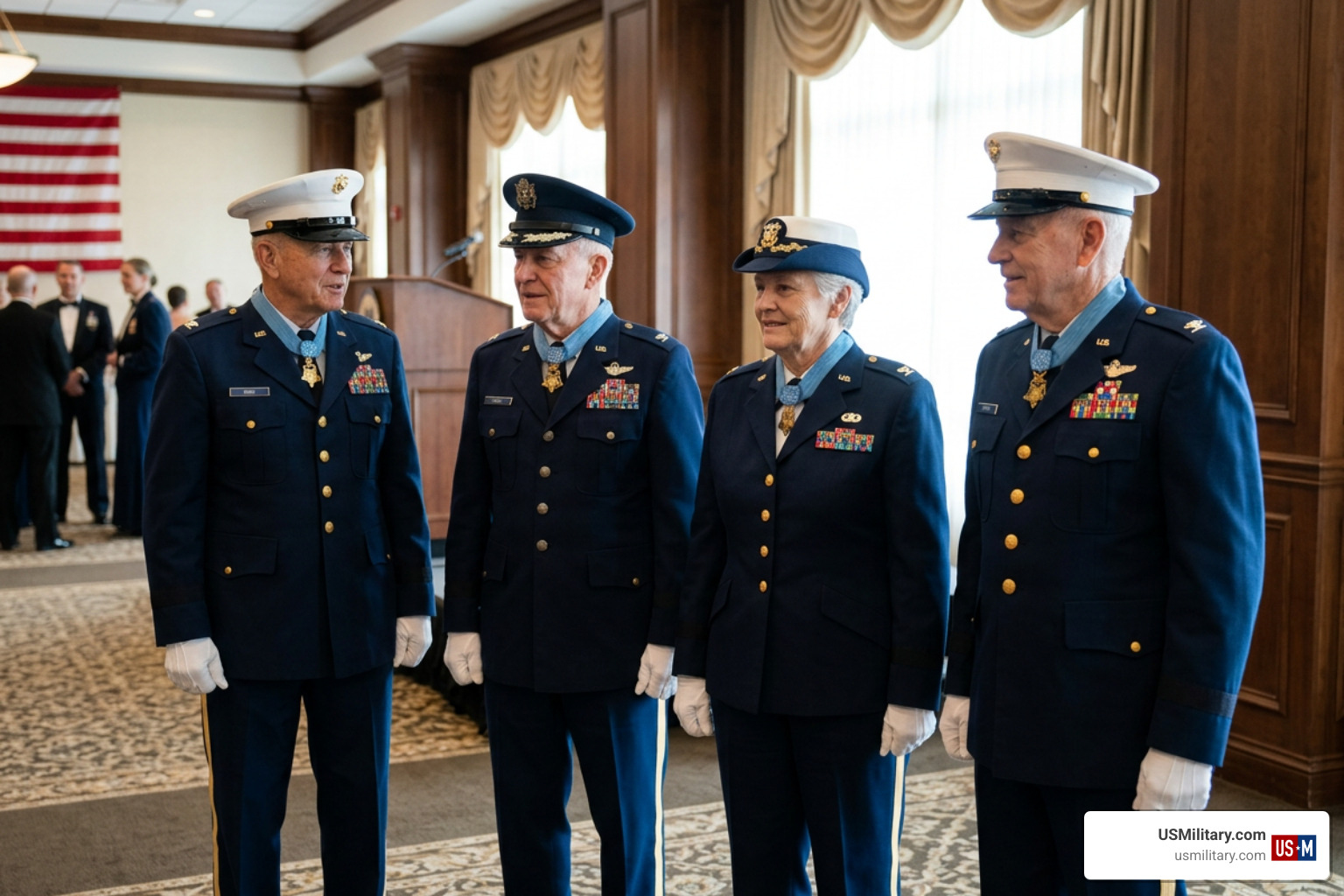
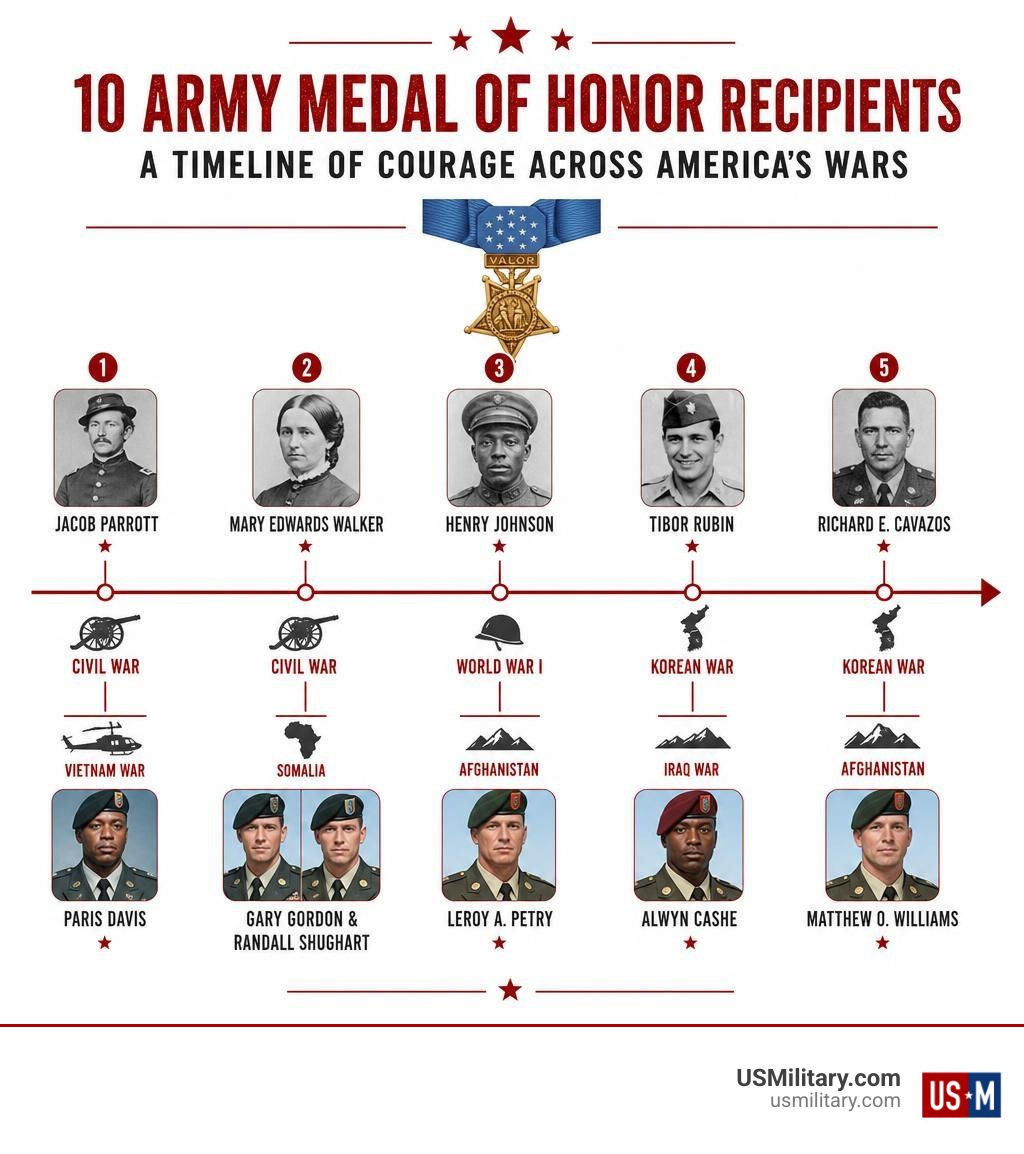
10 Army Medal of Honor recipients have been selected here to represent the best of American military valor — spanning the Civil War all the way to the War on Terror.
Here is a quick overview of the 10 recipients covered in this article:
| # | Recipient | Conflict | Status |
|---|---|---|---|
| 1 | Jacob Parrott | Civil War | Posthumous |
| 2 | Mary Edwards Walker | Civil War | Posthumous |
| 3 | Henry Johnson | World War I | Posthumous |
| 4 | Tibor Rubin | Korean War | Deceased |
| 5 | Richard E. Cavazos | Korean War | Deceased |
| 6 | Paris Davis | Vietnam War | Living |
| 7 | Gary Gordon & Randall Shughart | Somalia | Posthumous |
| 8 | Leroy A. Petry | Afghanistan | Living |
| 9 | Alwyn Cashe | Iraq War | Posthumous |
| 10 | Matthew O. Williams | Afghanistan | Living |
The Medal of Honor is the highest military decoration the U.S. government can award. Of the 3,500+ total recipients, 2,465 have been U.S. Army soldiers — more than any other branch.
These are not just war stories. They are lessons in courage, sacrifice, and what it means to put others first under impossible conditions.
As of July 2026, 65 living Medal of Honor recipients remain. Many continue to serve their country in peacetime by promoting the values the medal represents — courage, integrity, and patriotism.
I’m Larry Fowler, publisher of USMilitary.com, and I’ve spent nearly two decades helping active-duty service members and veterans navigate military service and benefits — including studying the history of 10 Army Medal of Honor recipients and the extraordinary actions behind each award. Read on for the full stories of these legendary soldiers.
History and Evolution of the Army Medal of Honor
To truly appreciate the actions of our 10 Army Medal Of Honor Recipients, we must understand the history of the award itself. The Medal of Honor was born out of necessity during the darkest days of the American Civil War.
While the Navy version was authorized first in December 1861, the Army version was established on July 12, 1862, following a bill introduced by Massachusetts Senator Henry Wilson. You can read more about its origins on the Medal of Honor history page.
In those early days, the criteria for the medal were vastly different than they are today. It was initially the only military award available for valor, meaning some early medals were handed out for actions that, while brave, might not meet today’s incredibly strict standards. Over the decades, the military established a clear hierarchy of awards, which you can explore in our guide to Military Ranks in Order. This “Pyramid of Honor” reserved the Medal of Honor strictly for those who distinguished themselves “conspicuously by gallantry and intrepidity at the risk of life above and beyond the call of duty.”
As the criteria evolved, so did the physical medal. Today, there are three distinct designs: the original star shape for the Navy, Marine Corps, and Coast Guard; the wreath version designed for the Army in 1904; and the altered wreath version created for the Air Force in 1965.
The ultimate resting place for many who wore this medal is Arlington National Cemetery, where more than 400 recipients are interred or memorialized. Their legacies remain preserved for future generations, and you can search their records through the database of Arlington National Cemetery burials.
Profiles of 10 Army Medal Of Honor Recipients
The following ten individuals represent different eras, backgrounds, and ranks within the U.S. Army. Yet, each of them shared an unwavering commitment to their fellow soldiers and their country.
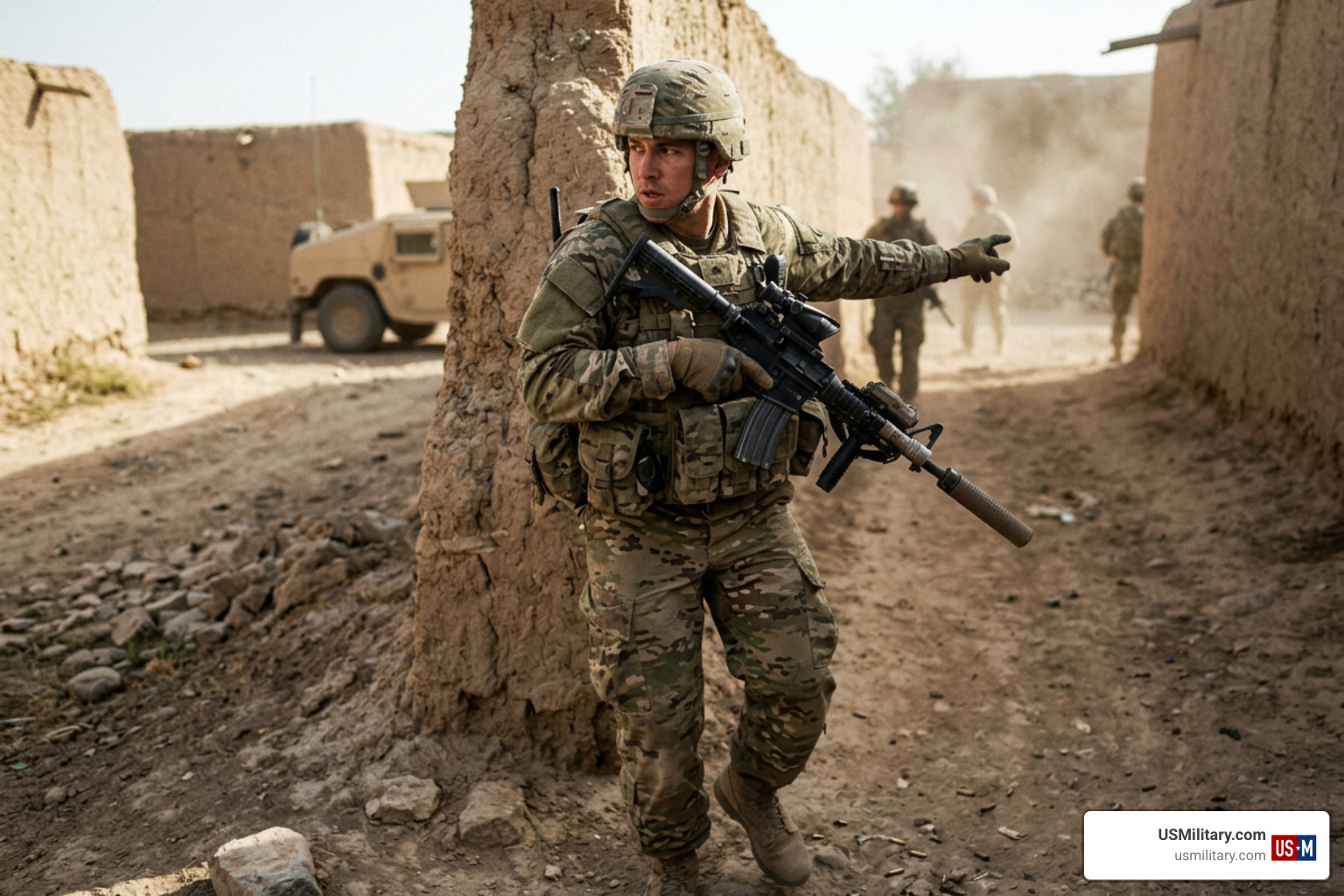
Through their official citations, compiled by the Department of Defense on the Army Medal of Honor Recipients portal, we can see the sheer diversity of service members who have earned this distinction.
| Recipient | Rank at Action | Primary Unit | Key Action |
|---|---|---|---|
| Jacob Parrott | Private | 33rd Ohio Infantry | Penetrated enemy lines to disrupt Confederate rail networks. |
| Mary Edwards Walker | Contract Surgeon | Army of the Cumberland | Treated wounded on the front lines and survived POW captivity. |
| Henry Johnson | Private | 369th Infantry Regiment | Fought off a German raiding party alone to save a fellow soldier. |
| Tibor Rubin | Corporal | 8th Cavalry Regiment | Defended a hill single-handedly and kept fellow POWs alive. |
| Richard E. Cavazos | First Lieutenant | 65th Infantry Regiment | Led multiple daring rescues of wounded men under heavy fire. |
| Paris Davis | Captain | 5th Special Forces Group | Refused evacuation to rescue pinned-down teammates in Vietnam. |
| Gary Gordon & Randall Shughart | Master Sergeant / Sergeant First Class | USASOC / Delta Force | Volunteered to defend a downed helicopter crew in Mogadishu. |
| Leroy A. Petry | Staff Sergeant | 75th Ranger Regiment | Threw a live enemy grenade away from his team, losing his hand. |
| Alwyn Cashe | Sergeant First Class | 3rd Infantry Division | Pulled multiple soldiers from a burning vehicle while on fire. |
| Matthew O. Williams | Sergeant | 3rd Special Forces Group | Evacuated casualties down a sheer cliff face under intense fire. |
1. Jacob Parrott: The First of the 10 Army Medal Of Honor Recipients
In April 1862, a young Private named Jacob Parrott volunteered for a mission so dangerous it sounded like the plot of a Hollywood movie. Parrott and a small group of Union soldiers, later known as “Andrews’ Raiders,” slipped deep into Confederate territory in civilian clothing. Their mission: hijack a locomotive named The General and drive it north, destroying tracks, bridges, and telegraph lines along the way.
The mission, known historically as the Great Locomotive Chase, ended in their capture. Parrott was brutally beaten and tortured by his captors but refused to reveal the identities of his comrades or the details of their mission.
Following a prisoner exchange, Parrott was brought to Washington, D.C. On March 25, 1863, Secretary of War Edwin Stanton presented him with the very first Medal of Honor ever awarded. His resilience under torture set the standard for what it meant to hold the line under pressure.
2. Mary Edwards Walker: The Only Female of the 10 Army Medal Of Honor Recipients
Dr. Mary Edwards Walker was a trailblazer in every sense of the word. At the outbreak of the Civil War, she attempted to join the Union Army as a medical officer but was rejected because she was a woman. Undeterred, she volunteered as a civilian contract surgeon, frequently crossing battle lines to treat wounded soldiers from both sides.
In 1864, she was captured by Confederate forces and spent four months in a notorious prisoner-of-war camp before being exchanged. In recognition of her tireless service on the front lines, President Andrew Johnson awarded her the Medal of Honor in 1865.
However, her story took a controversial turn in 1917 when Congress revised the medal’s criteria, restricting it to those who engaged in actual combat. Walker’s medal, along with hundreds of others, was rescinded. She flatly refused to return it, wearing it proudly on her lapel until her death. In 1977, President Jimmy Carter officially restored her award, cementing her status as the only female recipient in American history.
3. Henry Johnson: World War I Hero of the Harlem Hellfighters
Private Henry Johnson served with the 369th Infantry Regiment, an all-Black unit famously known as the “Harlem Hellfighters.” Because of racial segregation policies within the U.S. military at the time, Johnson’s unit was assigned to fight under French command.
On May 15, 1918, while on sentry duty in the Argonne Forest, Johnson and a fellow soldier came under a surprise attack by a German raiding party of at least a dozen men. Despite suffering 21 distinct wounds, Johnson fought back with his rifle, then his rifle butt, and finally his bolo knife when he saw the Germans attempting to take his comrade prisoner. He successfully repelled the attack, saving his fellow soldier and preventing a breach of the Allied lines.
While the French government immediately awarded Johnson their highest military honor, the Croix de Guerre, his own country offered no official recognition during his lifetime. Decades of advocacy finally culminated in 2015 when President Barack Obama posthumously awarded him the Medal of Honor, adding him to the proud legacy of African-American Medal of Honor recipients.
4. Tibor Rubin: Holocaust Survivor and Korean War Hero
Tibor Rubin’s survival story began long before he ever wore an American uniform. As a Jewish teenager in Hungary, he survived 14 months in the Mauthausen concentration camp. After being liberated by U.S. soldiers, he vowed to move to America and join the Army to repay the country that saved his life.
During the Korean War, Corporal Rubin found himself defending a hill single-handedly for 24 hours to cover his unit’s retreat, personally neutralizing dozens of enemy fighters. Later, his unit was overrun, and Rubin was captured.
For the next 30 months, he survived a Chinese POW camp. Using the survival skills he learned in the Holocaust, he repeatedly sneaked out of the camp at night to steal food from enemy storehouses, keeping his fellow prisoners alive.
Despite being nominated for the Medal of Honor by his officers, the paperwork was intentionally held back by a sergeant who harbored deep anti-Semitic prejudices. It took a massive congressional review of military records to rectify the injustice. In 2005, Rubin finally received his long-overdue medal from President George W. Bush.
5. Richard E. Cavazos: Legendary Leader in the Korean War
First Lieutenant Richard E. Cavazos distinguished himself during the Korean War as a platoon leader with the 65th Infantry Regiment, a legendary unit composed primarily of Puerto Rican soldiers.
During an assault on a heavily fortified enemy position on June 14, 1953, Cavazos’ platoon came under intense artillery and small-arms fire. Despite being ordered to withdraw, Cavazos noticed that several of his men were missing. He made multiple solo trips back into the active impact zone, braving heavy fire to locate and carry wounded soldiers to safety.
His actions that day saved countless lives and showcased the tactical brilliance that would define his career. He eventually rose through the ranks to become the U.S. Army’s very first Hispanic four-star general. His heroic actions in Korea were officially recognized alongside other legends in a special ceremony highlighting 7 Soldiers from Korean and Vietnam Wars.
6. Paris Davis: One of the First Black Special Forces Officers
Captain Paris Davis was one of the first African American officers in the newly formed Army Special Forces. In June 1965, during a fierce battle near Bồng Sơn, Vietnam, Davis and his small team of Green Berets were pinned down by a massive North Vietnamese force.
Davis was shot several times but refused to be evacuated. When he saw his teammates lying wounded in an open rice paddy, he crawled out under intense fire to rescue them one by one. Despite direct orders from his commander to withdraw, Davis famously replied, “I’m not leaving my men.”
Davis’s commander immediately submitted him for the Medal of Honor, but the paperwork mysteriously vanished twice in Saigon. Many suspected racial bias played a role in the “lost” files. Decades later, a dedicated team of volunteers and veterans reconstructed the file. In March 2023, nearly 60 years after his heroic actions, Davis was finally awarded the medal, receiving his AUSA Marshall Medal recognition as well for his lifetime of service.
7. Gary Gordon and Randall Shughart: Somalia Snipers
On October 3, 1993, during the Battle of Mogadishu, a U.S. Black Hawk helicopter was shot down by Somali militia. A large, heavily armed crowd of insurgents quickly began advancing on the crash site, where the surviving crew members lay injured and trapped.
From a helicopter overhead, sniper team leader Master Sergeant Gary Gordon and Sergeant First Class Randall Shughart repeatedly requested permission to insert themselves on the ground to protect the crew. They were denied twice due to the extreme danger, but they persisted until their commanders finally agreed.
Equipped with only their sniper rifles and pistols, Gordon and Shughart fought their way through a dense maze of shanties to reach the crash site. They pulled the wounded pilot, Michael Durant, from the cockpit and established a defensive perimeter. They held off hundreds of armed militia members until they ran out of ammunition and were both mortally wounded. Their sacrifice saved Durant’s life and remains one of the most profound examples of teamwork in the history of Special Operations Forces recipients.
8. Leroy A. Petry: Modern Ranger Valor in Afghanistan
On May 26, 2008, Staff Sergeant Leroy A. Petry and his team of Army Rangers were clearing a target compound in Paktya Province, Afghanistan, when they came under heavy fire. Petry was shot through both legs but managed to lead his men to a temporary covered position.
An insurgent threw a hand grenade that landed just feet from his pinned-down teammates. Recognizing the immediate danger to his men, Petry did not hesitate. He crawled forward, picked up the live grenade, and prepared to throw it back.
As he released the grenade, it detonated, severing his right hand. Despite his catastrophic injury, Petry remained conscious, applied his own tourniquet, and continued to direct his squad until help arrived. His selfless act saved the lives of his fellow Rangers. Petry survived his injuries, received a state-of-the-art prosthetic hand, and remains an active voice among living Medal of Honor recipients.
9. Alwyn Cashe: Unmatched Heroism in Iraq
Sergeant First Class Alwyn Cashe was serving in Salah ad Din Province, Iraq, on October 17, 2005, when his Bradley Fighting Vehicle struck an improvised explosive device (IED). The blast ruptured the vehicle’s fuel tank, showering the interior and the crew with diesel fuel before the vehicle erupted in flames.
Cashe escaped the vehicle with minor injuries, but he immediately realized that his squad was trapped inside. Without regard for his own safety, he ran back to the burning vehicle to pull the driver to safety.
As he worked, his fuel-soaked uniform caught fire. Covered in flames, Cashe repeatedly returned to the burning vehicle, pulling six of his soldiers and an Iraqi interpreter from the inferno. He refused medical evacuation until all of his men had been treated first.
Cashe later succumbed to his severe burns, but his legacy of absolute devotion to his men redefined the standard of modern military heroism. He was posthumously awarded the Medal of Honor in December 2021, and his career remains a shining example of the dedication celebrated by awards like the Army Good Conduct Medal.
10. Matthew O. Williams: Shok Valley Savior
In April 2008, Sergeant Matthew O. Williams was deployed to Shok Valley, Afghanistan, as part of a Special Forces operational detachment. Their mission was to capture or kill high-value targets in a heavily defended mountain fortress.
As the lead element moved up the mountain, they were ambushed by a force of over 100 insurgents, pinning them down on a sheer cliff face. When he heard that his fellow Green Berets were wounded and in danger of being overrun, Williams gathered a small team of Afghan commandos and charged up the mountain under heavy fire.
Over the course of a brutal six-hour firefight, Williams repeatedly exposed himself to enemy fire to rescue wounded soldiers, establish a firing position to keep the insurgents back, and coordinate the evacuation of casualties down a 100-foot cliff. His quick thinking and tactical leadership saved the lives of his entire team. Williams was awarded the Medal of Honor in 2019, showcasing the incredible caliber of soldiers produced by the Special Operations Forces recipients program. If you are inspired by his story and want to explore your own path of service, you can learn more about the process through US Army Recruiting.
Common Themes of Courage, Sacrifice, and Leadership
When we look closely at these 10 Army Medal Of Honor Recipients, several powerful themes emerge. First is the sheer reality of the risk involved: many of these medals were awarded posthumously. This stark statistic underscores the ultimate sacrifice required when a soldier decides to put the lives of their teammates above their own survival.

Second, these actions did not just earn medals; they directly impacted the outcome of battles and saved lives. Whether it was Gary Gordon and Randall Shughart holding off a militia to keep a pilot alive, or Alwyn Cashe pulling his squad from a burning vehicle, these soldiers altered the course of history for their units.
For modern service members, these stories serve as the ultimate leadership manual. They remind us that true leadership isn’t about rank or authority; it is about responsibility, integrity, and the willingness to serve those under your command. If you are considering a career in the military or want to learn how you can serve, you can find a local office using our Army Recruiter Near Me tool.
The process of moving from an act of valor to receiving the nation’s highest honor is highly selective, as illustrated in the step-by-step progression below:

Frequently Asked Questions About Army Medal of Honor Recipients
How many Army soldiers have received the Medal of Honor?
To date, the U.S. Army has awarded 2,465 Medals of Honor. This represents the largest share of medals awarded among all branches of the military. You can explore the historical breakdown of these awards in the congressional report on Medal of Honor Recipients: 1979-2007.
Why were some Medal of Honor awards delayed or upgraded decades later?
Delays in awarding the Medal of Honor have historically occurred due to administrative errors, lost paperwork, or systemic racial discrimination. In the late 1990s and early 2000s, Congress commissioned comprehensive reviews of military records to ensure that minority service members who had been overlooked received their proper recognition. This process resulted in several upgrades from lesser awards to the Medal of Honor, particularly for African-American Medal of Honor recipients and Asian-American veterans of World War II.
How many living Medal of Honor recipients are there today?
As of July 2026, there are 65 living Medal of Honor recipients. These individuals continue to serve their country in peacetime by visiting schools, speaking to community groups, and promoting the core values of the medal. You can view the current roster of active members on the official list of living Medal of Honor recipients.
Conclusion
The stories of these 10 Army Medal Of Honor Recipients remind us that the true strength of the United States military lies not in its technology or weaponry, but in the character of the men and women who wear the uniform. Their courage, integrity, and willingness to sacrifice everything for their comrades represent the very best of the American spirit.
At USMilitary.com, we are committed to supporting our active-duty service members, veterans, and their families by providing the resources they need to thrive both during and after their service. Whether you are interested in reading about 25 Famous Veterans Who Became Celebrities or want to explore our Complete Guide to Branches of the Military, we are here to guide you every step of the way.