
The Real Employment Challenge Facing Army Spouses Today

Army spouse career resources for jobs, licensing, and remote work are more important than ever — and harder to navigate than they should be. Here is a quick snapshot of your best starting points:
Top military spouse career resources at a glance:
| Resource | What It Does | Where to Start |
|---|---|---|
| Military OneSource SECO | Free career coaching and job tools | militaryonesource.mil |
| MyCAA (SpouseWorks) | Up to $4,000 for licenses and certifications | mycaa.militaryonesource.mil |
| USAJOBS Spouse Preference | Non-competitive federal hiring (EO 13473) | usajobs.gov |
| MSEP | 500+ employers committed to hiring spouses | myseco.militaryonesource.mil |
| Hiring Our Heroes | 12-week paid corporate fellowships | hiringourheroes.org |
| DOL American Job Centers | Local job training with spouse priority | careeronestop.org |
| License Reimbursement | Up to $1,000 per PCS for relicensing fees | Your service branch HR |
The numbers tell a hard story. Military spouses face roughly a 21% unemployment rate — four to five times the national average — and a 26% wage gap compared to civilian peers. The cause is largely structural: most military families move every two to three years, and more than 30% of military spouses work in licensed professions where credentials don’t automatically follow them across state lines.
A 2019 DoD survey found that one in five licensed military spouses waited 10 months or more just to get their credential recognized after a move. That is nearly a year of lost income — not because of a lack of skill, but because of paperwork and policy gaps.
The good news is that the landscape has changed significantly. Federal programs, interstate licensing compacts, and remote work options have opened real paths forward for spouses who know where to look.
I’m Larry Fowler, publisher of the USMilitary.com Network since 2007 and a long-time advocate for military families navigating VA benefits, career transitions, and service-related decisions. Covering Army spouse career resources across jobs, licensing, and remote work has been a core part of what we do here, and this guide pulls together everything that actually works in one place.
Simple military spouse career resources: jobs, licensing & remote work word guide:
- 10 Amazing Benefits Of Being a Military Spouse
- benefits of marrying a soldier
- military spouse benefits
Navigating Military Spouse Career Resources: Jobs, Licensing & Remote Work

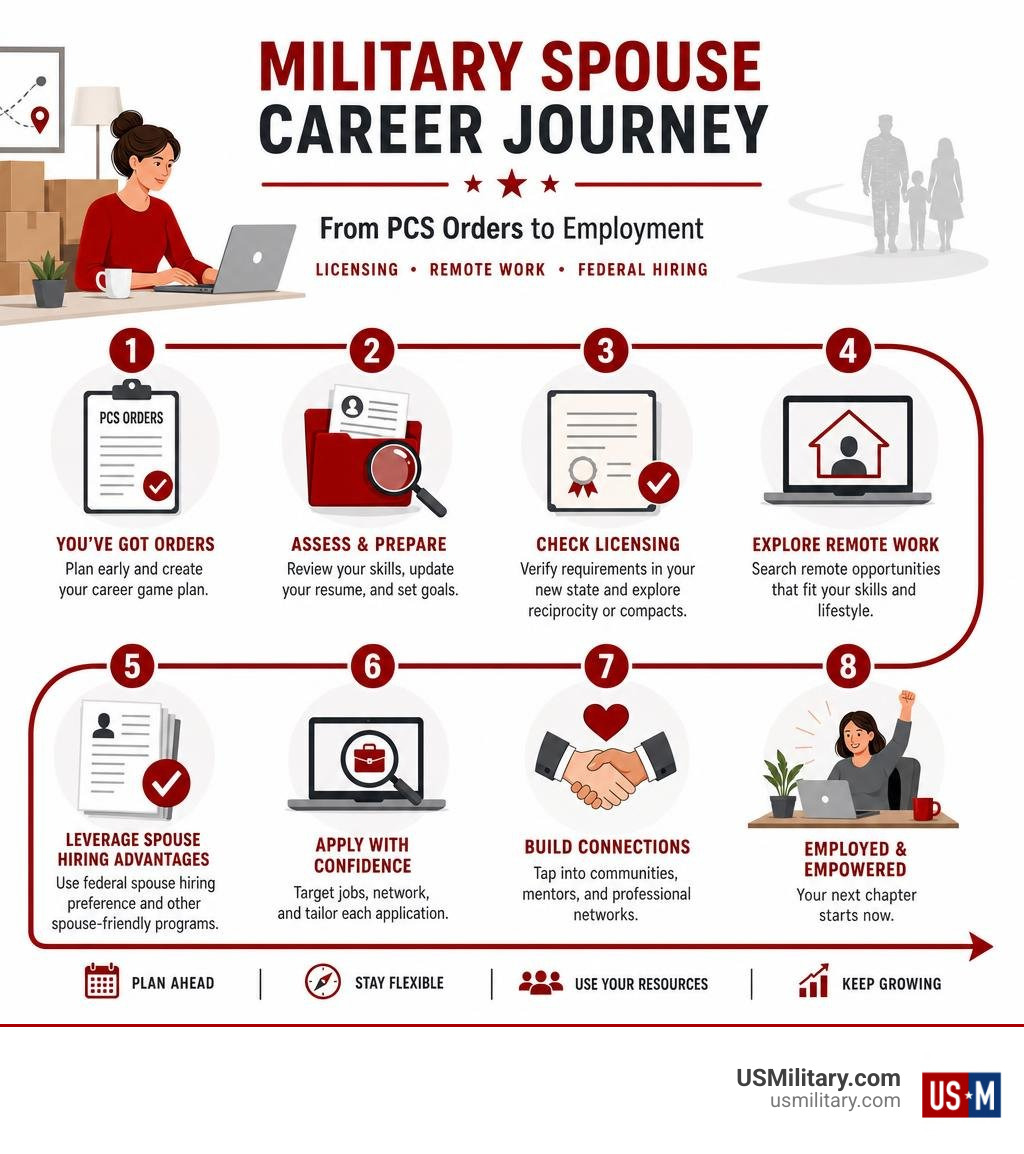
When you receive PCS orders, the clock starts ticking. For many of us, the stress of packing up a household is only eclipsed by the anxiety of leaving a job we love and starting the job hunt all over again. Fortunately, we do not have to tackle this transition alone.
Your first and most important stop during any relocation should be the Spouse Education and Career Opportunities (SECO) program, which is accessible through Military OneSource. SECO provides free, comprehensive career coaching, personality assessments, and localized resources to help you plan your next professional move. Whether you need help rewriting your resume or want to explore an entirely new field, their certified career coaches are available six days a week to guide you.
To get the most out of your transition, we highly recommend utilizing the resources outlined in the Military Spouse Career Support During PCS | Military OneSource . This guide outlines how to prepare your job search up to six months before your move, giving you the best chance of landing a position before your household goods even arrive.
Beyond SECO, the Department of Defense has established centralized hubs to coordinate employment initiatives across all service branches. By checking out the Spouse Employment DoD resources, you can access direct portals for Non-Appropriated Fund (NAF) jobs, military spouse-friendly corporate networks, and specialized transition assistance.
Choosing Portable Careers: Military Spouse Career Resources for Jobs, Licensing & Remote Work
A portable career is a professional path that you can easily pack up and take with you, regardless of where the military sends your family. When we evaluate the best military spouse career resources: jobs, licensing & remote work, certain industries consistently stand out as highly adaptable to the mobile military lifestyle:
- Information Technology (IT) and Cybersecurity: Tech roles are inherently digital, making them perfect for remote work. Whether you specialize in software development, data analytics, or cloud administration, tech skills are highly sought after by global employers. If you are interested in how military-aligned training can jumpstart these paths, read about the 10 High Paying Civilian Jobs with Military Training.
- Healthcare Administration and Telehealth: While clinical roles like nursing require state-specific licensing (which we will cover below), healthcare administration, medical coding, billing, and virtual health coaching are highly portable and offer excellent remote flexibility.
- Education and Virtual Instruction: Online tutoring, corporate training, and curriculum development have exploded in popularity. These roles allow you to maintain a consistent client base or teaching schedule regardless of your physical location.
- Professional Services and Consulting: Fields like bookkeeping, digital marketing, project management, and freelance writing allow you to build a personal brand or work for agencies that value remote, project-based talent.
Choosing a portable field is one of the smartest long-term career moves you can make. It ensures that when your sponsor benefits from the Benefits of Joining the Military, your career does not have to be the sacrifice that pays for those opportunities.
Remote-First Job Categories and Top Employers
Remote work is the ultimate “PCS-proof” career strategy. Rather than resigning and starting from scratch every two years, a remote-first position allows you to pack up your laptop in Virginia and open it up in Hawaii without missing a single paycheck.
To find these opportunities, we recommend starting with the National Labor Exchange (USNLX), which hosts a dedicated database of verified virtual jobs. This resource filters out the spam and work-from-home scams that plague public job boards, connecting you directly with legitimate corporate employers.
Additionally, the federal government has made massive strides in supporting remote military spouses. The Department of Veterans Affairs (VA) has emerged as a leading champion for military families. The VA is a proud participant in the “4+1 Commitment,” a voluntary pledge where federal agencies and private employers commit to expanding spouse employment through four core policies:
- Facilitating job transferability when a spouse relocates.
- Offering robust remote and telework options.
- Providing flexible work schedules to accommodate military life.
- Granting up to five days of paid administrative leave for PCS relocations.
To search for positions within an organization that actively honors these policies, explore the listings and application guides on Jobs for military spouses – VA Careers . Through programs like the VA Military Spouse Transition and Employment Program (VMSTEP), the VA actively recruits, hires, and retains military spouses, recognizing that our experience with the military lifestyle makes us uniquely qualified to serve our nation’s veterans.
Understanding Federal Spouse Preference and USAJOBS
If you have ever wanted to work for the federal government, your status as a military spouse provides a powerful advantage. Under Executive Order 13473, eligible military spouses receive a non-competitive hiring authority, commonly referred to as Military Spouse Preference (MSP).
This preference allows federal agencies to bypass the traditional, highly competitive civil service examining process. Instead of competing against hundreds of applicants, a hiring manager can select a qualified military spouse directly for an open position.
To use this preference on USAJOBS, you must check the “Military Spouse” eligibility box when creating your profile and applying for jobs. You will also need to upload specific supporting documentation to prove your eligibility:
- Your Sponsor’s PCS Orders: These orders must show that your sponsor is being relocated, and they must list you as a dependent. MSP is generally location-specific, meaning you are eligible for federal jobs within the commuting area of your sponsor’s new duty station.
- Proof of Marriage: A copy of your marriage certificate is required to verify your relationship to the service member.
- DD-214 or DD-1172: If applicable, additional military documentation may be requested to verify your sponsor’s active status or retirement.
Maximizing Your Search with Military Spouse Career Resources: Jobs, Licensing & Remote Work
While USAJOBS is the primary portal for federal service, you can maximize your employment prospects by combining federal preference programs with private-sector initiatives.
The Military Spouse Employment Partnership (MSEP) is a targeted recruitment program that connects military spouses directly with corporate employers. Currently, MSEP features over 1,000 partner employers — including major financial institutions, healthcare providers, and technology firms — who have collectively hired more than 175,000 military spouses since 2011. These companies have made a formal commitment to recruit, hire, promote, and retain military spouses, making them excellent targets for your job search.
When navigating these complex job markets, it is helpful to understand how civilian employers view military experience. If you are helping your veteran sponsor transition alongside you, or if you are looking to translate your own prior service into a corporate career, check out our guide on Veterans Career Transitions for strategies on translating military jargon into civilian success.
Funding Education, Certifications, and Fellowships
One of the biggest hurdles to building a portable career is the upfront cost of education and credentialing. Fortunately, there are several robust programs specifically designed to fund your professional development.
The most famous of these is the My Career Advancement Account (MyCAA) Scholarship, which was recently rebranded as the SpouseWorks Scholarship. This program provides up to $4,000 in tuition assistance (with a $2,000 annual fiscal year cap) for eligible military spouses. The funds can be used to earn professional licenses, certifications, or associate degrees in high-growth, portable career fields.
In recent years, eligibility for the program has expanded significantly. It now covers spouses of active-duty service members, as well as National Guard and Reserve members on Title 10 orders, in pay grades E-1 to E-9, W-1 to W-3, and O-1 to O-3.
To understand how to leverage these education benefits alongside other hiring initiatives, read the comprehensive breakdown in Military Spouse Employment: Portable Careers, MyCAA, and Preference .
For spouses who already hold a degree but need help breaking into corporate environments, the Hiring Our Heroes (HOH) Corporate Fellowship Program is a game-changer. This program provides 12-week paid professional fellowships with Fortune 500 companies and military-friendly employers. These fellowships act as hands-on corporate “returnships,” allowing you to gain high-level experience, build a local network, and often secure a full-time job offer at the conclusion of the cohort.
| Feature | MyCAA (SpouseWorks) | Hiring Our Heroes Fellowship |
|---|---|---|
| Primary Focus | Funding for licenses, certifications, & associate degrees | Paid corporate work experience & direct hiring paths |
| Financial Benefit | Up to $4,000 lifetime ($2,000 annual cap) | Paid 12-week fellowship with corporate employers |
| Target Audience | Spouses of E-1 to E-9, W-1 to W-3, O-1 to O-3 | Spouses looking for corporate career entry or re-entry |
| Best For | Up-skilling, professional credentials, and initial training | Mid-to-senior professionals seeking W2 corporate roles |
Overcoming the PCS Licensing and Certification Barriers
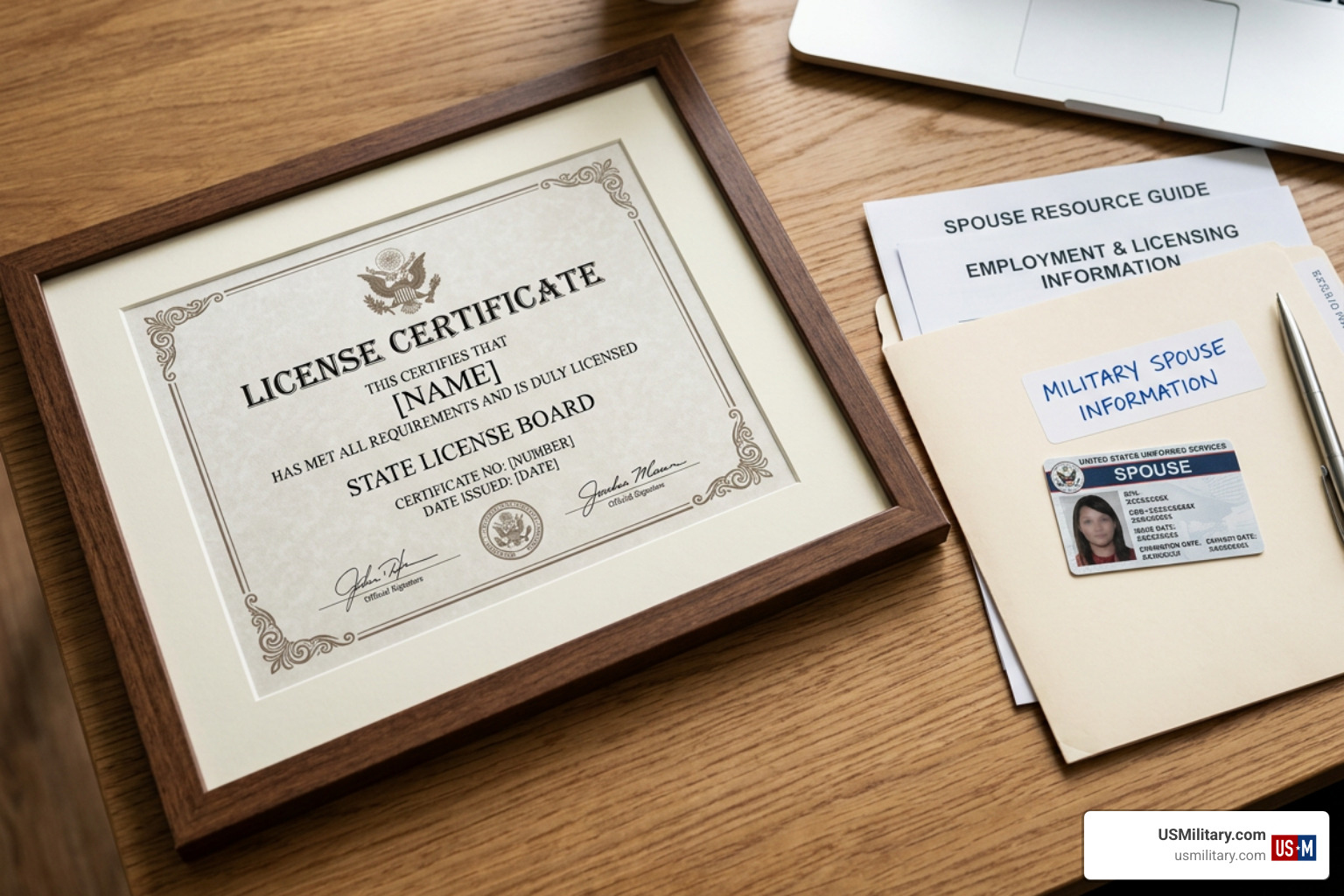
If you work in a profession that requires a state-issued license — such as nursing, teaching, physical therapy, real estate, or mental health counseling — a PCS move can feel like hitting a brick wall. Historically, moving to a new state meant spending hundreds of dollars and waiting up to 10 months to retake exams, submit fingerprints, and have your credentials reviewed by a new state board.
Fortunately, state and federal lawmakers have made massive strides in addressing this issue. Today, nearly every state has passed military spouse licensing legislation. These laws generally provide three pathways to help you get to work faster:
- Licensure by Endorsement: If you hold an active, clean license in one state, at least 32 states will quickly issue you an equivalent license in their state based on your existing credentials.
- Temporary Licensure: Many states will issue an immediate, temporary license (typically valid for six months) allowing you to practice while the board processes your permanent application.
- Interstate Licensing Compacts: This is the gold standard of portability. Compacts allow professionals to hold a single multi-state license that is recognized across all participating states. Examples include the Nurse Licensure Compact (NLC) covering 41 states, the Physical Therapy Compact (PT Compact), and the Interstate Teacher Mobility Compact.
To see how your specific profession and state handle these transitions, consult the Licensure Portability for Military Spouses by State: Complete Guide | Military Transition Toolkit .
Additionally, to understand the broader legislative landscape and your legal rights as a relocating professional, we highly recommend reviewing the Military Spouse Employment Policies compiled by the National Conference of State Legislatures.
Reimbursement for License Transfer Costs
Even with expedited licensing, the fees for background checks, application processing, and exams can quickly add up. To ease this financial burden, the Department of Defense allows military spouses to be reimbursed for up to $1,000 in licensing and certification transfer costs per PCS move.
This benefit is available across all service branches. To qualify, the relocation must be the result of active-duty PCS orders, and the fees must be directly related to transferring your professional credentials to the new state.
Be sure to keep every receipt, exam confirmation, and licensing board invoice. Once you arrive at your new duty station, you can submit these expenses through your sponsor’s finance office for full reimbursement.
Resume and LinkedIn Strategies for Frequent Relocations
One of the most common questions we get is: “How do I write a resume when my employment history looks like a map of the United States?”
Many spouses try to hide their military connection or employment gaps on their resumes, fearing that civilian employers will see them as “temporary” hires who will leave in two years. However, trying to hide this pattern often backfires, leaving employers to assume the worst about your career gaps.
Instead, we recommend owning your story. Treat your PCS moves as major logistical achievements rather than career interruptions. On your resume, you can address relocations directly in your timeline with a simple, professional one-line entry:
Relocation / PCS Move — Norfolk, VA to San Diego, CA | Feb 2024 – May 2024
This immediately explains the brief gap in your employment history and highlights your adaptability.
On LinkedIn, your profile should be optimized to attract remote-first employers or hiring managers at your new location. Here are three key strategies to implement today:
- The Location Field Strategy: If you are actively searching for remote work, set your LinkedIn location to “United States” rather than a specific base or small military town. If you are looking for local work at an upcoming duty station, change your location to the new metro area up to 90 days before you move.
- The Headline Framing: Use your headline to showcase your skills first, and your military adaptability second. For example: “Senior Project Manager | Agile Practitioner | Remote Operations Specialist (Military Spouse)”.
- Use Tailored Tools: For a step-by-step breakdown of how to structure your resume and LinkedIn profile to convert applications into interviews, read the Military Spouse PCS Job Search Playbook: Find Work at Every Station | Best Military Resume .
Your First 90 Days: On-Base and Virtual Networking Tactics
The first week at a new duty station is always a whirlwind, but establishing your professional footprint early is key to a short job search.
During your first 90 days, we recommend following this structured checklist to plug into local and virtual career networks:
- Week 1 – Walk into the Family Support Center: Whether it is called Army Community Service (ACS), the Fleet and Family Support Center (FFSC), or the Military and Family Readiness Center (M&FRC), physically walk into this office. Ask to speak with an Employment Readiness Specialist. They maintain direct relationships with local civilian employers, defense contractors, and on-base hiring managers.
- Week 2 – Leverage the Base Library and Transition Office: Base libraries often host free professional workshops, and transition offices can connect you with local hiring events and career preparation programs.
- Month 1 – Join Spouse Clubs and Command Networks: Do not underestimate the power of informal networking. Command Ombudsmen, spouse clubs, and local military family groups are often the first to hear about unadvertised job openings on and off base.
- Month 2 – Virtual Networking on MSEP: Register on the Military Spouse Employment Partnership portal and begin connecting with corporate recruiters who are actively seeking military talent.
For more information on how to coordinate these steps with your service branch’s specific readiness programs, explore the official Military Spouse Employment resources provided by the Army’s Soldier for Life program.
Frequently Asked Questions about Military Spouse Careers
How does the $1,000 licensing reimbursement work after a PCS?
To get reimbursed for your licensing fees, you must submit a claim through your sponsor’s finance office at the new duty station. You will need to provide a copy of the PCS orders listing you as a dependent, receipts showing the fees you paid to the new state’s licensing board, and proof of your previous active license. Each service branch has its own specific administrative form (such as a standard travel voucher or local claim form), so your first stop should be the base finance office or your local Employment Readiness Specialist to get the correct paperwork.
What is the MyCAA scholarship and who qualifies in 2026?
The My Career Advancement Account (MyCAA) scholarship — now commonly referred to as the SpouseWorks Scholarship — is a workforce development program providing up to $4,000 in tuition assistance. In 2026, the program is open to spouses of active-duty service members (and National Guard/Reserve members on active Title 10 orders) in pay grades E-1 to E-9, W-1 to W-3, and O-1 to O-3. The funds can be used for professional licenses, certifications, or associate degrees at any participating, accredited school.
Can military spouses use federal preference for remote positions?
Yes, military spouses can use their non-competitive hiring preference (EO 13473) to apply for remote and telework-eligible federal positions on USAJOBS. However, keep in mind that some federal remote positions still have geographic restrictions (such as requiring you to live within a certain distance of a regional office or within the United States). Always read the job announcement carefully to ensure you meet both the professional qualifications and the geographic residency requirements.
Conclusion
Building a career that survives — and thrives through — the chaotic cycle of military moves is entirely possible. By leveraging the military spouse career resources: jobs, licensing & remote work available to you, you can stop restarting your professional life at every new duty station. From MyCAA funding and federal hiring preferences to state licensing compacts and remote-first employers, the tools are in place to help you succeed.
For military spouses who are also considering taking their career into their own hands, we encourage you to explore our resources on Starting a Veteran Owned Business or learning about specialized transition support through the Veteran Readiness Employment (VRE) program.
We are proud to stand with you as you navigate this unique journey. For more comprehensive guides, policy updates, and financial resources tailored to your lifestyle, visit USMilitary.com and check out our complete breakdown of Military Spouse Benefits. Find inspiration and strategies for overcoming life’s obstacles in the pages of Dare to Live Greatly.