
Why Army Reserve Federal Tuition Assistance Can Pay for Your Degree

Army Reserve federal tuition assistance is a program that helps drilling Reservists pay for college courses — with the Army covering up to 100% of tuition costs.
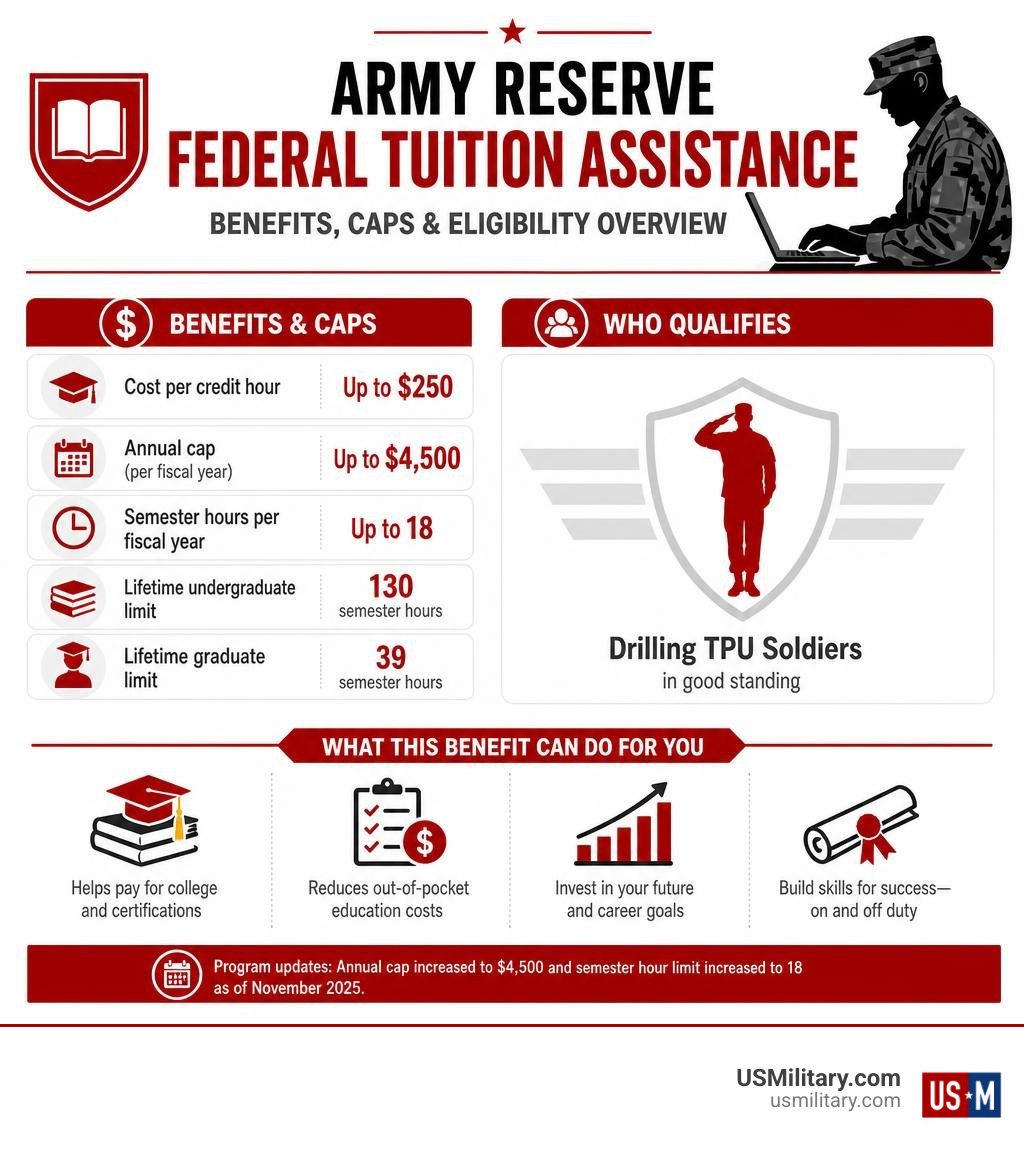
Here’s a quick summary of what the program offers right now (as of July 2026):
| Benefit | Amount |
|---|---|
| Cost per credit hour | Up to $250 |
| Annual cap (per fiscal year) | Up to $4,500 |
| Semester hours per fiscal year | Up to 18 |
| Lifetime undergraduate limit | 130 semester hours |
| Lifetime graduate limit | 39 semester hours |
| Who qualifies | Drilling TPU Soldiers in good standing |
The Army raised the annual cap from $4,000 to $4,500 and increased the semester hour limit from 16 to 18 as of November 2025. This is real money — and most eligible Soldiers never use it.
Whether you’re thinking about going back to school or already enrolled, understanding how this benefit works can save you thousands of dollars out of pocket.
I’m Larry Fowler, publisher of the USMilitary.com Network and a longtime advocate for helping service members navigate benefits like army reserve federal tuition assistance — a topic I’ve covered extensively since 2007 across one of America’s largest privately owned military information platforms. Read on, and I’ll walk you through exactly how to make the most of every dollar this program offers.
Understanding Army Reserve Federal Tuition Assistance: Eligibility and Overview
We know that higher education is one of the primary reasons many patriotic citizens choose to wear the uniform. The Army Reserve Federal Tuition Assistance (TA) program is a powerful financial tool designed to support your voluntary, off-duty civilian education. Whether you are pursuing an associate degree, a bachelor’s degree, a master’s degree, or professional certifications, this program is designed to keep your out-of-pocket costs as close to zero as possible.
To receive these funds, you must attend an academic institution that is regionally or nationally accredited by an agency recognized by the U.S. Department of Education. Furthermore, the school must be a signatory to the Department of Defense Memorandum of Understanding (DoD MOU). This agreement ensures that colleges maintain fair academic practices and credit transfer policies for military students.
For official guidelines and deep-dive policy sheets, you can always refer to the Tuition Assistance (TA) – Army Reserve – MyArmyBenefits?serv=125) page.
Who Qualifies for Army Reserve Federal Tuition Assistance?
The beauty of the TA program is that it is widely accessible. To qualify, you must be a drilling Reservist in the Troop Program Unit (TPU) in good standing. This means you are actively participating in your monthly drills and annual training, and you are not currently flagged for physical administrative actions, adverse legal proceedings, or failing APFT/ACFT standards.
Additionally, you must have sufficient service time remaining on your enlistment contract to complete the courses before your scheduled separation date. If you are still in the process of entering the reserve component or want to know how this fits into your enlistment timeline, check out our guide on How to Apply for the Army Reserves: Balancing Civilian Life and Service.
Drill Status vs. Active Duty (Title 10/32) Requirements
Your status in the Army Reserve determines which pot of money you draw from and how your benefits are processed.
- TPU Status (Drill Status): This is the classic “one weekend a month, two weeks a year” status. As a drilling TPU Soldier, you are fully authorized to participate in the federal TA program.
- Active Duty Orders (Title 10 / Title 32): If you are mobilized, deployed, or serving on Active Guard Reserve (AGR) status under Title 10 or Title 32 orders, you remain fully eligible for federal TA. Your application workflow through ArmyIgnitED remains largely the same, but your service obligations may adjust depending on your officer or enlisted status.
Understanding how your reserve status compares to other components is highly valuable when planning your career. We encourage you to read our breakdown of the Army Reserve vs National Guard to see how educational funding and deployment statuses differ between the two forces.
Current Benefit Caps, Lifetime Limits, and Recent Policy Changes
Staying updated on policy changes is critical to avoiding unexpected tuition bills. The Army regularly reviews its voluntary education programs to manage its budget while remaining competitive with other branches.
To give you a clear picture of how the program has improved, let’s look at the transition from previous years to the current 2025–2026 standard:
| Policy Metric | Previous Standard | Current Standard (Post-November 2025) |
|---|---|---|
| Annual Funding Cap | $4,000 per fiscal year | $4,500 per fiscal year |
| Semester Hour Cap | 16 semester hours per fiscal year | 18 semester hours per fiscal year |
| Undergraduate Credit Limit | 130 semester hours | 130 semester hours |
| Graduate Credit Limit | 39 semester hours | 39 semester hours |
| Cost Limit per Credit Hour | Up to $250 | Up to $250 |
These changes represent a significant win for Army Reserve Soldiers, bringing the Army’s benefits in line with the Air Force and Navy. However, the Army also introduced stricter guidelines for other educational programs to ensure financial sustainability. You can read the official announcement on these adjustments on the Army approves tuition assistance increase, adjusts credentialing program > U.S. Army Reserve > News-Display page.
The 2025–2026 Policy Updates: Higher Caps and New Rules
While the increase to a $4,500 annual cap and 18 semester hours has made pursuing a degree easier, the Credentialing Assistance (CA) program saw some tightening. The CA program, which funds professional credentials and licenses through Army COOL, had its annual cap reduced from $4,000 to $2,000.
Furthermore, the Army capped aviation-related credentials at $1,000 per year. Soldiers are also limited to completing one credential per year, with a lifetime maximum of three credentials within a 10-year period. These adjustments were made because the CA program’s costs had nearly doubled every year since its launch in 2020. By scaling back CA and boosting academic TA, the Army is prioritizing long-term degree completion.
Lifetime Limits and Degree Restrictions
While the annual caps are generous, there are strict lifetime limits on how much army reserve federal tuition assistance you can use:
- Undergraduate Limit: You are capped at 130 semester hours of undergraduate credit, or the completion of your baccalaureate degree, whichever comes first.
- Graduate Limit: You are capped at 39 semester hours of graduate credit, or the completion of your master’s degree, whichever comes first.
Additionally, TA will not pay for lateral degrees. If you already hold a bachelor’s degree (even if earned as a civilian before joining), you cannot use TA to earn a second bachelor’s or an associate degree. TA must always be used to climb to a higher rung on the educational ladder. Finally, first professional degrees — such as doctorates, PhDs, and Juris Doctorates (law degrees) — are not eligible for TA funding.
Navigating the ArmyIgnitED Application Process
Every dollar of your federal TA is requested and managed through the ArmyIgnitED online portal. While the portal has become much more user-friendly over the years, navigating it still requires careful attention to detail.
Before you can request tuition funding, you must establish an account, work with a military Education Services Officer (ESO) to declare an educational goal, and upload a verified degree plan from your chosen school.
Step-by-Step Guide to Applying for Army Reserve Federal Tuition Assistance
To ensure your classes are paid for on time, follow this step-by-step application workflow:
- Create Your Account: Visit the official ArmyIgnitED portal and set up your student profile.
- Complete ArmyIgnitED 101: All first-time TA users must complete this online training module to understand their rights, responsibilities, and the recoupment policies.
- Use the Decision Support Tool: You must use the portal’s integrated decision support tool (such as TA Decide) to research your school’s tuition rates, graduation rates, and student outcomes.
- Declare Your Goal and Upload Your Plan: Work with your school to obtain an official degree plan listing every course required for graduation. Upload this plan into ArmyIgnitED.
- Request TA Early: You can submit a TA request up to 60 days before your class starts. Crucially, all TA requests must be submitted and approved at least seven days prior to your class start date. Late submissions will be automatically rejected, leaving you to pay the bill yourself.
If you are just beginning to look at how military service fits into your life, these educational perks are only the tip of the iceberg. Read about the other broad Benefits of Joining the US Army to see what else you qualify for.
Supervisor Approvals and Recoupment Policies
A major update implemented in March 2026 requires supervisor or commander representative approval for all TA and CA requests. This ensures that your chain of command is aware of your academic workload and can verify that your studies will not interfere with your military obligations.
To keep your TA funding, you must maintain a solid grade point average (GPA):
- Undergraduate Students: Must maintain a cumulative GPA of 2.0 or higher.
- Graduate Students: Must maintain a cumulative GPA of 3.0 or higher.
If you fail a class, receive an “unsatisfactory” grade, or withdraw after the school’s drop deadline, the Army will initiate a recoupment action to claw back the funds. This means you will have to pay the money back out of your drill pay or personal bank account.
Even worse, if you experience two recoupment actions in the same fiscal year, you will face an automatic 12-month suspension from using both Tuition Assistance and Credentialing Assistance.
Service Obligations and Officer Restrictions
Enlisted Soldiers do not incur any additional service obligation when using federal TA; they simply must complete their funded courses before their current enlistment contract expires. However, officers face different rules.
Commissioned officers and warrant officers incur a service obligation when utilizing TA:
- Reserve Component Officers: Incur a four-year Reserve Duty Service Obligation (RDSO). This four-year clock is calculated from the exact completion date of the last TA-funded course. If you take a single class and then decide to leave the Reserve before those four years are up, you may have to pay back a prorated portion of the funds, or you will be blocked from resigning your commission.
- Active Duty Officers (including AGR): Incur a two-year Active Duty Service Obligation (ADSO), also calculated from the completion date of the last funded class.
Additionally, commissioned officers (O-1 through O-10) are completely ineligible to receive Credentialing Assistance (CA) funding, though they can freely use academic TA. Warrant officers remain eligible for both programs.
Combining TA with the GI Bill and Other Education Benefits
One of the smartest moves you can make is layering your benefits to minimize your personal debt. However, you must carefully navigate the rules to avoid “double-dipping” violations.
As an Army Reserve Soldier, you have access to several major education programs:
- Montgomery GI Bill Selected Reserve (MGIB-SR / Chapter 1606): This benefit pays up to $493 per month (as of the October 2025 rate adjustment) directly to full-time students for up to 36 months. Important Rule: You cannot use Chapter 1606 and federal TA to fund the exact same course at the same time. You can, however, use TA for your tuition and use MGIB-SR to cover your living expenses, books, and other fees, provided they are applied correctly.
- MGIB-SR Kicker: If you secured an education “Kicker” in your enlistment contract, you can receive up to an additional $350 per month on top of your standard GI Bill payment.
- Post-9/11 GI Bill (Chapter 33): If you have served on qualifying active duty orders (such as deployments or mobilizations), you earn eligibility percentages for the Post-9/11 GI Bill. This can cover up to 100% of your tuition, provide a monthly housing allowance (MHA) equal to an E-5 with dependents, and pay a $1,000 annual book stipend.
- State Tuition Assistance: Unlike the National Guard, which features robust state-funded tuition waivers, the Army Reserve is a federal force. However, some states do offer partial education grants or waivers to any resident veteran or military member.
To see how these educational tools fit into your overall military financial plan, check out our comprehensive resource, The Ultimate Guide to Military Benefits.
Frequently Asked Questions about Army Reserve TA
When it comes to voluntary education, financial aid, and degree planning, we get a lot of questions from Soldiers trying to make sense of the regulations. Here are the answers to the most common queries.
Can I use TA for a second degree at the same level?
Generally, no. The TA program is built to help you progress to higher levels of education. If you already have a bachelor’s degree, you cannot use TA to get a second bachelor’s degree or an associate degree.
However, there is a 10-year service rule exception. If you have completed at least 10 years of service and used TA to fund any portion of your undergraduate degree, you may be authorized to pursue a second, higher-level degree or a specialized certificate program under specific transition guidelines. Always consult your Education Center to see if you qualify for this exception.
What happens if I fail a class funded by Tuition Assistance?
If you fail a course or receive a grade below the required threshold (a “D” or “F” for undergraduates, or a “C” or lower for graduate courses), the Army will initiate a recoupment action. You will be required to pay back the exact amount of tuition the Army paid on your behalf.
Additionally, as mentioned earlier, receiving two failing grades or recoupment actions within the same fiscal year will trigger an automatic 12-month suspension from both the TA and CA programs.
Can I combine Federal Tuition Assistance with State Tuition Assistance?
Because the Army Reserve is a federal entity, you primarily rely on federal TA. However, if your state of residence offers unique educational benefits to drilling Reservists or veterans, you can often combine them.
The strict rule is that you cannot receive duplicate payments for the same dollar of tuition. For example, if a state program pays 50% of your tuition, federal TA can only be applied to cover the remaining 50%. You must also remember the Chapter 1606 restriction: you cannot draw MGIB-SR payments for a specific class that is already being 100% funded by federal TA.
Conclusion
Maximizing your army reserve federal tuition assistance is one of the most effective ways to set yourself up for civilian and military success. By taking advantage of the updated $4,500 annual cap and 18 semester hours, you can earn your degree completely debt-free while continuing to serve your country.
At USMilitary.com, we are dedicated to helping you make sense of your benefits, plan your career advancement, and secure your financial future. If you are ready to take the next step in your military journey, we invite you to Explore the Benefits of Joining the Military and see how you can make the system work for you.