
What Is the Salary of a US Army Private in 2026?

The salary of a US Army Private depends on your pay grade, how long you’ve served, and whether you’re active duty or part-time Reserve or Guard. Here’s the quick answer:
| Rank | Pay Grade | Monthly Basic Pay (2026) | Annual Basic Pay (2026) |
|---|---|---|---|
| Private (first 4 months) | E-1 | $2,225.70 | ~$26,708 |
| Private (after 4 months) | E-1 | $2,407.20 | ~$28,886 |
| Private | E-2 | $2,697.90 | ~$32,375 |
Note: These figures are base pay only and do not include tax-free allowances like BAH and BAS, which can significantly increase your total take-home compensation.
These numbers reflect the 3.8% military pay raise that took effect January 1, 2026. That raise pushed E-1 pay up from roughly $2,319/month in 2025 to $2,407.20/month today. E-2 climbed from about $2,363 to $2,697.90 per month over the same period.
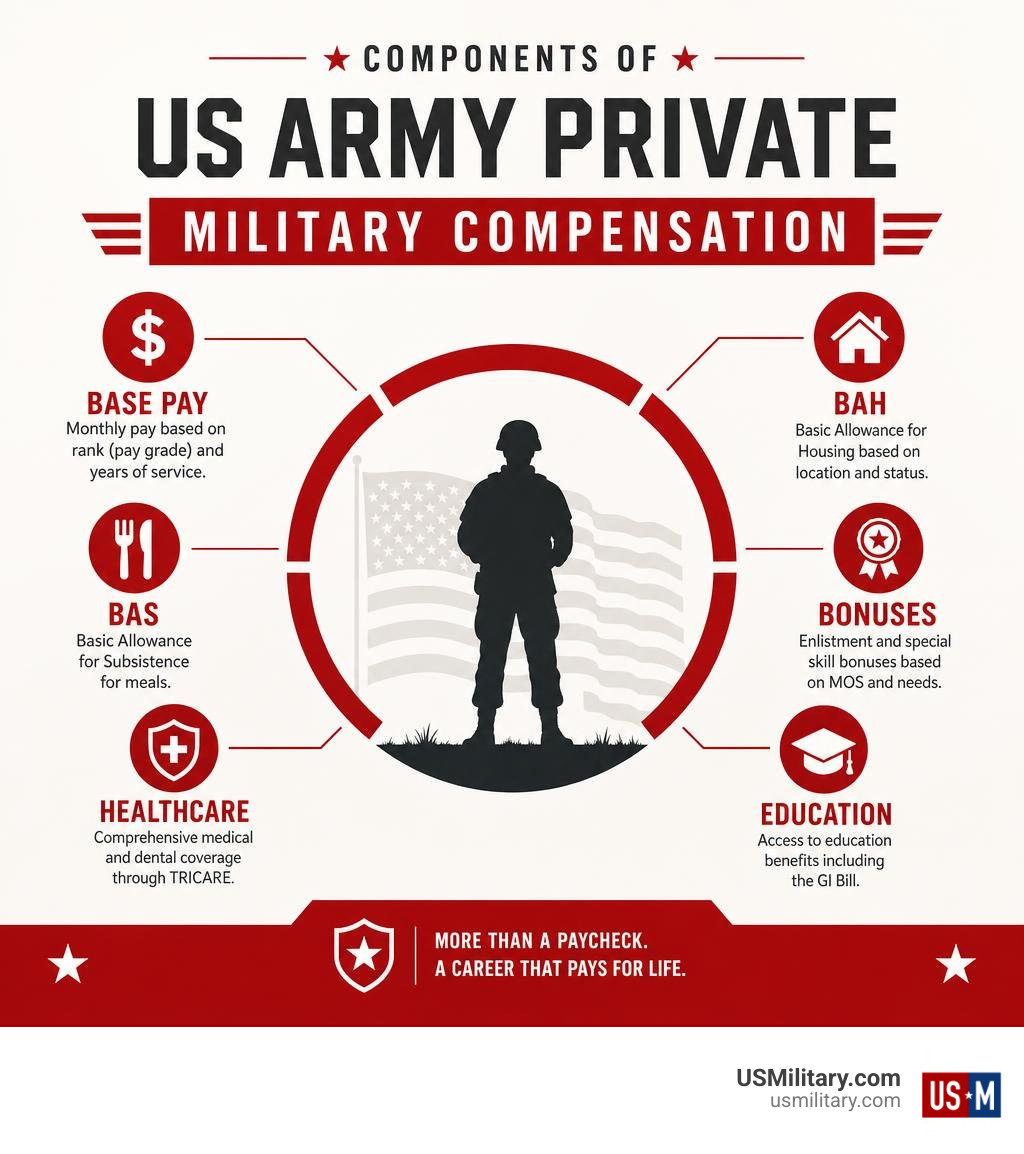
But base pay is only part of the picture. Most Army Privates also receive:
- Tax-free housing allowance (BAH) — varies by location and dependent status
- Food allowance (BAS) — $476.95/month for enlisted members in 2026
- Free healthcare through TRICARE
- Education benefits including the GI Bill
- Enlistment bonuses up to $20,000 depending on your MOS
This guide breaks down every layer of Army Private compensation so you can understand exactly what you’d earn — and what it’s worth.
I’m Larry Fowler, publisher of the USMilitary.com Network, where I’ve spent nearly two decades helping recruits, active-duty service members, and veterans navigate military pay, VA benefits, and career decisions — including the often-misunderstood salary of a US Army Private. Whether you’re weighing enlistment or trying to make sense of your first Leave and Earnings Statement, this guide will walk you through everything you need to know.
Understanding the Military Pay Structure
To truly understand the salary of us army private, we first have to look at how the military structures its entire compensation system. Unlike the corporate world, where salaries are often negotiated in secret and can vary wildly based on how well you interviewed, the United States Armed Forces use a standardized, highly transparent pay scale.
This structure is uniform across all eight uniformed services. Whether you are looking at the Army, the Marine Corps, or studying the Navy Pay Chart 2026, the base pay for an E-1 or E-2 is exactly the same.
The system relies on three core variables:
- Pay Grade: This is the alphanumeric code associated with your military rank. Enlisted grades run from E-1 through E-9. Warrant officers use W-1 through W-5, and commissioned officers use O-1 through O-10.
- Rank: This is the title associated with your pay grade (e.g., “Private” for E-1, or “Private Second Class” / “Private First Class” depending on the branch and specific grade).
- Years of Service: The cumulative time you have served in the military. As you gain experience, your basic pay automatically increases at specific milestones (usually every two years).
For a complete overview of how these variables interact across all ranks, you can review The Ultimate Guide to 2026 Military Pay Chart.
Every year, Congress evaluates military compensation to ensure it keeps pace with the private sector. These adjustments are typically based on the Employment Cost Index (ECI). Thanks to recent legislative efforts, we saw a substantial Projected Military Pay Raise for 2026 of 3.8%, which officially went into effect on January 1, 2026. This raise has provided a much-needed boost to the wallets of our newest recruits. To see how these rates compare historically, you can also look back at the U.S. Army Basic Pay Charts for 2024 or reference the official 2025 Basic Pay: Enlisted tables.
How Rank and Time-in-Service Determine Pay
For senior enlisted personnel and officers, time-in-service is a major driver of pay increases. For example, an E-6 with ten years of service makes significantly more than an E-6 with only four years of service.
However, for an Army Private, time-in-service plays a very minor role. Why? Because the ranks of E-1 (Private) and E-2 (Private Second Class or Private) are transitionary. According to the U.S. Army Private – Pay Grade and Rank Details, these entry-level positions are designed for training and initial integration.
Consequently, the E-1 pay table is completely flat across all years of service. An E-1 makes the same basic pay whether they have one year of service or two. The system is built this way because no soldier is expected to remain an E-1 for long. In fact, if you are still an E-1 after two years, something has gone seriously wrong!
How Promotion Timelines Affect the Salary of US Army Private
Because time-in-service raises do not apply to entry-level privates, the fastest way to secure a pay raise is through promotion. Fortunately, the Army’s promotion timeline for new recruits is structured for rapid advancement:
- E-1 to E-2: This is typically an automatic promotion that occurs after 6 months of active-duty service. Once you hit this milestone, your pay grade officially transitions, and your base pay jumps instantly.
- E-2 to E-3 (Private First Class): This promotion is also largely automatic and generally occurs after 12 months of active-duty service (with at least 4 months as an E-2).
By understanding this progression, a new recruit can plan their financial future with confidence. You won’t be stuck at the starting E-1 salary for long; within a year of enlistment, you will likely have advanced two pay grades, significantly raising your monthly base earnings.
The Base Salary of US Army Private (E-1 and E-2) in 2026

When evaluating the salary of us army private, we have to distinguish between active-duty soldiers (who serve full-time) and Reserve or National Guard soldiers (who serve part-time). Active-duty soldiers receive a monthly salary distributed on the 1st and 15th of every month. Part-time service members receive “drill pay,” which is calculated based on the number of individual training periods they complete each month.
If you want to dive deeper into the active-duty pay rates across different ranks, check out our guide on How Much You Will Earn on Active Duty in 2026.
To give you a clear, side-by-side comparison of active duty versus part-time drill pay for E-1 and E-2 ranks in 2026, we have compiled the official figures below:
| Pay Grade & Status | Monthly Base Pay / Drill Pay | Annual Base / Drill Equivalent |
|---|---|---|
| E-1 Active Duty (Under 4 Months) | $2,225.70 | $26,708.40 |
| E-1 Active Duty (4+ Months) | $2,407.20 | $28,886.40 |
| E-1 Reserve/Guard (Drill Pay) | ~$374.00 per weekend | ~$4,488.00 |
| E-2 Active Duty | $2,697.90 | $32,374.80 |
| E-2 Reserve/Guard (Drill Pay) | ~$418.00 per weekend | ~$5,016.00 |
Note: Reserve and National Guard annual estimates assume the standard training schedule of one weekend per month (4 drill periods) plus two weeks of annual active-duty training.
E-1 Private Base Pay Breakdown
The E-1 pay grade is unique because it features a two-tiered pay structure during your first few months of service.
When you first arrive at Basic Combat Training (BCT), you are classified as an E-1 with less than four months of service. For those first four months, your monthly basic pay is $2,225.70.
Once you hit your 121st day of active duty, your pay automatically increases to the standard E-1 rate of $2,407.20 per month. This translates to an annual basic pay of $28,886.40. For a detailed breakdown of historical E-1 pay rates and trends, you can explore the Army Private Pay for 2026 | FedPayscale.org database.
E-2 Private Base Pay Breakdown
Once you promote to E-2 (Private Second Class), your financial landscape improves. In 2026, the basic pay for an E-2 is $2,697.90 per month, which totals $32,374.80 annually.
Just like the E-1 pay grade, E-2 pay does not increase with years of service; it remains flat because you are expected to promote to E-3 (PFC) within a few months. For more details on E-2 pay rates, you can visit Army Private Pay for 2026 | FedPayscale.org or consult our comprehensive Pay Chart Military 2026 resource.
Beyond Base Pay: Allowances, Benefits, and Incentives
Focusing solely on base pay misses the most lucrative aspect of military compensation. In the civilian world, your salary has to cover housing, utilities, food, healthcare, and retirement savings. In the U.S. Army, a massive portion of these living expenses is either fully covered by the government or paid out as tax-free allowances.
When we calculate these additions, the total compensation package for an Army Private easily rivals, and often exceeds, entry-level civilian corporate salaries. To see how these allowances scale up as you promote, check out the Military Pay Chart 2026 or read the Indeed overview on Q&A: What’s Included in a US Army Salary? – Indeed.

Housing and Subsistence Allowances (BAH and BAS)
For soldiers who do not live in government-provided barracks (usually those who are married or have dependents), the military provides two substantial monthly allowances:
- Basic Allowance for Housing (BAH): This is a tax-free monthly payment designed to cover your rent and utilities. The exact amount is calculated based on your rank, geographic duty location, and whether or not you have dependents. Because BAH is tied to local rental markets, soldiers stationed in high-cost areas (like San Diego, Hawaii, or New York) receive significantly higher payments. In 2026, BAH rates received an average increase of 4.2% to help combat inflation.
- Basic Allowance for Subsistence (BAS): This allowance is meant to offset the cost of a soldier’s meals. In 2026, the BAS rate for enlisted soldiers is $476.95 per month. If you live in the barracks and eat at the military dining facility (DFAC), this allowance is typically deducted to cover your meals. However, if you live off-post, this money goes straight into your bank account tax-free.
Healthcare, Education, and Retirement Benefits
Beyond direct cash allowances, the Army provides world-class benefits that save soldiers thousands of dollars annually:
- TRICARE Healthcare: Active-duty soldiers and their immediate family members receive comprehensive medical, dental, and vision coverage at little to no out-of-pocket cost. In the civilian sector, family health insurance premiums and deductibles can easily eat up $500 to $1,000 of your monthly take-home pay.
- Education Benefits: The Post-9/11 GI Bill covers up to 100% of tuition and fees at public colleges and universities, provides a monthly housing allowance while you attend school, and offers a yearly book stipend. Additionally, active-duty soldiers can utilize Tuition Assistance (TA) to pay for college courses while serving, without touching their GI Bill.
- The Blended Retirement System (BRS): This modern retirement plan combines a traditional pension with a 401(k)-style Thrift Savings Plan (TSP). The Army automatically contributes 1% of your base pay to your TSP after 60 days of service, and will match your personal contributions up to an additional 4% after two years. If you choose to make a career of the military, you can retire after 20 years of service with a lifetime monthly pension. Learn more about how this works with our guide to Military Retirement Pay.
Special Pay, Bonuses, and Tax Advantages
To recruit and retain talent in critical roles, the Army offers several financial incentives:
- Enlistment Bonuses: Depending on your chosen Military Occupational Specialty (MOS) and when you ship to basic training, you could qualify for enlistment bonuses of up to $20,000 (and sometimes even more for highly critical fields).
- Special Duty Pay: Soldiers performing hazardous duties, serving in combat zones, or holding specialized assignments (like flight duty or diving) receive extra monthly specialty pay.
- Tax Exemptions: This is one of the most overlooked perks of military service. While your base pay is subject to federal and state income taxes, your allowances (like BAH and BAS) are 100% tax-free. Furthermore, if you deploy to a designated combat zone, your entire base pay earned during that deployment is completely exempt from federal income taxes.
For a look at how these incentives scale up to the highest levels of the military, you can read about the Highest Paying Military Ranks or check out the Army Pay Scale 2025: Complete Military Compensation Guide.
Active Duty vs. Part-Time Reserve and National Guard Pay
Not everyone who joins the Army does so full-time. The Army Reserve and Army National Guard offer citizens the opportunity to serve their country part-time while maintaining civilian careers or attending college.
Part-time soldiers are compensated using a system called drill pay. A standard drill weekend consists of four “drill periods” (two periods per day). For each individual drill period, a Reserve or National Guard soldier earns the equivalent of one day of active-duty basic pay.
Therefore, a single weekend of drilling yields four days’ worth of active-duty base pay. Additionally, part-time soldiers must complete two weeks of Annual Training (AT) each year, during which they receive full active-duty pay and allowances.
To learn more about how this structure applies across different enlisted and officer ranks, check out our resource on All About 2026 Military Pay Chart for Enlisted Officers or visit the official Money & Pay Charts – US Army page.
Comparing the Salary of US Army Private to Civilian Entry-Level Jobs
When young adults graduate high school, they often compare military service to entry-level civilian jobs. At first glance, a civilian job offering $15 to $18 an hour (roughly $31,000 to $37,000 a year) might seem comparable to or even better than an Army Private’s starting base pay of $28,886.
However, this comparison is highly deceptive. As a civilian earning $35,000 a year, you must pay for:
- Rent and utilities (averaging $1,200 to $1,800+ per month)
- Groceries and food ($300 to $400 per month)
- Health insurance premiums, copays, and deductibles
- Taxes on 100% of your income
An active-duty Army Private living in the barracks has zero housing costs, zero utility bills, and zero grocery bills. Their healthcare is entirely free. When you calculate the “civilian equivalent salary”—the amount of money a civilian would need to earn to match the take-home pay and lifestyle of an active-duty soldier—an Army Private’s compensation package is often valued at well over $45,000 to $50,000 per year.
Frequently Asked Questions About Army Private Pay
Navigating military pay can be confusing, especially for new recruits and their families. Here are the answers to some of the most common questions we receive.
What is the starting monthly pay for an E-1 Private in 2026?
For your first four months of active-duty service, your basic monthly pay as an E-1 is $2,225.70. Once you have completed four months of service, your monthly basic pay automatically increases to $2,407.20.
How long does it take to promote from E-1 to E-2?
Promotion from E-1 to E-2 is typically automatic and occurs after 6 months of active-duty service. This promotion instantly increases your monthly basic pay to $2,697.90.
Are Army Private allowances like BAH and BAS taxed?
No. All military allowances, including the Basic Allowance for Housing (BAH) and Basic Allowance for Subsistence (BAS), are 100% tax-free. Only your basic pay and certain special hazard or incentive pays are subject to federal and state income taxes. This tax exemption significantly increases your actual take-home pay compared to an equivalent civilian salary.
Conclusion
The salary of us army private is far more than just the number printed on a basic pay chart. When you factor in rapid promotion timelines, tax-free housing and food allowances, comprehensive medical coverage, and robust education benefits like the GI Bill, the total compensation package provides an incredibly secure financial foundation for young men and women starting their careers.
At USMilitary.com, we are dedicated to helping you make informed decisions about your military career, financial planning, and transition back to civilian life. If you are considering enlistment, we highly recommend taking the next step to explore the incredible benefits of joining the US Army.
To compare branches, calculate your potential benefits, or learn more about VA loans and military resources, visit us at USMilitary.com today. Your journey from basic training to a secure financial future starts with the right information!