
What Is Army Retirement Percentage — and How Is It Calculated?

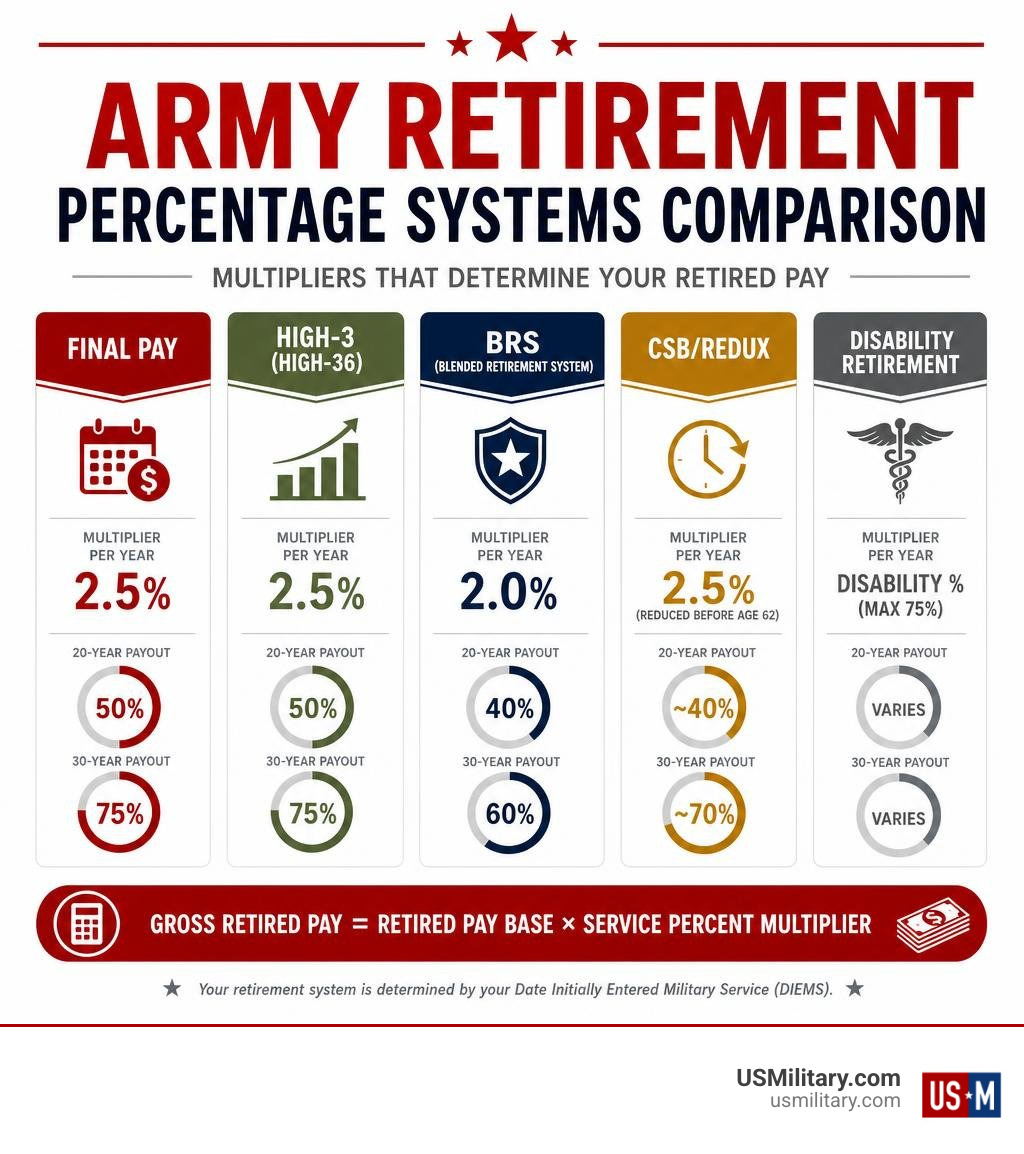
The Army retirement percentage is the core multiplier that determines how much of your base pay you receive as a monthly pension for life. Here’s a quick-reference breakdown:
| Retirement System | Multiplier Per Year | 20-Year Payout | 30-Year Payout |
|---|---|---|---|
| Final Pay | 2.5% | 50% | 75% |
| High-3 (High-36) | 2.5% | 50% | 75% |
| CSB/REDUX | 2.5% (reduced before 62) | ~40% | ~70% |
| Blended Retirement System (BRS) | 2.0% | 40% | 60% |
| Disability Retirement | Disability % (max 75%) | Varies | Varies |
The formula itself is straightforward:
Gross Retired Pay = Retired Pay Base × Service Percent Multiplier
For example, an active duty Soldier who serves 20 years under the High-3 system earns a 50% multiplier (20 × 2.5%). That means if their average highest-36-month basic pay was $6,000/month, they receive $3,000/month for life.
Despite the formula being simple, which system applies to you — and how disability, reserve points, or the BRS change your percentage — is where things get complicated. Only about 30% of officers and 10% of enlisted Soldiers serve long enough to retire, making this knowledge critical for those who do reach that milestone.
I’m Larry Fowler, publisher of the USMilitary.com Network since 2007 and a longtime resource for veterans and active duty service members navigating complex topics like Army retirement percentage calculations and VA benefits. In this guide, I’ll walk you through every formula, system, and rule that affects your final retirement percentage so you can plan with confidence.
How DIEMS Determines Your Army Retirement Percentage System
To understand your specific Army retirement percentage, you first have to know your Date Initially Entered Military Service (DIEMS). Your DIEMS is the exact day you first entered military status—whether that was enlisting, entering a service academy, or joining the ROTC delayed entry program.
Your DIEMS dictates which retired pay system you fall under, which directly controls your multiplier formula. Reviewing our comprehensive guide on Military Retirement Pay can give you a solid baseline before diving into the specific eras.

Here is a quick look at how entry dates map to retirement systems:
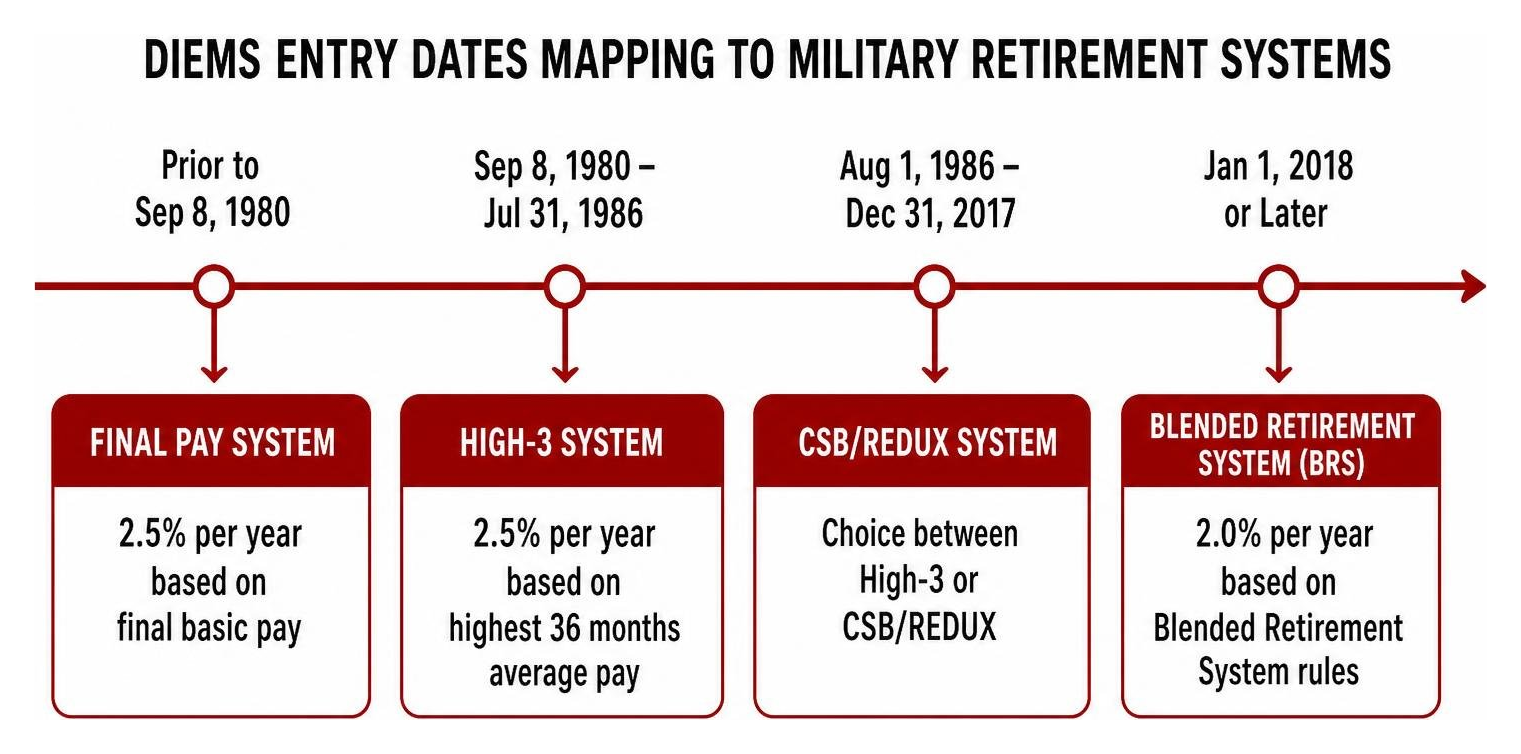
- DIEMS Prior to September 8, 1980: Final Pay System (2.5% per year based on final basic pay).
- DIEMS September 8, 1980 – July 31, 1986: High-3 System (2.5% per year based on highest 36 months average pay).
- DIEMS August 1, 1986 – December 31, 2017: Choice between High-3 or CSB/REDUX.
- DIEMS January 1, 2018 or Later: Blended Retirement System (BRS) with a 2.0% multiplier.
Final Pay and High-3 Army Retirement Percentage Formulas
If you joined the military before September 8, 1980, your pension percentage uses the Final Pay System. Under this legacy model, each year of active duty service adds 2.5% to your service multiplier. Upon hitting the 20-year milestone, you earn a 50% multiplier applied directly to your final monthly basic pay.
For the vast majority of legacy career Soldiers serving today, the High-3 System (also known as High-36) applies. If your DIEMS falls between September 8, 1980, and December 31, 2017, your multiplier math remains 2.5% per year of creditable active service:
- 20 Years of Service: 20 × 2.5% = 50% multiplier
- 24 Years of Service: 24 × 2.5% = 60% multiplier
- 30 Years of Service: 30 × 2.5% = 75% multiplier
- 40 Years of Service: 40 × 2.5% = 100% multiplier
The key distinction in High-3 is what the multiplier multiplies. Instead of taking your very last month of basic pay, DFAS averages your highest 36 consecutive months of basic pay (typically your final 3 years). You can check official guidelines via Retired Pay For Soldiers | The Official Army Benefits Website to verify your pay base calculations.
Blended Retirement System Army Retirement Percentage Multiplier
For service members entering on or after January 1, 2018 (or those who opted in during the 2018 open window), the Blended Retirement System (BRS) changes the pension percentage equation.
Under BRS, the service percent multiplier drops from 2.5% to 2.0% per year.
Here is how BRS retirement percentages stack up:
- 20 Years of Service: 20 × 2.0% = 40% multiplier
- 24 Years of Service: 24 × 2.0% = 48% multiplier
- 30 Years of Service: 30 × 2.0% = 60% multiplier
Why the reduction in monthly pension percentage? In exchange for a lower baseline pension percentage, the government provides automatic 1% contributions and up to a 4% matching contribution to your Thrift Savings Plan (TSP), alongside potential mid-career continuation pay. If you want to explore the strategic trade-offs between traditional pensions and BRS matching, check out The Golden Years Navigating Your Active Duty Retirement Options.
Computing Your Army Retirement Percentage Across Retirement Systems
Calculating your gross monthly pay always follows the standard Department of Defense formula:
$$\text{Gross Retired Pay} = \text{Retired Pay Base} \times \text{Service Percent Multiplier}$$
By federal regulation, gross retired pay is always rounded down to the nearest whole dollar. Cost-of-Living Adjustments (COLA) are applied annually to preserve your purchasing power against inflation.
To streamline your retirement projection, you can test your numbers using an external Army Retirement Pay Calculator.
Below is a direct comparison of how different systems calculate your Army retirement percentage and gross pay assuming 20 years of active service with a $6,000 High-3 average basic pay base:
| System | Pension Multiplier Formula | 20-Year Multiplier | Average Base Pay | Monthly Pension |
|---|---|---|---|---|
| Final Pay | Years × 2.5% | 50.0% | $6,000 (Final Pay) | $3,000 |
| High-3 | Years × 2.5% | 50.0% | $6,000 (High-36) | $3,000 |
| CSB/REDUX | (Years × 2.5%) – Penalty | 40.0% | $6,000 (High-36) | $2,400 |
| BRS | Years × 2.0% | 40.0% | $6,000 (High-36) | $2,400 |
CSB/REDUX Reduction Impact on Your Percentage
If your DIEMS fell between August 1, 1986, and December 31, 2017, you may have been offered the Career Status Bonus (CSB)/REDUX option at your 15th year of service. In exchange for a $30,000 cash bonus, Soldiers agreed to a reduced service percent multiplier.
Under REDUX, your multiplier is reduced by 1 percentage point for each year under 30 years served:
- At 20 years, instead of a standard 50% High-3 multiplier, your percentage is reduced by 10% (30 – 20 = 10), leaving you with a 40% multiplier.
- At age 62, the law automatically resets your pension percentage back to the full High-3 level (e.g., restoring your 20-year multiplier from 40% back to 50%), including a one-time COLA catch-up adjustment.
Reserve Component Army Retirement Percentage and Point Calculations
Calculating your Army retirement percentage as an Army Reserve or Army National Guard Soldier requires converting your earned retirement points into equivalent years of active duty service.

Reservists do not earn retirement percentages directly from calendar years. Instead, total retirement points are divided by a 360-day divisor to determine active duty equivalent years.
$$\text{Active Duty Equivalent Years} = \frac{\text{Total Retirement Points}}{360}$$
Once you have your active duty equivalent years, you multiply that number by the applicable system multiplier (2.5% for High-3 or 2.0% for BRS):
- Calculate Active Service Equivalent: If you accumulate 7,200 retirement points over a Guard or Reserve career, divide by 360:
$$7,200 \div 360 = 20 \text{ active duty service years}$$ - Apply System Multiplier: Under the traditional High-3 system, multiply 20 active duty equivalent years by 2.5%:
$$20 \times 2.5\% = 50\% \text{ multiplier}$$ - Determine Non-Regular Pay Start: Unlike active duty Soldiers who draw pay immediately upon retiring, non-regular Reserve component retirees typically begin drawing pay at age 60 (or earlier if qualifying deployment time reduces the age requirement).
If you are thinking about transitioning between active component service and the Reserve components, check out our guide on The Crossover Maximizing Your Retirement Benefits When Moving From Active Duty To Reserves.
Medical Disability Army Retirement Percentage Rules
When a Soldier is medically retired due to a service-connected disability, the rules for computing retired pay percentages change significantly. You can review official regulatory guidance at the Defense Finance and Accounting Service > RetiredMilitary > plan > estimate page.
For medical disability retirement, gross retired pay is calculated using whichever formula gives the Soldier the higher monthly payout:
- Length of Service Formula: Active Duty Equivalent Years × Multiplier (2.5% or 2.0%)
- Disability Percentage Formula: DoD Disability Rating Percentage × Retired Pay Base
By federal statute, the maximum percentage multiplier allowed under the disability percentage formula is capped at 75%. However, if a Soldier completes 32 or more years of service under the length of service calculation (32 × 2.5% = 80%), the length of service multiplier is not restricted by the 75% disability cap for retirements taking place after January 1, 2007.
To understand how military disability pay interacts with VA disability compensation, read our breakdown on Can You Receive 100 Va Disability And Military Retirement Pay.
TDRL vs PDRL Army Retirement Percentage Differences
Soldiers medically retired from service are placed on either the Temporary Disability Retired List (TDRL) or the Permanent Disability Retired List (PDRL):
- Temporary Disability Retired List (TDRL): Applied when a service member has a qualifying disability that is not yet stable. While on TDRL, the law guarantees a minimum multiplier floor of 50% of your retired pay base, regardless of whether your actual disability rating or service time would yield a lower percentage. TDRL re-evaluations must occur periodically.
- Permanent Disability Retired List (PDRL): Applied when a disability is determined to be permanent and stable. PDRL retirement pay does not carry a mandatory 50% floor; pay is calculated strictly using the higher of the length of service multiplier or the assigned DoD disability percentage (capped at 75%).
For complete transition and medical evaluation logistics, consult the official U.S. Army Retirement Planning Guide 2024.
Frequently Asked Questions About Army Retirement Percentages
What is the maximum Army retirement percentage a Soldier can receive?
Under the disability rating formula, the legal maximum percentage cap is 75%. However, under the standard length-of-service calculation for regular active duty retirements, there is no longer a 75% cap for retirements after January 1, 2007. A Soldier who serves 40 years under the High-3 system receives a 100% service percent multiplier (40 × 2.5%).
How do reserve points convert into an Army retirement percentage?
To convert reserve points into an Army retirement percentage, add all active duty, drill, extension, and administrative points together and divide the total by 360. This gives you your active duty service equivalent in years. Then, multiply those years by 2.5% (for High-3) or 2.0% (for BRS). For example, 3,600 points divided by 360 equals 10 active service years, yielding a 25% High-3 pension multiplier.
How does the Blended Retirement System alter the Army retirement percentage multiplier?
The Blended Retirement System (BRS) lowers the monthly pension multiplier from 2.5% per year to 2.0% per year. This results in a 40% baseline pension percentage at 20 years of service instead of 50%. In exchange, BRS offers automatic and matching Thrift Savings Plan (TSP) contributions up to 5% of basic pay, which service members can keep even if they separate prior to completing 20 years.
Conclusion
Understanding your Army retirement percentage empowers you to make informed decisions about your military career, transition timeline, and long-term financial security. Whether you are aiming for the 20-year mark, converting Guard and Reserve points, or evaluating medical retirement pathways, knowing how multipliers interact with your basic pay base keeps you in total command of your pension potential.
For detailed guides on pension eligibility criteria, benefit applications, and career transition resources, explore The Ultimate Guide To Army Pension Eligibility And Retirement Pay or visit us at USMilitary.com.