
Why the Army Radio Alphabet Matters
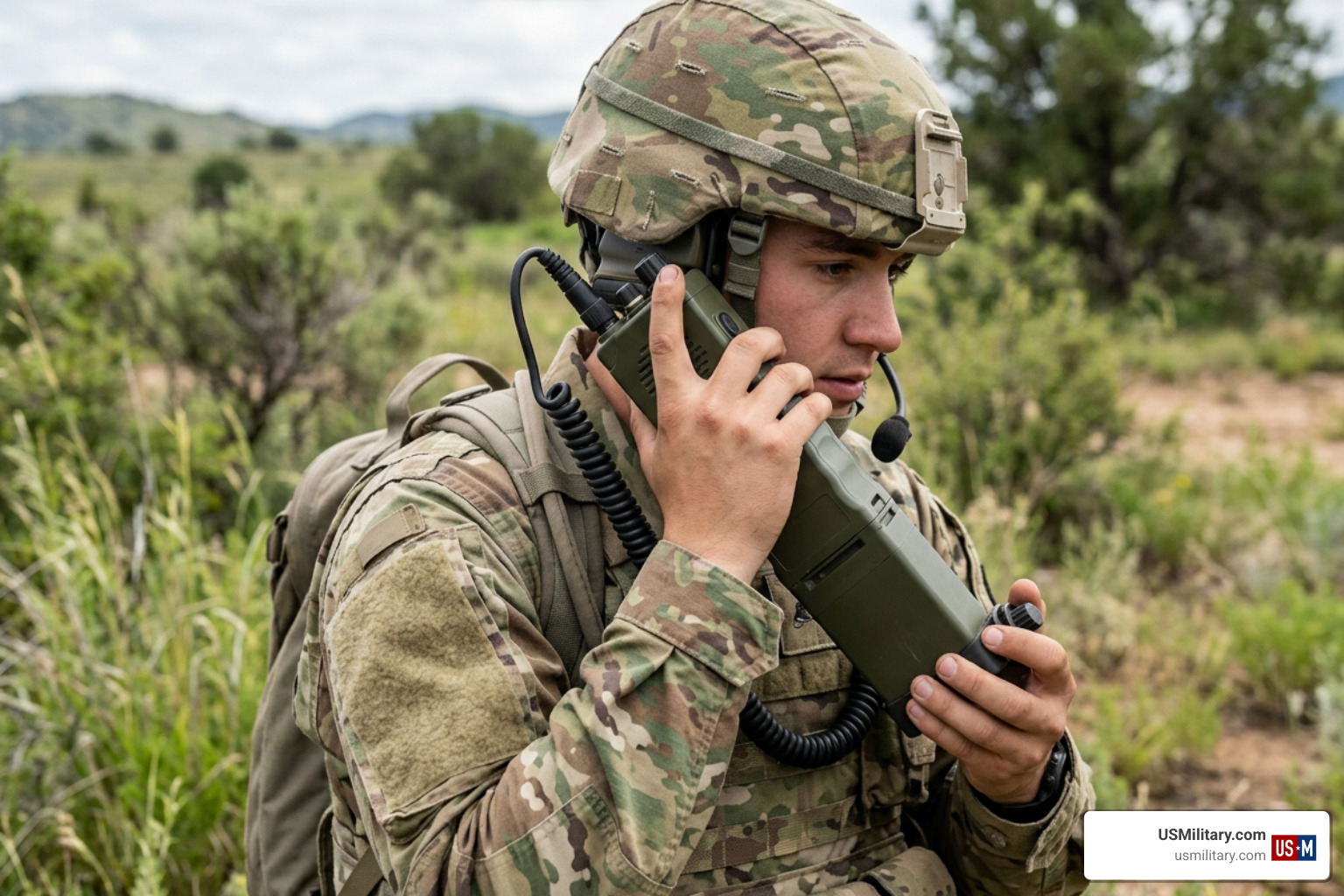
The army radio alphabet is the NATO spelling system used to make letters and numbers clear over radio, phone, and other voice links. Instead of saying a letter by itself, operators use a standard word: Alfa, Bravo, Charlie, Delta through Zulu.
| Letter or number | Radio pronunciation |
|---|---|
| A | Alfa |
| B | Bravo |
| C | Charlie |
| 3 | Tree |
| 4 | Fower |
| 5 | Fife |
| 9 | Niner |
This matters when static, distance, stress, accents, or background noise could turn one sound into another. Letters such as B, C, D, P, T, M, and N are easy to confuse on a weak signal. Standard words give each letter a distinct sound and help military units, pilots, and allied forces confirm the right information the first time.
The modern system is formally called the International Radiotelephony Spelling Alphabet. NATO adopted it in 1956 after extensive comprehension testing with speakers from 31 nationalities. It replaced earlier military systems, including the World War II-era Able Baker alphabet, with a shared standard built for international operations.
This guide covers the full letter list, special number pronunciation, radio prowords, military time, and the basic procedures behind clear voice traffic.
I am Larry Fowler, publisher of the USMilitary.com Network since 2007, serving active-duty members, veterans, and people considering military service. My work helping readers understand military careers and service-related topics informs this practical guide to the army radio alphabet and the communication standards behind it.
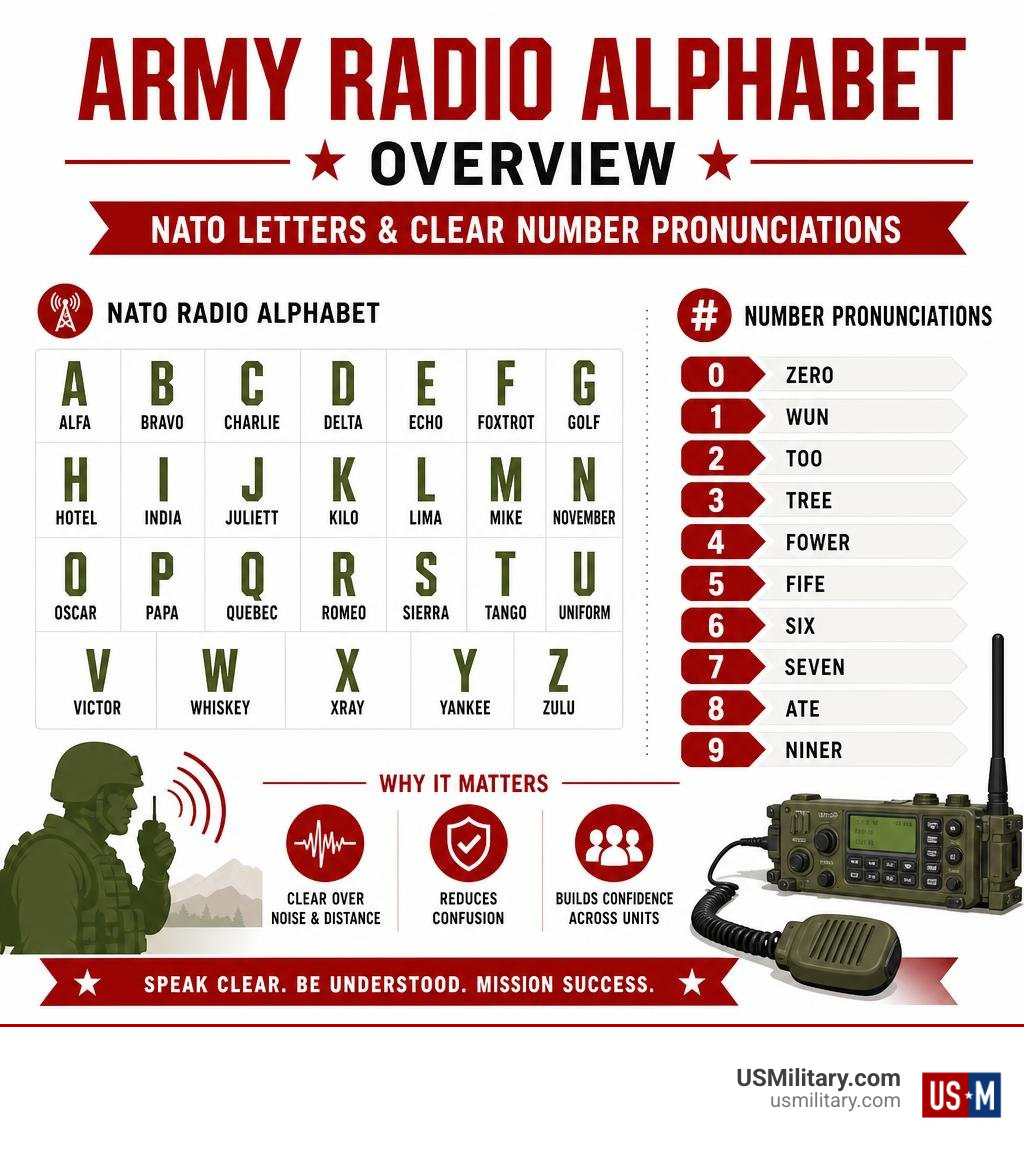
Army radio alphabet glossary:
- Alphabet military
- military alphabet phonetics
- military communication alphabet
What is the NATO Phonetic Alphabet and Why Military Forces Use It
When operating in tactical environments, split-second miscommunications can carry severe consequences. We rely on the army radio alphabet to eliminate ambiguity over high-frequency radios, combat net radios like SINCGARS, and satellite links. For a deep dive into the broader tactical communication architecture, check out our Phonetic Military Alphabet Complete Guide.
Radio signals in combat zones or training areas are often compromised by environmental static, engine noise, gunfire, or distance. In acoustic science, standard English letter names suffer from low distinctiveness—letters like “B,” “C,” “D,” “E,” “P,” and “T” share identical rhyming vowel endings (the “ee” sound). Over a scratchy connection, distinguishing “Bravo” from “Delta” is effortless, whereas telling “B” from “D” is nearly impossible.
According to the official NATO phonetic alphabet – Wikipedia historical record, the International Civil Aviation Organization (ICAO) conducted hundreds of thousands of comprehension tests across 31 nationalities to engineer words that remain acoustically distinct regardless of native accents or background noise. The primary goal was to maximize acoustic distinctiveness and ensure cross-language usability for multinational joint forces.
Today, this system is trusted not only by defense forces worldwide, but also by emergency responders, air traffic controllers, and maritime operators. By establishing a single global standard, allied units operate with complete tactical clarity whether calling in air support or transmitting critical medical evacuation (MEDEVAC) data.
History and Evolution of the Army Radio Alphabet
Military communications were not always unified under a single phonetic standard. Early radio and wire telephone systems in the 1920s relied on varying regional lists. The International Telecommunication Union (ITU) established the first internationally recognized telephone spelling alphabet in 1927 using geographical names like Amsterdam, Baltimore, and Canada.
As World War II broke out, military branches required a streamlined system for field combat. In 1941, the United States military adopted the Joint Army/Navy Phonetic Alphabet, widely known as the “Able Baker” alphabet. This system assigned familiar words to letters:
- A = Able
- B = Baker
- C = Charlie
- D = Dog
- V = Victor
While Able Baker served Allied forces well during WWII, international operations following the war revealed significant drawbacks. Non-English-speaking allies struggled with English pronunciations, leading to confusion during joint NATO maneuvers. To explore the historical evolution in detail, read Military Alphabet – Army Alphabet Facts and learn What Is The Military Alphabet.
By 1951, the International Air Transport Association (IATA) proposed a draft international alphabet. Extensive testing led by ICAO and NATO refined this draft, leading to the final adoption of the current NATO Phonetic Alphabet on March 1, 1956. Words like “Nectar” were replaced with “November,” and “Extra” was replaced with “X-ray” (later stylized as “Xray”) to build a universally recognized voice communication standard.
Mastering the Army Radio Alphabet: Letter and Pronunciation Guide
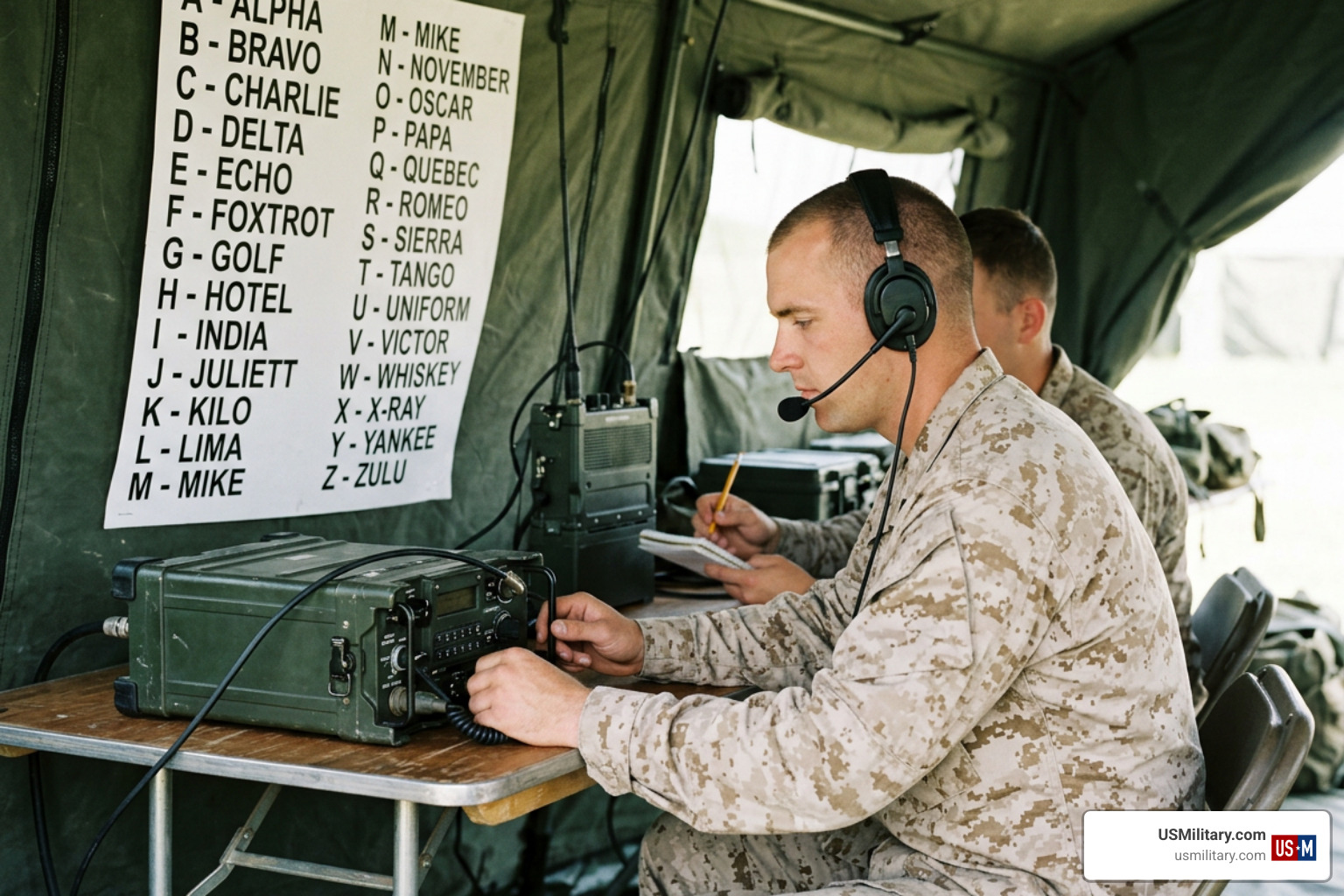
To speak like a professional radio operator, memorizing the standard list is only the first step. You must also master the official phonic pronunciations designed to smooth out regional accents and maximize speech intelligibility over crackling radio frequencies. If you want to enhance your tactical vocabulary further, check out Military Alphabet Phonetics The No-Nonsense Guide To Sounding Tactical and browse through our recommended list of 10 Must Read Books On Military Alphabet.
Notice how specific words are spelled non-traditionally in official NATO documentation:
- Alfa is spelled with an “f” instead of “ph” so non-English speakers (such as French or Spanish speakers) do not pronounce it incorrectly.
- Juliett is spelled with a double “t” at the end so French speakers pronounce the final hard “t” sound rather than leaving it silent.
Below is the complete standard reference table for all 26 letters:
| Letter | Code Word | Phonic Pronunciation Guide |
|---|---|---|
| A | Alfa | AL-FAH |
| B | Bravo | BRAH-VOH |
| C | Charlie | CHAR-LEE |
| D | Delta | DELL-TAH |
| E | Echo | ECK-OH |
| F | Foxtrot | FOKS-TROT |
| G | Golf | GOLF |
| H | Hotel | HOH-TELL |
| I | India | IN-DEE-AH |
| J | Juliett | JEW-LEE-ETT |
| K | Kilo | KEY-LOH |
| L | Lima | LEE-MAH |
| M | Mike | MIKE |
| N | November | NO-VEM-BER |
| O | Oscar | OSS-CAH |
| P | Papa | PAH-PAH |
| Q | Quebec | KEH-BECK |
| R | Romeo | ROW-ME-OH |
| S | Sierra | SEE-AIR-RAH |
| T | Tango | TANG-GO |
| U | Uniform | YOU-NEE-FORM |
| V | Victor | VIK-TAH |
| W | Whiskey | WISS-KEY |
| X | Xray | ECKS-RAY |
| Y | Yankee | YANG-KEY |
| Z | Zulu | ZOO-LOO |
Non-rhotic pronunciation (dropping the hard trailing “r” sound in words like Oscar or Victor) is encouraged in international voice procedure to maintain clarity across foreign languages and accents.
Handling Isolated Letters and Abbreviations
When transmitting acronyms, call signs, or map grid coordinates over voice channels, we avoid spelling out full phrases unless requested. Instead, isolated letters and abbreviations are pronounced directly using their phonetic equivalents. For practical advice on transitioning from civilian habits to crisp tactical speech, read Stop Saying A As In Apple And Master The Civilian Military Alphabet and Dont Be A Charlie And Master The Military Communication Alphabet Today.
For example, when transmitting the military acronym “SOP” (Standard Operating Procedure), an operator states “Sierra-Oscar-Papa.” When reading a vehicle bumper mark or unit call sign such as “B2C,” the operator states “Bravo-Tree-Charlie.”
Key guidelines for abbreviations and isolated letters include:
- No Proword Needed for Standard Spelling: In routine traffic, you do not need to say “I SPELL” before standard NATO phonetics unless the receiver specifically asks for clarification or garbled static requires re-transmission.
- Grid Coordinates: Map grid coordinates must be transmitted as individual phonetic characters followed by single numerical digits. Grid “DH98” is transmitted as “Delta-Hotel-Niner-Eight.”
- Unit Call Signs: Call signs combining letters and numbers (e.g., “E39”) are spoken character-by-character as “Echo-Tree-Niner.”
For a deeper understanding of how these conventions play out in everyday military life, read Whether Youre In The Military Or Not You Probably Know At Least Part Of The Military Alphabet Heres How Its Used Today And What Makes It So Important.
Spoken Numbers, Tactical Time, and Grid Coordinates
Numbers are just as crucial as letters when passing fire orders, troop counts, grid locations, or rendezvous points. Saying a standard civilian number over static can lead to fatal misunderstandings. To master military numeric speech, explore How To Speak Military Numbers Without Sounding Like A Civilian.
According to military doctrine detailed in FM 24-19: Radio Operator’s Handbook – Chptr 5 Operating Procedures, spoken numbers must follow strict phonetic modifications:
| Digit | Spoken Word | Vocal Enunciation |
|---|---|---|
| 0 | ZERO | ZE-RO |
| 1 | WUN | WUN |
| 2 | TOO | TOO |
| 3 | TREE | TREE |
| 4 | FOWER | FOW-ER |
| 5 | FIFE | FIFE |
| 6 | SIX | SIX |
| 7 | SEVEN | SEV-EN |
| 8 | AIGHT | AIT |
| 9 | NINER | NIN-ER |
The Digit-by-Digit Rule: Numbers are transmitted digit-by-digit, never as full combined words, with a small exception for exact multiples of thousands:
- “12” is spoken as “WUN TOO” (never “twelve”).
- “44” is spoken as “FOW-ER FOW-ER” (never “forty-four”).
- “136” is spoken as “WUN TREE SIX”.
- Exact thousands use the proword “THOUSAND”: “5,000” is spoken as “FIFE THOUSAND”, while “5,200” is spoken as “FIFE TOO ZERO ZERO”.
Operators use the proword FIGURES right before sending numbers if there is any chance the receiver might confuse the numerical digits with spoken words of similar sound.
Military Time Transmissions and Time Zone Designators
Accurate time keeping coordinates complex combat operations across multiple global sectors. The military relies on the 24-hour clock system and standardized phonetic time zone suffixes. Learn the operational rules in How To Read Military Time and review our main guide on Military Time.
In written military time, four digits are used without colons (e.g., 0800 or 1530). When spoken over the radio:
- 0800 is spoken as “ZERO EIGHT HUNDRED.”
- 1430 is spoken as “FOURTEEN TREE ZERO” or “ONE FOWER TREE ZERO.”

Global operations rely on Coordinated Universal Time (UTC), designated in military communications by the letter Zulu (“Z”). Greenwich Mean Time (UTC+0) is “Zulu Time.” When operating in local time zones, a single phonetic letter designates the time offset.
An interesting detail of military time zone designators is that the letter Juliet (“J”) is omitted from international UTC time zone maps. “Juliet” is specifically reserved by radio operators to signify local time wherever the transmitting station is physically located. For example, transmitting “1400J” is pronounced “FOURTEEN HUNDRED JULIET,” representing 2:00 PM local time.
Radio Net Procedures, Prowords, and Tactical Protocol
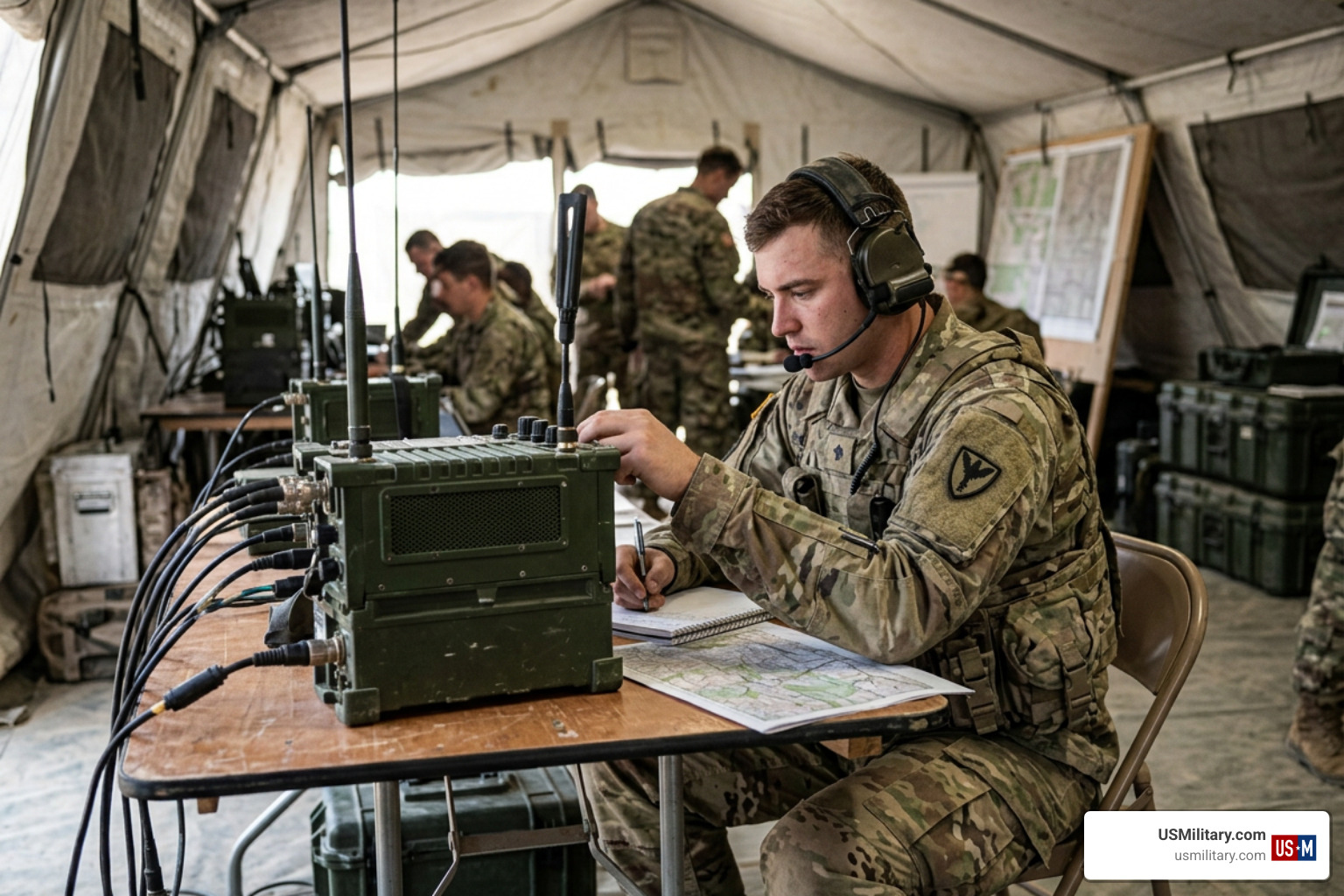
Operating a military tactical radio net requires far more than just standard vocabulary—it demands strict transmission etiquette and procedural discipline. A tactical radio net is an organized network of radios operating on a shared frequency. Net Control Station (NCS) manages order and traffic priority across all net members.
Procedural words, or prowords, are standardized phrases designed to condense radio traffic and eliminate ambiguity. Common prowords include:
- ROGER: “I have received your last transmission satisfactorily.” (Note: ROGER never means “yes” or “affirmative”—it only confirms receipt).
- WILCO: “I have received your message, understand it, and WILL COMPLY.” (Because WILCO implies receipt, you never say “ROGER WILCO”—saying both is redundant).
- OVER: “This is the end of my transmission to you, and a response IS necessary.”
- OUT: “This is the end of my transmission to you, and NO response is expected.” (Crucial rule: Never say “OVER AND OUT”—the two terms are mutually exclusive!).
- SAY AGAIN: “Repeat your last transmission.” (Never use the word “REPEAT” on a military radio, as “REPEAT” is an artillery proword ordering batteries to fire the exact same fire mission again!).
- CORRECTION: “An error has been made in this transmission. Transmission continues with the last word correctly spoken.”
- FIGURES: “Numerals follow.”
When opening a radio net, the NCS conducts an alphanumeric roll call. Net participants must enter the net in strict sequence based on call sign suffixes (e.g., NCS station E46, followed by duty positions E13, E39, etc.).
For authoritative protocol standards, review official military doctrine in FM 24-19: Radio Operator’s Handbook – Chptr 5 Operating Procedures and signaling rules in Signalling Information.
Practical Exercises for Learning the Army Radio Alphabet
Building speed and accuracy with tactical voice communications requires deliberate daily practice. To build natural muscle memory:
- License Plate Spelling: While driving or commuting, spell out nearby vehicle license plates using phonetic code words and phonetic numbers. For example, seeing “7KT-409” should prompt you to instantly recite “SEVEN KILO TANGO FOWER ZERO NINER.”
- Reading Street Signs: Convert street names and building addresses into phonetic callouts while walking or travelling.
- Written Dictation Drills: Have a training partner read random alphanumeric strings while you transcribe them into standard military notation (remembering to slash zeroes as “Ø” and underline Z’s as “Z” to avoid handwritten numerical confusion).
- Mock Call Signs and Grid Runs: Practice calling in mock MEDEVAC reports or grid coordinates using proper prowords (ROGER, WILCO, OVER, OUT).
Frequently Asked Questions About the Army Radio Alphabet
Why is 9 pronounced as ‘niner’ and 3 as ‘tree’ on military radio?
The number 9 is pronounced as “NINER” to prevent audio confusion with the number 5 (“FIFE”) and to avoid confusion with the German word “nein” (meaning “no”), which is pronounced identically to “nine.” Over crackling or static-heavy channels, “nine” and “five” sound remarkably similar due to their trailing consonant sounds.
Similarly, the number 3 is pronounced as “TREE” (dropping the “th” sound) because non-English speakers often struggle with the English “th” friction sound, turning “three” into “sri” or “free.”
Number 4 is spoken as “FOWER” (two syllables) and 5 as “FIFE” (hard “f” ending) to maintain sharp acoustic separation over low-bandwidth military frequencies.
What is the difference between the NATO alphabet and WWII Able Baker?
The Able Baker alphabet was the joint U.S. Army and Navy phonetic alphabet adopted in 1941 for World War II (featuring words like Able, Baker, Charlie, Dog, Easy, Fox). While effective for native English speakers, Able Baker proved difficult for foreign allied nations during post-war NATO joint operations.
The modern NATO phonetic alphabet (Alfa, Bravo, Charlie, Delta, Echo, Foxtrot) was finalized in 1956 after comprehensive multinational scientific testing involving 31 nationalities. Words in the NATO system were specially engineered to be instantly recognizable across diverse international languages, accents, and dialects.
How do you properly open and close a military radio net?
To open a tactical radio net:
- The Net Control Station (NCS) transmits a call to all member stations in alphanumeric order.
- Member stations respond in their assigned sequence using abbreviated call signs, stating their readiness level or reporting traffic priority.
- NCS confirms all stations are checked into the net.
To close a radio net:
- NCS issues a formal close-down order.
- Member stations acknowledge the order in exact alphanumeric sequence.
- NCS signs off the net with the proword “OUT.”
Conclusion
Mastering the army radio alphabet is a foundational skill for anyone in the military or emergency response services. By substituting easily confused letter sounds with distinct code words—and using modified number pronunciations like “TREE” and “NINER”—you eliminate miscommunication, safeguard operational security, and maintain absolute clarity when static or chaos hits the radio net.
Whether you are preparing for military enlistment, practicing field maneuvers, or simply honing tactical communication skills, mastering these protocols ensures your message gets through loud and clear every single time.
For complete resources on military benefits, career path comparisons across all service branches, VA home loans, and expert tactical guidance, explore our primary resources at USMilitary.com and dive deeper into our dedicated USMilitary.com Military Alphabet Guide. If you are seeking inspirational reading on personal leadership and service, explore Dare to Live Greatly on Amazon.