
Why the Past VA Disability Calculator Still Matters for Every Veteran

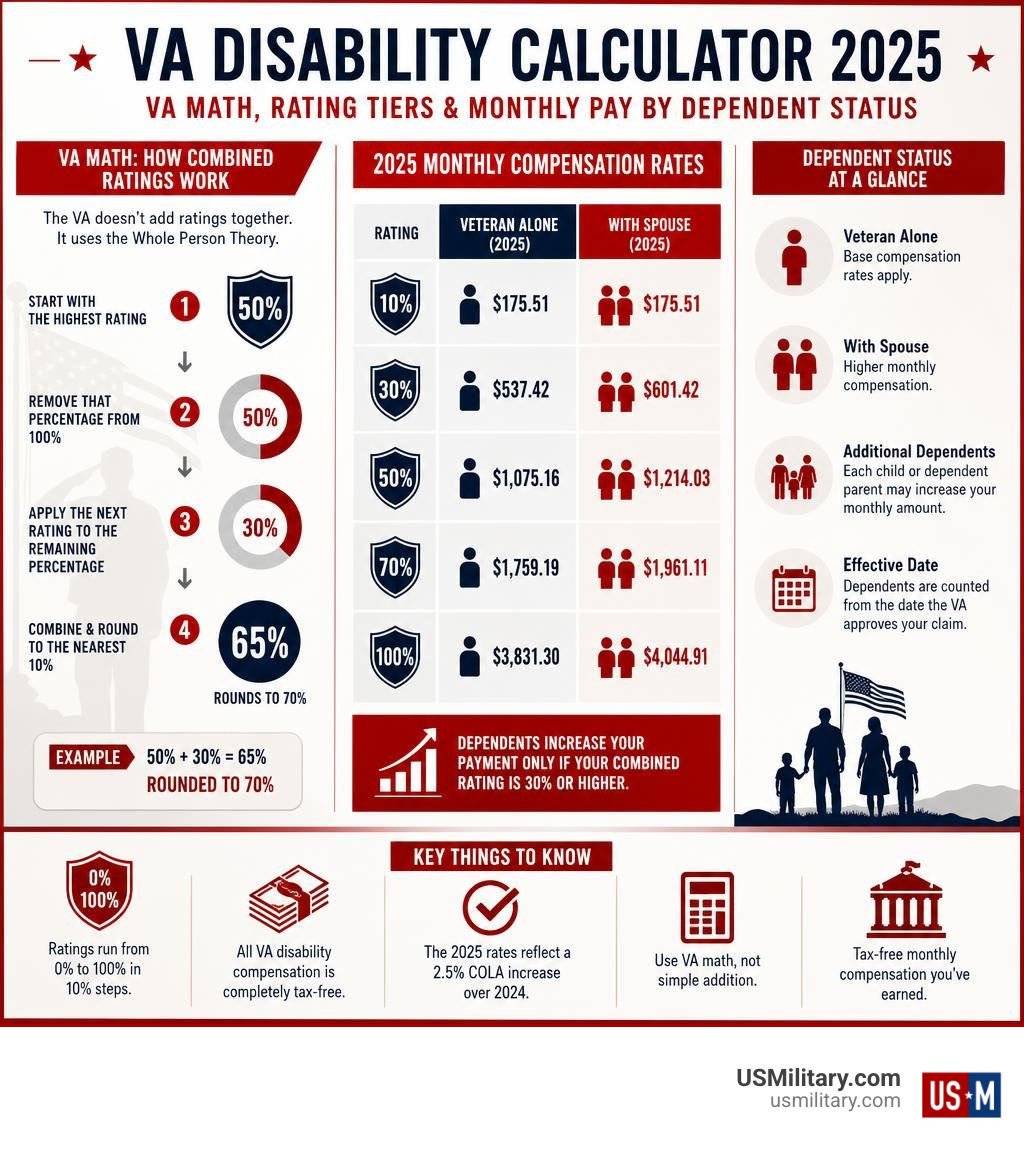
Using a VA disability calculator in 2025 is the fastest way to estimate your monthly tax-free compensation before diving into the full details. Here is a quick snapshot to answer the most common questions right away:
| Rating | Veteran Alone (2025) | With Spouse (2025) |
|---|---|---|
| 10% | $175.51 | $175.51 |
| 30% | $537.42 | $601.42 |
| 50% | $1,075.16 | $1,214.03 |
| 70% | $1,759.19 | $1,961.11 |
| 100% | $3,831.30 | $4,044.91 |
Key things to know up front:
- Ratings run from 0% to 100% in 10% steps
- The VA does not add ratings together — it uses a formula called VA math
- Dependents only increase your payment if your combined rating is 30% or higher
- All VA disability compensation is completely tax-free
- The 2025 rates reflect a 2.5% COLA increase over 2024
If your combined rating looks lower than you expected, you are not alone. Many veterans are surprised to learn that a 50% rating plus a 30% rating does not equal 80% — it equals 65%, which rounds to 70%. That gap can mean hundreds of dollars less per month.
I’m Larry Fowler, publisher of USMilitary.com, and I’ve spent nearly two decades tracking VA benefits trends — including every update to the VA disability calculator 2025 — helping veterans and their families cut through the complexity and claim what they’ve earned. In this guide, I’ll walk you through exactly how the system works, step by step.
What is a VA Disability Calculator 2025 and How Does It Work?
A VA disability calculator 2025 is an interactive, digital tool designed to translate your individual physical and mental service-connected conditions into an estimated overall rating and a corresponding monthly monetary payout.
When you serve, your body and mind take on wear and tear. If you file a claim and the Department of Veterans Affairs (VA) approves it, they assign a percentage rating to each of your conditions. These ratings reflect how much a condition decreases your overall health and ability to function in daily life.
However, because you cannot be more than 100% disabled, you cannot simply add these percentages together using standard addition. That is where a digital calculator becomes invaluable. By inputting your individual ratings, the tool automatically applies the complex legal formulas used by the VA to give you an accurate combined rating.
Best of all, these monthly compensation payments are completely tax-free benefits at both the federal and state levels. They do not count toward your gross income, meaning every dollar estimated by our VA disability calculator 2 goes straight into your pocket to support you and your family.
Estimating Your Monthly Compensation
To give you an accurate picture, the calculator takes your combined percentage rating and cross-references it with your personal demographic details. It asks questions about your household, such as whether you are married, have children, or support dependent parents. Because the VA pays higher basic rates to veterans with family obligations, a calculator helps you see exactly how these adjustments scale up your monthly compensation. The primary goal of using a calculator is payment estimation. The tool references the official, legally mandated basic rates set by the federal government.
If you want to bypass the manual math entirely and see your potential payout instantly, we highly recommend trying the va disability calculator 2 to run different household scenarios and see how adding or modifying ratings changes your monthly bottom line.
Demystifying “VA Math” and Combined Disability Ratings
If you have ever tried to add up your VA disability ratings and ended up with a headache, you have experienced the confusing reality of VA math.
The VA does not use standard addition because of the “whole person theory.” This mathematical framework dictates that a veteran can never be more than 100% able-bodied. When you receive your first disability rating, it is subtracted from your “whole” healthy self. Any subsequent ratings you receive are not taken from your original 100% starting point; instead, they are calculated as a percentage of your remaining healthy efficiency.
To make this easier to understand, the VA publishes a combined rating table. You can read more about how the government officially structures these evaluations by visiting the VA’s page About Disability Ratings.

Step-by-Step Combined Rating Calculation
To calculate a combined rating manually, you must follow a strict sequential calculation. The VA always ranks your disabilities from the highest percentage rating to the lowest percentage rating before performing any math.
Let’s look at a real-world example of how this works. Imagine a veteran has three service-connected conditions:
- PTSD rated at 50%
- Sleep apnea rated at 30%
- Tinnitus rated at 10%
Here is how the sequential calculation unfolds:
- Start with a “whole person” value of 100% (fully healthy).
- Apply the highest rating (50% PTSD):
- 50% of 100 is 50.
- Subtract 50 from 100, leaving the veteran with a 50% remaining healthy efficiency.
- Apply the next highest rating (30% Sleep Apnea) to the remaining 50% healthy efficiency:
- 30% of 50 is 15.
- Subtract 15 from the remaining 50, leaving the veteran with a 35% remaining healthy efficiency.
- The total accumulated disability is now 50% + 15% = 65%.
- Apply the lowest rating (10% Tinnitus) to the remaining 35% healthy efficiency:
- 10% of 35 is 3.5.
- Subtract 3.5 from the remaining 35, leaving the veteran with a 31.5% remaining healthy efficiency.
- The total unrounded accumulated disability is now 65% + 3.5% = 68.5%.
Once all conditions are calculated, the VA applies its official rounding rules to determine your final combined rating. The final percentage is rounded to the nearest 10% increment:
- Any unrounded value ending in 1 through 4 rounds down to the nearest 10%.
- Any unrounded value ending in 5 through 9 rounds up to the nearest 10%.
In our example, the unrounded sum is 68.5%. Because the final digit ends in 5 or higher, the VA rounds this value up to a final combined rating of 70%.
If you want to see how different combinations of ratings interact, you can use the official VA disability rating chart 2025 to map out your own conditions.
The Bilateral Factor in the va disability calculator 2025
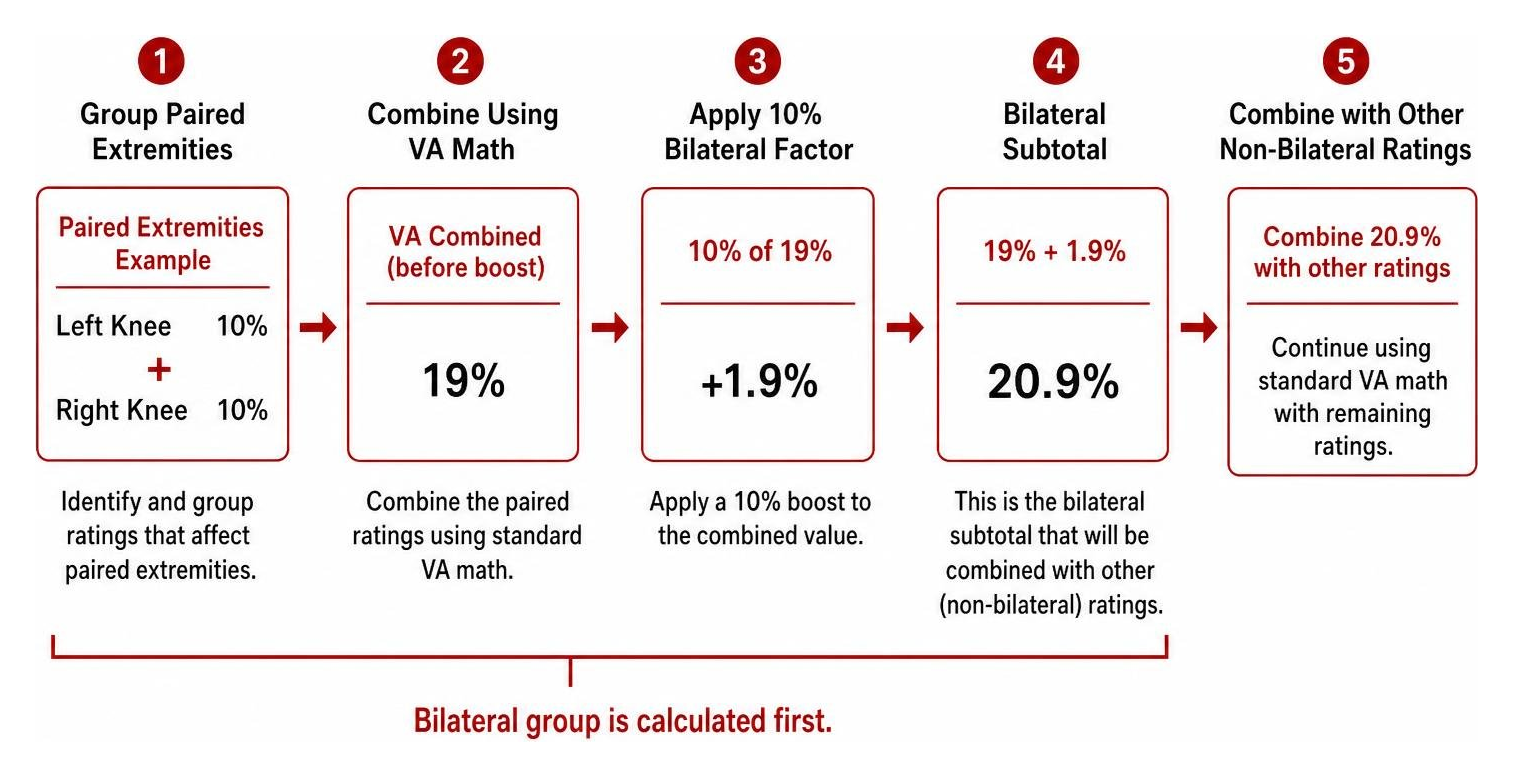
One of the most overlooked aspects of VA math is the bilateral factor. This rule is designed to provide extra compensation to veterans who have service-connected disabilities affecting paired extremities. This means if you have conditions affecting both of your arms, both of your legs, or paired skeletal muscles, you qualify for a special mathematical boost.
The bilateral factor applies a 10% multiplier to the combined value of your paired extremities before those conditions are combined with any of your other non-bilateral disabilities.
For example, if you have a 10% rating for your left knee and a 10% rating for your right knee, the VA does not just combine them normally. Instead, they combine the two knee ratings using standard VA math (which equals 19%), and then they add a 10% boost of that combined value (1.9%), resulting in a bilateral subtotal of 20.9%. This subtotal is then combined with any other ratings you have, such as mental health or respiratory conditions.
Because bilateral calculations are incredibly tedious to perform by hand, a modern calculator is essential. You can review how these paired extremity rules are structured by exploring the VA disability rating charts 2025.
2025 VA Disability Pay Rates and COLA Adjustments
Every year, the federal government adjusts VA disability rates to ensure that veterans do not lose purchasing power to inflation. This annual update is known as the Cost-of-Living Adjustment (COLA), and by law, the VA is required to match the exact percentage adjustment made to Social Security benefits.
For the 2025 calendar year, veterans received a 2.5% COLA increase over their 2024 benefits. This inflation adjustment helped offset the rising costs of housing, groceries, and healthcare. If you want to dive deep into the specific historical numbers, you can view the complete 2025 VA disability rates tables.
Comparing 2024 vs 2025 VA Disability Rates
To help you see how the 2.5% COLA increase translated into real dollars, let’s compare the basic monthly rates for a single veteran with no dependents between 2024 and 2025:
| Combined Rating | 2024 Basic Monthly Rate | 2025 Basic Monthly Rate | Net Monthly Increase |
|---|---|---|---|
| 10% | $171.23 | $175.51 | $4.28 |
| 20% | $338.49 | $346.95 | $8.46 |
| 30% | $524.31 | $537.42 | $13.11 |
| 40% | $755.28 | $774.16 | $18.88 |
| 50% | $1,075.16 | $1,102.04 | $26.88 |
| 60% | $1,361.88 | $1,395.93 | $34.05 |
| 70% | $1,716.28 | $1,759.19 | $42.91 |
| 80% | $1,995.01 | $2,044.89 | $49.88 |
| 90% | $2,246.91 | $2,303.08 | $56.17 |
| 100% | $3,737.85 | $3,831.30 | $93.45 |
As you can see, while a 10% rating saw a modest increase of $4.28 per month, a 100% rated veteran received nearly $100 more each month. This highlights why keeping track of annual adjustments is so critical for long-term financial planning.
To review the historical context of these changes, you can check out the va disability rates 2024 guide as well as the 2024 va disability rates increase 2 analysis.
How Dependents Affect Your Monthly Payment
Many veterans do not realize that their household size can dramatically increase their monthly VA paycheck. If you have a combined disability rating of 30% or higher, you are legally eligible to receive additional monthly compensation for your qualifying dependents.
Qualifying dependents include:
- A dependent spouse
- Dependent children under the age of 18
- Dependent children between the ages of 18 and 24 who are enrolled full-time in an approved school program
- Dependent parents whom you financially support
It is important to note that if your combined rating is only 10% or 20%, you receive a flat monthly rate. The VA does not pay extra dependent allowances for these lower tiers, regardless of how many children or parents you support.
Once you cross that 30% threshold, the financial additions scale up with your percentage. For example, in 2025, a 100% disabled veteran with a spouse receives $4,044.91, which is $213.61 more per month than a single veteran at the same rating.
To ensure you are calculating these additions correctly, you can check the official Current Veterans Disability Compensation Rates directly from the VA.
Advanced VA Benefits: TDIU, SMC, and Rating Protection
For veterans navigating severe disabilities, there are several advanced programs and legal protections that can significantly alter how you use a calculator and manage your claims.
Whether you are unable to work, require daily caregiving assistance, or are worried about the VA reducing your rating over time, understanding these rules is essential to safeguarding your financial security. If you are aiming for maximum compensation, our how much VA 100 disability guide offers a comprehensive breakdown of these top-tier benefits.
TDIU vs. 100% Schedule Rating
Many veterans believe that the only way to receive the maximum 100% monthly payout is to have their individual disabilities combine to 100% using VA math. However, there is a crucial alternative pathway known as TDIU (Total Disability Individual Unemployability).
Here is how the two pathways compare:
- 100% Schedular Rating: Your service-connected conditions combine to 100% using standard VA math. Under a schedular rating, there are absolutely no employment or earnings restrictions. You can work a full-time job and earn unlimited income while still receiving your full monthly disability check.
- TDIU (Total Disability Individual Unemployability): This benefit is designed for veterans whose service-connected conditions prevent them from securing or maintaining “substantially gainful employment.” If you qualify, the VA will pay you at the 100% rate even if your combined schedular rating is lower (such as 70% or 80%).
To qualify for TDIU, you generally must have at least one service-connected condition rated at 60% or higher, or a combined rating of 70% or higher with at least one individual condition rated at 40% or higher.
The major trade-off with TDIU is the earnings restriction. Because the benefit is based on your inability to work, your earned income from employment must remain below the federal poverty threshold (approximately $15,650 for a single person) unless you work in a highly protected, sheltered workshop environment.
If your conditions have worsened and you are struggling to stay employed, you should read our guide on how to increase va disability rating to explore your options.
Special Monthly Compensation (SMC) and PACT Act Presumptives

Beyond standard disability pay, the VA offers two major programs that can provide substantial financial boosts: Special Monthly Compensation (SMC) and PACT Act presumptive conditions.
Special Monthly Compensation (SMC) is an additional, tax-free benefit paid to veterans who suffer from severe, specific disabilities. This includes the loss or loss of use of creative organs, hands, feet, or eyesight, as well as veterans who are bedridden or require daily Aid and Attendance caregiving.
- The most common entry-level tier is SMC-K, which is an add-on payment (worth $137.85 per month in 2025/2026) paid on top of your standard monthly disability check for the loss of use of a single extremity or creative organ.
The PACT Act, signed into law in 2022, represents the largest expansion of veteran healthcare and benefits in decades. It established a long list of presumptive conditions for veterans exposed to toxic substances, burn pits, radiation, and Agent Orange during their service.
- A “presumptive condition” means that if you served in a qualifying location during a specific timeframe, the VA automatically assumes your illness (such as certain cancers, chronic bronchitis, or severe hypertension) was caused by your military service. You do not have to provide a complex medical link to prove service connection.
Understanding how these toxic exposure claims fit into your overall profile is crucial. You can find detailed charts and condition lists in our va disability rating charts 2025 resource.
Understanding the 5-Year, 10-Year, and 20-Year Rules
Once you secure a VA disability rating, you want to make sure it is protected. The VA has the legal authority to re-evaluate your conditions and potentially reduce your rating if they believe your health has improved. However, the longer your rating remains in place, the harder it becomes for the VA to legally reduce it, thanks to three critical protection rules:
- The 5-Year Rule (Stabilized Ratings): If your rating has been in effect for 5 years or longer, the VA considers it “stabilized.” The VA cannot reduce a stabilized rating based on a single, isolated medical exam. They must show sustained, long-term medical improvement across multiple records before they can legally lower your percentage.
- The 10-Year Rule (Protected Service Connection): Once your service connection has been active for 10 years or more, the VA cannot sever or eliminate your service connection unless there is clear proof of original fraud. Even if your physical rating percentage is reduced, your legal status as a service-connected disabled veteran remains locked in.
- The 20-Year Rule (Protected Rating Level): This is the gold standard of protection. Once a specific rating level (such as 70%) has been active for 20 continuous years, the VA cannot reduce it below that percentage under any circumstances, except in rare cases of fraud.
Knowing these timelines helps you navigate future medical re-examinations with confidence. For a deeper look at how to protect your benefits, read our comprehensive va disability pay 2026 guide.
Looking Ahead: Transitioning to 2026 Rates
As we move forward through 2026, veterans are now receiving payments based on the latest cost-of-living adjustments. The federal government enacted a 2.8% COLA increase for 2026, which officially took effect on December 1, 2025.
This 2.8% boost bumped the basic monthly rate for a single veteran at 100% from $3,831.30 up to $3,938.58.
If you are planning your household budget for the current year, it is vital to use up-to-date numbers. You can find all the current tables and payment schedules in our va disability pay 2026 guide, or read everything you need to know about the transition in our 2026 va disability rates everything you need to know master resource.
Frequently Asked Questions
Navigating the VA benefits system can raise a lot of questions. Here are clear, straightforward answers to the most common inquiries we receive from veterans.
How do I use a VA disability calculator 2025?
Using a digital calculator is incredibly simple and takes less than two minutes.
First, gather your official VA rating decision letters.
Next, input your individual disability percentages into the calculator, starting with your highest rated condition down to your lowest.
Finally, select your household dependent status (such as married, supporting parents, or having children under 18). The calculator will automatically perform the sequential VA math, apply any bilateral extremity factors, and display your estimated monthly tax-free payment.
Can I receive VA disability and Social Security benefits at the same time?
Yes! You can absolutely receive both VA disability compensation and Social Security Disability Insurance (SSDI) at the same exact time.
Because they are completely separate federal programs managed by different agencies, they do not offset or reduce each other. Receiving a high VA disability rating does not penalize your Social Security payout, allowing you to collect concurrent benefits to maximize your household income.
Is VA disability compensation taxable?
No, VA disability compensation is completely tax-free. Under federal law (26 USC 104), these monthly payments are not considered gross income. You do not have to report them on your federal tax return, they are not subject to Social Security or Medicare taxes, and almost every state also exempts them from state income taxes.
Conclusion
Calculating your VA disability rating does not have to be an overwhelming chore. By understanding the fundamentals of VA math, accounting for bilateral extremity factors, and ensuring your household dependents are properly registered, you can take complete control of your financial future.
At USMilitary.com, we are dedicated to providing clear, unbiased, and comprehensive resources for our active-duty service members, veterans, and military families. From finding the best home loan options to demystifying complex benefit tables, we are here to support you at every stage of your post-military life.
If you are ready to estimate your monthly compensation and see what you have earned, take the first step today by using our free, private va disability calculator 2. For more expert guides and tools, explore our main hub at USMilitary.com or check out resources like Dare to Live Greatly to help guide your transition journey.