
Eligibility and Common Service-Connected Conditions for Soldiers

To file for VA disability, Army veterans must establish an effective date by submitting an Intent to File, gather essential evidence—including Service Treatment Records (STRs), current medical diagnoses, and nexus opinions—and submit VA Form 21-526EZ online at VA.gov or by mail. Qualifying for VA Disability Compensation provides tax-free monthly payments designed to offset lost earning capacity from service-connected impairments. Understanding your full range of Army veteran benefits ensures you receive the compensation earned during your military career. Serving in the Army places unique physical and mental demands on soldiers, from daily PT to combat deployments, leading to distinct wear and tear.
The conditions affecting soldiers span a wide variety of medical categories:
- Musculoskeletal Injuries: Nearly half of all Army service members experience one or more musculoskeletal injuries each year, making them the leading health challenge across the force. Repetitive road marching while carrying combat loads exceeding 80 pounds places immense strain on knees, ankles, hips, and the spine. Common claims include degenerative disc disease, lumbar strain, patellofemoral pain syndrome, and chronic plantar fasciitis.
- Hearing Loss and Tinnitus: Constant proximity to small-arms fire, artillery, tracked vehicles, and aircraft makes acoustic trauma universal. Tinnitus (ringing in the ears) remains one of the most frequently granted service-connected conditions.
- Traumatic Brain Injury (TBI): Explosive blasts, vehicle rollovers, and training concussions can cause mild to severe TBIs, often resulting in migraines, memory loss, and sensory sensitivity.
- Mental Health Conditions: High-stress operational tempos and combat tours frequently trigger Post-Traumatic Stress Disorder (PTSD), major depressive disorder, and generalized anxiety.
- Military Sexual Trauma (MST): Approximately 1 in 4 women and 1 in 100 men in the Army report experiencing Military Sexual Trauma during their military service. The VA handles these sensitive claims with specialized adjudicators who evaluate both direct records and behavioral markers.
Step 1: Meet Core Service and Discharge Requirements
To file a successful claim, your discharge status must be anything other than dishonorable (e.g., Honorable, General Under Honorable Conditions). Your active duty DD Form 214 acts as the foundational verification document for all claims.
For active-duty soldiers, injuries and illnesses incurred during your enlistment are covered under the standard presumption of sound condition upon entry, unless noted otherwise in your enlistment physical.
For drilling Army Reserve and Army National Guard soldiers, the eligibility criteria differ. When serving on Inactive Duty for Training (IDT/drill weekends), the law covers disabilities specifically caused by injuries, heart attacks (myocardial infarction or cardiac arrest), or strokes (cerebrovascular accidents). To substantiate these claims, you must provide Line of Duty (LOD) investigation documentation proving the incident occurred during authorized duty hours.
Understanding Presumptive Conditions and Toxic Exposures
Normally, you must prove that a specific in-service event caused your medical diagnosis. However, under statutory rules established by Congress—including the landmark PACT Act—certain conditions are legally presumed to be service-connected.

Presumptive rules eliminate your need to provide a direct medical link if you served in designated locations during specific timeframes:
- Burn Pits and Airborne Hazards (Post-9/11 & Gulf War): Service in Iraq, Afghanistan, Kuwait, Saudi Arabia, and surrounding airspace qualifies soldiers for presumptive coverage for over 20 respiratory conditions and cancers, including asthma, chronic bronchitis, COPD, rhinitis, and sinusitis.
- Agent Orange Exposure (Vietnam & Korean DMZ): Exposure to tactical herbicides grants presumptive status for conditions like Type 2 diabetes, ischemic heart disease, Parkinson’s disease, and multiple myeloma.
- One-Year Post-Discharge Window: Certain chronic conditions—such as arthritis, hypertension, or peptic ulcers—that manifest to a degree of 10% or more within 365 days of separation are presumed to be related to your military service.
How Army Veterans Successfully File For VA Disability Step-by-Step
Filing an airtight claim requires a disciplined approach to documentation and deadlines. When discovering How to File a VA Disability Claim, the process begins by formally notifying the agency of your claim.
If you plan to submit a paper claim, file an Intent to File (VA Form 21-0966). If you submit online via VA.gov, starting the application automatically establishes your effective date. You then have up to 365 days to gather your evidence and submit the completed package. Every month that passes while compiling evidence is preserved, meaning your eventual back pay calculates back to the date you initiated the file.
When you are ready, follow official guidelines on How To File A VA Disability Claim | Veterans Affairs using VA Form 21-526EZ (Application for Disability Compensation and Related Compensation Benefits).
How Army Veterans Successfully File For VA Disability Online and By Mail
The VA provides several pathways to submit your application:
- Online via VA.gov: The fastest and most transparent option. You can upload digital records, track claim movement, and view correspondence directly.
- By Mail: Send hard-copy documents to the centralized processing facility:
> Department of Veterans Affairs
> Claims Intake Center
> PO Box 4444
> Janesville, WI 53547-4444 - In Person: Visit your nearest VA Regional Office (VARO) to hand-deliver your application and have it date-stamped.
- With Accredited Assistance: Partnering with a Veteran Service Officer (VSO) from organizations like the VFW, DAV, or American Legion provides free, professional guidance. If you need dedicated guidance, check our resource on Help Filing VA Disability Claim.
Benefits Delivery at Discharge (BDD) vs Post-Separation Claims
Transitioning soldiers should always aim to use the Benefits Delivery at Discharge (BDD) program.
- The 180 to 90 Day Window: If you have between 180 and 90 days remaining on active duty, you can submit your claim before leaving the Army.
- The Advantage: BDD allows you to attend your Compensation and Pension (C&P) exams while still on active duty, complete your Separation Health Assessment, and potentially receive your official rating decision the day after your discharge date.
- Under 90 Days: If you have fewer than 90 days left on active duty, you cannot use the BDD pathway. Your submission will be processed as a standard or fully developed post-separation claim once you receive your official DD214. Review The Complete Guide to VA Disability Claims to plan your timing effectively.
Fully Developed Claims (FDC) to Speed Up Decisions
The VA processes claims using two primary tracks: Standard Claims and Fully Developed Claims (FDC).
In a standard claim, you ask the VA to retrieve private medical records on your behalf, which can significantly lengthen processing times. In contrast, an FDC requires you to gather and upload all private medical files, military records, and supporting statements at the exact time of submission, certifying that no further evidence is needed.
Using the FDC program accelerates the timeline. As of August 2026, the average processing time across all disability claims is approximately 68.6 days. Submitting an FDC ensures your claim lands near that benchmark. For a detailed breakdown of this fast-track submission model, see our guide on Disability Benefits Made Easy: A Step-by-Step Application Guide.
Types of Claims: Original, Increased, Secondary, and Supplemental
Not all claims follow the same administrative path. When managing your VA Disability Claims, filing under the correct classification prevents immediate administrative rejections.
| Claim Type | Purpose | Key Evidence Required |
|---|---|---|
| Original Claim | First-time claim for disability compensation. | DD214, Service Treatment Records, current medical diagnosis, medical nexus. |
| Increased Claim | Higher rating for an existing service-connected condition that has worsened. | Recent medical exams, treatment notes showing increased severity or functional loss. |
| Secondary Claim | New condition caused or aggravated by an existing service-connected disability. | Current diagnosis, medical nexus letter establishing causation from primary condition. |
| Supplemental Claim | Reopening a previously denied issue with new facts. | New and relevant evidence not previously considered, or changes in statutory law (e.g., PACT Act). |
Filing for Condition Aggravation and Rating Increases
Service-connected injuries rarely remain static over decades. If a 10% knee rating now prevents you from climbing stairs or causes severe mobility limitations, you are legally entitled to request an evaluation for an increased rating.
To file an increased claim, gather up-to-date treatment records showing decreased range of motion, increased pain frequency, or greater functional loss. For actionable advice on escalating your percentages, explore our walkthrough on How to Increase VA Disability Rating.
If severe service-connected disabilities prevent you from securing or maintaining substantially gainful employment, you may qualify for Total Disability based on Individual Unemployability (TDIU). TDIU pays compensation at the 100% rate even if your combined rating is lower (such as a single 60% condition or a combined 70% rating with one condition at 40%). This benefit requires submitting VA Form 21-8940 along with employment verification via VA Form 21-4192.
Establishing Causation in Secondary Service-Connected Claims
A secondary service-connected disability occurs when an already service-connected problem causes or worsens a new, distinct medical condition.
Consider an infantry veteran with a service-connected left knee injury. Over years of limping, the veteran develops compensatory biomechanical strain, leading to severe right hip degeneration and chronic lumbar disc disease.
To win a secondary claim, you must provide medical evidence establishing causation. A physician must outline the physiological mechanism connecting the secondary ailment to the original condition. Another common example involves taking prescribed NSAIDs for a service-connected orthopedic condition, which subsequently causes secondary gastroesophageal reflux disease (GERD) or stomach ulcers.
Gathering Vital Evidence: Medical Records, Nexus Letters, and Buddy Statements

A winning disability claim rests on objective documentation. Understanding How to Do the VA Claim Process the Right Way requires collecting three core elements of evidence:
- Service Treatment Records (STRs): Your military medical records documenting clinic visits, sick call slips, profile sheets (DA Form 3349), and post-deployment health assessments.
- Private and VA Medical Records: Current diagnoses, imaging (X-rays, MRIs), and ongoing physical therapy notes. If private doctors treated you, complete VA Form 21-4142 to authorize the VA to retrieve them, or obtain the records yourself for your FDC upload.
- Medical Nexus Opinions: A formal letter written by a qualified healthcare provider stating that your current condition is “at least as likely as not” (a 50% or greater probability) related to your military service. If you need an independent evaluation, look into finding qualified nexus letter doctors near me.
Writing Compelling Lay Evidence and Buddy Statements
When service treatment records are sparse—which often happens because soldiers avoid sick call to stay with their units—lay statements fill the evidentiary gap.
Lay evidence includes personal statements from you describing the in-service event and daily functional impact, as well as “buddy statements” from fellow squad members, platoon leaders, or spouses who observed the event or witnessed your physical decline.
- VA Form 21-4138 (Statement in Support of Claim): Use this form for your personal statement. Detail the date, location, and operational context of the injury, and describe your ongoing symptoms.
- VA Form 21-10210 (Lay/Witness Statement): Provide this form to former service members or family. A squad mate can verify: “I was on the field training exercise in 2018 when Specialist Smith fell off the LMTV and severely twisted his ankle; we carried him to the aid tent.” Lay statements do not provide medical conclusions, but they legally establish the occurrence of the in-service event.
Handling Missing Records and the NPRC Fire Reconstruction
Some veterans face missing paperwork. A notable challenge affects older veterans whose records were housed at the National Personnel Records Center (NPRC) in St. Louis during the catastrophic 1973 fire, which destroyed millions of Army personnel files spanning 1912 to 1960.
If your records were destroyed or lost in transit, the VA is legally obligated under its Duty to Assist to help reconstruct your service history. You can support this reconstruction by providing alternate documents: unit daily logs, morning reports, orders, decoration citations, performance evaluations, and buddy statements that verify your assigned units and operational dates.
What to Do If Your Army VA Disability Claim Is Denied

Receiving a claim denial or an unexpectedly low disability rating can feel discouraging, but a denial is not the end of the road. Read the VA Rating Decision Letter thoroughly. Adjudicators must provide a clear legal explanation detailing why the claim was denied—whether you lacked a confirmed current diagnosis, failed to establish an in-service event, or missed a medical nexus.
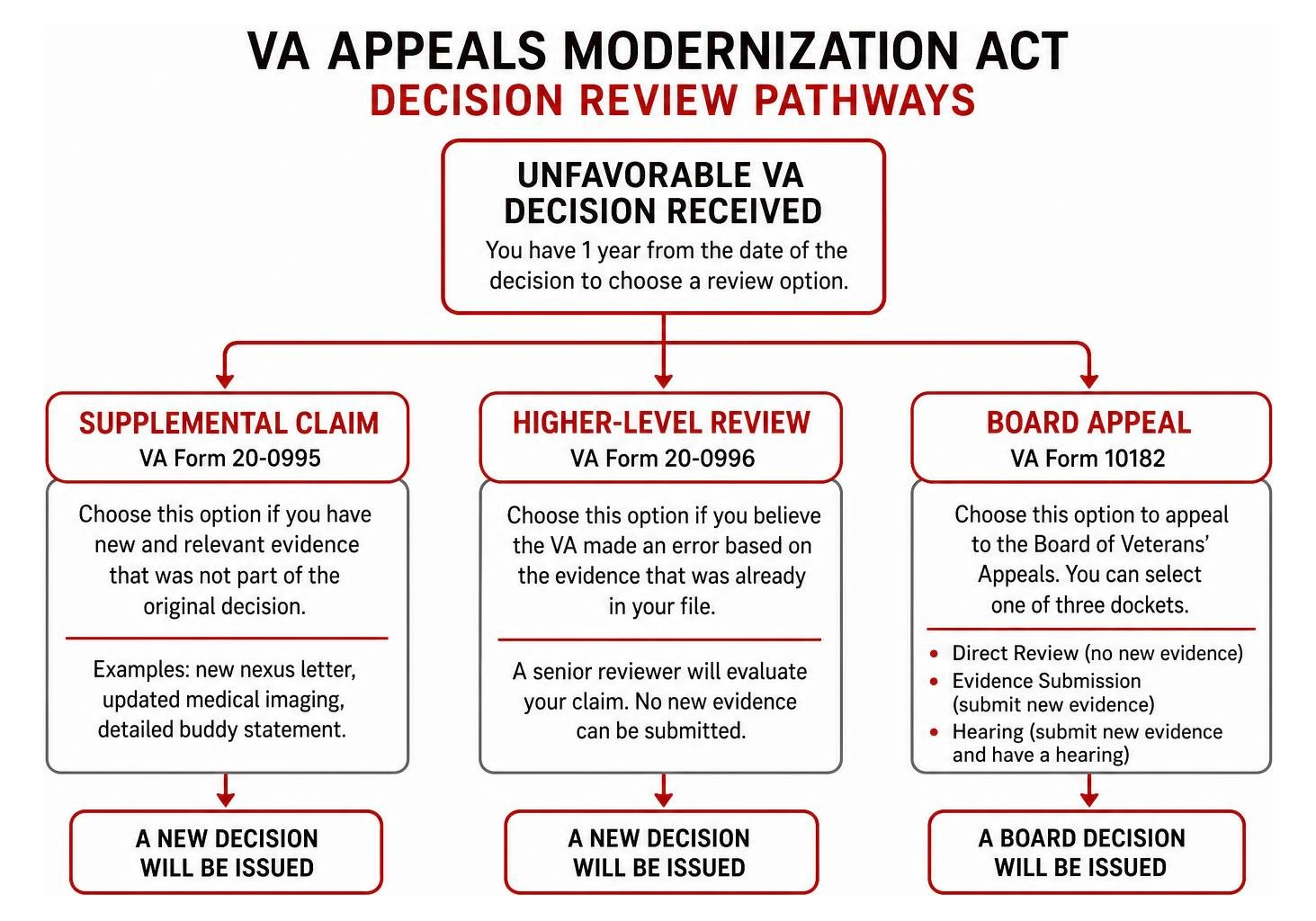
Under the Appeals Modernization Act (AMA), you have three distinct review pathways to challenge an unfavorable decision without losing your original effective date, provided you file within one year:
To explore these options in depth, review our step-by-step breakdown on How to File a VA Disability Claim Appeal.
How Army Veterans Successfully File For VA Disability Appeals and Decision Reviews
- Supplemental Claim (VA Form 20-0995): Choose this lane if you have new and relevant evidence that the VA did not have during the initial review, such as a new nexus letter, updated diagnostic imaging, or a detailed buddy letter.
- Higher-Level Review (VA Form 20-0996): Choose this lane if you believe the adjudicator made an error based on the existing evidence. A senior rating specialist will review the same record without allowing any new evidence to be submitted. You can request an informal phone conference to point out specific errors.
- Board of Veterans’ Appeals (VA Form 10182): Appeal directly to a Veterans Law Judge in Washington, D.C. You can choose a direct review of the record, submit additional evidence within a 90-day window, or request a formal hearing with the judge.
Frequently Asked Questions About Army VA Disability Claims
How long does the VA take to process an Army disability claim?
As of August 2026, the national average processing time for disability-related claims is roughly 68.6 days. Timelines vary based on claim complexity, the number of claimed conditions, whether you submit a Fully Developed Claim, and the scheduling speed of third-party Compensation and Pension (C&P) medical examiners.
Can Army Reserve and National Guard soldiers file for VA disability?
Yes. Reserve and Guard personnel can file for injuries sustained during active duty tours (Title 10) under standard rules. For injuries incurred during inactive duty training (drilling weekends), the condition must stem from an injury, heart attack, or stroke sustained during duty hours, supported by an official Line of Duty (LOD) investigation.
What is the three-element rule for VA service connection?
To grant direct service connection, the VA requires three specific components:
- A current, formal medical diagnosis of a physical or mental disability.
- Evidence of an in-service incurrence, injury, illness, or event.
- A medical nexus linking the current diagnosis directly to the military event (phrased as “at least as likely as not”).
Conclusion
Successfully filing a VA disability claim requires thorough preparation, accurate medical documentation, and a clear understanding of the rules. By establishing your effective date early, compiling your service treatment records, gathering strong lay evidence, and filing a Fully Developed Claim, you put yourself in the best position for a fast, fair rating.
Once your claim is approved, check our updated VA disability pay tables to see your exact tax-free monthly compensation based on your rating percentage and eligible dependents. For more resources covering benefits, transitions, and military finance, explore everything we offer at USMilitary.com. If you are seeking practical encouragement and personal resilience during your transition to civilian life, consider reading Dare to Live Greatly. You stood up and served our nation—now make sure you receive every benefit you rightfully earned.