
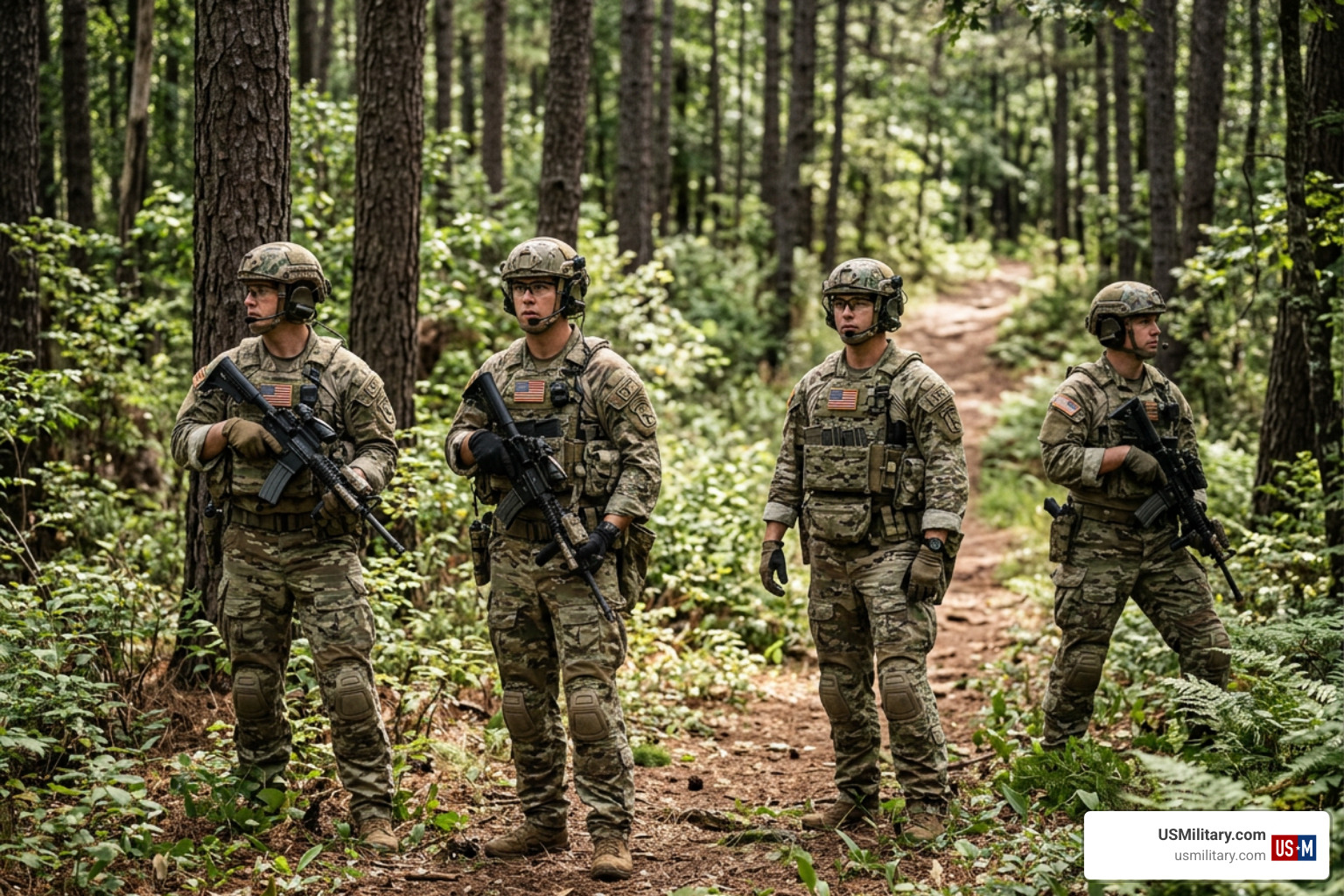
U.S. Army Special Forces, widely known as the Green Berets, were built to work with local partners, organize resistance, gather intelligence, and conduct unconventional warfare. Their future depends on keeping those strengths while becoming harder to detect and better connected to cyber, space, electronic warfare, drones, and information operations.
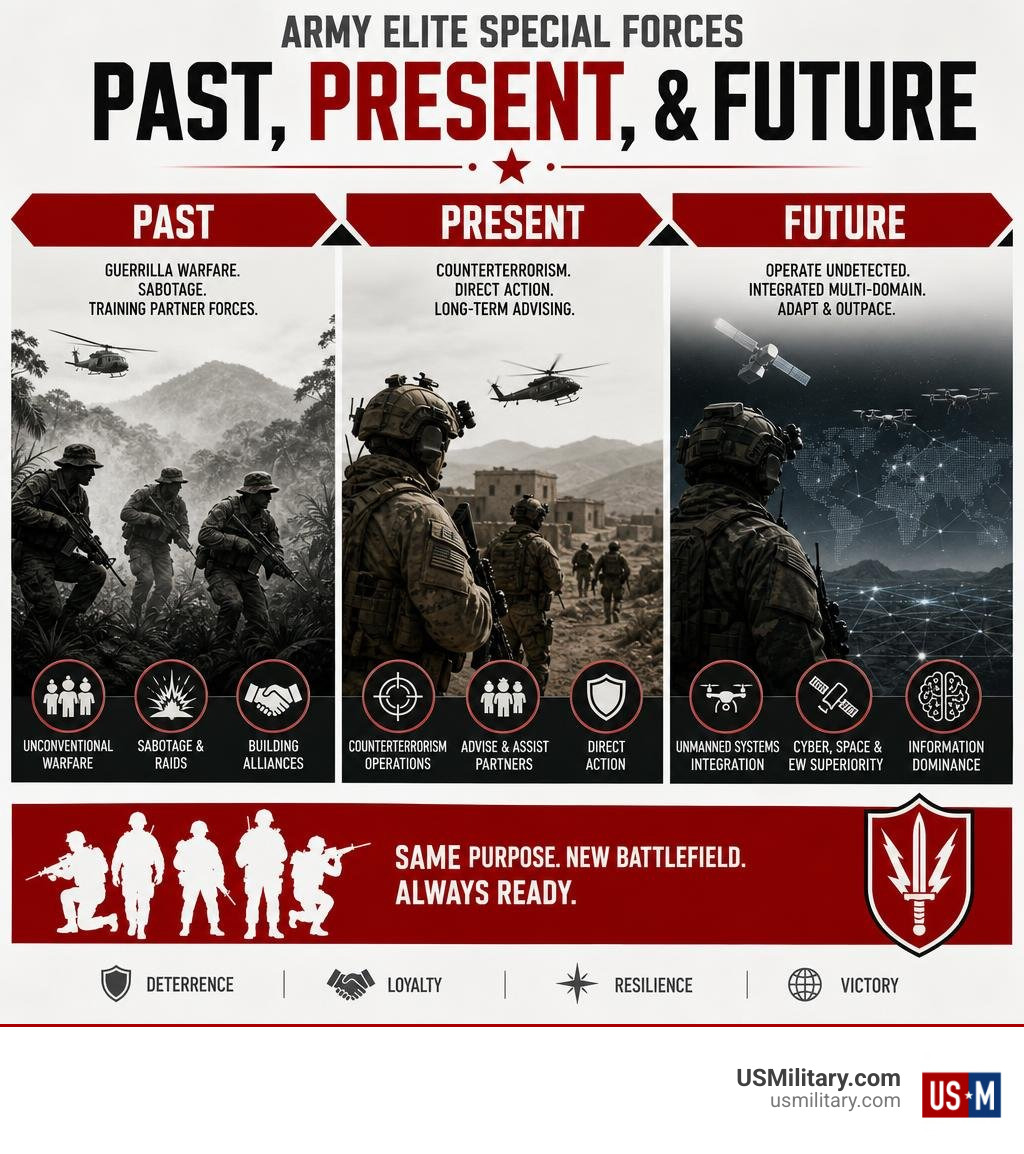
In short, the Past, Present, & Future of Army Elite Special Forces follows three major shifts:
- Past: World War II and Cold War teams focused on guerrilla warfare, sabotage, and training partner forces behind enemy lines.
- Present: After 9/11, the force expanded for counterterrorism, direct action, and long-term advising missions in places such as Afghanistan, Iraq, and the Philippines.
- Future: Green Berets must operate in sensor-heavy environments shaped by drones, facial recognition, digital tracking, and near-peer competition with China and Russia.
Special Forces remain a small part of the military, but their reach is large. Army special operations personnel work with allies across dozens of countries each year, often providing a lower-footprint option before a larger U.S. force is needed. Yet growth, repeated deployment cycles, and a battlefield that can expose a team through its electronic signals have raised a serious question: can the classic 12-person Operational Detachment Alpha remain effective without a major redesign?
I am LARRY FOWLER, publisher of the USMilitary.com Network since 2007, serving military members and veterans with clear guidance on military careers, recruiting, and benefits. In this guide to the Past, Present, & Future of Army Elite Special Forces, I will connect the Green Berets’ history, current challenges, and next-generation role in simple terms.
Past, Present, & Future of Army Elite Special Forces terms explained:
- Delta Special Forces
- army ranger vs green beret
- special forces
Historical Origins and Doctrine: The Past, Present, & Future of Army Elite Special Forces
Understanding the modern Green Beret requires looking back at the crucible of World War II and the early Cold War. The lineage of U.S. Army Special Forces traces directly to the Office of Strategic Services (OSS) Operational Groups and Jedburgh teams, along with specialized jungle reconnaissance units like the Alamo Scouts and the combined U.S.-Canadian First Special Service Force. In June 1952, under the leadership of Colonel Aaron Bank, the Army officially established the 10th Special Forces Group at Fort Bragg (now Fort Liberty), North Carolina.
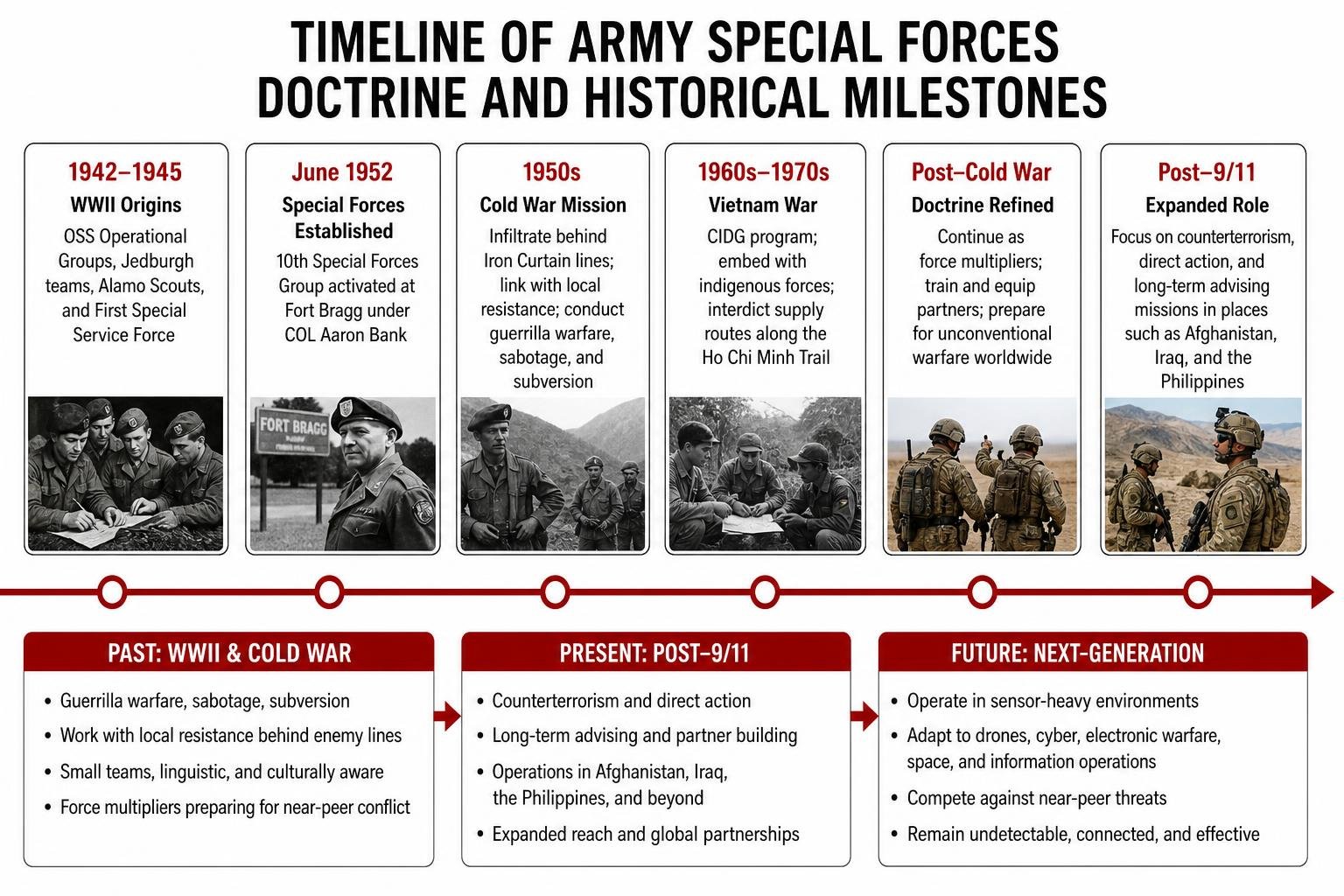
The primary mission was straightforward but daunting: infiltrate behind Iron Curtain lines in the event of a Soviet invasion of Western Europe, link up with local resistance movements, and conduct guerrilla warfare, sabotage, and subversion. Unlike conventional units designed to conquer territory through raw firepower, Special Forces were designed as force multipliers—small teams of mature, linguistically capable soldiers who could organize indigenous populations into effective fighting movements. For service members interested in joining the ranks of the special operations community, this human-centric philosophy remains the cornerstone of the Green Beret identity, documented extensively across historical research on Army Special Forces development.
Tracing Lineage: Past, Present, & Future of Army Elite Special Forces in Conflict
The theoretical doctrine of unconventional warfare (UW) met real-world operational testing during the Vietnam War. Special Forces established the Civilian Irregular Defense Group (CIDG) program, embedding in remote highlands alongside indigenous Montagnard tribesmen to secure the border and interdict North Vietnamese supply routes along the Ho Chi Minh Trail. Their valor and tactical innovation resulted in 17 Medals of Honor awarded to Green Berets during the conflict, cementing their reputation as premier irregular warriors.
The post-Vietnam drawdown brought severe institutional headwinds. During the 1970s, as the Department of Defense pivoted back toward conventional armored warfare in Central Europe and ended the draft, Special Forces faced massive budget and personnel cuts. By 1980, the active-duty force had been reduced to just three groups with roughly 3,600 personnel. The pivotal 1978 decision to retain the 7th Special Forces Group halted this decline, ultimately leading to the formal establishment of the Special Forces Branch in 1987 (Career Management Field 18). This vital organizational move gave the regiment administrative independence, professionalized career pathways, and laid the groundwork for modern special operations. Those exploring this heritage can take a deep dive into Special Forces life and missions to understand how these historical shifts shaped today’s training pipelines.
Unconventional Warfare vs. Direct Action: From Cold War to GWOT
Following the terrorist attacks of September 11, 2001, Army Special Forces demonstrated their classic UW roots during the opening months of Operation Enduring Freedom. Small Operational Detachment Alpha (ODA) teams from the 5th Special Forces Group infiltrated Afghanistan, linked up on horseback with the Northern Alliance, directed precision close air support, and rapidly dismantled the Taliban regime. In northern Iraq during 2003, Task Force Viking paired Green Berets with Kurdish Peshmerga forces, effectively tying down 13 Iraqi Army divisions (approximately 100,000 enemy troops) along a 350-kilometer front with minimal conventional U.S. troop presence.
However, as the Global War on Terror (GWOT) expanded, the lines between classic unconventional warfare and direct action (DA) blurred significantly. Special Forces increasingly assumed high-tempo counterterrorism, night raids, and foreign internal defense (FID) advisory roles under Combined Joint Special Operations Task Forces (CJSOTFs).
| Operational Dimension | Unconventional Warfare (UW) / Partner Advising | Direct Action (DA) / Surgical Strike |
|---|---|---|
| Primary Objective | Enable resistance movements or strengthen allied host-nation forces | Capture or kill high-value targets; seize, destroy, or capture enemy assets |
| Operational Footprint | Low signature, persistent, small advising elements (12-person ODAs) | High-tempo, concentrated, heavily supported tactical strike force |
| Core Skill Sets | Cultural fluency, regional languages, advanced advising, negotiation | Precision marksmanship, explosive breaching, close-quarters battle |
| Primary Units | U.S. Army Special Forces (“White SOF”), Civil Affairs, PSYOP | Tier-1 SMUs (“Black SOF”), 75th Ranger Regiment |
| Timeline to Effect | Months to years (strategic persistence) | Minutes to hours (tactical precision) |
While surgical strikes dismantled terrorist networks, the continuous operational demand pulled Green Berets away from their historic core identity of deep-area irregular warfare, placing them in mission sets often shared with the 75th Ranger Regiment.
The Modern Dilemma: Structural Bloat and Hyper-Contested Battlefields
As the national defense strategy shifted toward strategic competition against peer adversaries like China and Russia, Army Special Forces reached an operational crossroads. Before September 11, active-duty Army special operations maintained roughly 15,000 billets. By 2022, that number had surged past 31,000, with the broader U.S. Army Special Operations Command (USASOC) housing around 36,000 military and civilian personnel and 19 general officer billets.
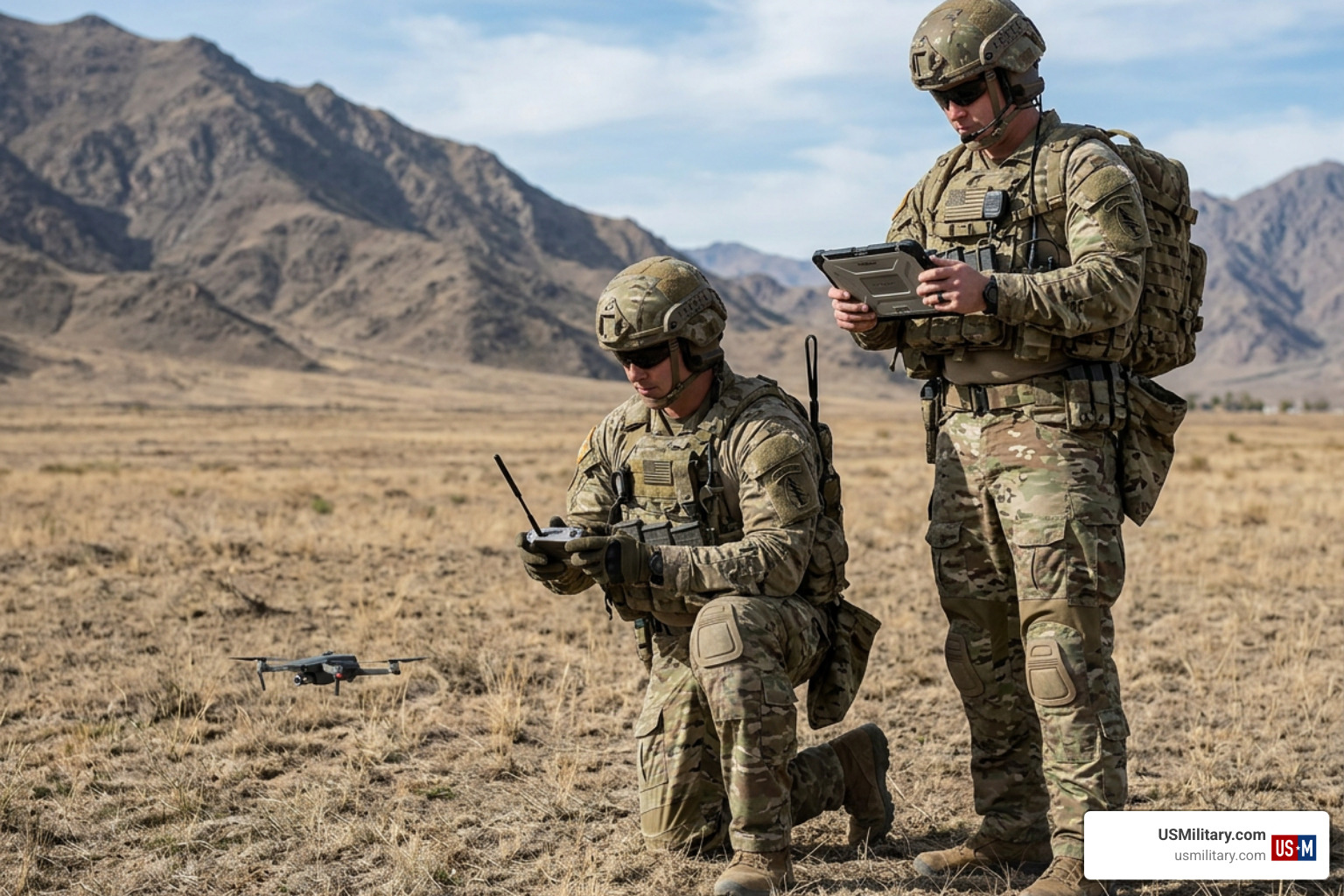
This massive expansion has prompted intense professional debate. In-depth analysis on Special Forces transformation challenges highlights that as the force expanded to feed continuous rotation requirements across the globe, it became larger, more bureaucratic, and increasingly visible to foreign intelligence networks.
The 36,000-Personnel Footprint and Institutional Inertia
Today, American Special Forces regularly deploy to approximately 70% of the world’s countries and conduct joint combined exchange training in nearly 90 nations annually. Yet, defense analysts have pointed out that presence does not equal strategy. Under the Global Force Management system, the relentless cycle of forward deployments often served as an end in itself rather than advancing clear, long-term strategic outcomes.
Past transformation initiatives, including the ARSOF 2022 strategy, correctly identified institutional shortfalls in multidomain integration and irregular warfare modernization. However, execution stalled due to deep-seated institutional inertia and continuous demand for rotational advisory missions. When evaluating the Army Ranger vs Green Beret mission scope, it is clear that while Ranger units refined rapid surgical-strike capabilities, the Special Forces Regiment struggled to maintain its unique identity while managing an oversized administrative and operational footprint.
Tactical Vulnerability in the Digital Age: Sensor-Dense Environments
The modern battlefield presents challenges that the classic 1960s-era 12-person ODA structure was never built to navigate. In denied areas controlled by peer adversaries, ubiquitous digital surveillance has erased traditional permissive environments:
- Pervasive Technical Surveillance: Ubiquitous facial recognition, biometric checkpoints, commercial satellite constellations, and integrated cellular monitoring make covert infiltration under civilian covers nearly impossible without state-level digital evasion techniques.
- Electromagnetic Emissions: Legacy tactical radios and data terminals generate detectable electronic signatures that adversary electronic warfare (EW) complexes can instantly locate and target with precision long-range fires.
- Autonomous Sensor Networks: Swarms of low-cost, AI-enabled unmanned aerial systems (UAS) monitor tactical assembly areas, stripping away concealment in dense jungle, rural, or urban terrain.
- Counter-UAS and Air Defense Bubbles: Adversary anti-access/area-denial (A2/AD) networks eliminate guaranteed U.S. air superiority, meaning ODAs operating in deep areas can no longer rely on immediate close air support or rapid combat search and rescue.
Future Force Transformation: Redesigning for Strategic Competition
To maintain tactical edge and strategic relevance, the force must modernize rapidly. As outlined in the strategic vision for Army Special Operations 2035, USASOC has outlined four core capability pillars to guide future doctrine:
- Indigenous Approach: Sustaining low-cost, high-impact regional partnerships that deny adversary footholds before conflict begins.
- Precision Targeting: Blending kinetic strikes with non-kinetic cyber, information, and electronic disruption.
- Understanding and Influence: Shaping local perceptions, countering adversary propaganda, and providing granular ground intelligence.
- Crisis Response: Providing rapid-deployment deterrent packages across contested regions.
Modern operators rely on advanced kit—from Nett Warrior situational awareness networks to high-definition night-vision systems and lightweight precision strike drones—as detailed in our look at essential equipment and mission technology.
Strategic Restructuring: Past, Present, & Future of Army Elite Special Forces in Great Power Competition
Meaningful modernization requires structural changes rather than just new gear. Leading defense planners have proposed consolidating select Special Forces elements alongside Civil Affairs and Psychological Operations into agile, multi-capability strike and influence complexes under Joint Special Operations Command (JSOC).
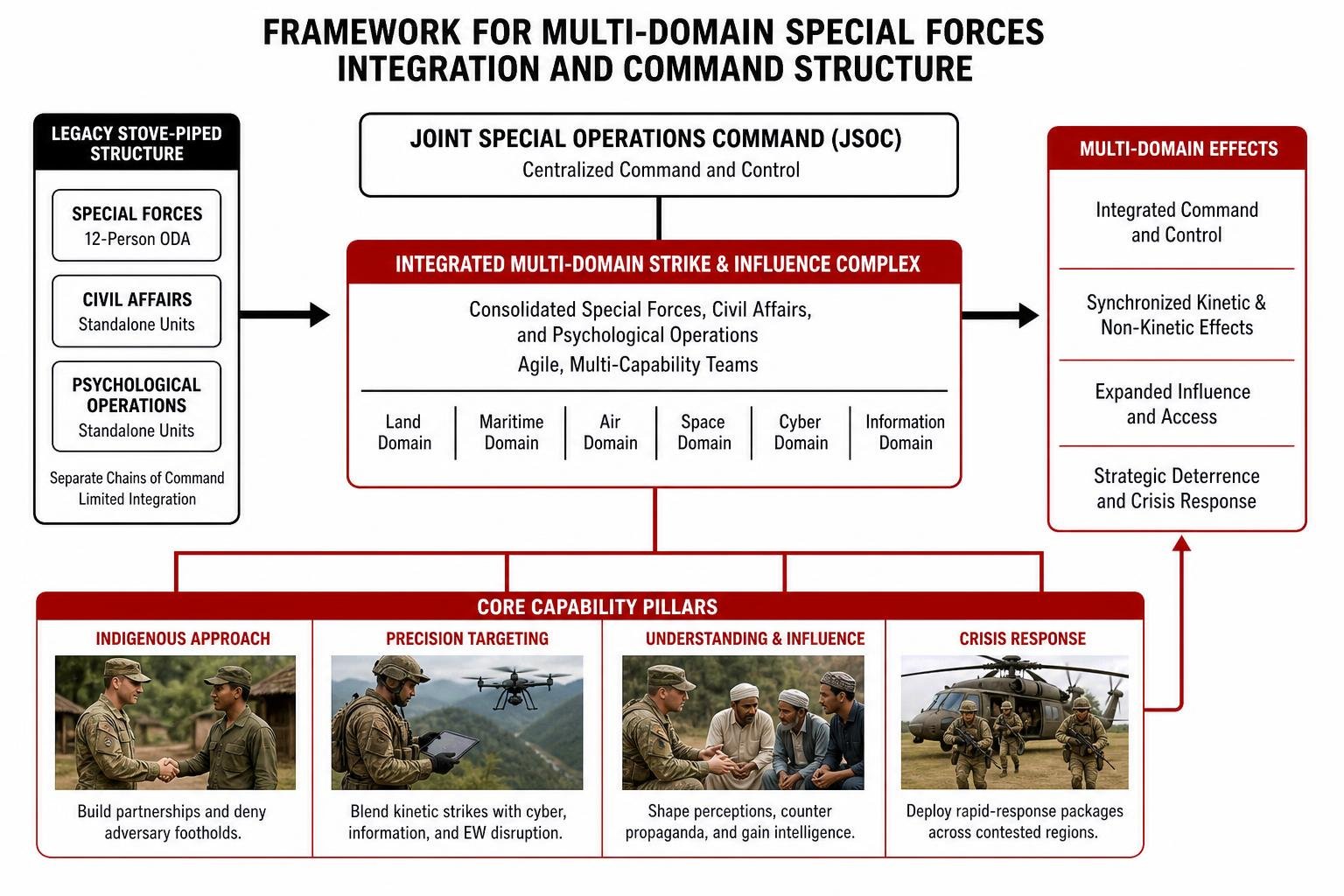
By benchmarking against the stringent, multi-domain standards seen in Delta Force specialized operational standards, the Special Forces pipeline is evolving to prioritize signature management, cyber network exploitation, and cognitive-domain operations alongside traditional small-unit tactics.
The Influence Triad and Multidomain Fusion
In great-power competition, non-kinetic tools are often as decisive as direct-fire engagements. U.S. Special Operations Command operates within an Influence Triad alongside U.S. Space Force and U.S. Cyber Command. By fusing tactical irregular warfare with cyber capabilities and satellite-enabled precision, small teams can produce outsized operational effects.
Key elements of this fusion include:
- Integrating the 4th Psychological Operations Group to disrupt adversary narratives in real time across contested digital spaces.
- Utilizing the 95th Civil Affairs Brigade to map human terrain and strengthen partner-nation resilience against economic coercion.
- Operating tactical MQ-1C Gray Eagle unmanned reconnaissance platforms to feed targeting data directly into joint fire networks.
Leveraging Reserve Component and Joint Interagency Networks
The Reserve Component represents a major strategic advantage for the future force. The 19th and 20th Special Forces Groups of the Army National Guard maintain the same rigorous standards as active-duty units while bringing specialized civilian skill sets:
- Cybersecurity and Tech Industry Expertise: Guard operators frequently work as engineers, data scientists, and cybersecurity leads at major technology firms, providing cutting-edge skills to military cyber operations.
- Interagency Coordination: Many Guard soldiers serve as civilian law enforcement officers, intelligence analysts, and emergency planners, easing interagency cooperation.
- Dual-Status Flexibility: Operating under both state (Title 32) and federal (Title 10) status, Guard units provide adaptable domestic crisis response and overseas security cooperation.
Considering that USSOCOM accounts for only 1.6% of the total Department of Defense budget, its global return on investment is remarkable. Special operations deliver global reach, alliance integration, and strategic deterrence at a fraction of conventional military costs.
Frequently Asked Questions About Army Special Operations
What historical factors led to the creation and expansion of Army Special Forces?
Army Special Forces were created in 1952 to meet Cold War unconventional warfare needs, building on the wartime experiences of the OSS and Alamo Scouts. President John F. Kennedy provided decisive executive support in the early 1960s, recognizing the Green Berets as the nation’s premier force for countering Soviet-backed insurgencies. Candidates must pass a rigorous 53-week qualification course, which we cover in our guide on the Special Forces selection and training pipeline.
Why does the current 12-person A-Team struggle in contested digital environments?
The legacy 12-man ODA was built for analog, low-technology environments where concealment depended primarily on physical terrain and camouflage. In modern denied areas, near-peer adversaries use integrated air defense systems, facial recognition cameras, commercial satellite monitoring, and signals-intelligence interceptors. A single unmasked cell phone, unencrypted radio transmission, or tactical heat signature can pinpoint an ODA’s position, making signature management training vital for survivability.
What is the strategic return on investment for USSOCOM’s budget?
USSOCOM receives roughly 1.6% of the annual defense budget yet maintains continuous deployments across approximately 70% of the globe and conducts exercises in nearly 90 countries each year. By training partner militaries, securing regional stability, and maintaining deep intelligence networks, Special Forces prevent localized gray-zone crises from escalating into large-scale, multi-billion-dollar conventional wars.
Conclusion
The Green Berets have repeatedly demonstrated their ability to adapt across seven decades of American military history—from the jungles of Vietnam to the rugged valleys of Afghanistan. As strategic competition reshapes the modern operating environment, the force is modernizing once again. By trimming unnecessary administrative bloat, mastering signature management, and fusing tactical skills with cyber, space, and information capabilities, Army Special Forces ensure they remain an indispensable instrument of national power.
At USMilitary.com, we are committed to providing service members, veterans, and prospective recruits with the insights they need to navigate military careers, benefits, and elite unit pathways. Whether you are planning your enlistment, researching VA benefits, or looking to compare Army Delta Force vs Navy SEALs, we stand ready to support your journey. Explore our comprehensive resources today to take your next step in military service.