
Can Army Disabled Veterans Lose Their VA Disability Benefits? Core Factors and Legal Triggers
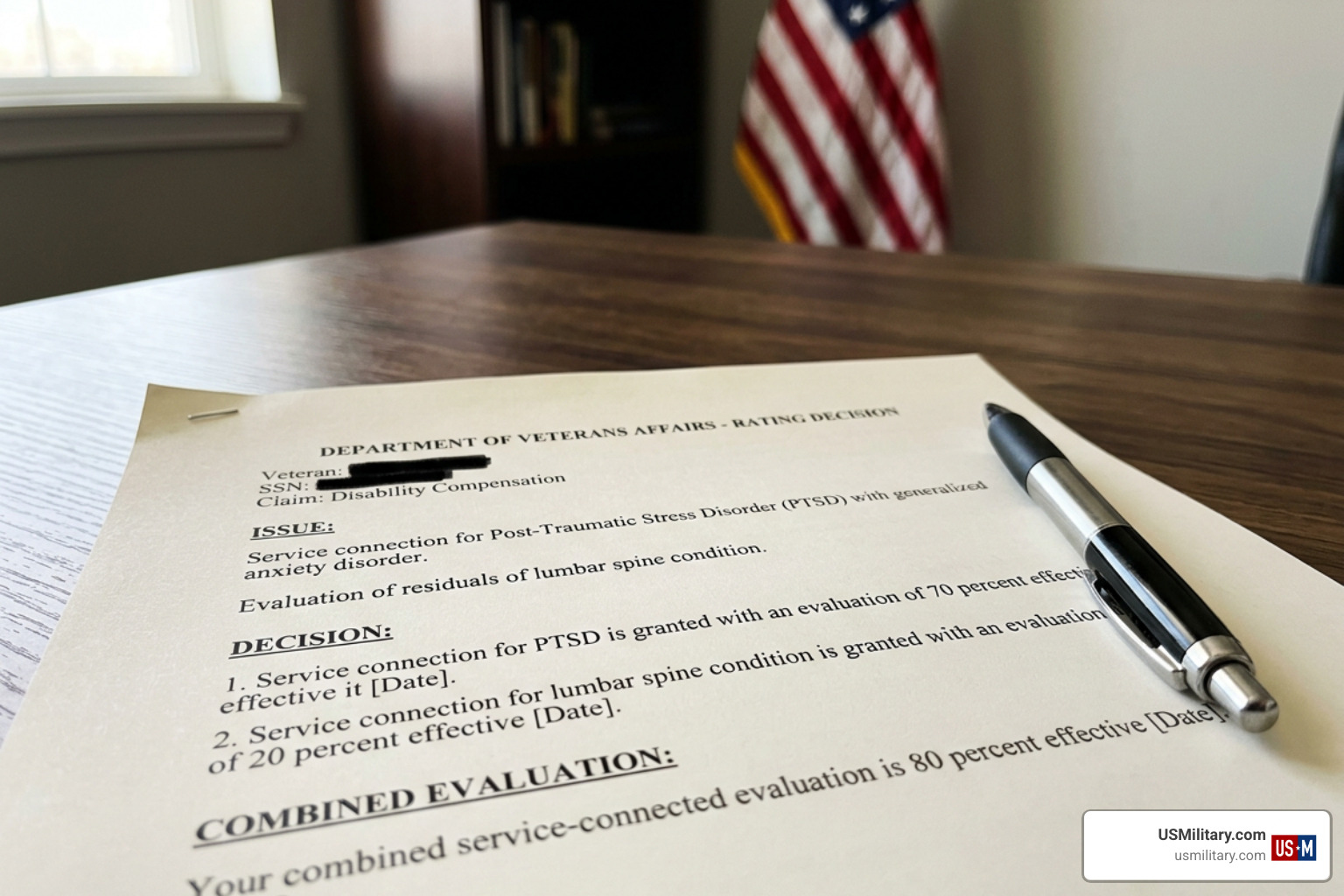
When service members transition out of the United States Army, VA disability compensation provides essential financial stability. However, the Department of Veterans Affairs does not guarantee that every monthly check continues indefinitely without oversight. Several legal triggers and administrative processes can cause a veteran’s compensation to drop or stop entirely.
The most frequent reason for a rating reduction is sustained medical improvement. If a service-connected condition is not marked as permanent, the VA may schedule routine Compensation and Pension (C&P) reexaminations. For instance, when service-connected cancer enters sustained remission, the VA reassesses the severity of residual symptoms and adjusts the disability rating downward. To legally lower a rating, the VA must prove that the improvement is not temporary and reflects real progress in your daily life and earning capacity. Reviewing the 10 red flags you will lose your VA disability helps identify early warning signs before a reduction proposal arrives.
Beyond medical recovery, specific legal mechanisms can terminate benefits:
- Clear and Unmistakable Error (CUE): If the VA establishes that the original grant of service connection contained an undebatable factual or statutory mistake—such as granting compensation to an individual with an uncharacterized or dishonorable discharge without a favorable character-of-service determination—the VA can sever the benefit.
- Veteran-Committed Fraud: Submitting altered military medical records, fabricating combat incident reports, or providing false statements about daily physical limitations will prompt an immediate revocation of benefits and potential federal prosecution.
- Failure to Meet Ongoing Criteria: Staying eligible requires adherence to official VA disability eligibility criteria. If a condition was granted on a secondary basis and the primary service-connected condition is legitimately severed, the secondary rating may fall away as well.
- Incarceration Rules: If a veteran is convicted of a felony and incarcerated for more than 60 days, the VA automatically reduces compensation payments under federal law. A veteran with a 20% rating or higher sees their monthly payment capped at the 10% rate, while a 10% rating is halved. The remaining funds can often be apportioned to eligible dependents to prevent family hardship.
- Substance Misuse Considerations: While substance use alone does not terminate benefits, direct injuries resulting from willful misconduct are uncompensated. You can read more about how substance treatment intersects with compensation in this guide on VA disability and drug use.
Understanding how to establish and protect your VA disability benefits eligibility ensures that your compensation stays intact over the long term.
Protected Disability Ratings: Understanding the 5, 10, and 20-Year Rules

Federal regulations (Title 38 of the Code of Federal Regulations) build strong legal shields around your disability ratings the longer you hold them. These “safe harbor” rules prevent arbitrary benefit cuts and place a heavy burden of proof on the VA.

The 5-Year Rule (Rating Stabilization)
Under 38 C.F.R. § 3.344, if a disability rating has continued at the same level for 5 years or more, the VA cannot reduce it based on a single snapshot examination. The VA must review the veteran’s complete medical history and establish sustained improvement under ordinary conditions of daily life.
You May Be Entitled to More VA Disability Money. Click Here To Speak With an Expert Regarding Increasing Your VA Disability Rating. We Can Also Help On Original Claims.
The 10-Year Rule (Service Connection Protection)
Under 38 C.F.R. § 3.957, once a disability has been service-connected for 10 years, the VA cannot sever service connection unless the original grant was obtained through fraud. Even if the VA discovers an administrative mistake was made a decade earlier, the service connection remains protected. However, the rating percentage itself could still be adjusted if the medical condition improves, unless covered by the 20-year rule.
The 20-Year Rule (Continuous Rating Protection)
Under 38 C.F.R. § 3.951(b), a disability rating continuous for 20 years or more cannot be reduced below that preserved level for any reason other than veteran fraud. Even if a reexamination shows significant medical improvement, the VA cannot lower the rate below the lowest percentage held during those two decades.
100% Permanent and Total (P&T) Status
Veterans granted 100% P&T status are exempt from future routine C&P reexaminations because their medical conditions are deemed total and permanent. While the VA technically retains authority to review a claim if the veteran opens a new claim for an increase or special monthly compensation, P&T ratings provide the strongest protection available.
Learning how to maintain your VA disability rating in 5 easy-to-follow steps allows you to safeguard these milestones. For those aiming for maximum coverage, understanding the extensive benefits of 100 VA disability and the specific evidentiary thresholds on how to increase VA disability from 80 to 100 can help secure long-term protection.
Military Retired Pay and Disability Offsets: CRDP vs. CRSC for Army Veterans
One common source of confusion among retired soldiers is the military retired pay offset. Historically, federal law prevented “double dipping”—meaning a military retiree could not receive both full military retired pay and VA disability compensation simultaneously. The retiree had to waive a dollar of retired pay for every dollar of tax-free VA disability compensation received.
Congress created two programs to restore these funds: Concurrent Retirement and Disability Pay (CRDP) and Combat-Related Special Compensation (CRSC). Navigating these options involves understanding the governing regulations under 10 U.S.C. § 1413a and DoD Financial Management Regulation 7000.14-R, Volume 7B, Chapter 63.
| Feature | Concurrent Retirement and Disability Pay (CRDP) | Combat-Related Special Compensation (CRSC) |
|---|---|---|
| Eligibility Requirement | 20+ years of active duty or equivalent reserve service credit | Any length of service, including Chapter 61 medical retirees |
| Minimum VA Rating | 50% service-connected rating | 10% combat-related disability rating |
| Application Process | Automatic enrollment via DFAS | Requires formal application (DD Form 2860) to Army HRC |
| Tax Status | Taxable income | 100% Federal and State Tax-Free |
| Chapter 61 (<20 yrs) Eligibility | Ineligible | Eligible (capped at longevity retirement value) |
| Scope of Disabilities Covered | All service-connected disabilities | Only disabilities directly linked to combat or war simulation |
Today, more than 310,000 retirees receive CRDP payments totaling over $427 million monthly. However, soldiers medically retired under Chapter 61 with fewer than 20 years of active service remain ineligible for CRDP. For instance, an Army soldier medically retired at 18 years of active service with a 70% VA disability rating must waive military retired pay to collect VA disability, creating an estimated $1,800 monthly lifetime gap compared to a 20-year retiree.
For combat-wounded soldiers, CRSC restores offset retired pay tax-free. To qualify through Army Human Resources Command (HRC), the veteran’s condition must fall under one of the four statutory categories detailed in this guide to Army CRSC types:
- Armed Conflict: Disabilities incurred during tactical combat operations or direct enemy engagements.
- Hazardous Service: Injuries sustained during airborne jumps, demolition work, live-fire maneuvers, or flight operations.
- Conditions Simulating War: Injuries resulting from war games, tactical field training at the National Training Center (NTC), or combat vehicle simulations.
- Instrumentality of War: Conditions caused by military weapons, combat equipment, or chemical agents (like Agent Orange or burn pits) unique to military operations.
Under 10 U.S.C. § 1212(c) and 38 C.F.R. § 3.700(a)(2), if an Army veteran received a lump-sum Disability Severance Pay (DSP) upon separation, the VA must recoup the gross amount of that severance pay before paying monthly compensation for that specific condition. Learn more about the overall tax implications of compensation in our guide on is a VA disability taxable.
How Federal Employment, Drill Pay, and TDIU Affect Your Monthly Payments
Federal Civil Service Employment
Many Army veterans pursue careers in federal civil service under the General Schedule (GS) system. A standard schedular disability rating (10% to 100%) is completely independent of civilian federal employment. A veteran with a 100% schedular rating collects $3,938.58 a month, tax-free, on top of their full GS salary and future FERS pension without any offset. Read more on how these streams interact at VA Disability + a Federal Job: What You Can Collect (2026).
Total Disability Individual Unemployability (TDIU)
The dynamic shifts completely if a veteran receives Total Disability Individual Unemployability (TDIU). TDIU pays at the 100% rate because the veteran cannot maintain substantially gainful employment due to service-connected conditions. If a veteran receiving TDIU secures full-time competitive employment (earning above the federal poverty threshold for 12 continuous months), the VA will initiate steps to revoke TDIU and return the veteran to their underlying schedular rating.
Military Drill Pay and 38 U.S.C. § 5304(c)
Army National Guard and Army Reserve soldiers face strict offset rules if they drill while receiving VA compensation. Under 38 U.S.C. § 5304(c), a veteran cannot receive VA disability compensation and military drill pay for the same calendar day.
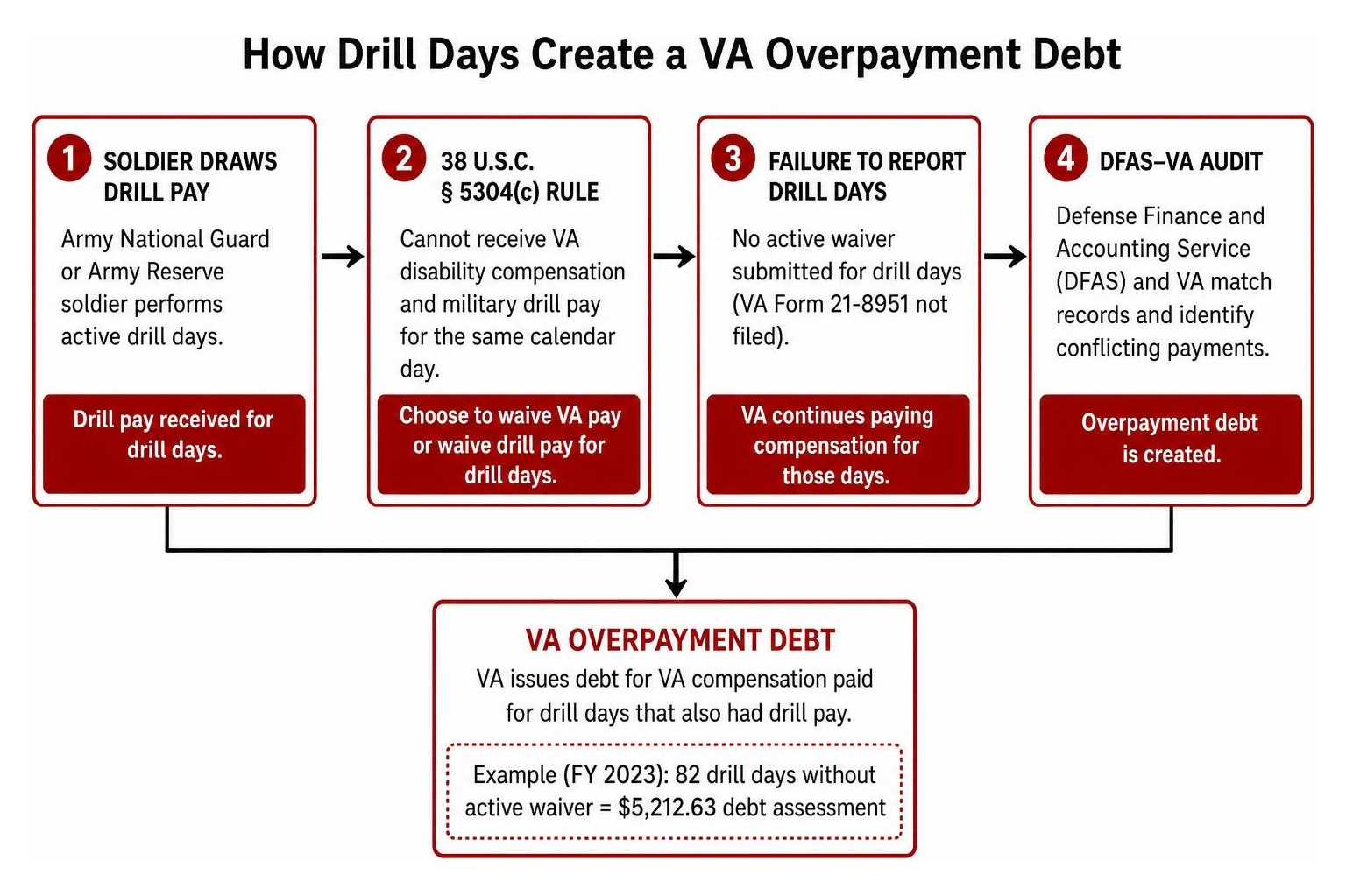
A veteran must choose between waiving VA compensation for drill days or waiving drill pay. Because military drill pay usually exceeds the daily rate of VA compensation, most soldiers waive VA pay for the exact number of active drill days (typically 63 to 84 days per year).
Failing to report drill days triggers automatic audits between the Defense Finance and Accounting Service (DFAS) and the VA. As documented in a Board of Veterans’ Appeals drill pay ruling, an Army reservist who performed 82 days of military duty in Fiscal Year 2023 without an active waiver received an overpayment debt assessment of $5,212.63. Submitting VA Form 21-8951 annually prevents unexpected debt collection. Review the top 15 reasons veterans are denied 100 percent VA disability rating to see how concurrent pay issues disrupt claim profiles.
What to Do If the VA Proposes to Reduce or Sever Your Disability Rating
If the VA intends to lower your rating or sever service connection, they must first send a Notice of Proposed Reduction. You have strong procedural rights, but you must act quickly within two rigid deadlines.

The Two Critical Response Windows
- 30-Day Window (Request a Hearing): If you request a VA hearing within 30 days of the date on the notice, the VA cannot reduce your monthly benefits until the hearing occurs and a formal decision is issued. This preserves your full monthly income while you prepare your defense.
- 60-Day Window (Submit Evidence): You have 60 days from the notice date to submit new clinical evidence, private Disability Benefits Questionnaires (DBQs), nexus letters, and personal statements showing that your condition has not experienced sustained improvement.
Choosing Your Appeal Strategy Under the Appeals Modernization Act (AMA)
If the VA issues an adverse final decision after the proposal period, you can pursue three primary lanes:
- Supplemental Claim (VA Form 20-0995): Submit new and relevant medical evidence that was not previously reviewed, such as private specialist reports.
- Higher-Level Review (VA Form 20-0996): Request a review by a senior claims adjudicator without submitting new evidence, pointing out errors of fact or law.
- Board of Veterans’ Appeals (VA Form 10182): Appeal directly to a Veterans Law Judge in Washington, D.C., with options for direct review, evidence submission, or a formal video hearing.
Check our analysis on what is the VA disability appeal success rate to compare your options. If your evidence is weak, read about VA disability claims that cannot be proven and consider consulting accredited representation from the top 10 VA disability attorneys. Learn more about broader administrative rules directly from this overview on how veterans can lose their VA benefits.
Frequently Asked Questions About VA Disability Benefits
Can Army Disabled Veterans Lose Their VA Disability Benefits Due to Medical Improvement?
Yes. If your service-connected disability shows sustained improvement under ordinary conditions of life during a routine C&P reexamination, the VA can propose a reduction. However, if your rating has been continuous for 5 years, the VA must prove sustained progress across multiple examinations. If held for 20 years, it cannot be reduced below that level except in cases of fraud.
Can Army Disabled Veterans Lose Their VA Disability Benefits If They Work a Federal Job?
No, as long as you hold a standard schedular rating. Schedular ratings have zero earned-income limits, allowing you to draw your full civil service GS salary, build a FERS pension, and receive tax-free VA compensation simultaneously. However, if you receive TDIU, competitive federal employment will trigger an income review and may result in the loss of individual unemployability status.
How Does Military Drill Pay Create an Overpayment Debt With the VA?
Under 38 U.S.C. § 5304(c), you cannot collect both VA disability compensation and military drill pay for the same day. If you drill in the Army Reserve or National Guard while receiving full VA compensation, the VA will calculate an overpayment for those drill days during annual DFAS data matching, creating a debt that must be repaid.
Conclusion
Understanding how VA regulations operate is the most effective way to protect your hard-earned benefits. While benefits can be reduced due to sustained medical improvement, statutory errors, or concurrent drill pay, the law provides strong safeguards at 5, 10, and 20 years. Maintaining continuous medical records, attending all scheduled examinations, and responding promptly to VA correspondence protects your financial security.
At USMilitary.com, our mission is to provide accurate, up-to-date guidance for current and former service members across all branches. Check your current monthly rates and compensation tiers using the updated VA disability pay tables to stay informed about your entitlements.