
Projected 2027 VA Disability Pay for Army Veterans

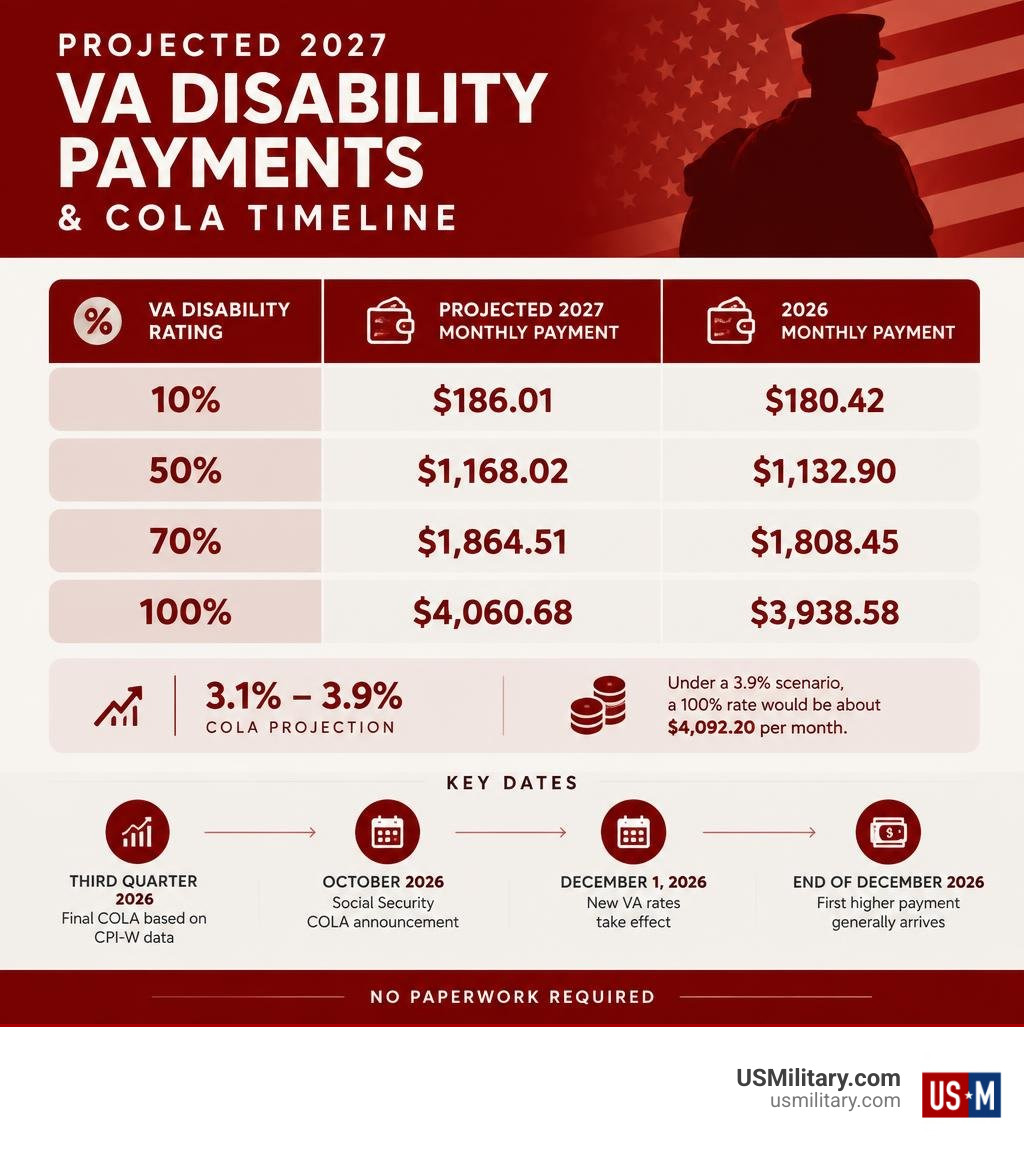
As of September 2026, the official 2027 VA disability rates have not been announced. Using a 3.1% COLA projection, an Army veteran with no dependents could receive:
| VA disability rating | Projected 2027 monthly payment | 2026 monthly payment |
|---|---|---|
| 10% | $186.01 | $180.42 |
| 50% | $1,168.02 | $1,132.90 |
| 70% | $1,864.51 | $1,808.45 |
| 100% | $4,060.68 | $3,938.58 |
VA disability compensation uses the same federal rate table for Army veterans and veterans of every other service branch. The final COLA will depend on third-quarter 2026 CPI-W inflation data, so estimates ranging from about 3.1% to 3.9% appear online. Under a 3.9% scenario, a single veteran rated at 100% would receive about $4,092.20 per month.
More Than 90% Of Clients Have Increased VA Disability Ratings! Why Settle For Less Than You Deserve? Expert Priority Help With Your VA Claim! Free Evaluation Call!
The Social Security COLA announcement is expected in October 2026. New VA rates should take effect December 1, 2026, with the first higher payment generally arriving at the end of December. Veterans do not need to file paperwork for the annual increase.
I’m LARRY FOWLER, publisher of the USMilitary.com Network, where I have followed VA disability trends, compensation changes, and military benefit questions since 2007. This guide explains What Are The Projected 2027 VA Disability Payouts For Army Veterans and what those estimates may mean for your household budget.
Understanding the 2027 VA Disability COLA Projections and Calculations
To make sense of the upcoming compensation adjustments, it helps to understand how the Department of Veterans Affairs determines annual rate changes. Annual increases are not arbitrary numbers pulled out of a hat. Instead, federal law ties the annual Cost-of-Living Adjustment (COLA) directly to the Consumer Price Index for Urban Wage Earners and Clerical Workers (CPI-W), which is measured and tracked by the Bureau of Labor Statistics (BLS).
By law, Congress enacts legislation ensuring that veterans’ benefits keep pace with the same percentage increase awarded to Social Security beneficiaries. The formula compares the average CPI-W figures from the third quarter (July, August, and September) of the current year against the average CPI-W baseline from the third quarter of the previous year. If inflation pushed consumer prices higher across those three months, your monthly compensation rises proportionately to protect your purchasing power.
Increase Your VA Disability Ratings. Click Here To Discuss Your Options With An Expert. Free Call.
Understanding this annual adjustment mechanism is essential, especially when you review our complete guide to navigating 2026 VA disability changes to see how prior adjustments have set the baseline for this year. The 2027 VA budget request includes an astounding $257.2 billion dedicated strictly to Compensation and Pension benefits, supporting over 7.4 million veterans and their survivors across the nation.

Key Timeline: When Rates Are Announced and Paid
Every year, tracking when economic figures turn into actual bank deposits follows a predictable schedule:
- Mid-October 2026: The BLS releases the final September inflation numbers on October 14, 2026. Simultaneously, the Social Security Administration announces the official 2027 COLA percentage. Shortly after, the VA publishes its updated compensation charts.
- December 1, 2026: The new benefit rates legally take effect nationwide.
- December 31, 2026: Because the VA pays benefits in arrears (meaning December benefits are paid on the first business day of January), and because January 1 is a federal holiday, the Defense Finance and Accounting Service (DFAS) and the VA deposit the first increased payment on December 31, 2026.
Why Projected COLA Percentages Vary Across Sources
As you research future payouts, you will find several different percentage scenarios cited by reputable financial analysts. This occurs because different organizations analyze inflation data at different points during the economic cycle:
- 3.1% Baseline: Reflects the initial hard data from early Q3 CPI-W releases, establishing a baseline assumption if economic inflation remains relatively stable.
- 3.8% Scenario: Incorporates seasonal commodity price increases and mid-year energy spikes evaluated by market economists.
- 3.9% Projection: An upper-tier projection representing the highest projected adjustment since 2022, favored by several advocacy groups anticipating sustained autumn consumer demand.
To see how these different economic scenarios translate across various rating tiers, you can review external tools such as the 2027 VA Disability Rates: Projected COLA Pay Chart as well as the VA Disability Rates 2027 – Projected Monthly Compensation scenario calculators.
What Are The Projected 2027 VA Disability Payouts For Army Veterans
Whether you served in the infantry, aviation, logistics, or medical corps, the VA uses a unified rating schedule under Title 38 of the Code of Federal Regulations. Compensation rates apply equally across all military branches.

The VA determines your overall payout using a whole-person rating formula. If you have multiple service-connected disabilities, they are not simply added together with standard math (for example, a 50% rating and a 30% rating equal 65%, which rounds to a 70% combined rating). You can explore how these individual percentages combine by checking our VA disability rating charts.
What Are The Projected 2027 VA Disability Payouts For Army Veterans Without Dependents?
For single Army veterans without qualifying dependents, here is how the confirmed 2026 VA disability rates compare against projected 2027 payouts under both the 3.1% and 3.9% COLA scenarios:
| Disability Rating | 2026 Confirmed Monthly Rate | Projected 2027 Monthly Rate (3.1% COLA) | Projected 2027 Monthly Rate (3.9% COLA) |
|---|---|---|---|
| 10% | $180.42 | $186.01 | $187.46 |
| 20% | $356.66 | $367.72 | $370.57 |
| 30% | $552.57 | $569.70 | $574.12 |
| 40% | $795.84 | $820.51 | $826.88 |
| 50% | $1,132.90 | $1,168.02 | $1,177.08 |
| 60% | $1,435.02 | $1,479.51 | $1,490.99 |
| 70% | $1,808.45 | $1,864.51 | $1,879.18 |
| 80% | $2,102.15 | $2,167.32 | $2,184.13 |
| 90% | $2,362.30 | $2,435.53 | $2,454.43 |
| 100% | $3,938.58 | $4,060.68 | $4,092.20 |
For an Army veteran at the 100% level, a 3.9% COLA adds $153.62 per month—delivering over $1,843 in additional tax-free cash every year.
What Are The Projected 2027 VA Disability Payouts For Army Veterans with Qualifying Dependents?
Once an Army veteran reaches a combined rating of 30% or higher, the VA adds compensation for qualifying family members, including a spouse, minor children, dependent adult children enrolled in college, and dependent parents.
Here is a look at projected monthly payments for veterans with a spouse:
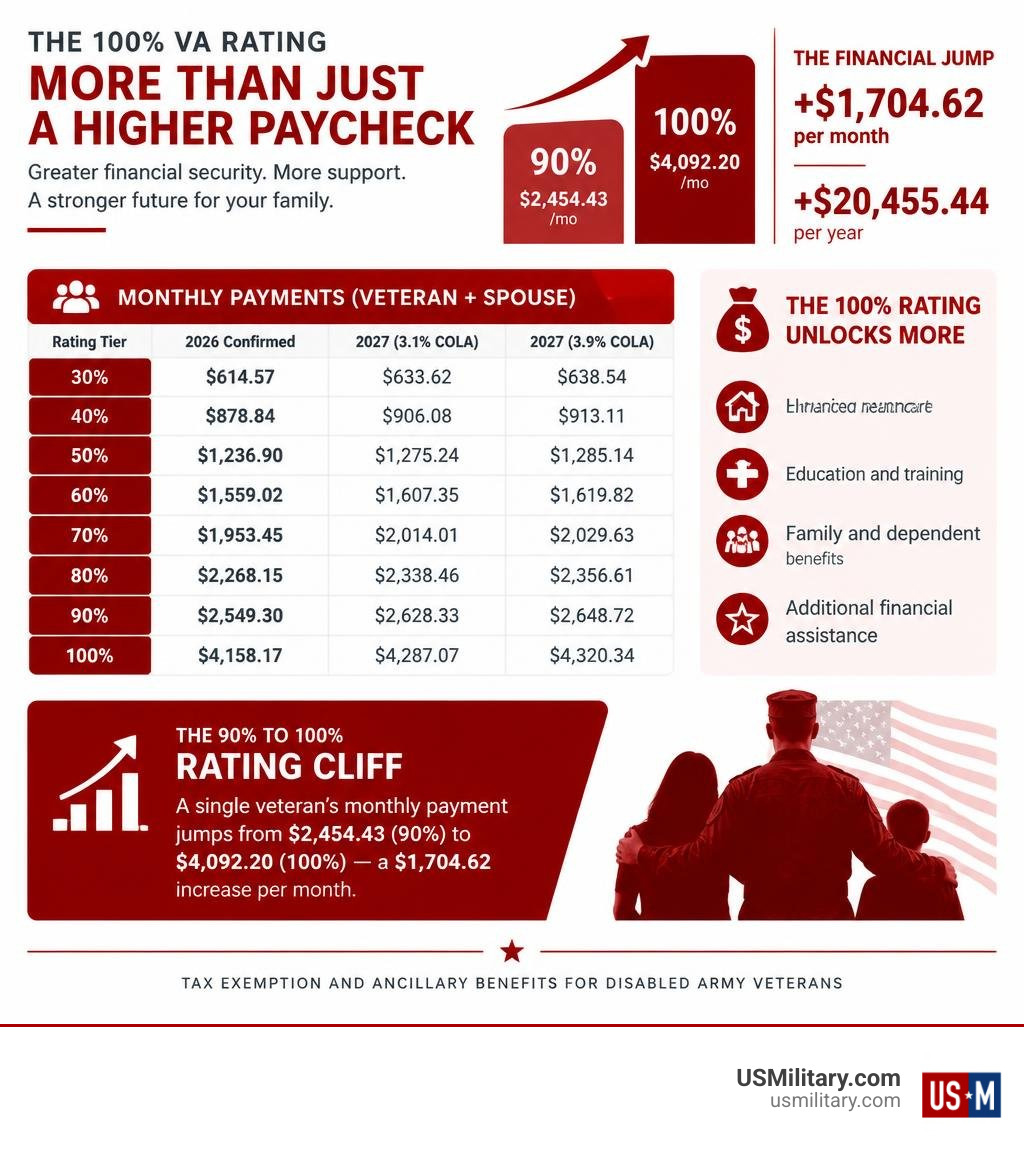
| Rating Tier | 2026 Confirmed (Veteran + Spouse) | Projected 2027 (3.1% COLA) | Projected 2027 (3.9% COLA) |
|---|---|---|---|
| 30% | $614.57 | $633.62 | $638.54 |
| 40% | $878.84 | $906.08 | $913.11 |
| 50% | $1,236.90 | $1,275.24 | $1,285.14 |
| 60% | $1,559.02 | $1,607.35 | $1,619.82 |
| 70% | $1,953.45 | $2,014.01 | $2,029.63 |
| 80% | $2,268.15 | $2,338.46 | $2,356.61 |
| 90% | $2,549.30 | $2,628.33 | $2,648.72 |
| 100% | $4,158.17 | $4,287.07 | $4,320.34 |
When additional children or dependent parents enter the picture, monthly stipends climb even further. For example, a 100% disabled veteran with a spouse and one child under 18 is projected to receive $4,452.88 per month at 3.1% COLA, reaching roughly $4,487.40 at 3.9%. To learn how dependent benefits protect military families, review our guide on 100 percent disabled veteran benefits for spouses.
The 90% to 100% Rating Cliff and Total Disability Value
In VA compensation, the gap between a 90% rating and a 100% rating is commonly called the “financial cliff.” Because of the whole-person non-additive formula, jumping from 90% to 100% requires substantial medical evidence, but the financial increase is extraordinary.
Under projected 2027 rates (at 3.9% COLA), a single veteran at 90% receives $2,454.43 per month, while a veteran rated at 100% receives $4,092.20. That represents an immediate jump of $1,704.62 per month—or $20,455.44 more per year.
Beyond direct compensation, reaching the 100% threshold unlocks an extensive tier of additional support explained in our overview of 100 disabled veteran benefits.
Tax Exemption and Ancillary Benefits for Disabled Army Veterans
One of the greatest advantages of VA disability compensation is its statutory tax status. Every dollar paid by the VA is 100% tax-exempt at both the federal and state levels. It is not considered taxable income by the IRS, does not need to be reported on your Form 1040, and is completely shielded from state income taxes across all 50 states. To explore how this works in detail, read the scoop on VA disability tax-free pay for service-related injuries.

In addition to monthly base compensation, disabled Army veterans can access multiple high-value ancillary programs:
- Special Monthly Compensation (SMC): Designed for severe disabilities, such as the loss of use of a limb, creative organ loss (SMC-K), or the need for regular Aid and Attendance (SMC-L through SMC-R). These monthly tiers pay substantial amounts above the standard 100% rate.
- CHAMPVA Healthcare: Provides comprehensive medical coverage for the spouse and dependent children of permanently and totally disabled (100% P&T) veterans who are not eligible for TRICARE.
- Property Tax Exemptions: Many states grant partial to 100% property tax waivers on primary residences for veterans with high ratings.
- Chapter 35 DEA (Dependents’ Educational Assistance): Provides monthly education stipends directly to eligible spouses and children pursuing college degrees or vocational training.
How Army Veterans Can Maximize Disability Ratings Ahead of 2027
If your service-connected conditions have worsened, you do not have to settle for an outdated rating. Preparing your medical files now allows you to secure the compensation you have rightfully earned before 2027 payments take effect.
To build a winning claim for an increase:
- Document Medical Evidence: Maintain ongoing treatment records from VA medical centers or private physicians showing how your symptoms limit your everyday occupational and social functioning.
- Secure Nexus Letters: Obtain a well-reasoned medical nexus letter from a qualified physician that clearly links your current condition to an event, injury, or illness during your Army service.
- Utilize Disability Benefits Questionnaires (DBQs): Have your physician complete condition-specific DBQs to present clear, objective medical metrics directly matching VA rating criteria.
- Identify Secondary Conditions: Many primary conditions cause secondary health issues. For example, a service-connected knee injury can cause degenerative disc disease in your back, or chronic pain may lead to service-connected depression or anxiety.
For actionable claim strategies, review our step-by-step walkthrough on how to increase your VA disability rating along with our forward-looking guide to VA disability claims in 2027.
Frequently Asked Questions About Projected 2027 VA Disability Payouts
Will VA disability payouts automatically increase in 2027?
Yes. Under federal law, VA disability compensation rates automatically receive the annual cost-of-living adjustment approved by Congress. You do not need to submit applications, file claims, or contact the VA to receive your higher monthly payment. The adjustment takes place automatically in DFAS and VA payment systems.
Are 2027 VA disability compensation payments taxable?
No. VA disability payments are completely exempt from federal, state, and local income taxes. They do not reduce your standard tax deductions, nor do they count toward your taxable gross income on annual IRS tax returns.
Do dependents increase payments for Army veterans rated at 10% or 20%?
No. Federal regulations mandate that additional allowances for spouses, children, and dependent parents only apply to veterans with a combined disability rating of 30% or higher. The monthly rates for 10% and 20% ratings are fixed flat amounts, regardless of your marital status or family size.
Conclusion
Staying proactive about your VA disability benefits is one of the most effective steps you can take toward securing your family’s long-term financial future. While the final 2027 Cost-of-Living Adjustment will be confirmed in mid-October 2026, these projections demonstrate that disabled Army veterans can expect meaningful financial growth to counteract inflation.
At USMilitary.com, we are committed to keeping you informed with accurate benefit updates, claims strategies, and veteran resources. To review current rates and prepare your household budget, explore our comprehensive VA disability pay tables today.