
What the Army Pay Chart For 2027 Could Pay

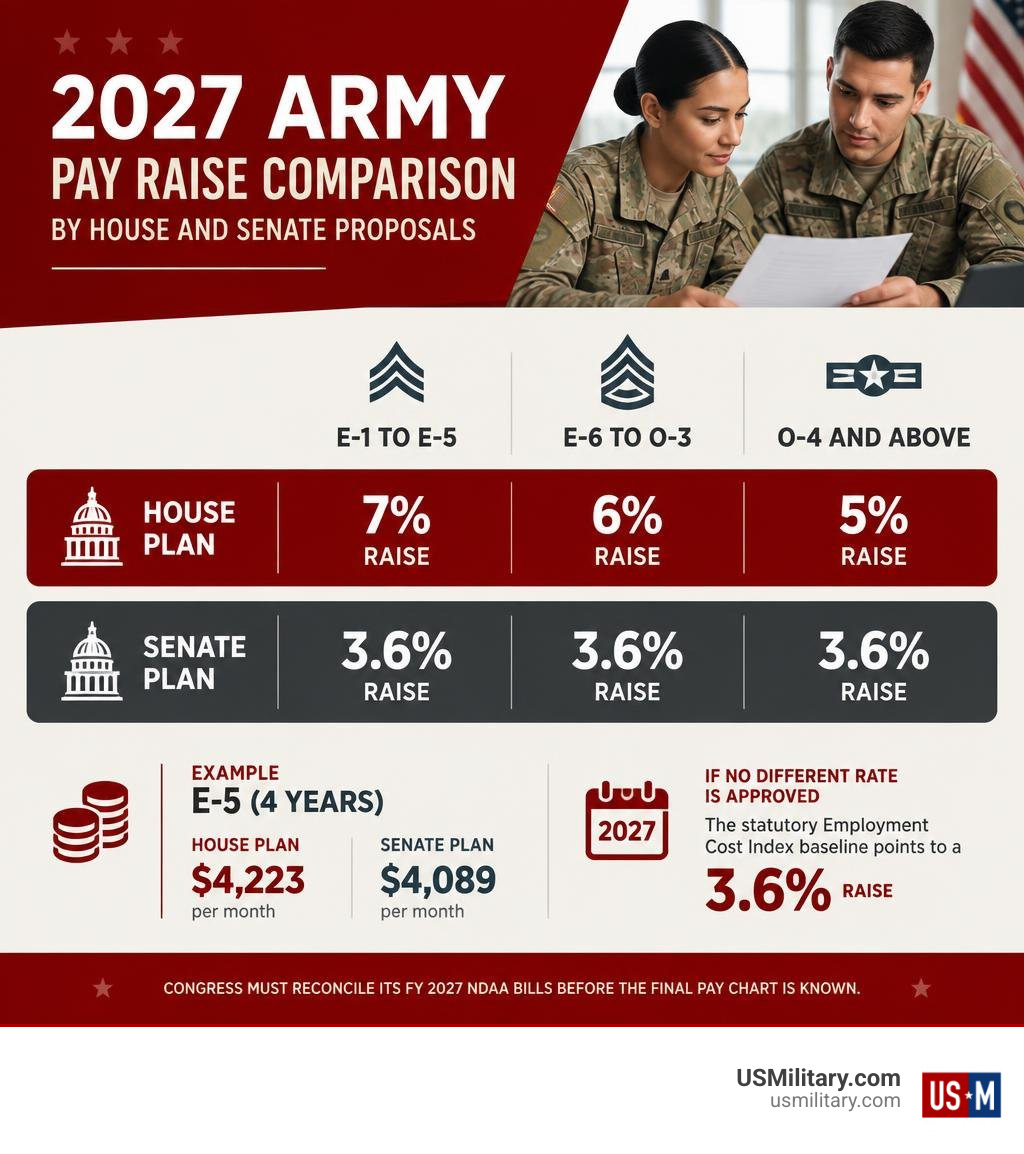
The Army Pay Chart For 2027 is not final yet. Two plans are under consideration for active-duty basic pay beginning January 1, 2027:
| Proposal | E-1 to E-5 | E-6 to O-3 | O-4 and above |
|---|---|---|---|
| House plan | 7% raise | 6% raise | 5% raise |
| Senate plan | 3.6% raise | 3.6% raise | 3.6% raise |
For example, an E-5 with four years of service is projected to receive about $4,223 per month under the House plan, compared with about $4,089 under the Senate plan. These are basic-pay estimates only. BAH, BAS, special pays, and taxes can change a soldier’s actual take-home amount.
Congress must reconcile its Fiscal Year 2027 NDAA bills before the final pay chart is known. If lawmakers do not approve a different rate, the statutory Employment Cost Index baseline points to a 3.6% raise.
I am LARRY FOWLER, publisher of the USMilitary.com Network, where I have tracked military pay, benefits, and service-member planning issues since 2007. This guide to the Army Pay Chart For 2027 breaks down each proposal so you can budget with the numbers available today.
Related content about Army Pay Chart For 2027:
- Early Look At the 2027 Military Pay Chart
- Estimated Military Pay Chart For 2027
- active duty military pay chart
Projected Army Pay Chart For 2027: House vs. Senate Proposals
As of September 2026, Capitol Hill is engaged in a major debate over active-duty compensation. The House of Representatives and the Senate Armed Services Committee have put forward two vastly different visions for how military compensation should adjust in Fiscal Year 2027.
The House of Representatives proposed a tiered pay structure aimed at aggressively bolstering earnings for junior and mid-grade personnel. Under this plan, soldiers in grades E-1 through E-5 would receive a 7.0% raise, grades E-6 through O-3 would receive a 6.0% raise, and senior officers in grades O-4 through O-10 would receive a 5.0% raise.
In contrast, the Senate Armed Services Committee proposed a flat 3.6% across-the-board raise tied directly to the Employment Cost Index (ECI). The Senate argues that a flat adjustment avoids military pay compression—a scenario where the pay gap between ranks narrows excessively, reducing the financial incentive for promotion. Furthermore, adopting the flat 3.6% rate yields an estimated $2.3 billion in budget savings compared to the tiered approach. Senate lawmakers aim to redirect those savings into infrastructure, barracks improvements, healthcare access, and military family support programs.
Official historical baselines can always be verified via the Military Pay Tables & Information published by the Defense Finance and Accounting Service (DFAS).
| Pay Grade & Experience | Estimated 2026 Base Pay | House Proposal (Tiered) | Senate Proposal (Flat 3.6%) | Monthly Difference |
|---|---|---|---|---|
| E-2 (< 2 YOS) | $2,407 | $2,575 (+7%) | $2,494 (+3.6%) | +$81 |
| E-4 (4 YOS) | $3,258 | $3,486 (+7%) | $3,375 (+3.6%) | +$111 |
| E-5 (4 YOS) | $3,947 | $4,223 (+7%) | $4,089 (+3.6%) | +$134 |
| E-6 (8 YOS) | $4,685 | $4,966 (+6%) | $4,854 (+3.6%) | +$112 |
| W-2 (6 YOS) | $5,595 | $5,931 (+6%) | $5,796 (+3.6%) | +$135 |
| O-3 (4 YOS) | $7,383 | $7,826 (+6%) | $7,649 (+3.6%) | +$177 |
| O-5 (16 YOS) | $10,120 | $10,626 (+5%) | $10,484 (+3.6%) | +$142 |
| O-6 (12 YOS) | $10,783 | $11,322 (+5%) | $11,171 (+3.6%) | +$151 |
Junior Enlisted Breakdown in the Army Pay Chart For 2027
Junior enlisted soldiers (E-1 through E-5) represent the vast majority of first-term service members. Over 600,000 active-duty personnel across the Department of Defense fall into these grades. Recruiting and retaining these soldiers remains a high priority for military leadership.
Under the House’s 7.0% proposal:
- An E-1 with less than 4 months of service would see basic pay climb to roughly $2,156 per month.
- An E-2 with under 2 years of service reaches $2,575 per month, compared to $2,494 under the Senate plan.
- An E-3 with over 3 years of experience earns approximately $2,865 per month.
- An E-4 (Specialist/Corporal) with 4 years of service receives roughly $3,486 per month.
- An E-5 (Sergeant) with 4 years of service sees monthly pay jump from $3,947 to $4,223—an increase of $276 per month ($3,312 annually). Under the Senate’s 3.6% proposal, that same E-5 receives $4,089 per month (a $142 monthly increase).
This targeted 7.0% boost builds upon earlier legislative efforts to position junior enlisted compensation competitively against private-sector entry-level wages.
Mid-Grade Enlisted and Junior Officer Projections
Mid-grade noncommissioned officers (E-6 Staff Sergeants) and junior company-grade officers (O-1 Second Lieutenants to O-3 Captains) form the tactical core of Army leadership. Under the House proposal, these ranks fall into the 6.0% tier. Under the Senate plan, they receive the uniform 3.6% bump.
- Staff Sergeant (E-6): An E-6 with 8 years of service earning an estimated $4,685 in 2026 increases to $4,966 under the 6.0% House rate, or $4,854 under the 3.6% Senate baseline.
- Second Lieutenant (O-1): An entry-level O-1 with under 2 years of service increases from roughly $3,826 to $4,056 under the House plan, versus $3,964 under the Senate measure.
- Captain (O-3): A seasoned O-3 with 4 years of service increases from $7,383 to $7,826 monthly under the 6.0% House plan (a $443 monthly raise), compared to $7,649 under the 3.6% Senate proposal. An O-3 with 8 years of service reaches approximately $8,417 per month.
Warrant and Commissioned Officers under the Army Pay Chart For 2027
Warrant officers (W-1 through W-5) provide technical mastery, while senior field-grade and general officers (O-4 through O-10) oversee operational commands.
Warrant officer grades W-1 through W-3 are grouped into the 6.0% bracket in the House bill, while W-4 and W-5 fall into the 5.0% tier:
- W-2 (Chief Warrant Officer 2): At 6 years of service, monthly base pay is estimated at $5,931 (House) versus $5,796 (Senate).
- W-4 (Chief Warrant Officer 4): At 14 years of service, pay adjusts to approximately $8,245 (House 5%) versus $8,135 (Senate 3.6%).
For senior commissioned officers:
- Major (O-4): An O-4 with 10 years of service rises to approximately $9,120 under the House plan versus $8,998 under the Senate plan.
- Colonel (O-6): An O-6 with 12 years of service increases from $10,783 to $11,322 monthly under the 5.0% House plan (a $539 monthly bump), compared to $11,171 under the 3.6% Senate version.
- Senior Flag Officers (O-7 to O-10): By federal statute (Title 37, Chapter 19, §1009), basic pay for general officers is capped at Level II of the Executive Schedule. Even with approved statutory raises, high-ranking officers at the cap do not receive base pay above the federal executive limit.
For a full breakdown of the data models across all branches, you can examine the 2027 Military Pay Chart 3.6 & 5-7% (All Pay Grades) or review An Early Look At The 2027 Military Pay Chart to compare service-specific projections.
Legislative Timeline and NDAA 2027 Approval Process
The annual military basic pay adjustment follows a structured legislative cycle outlined in the National Defense Authorization Act (NDAA).
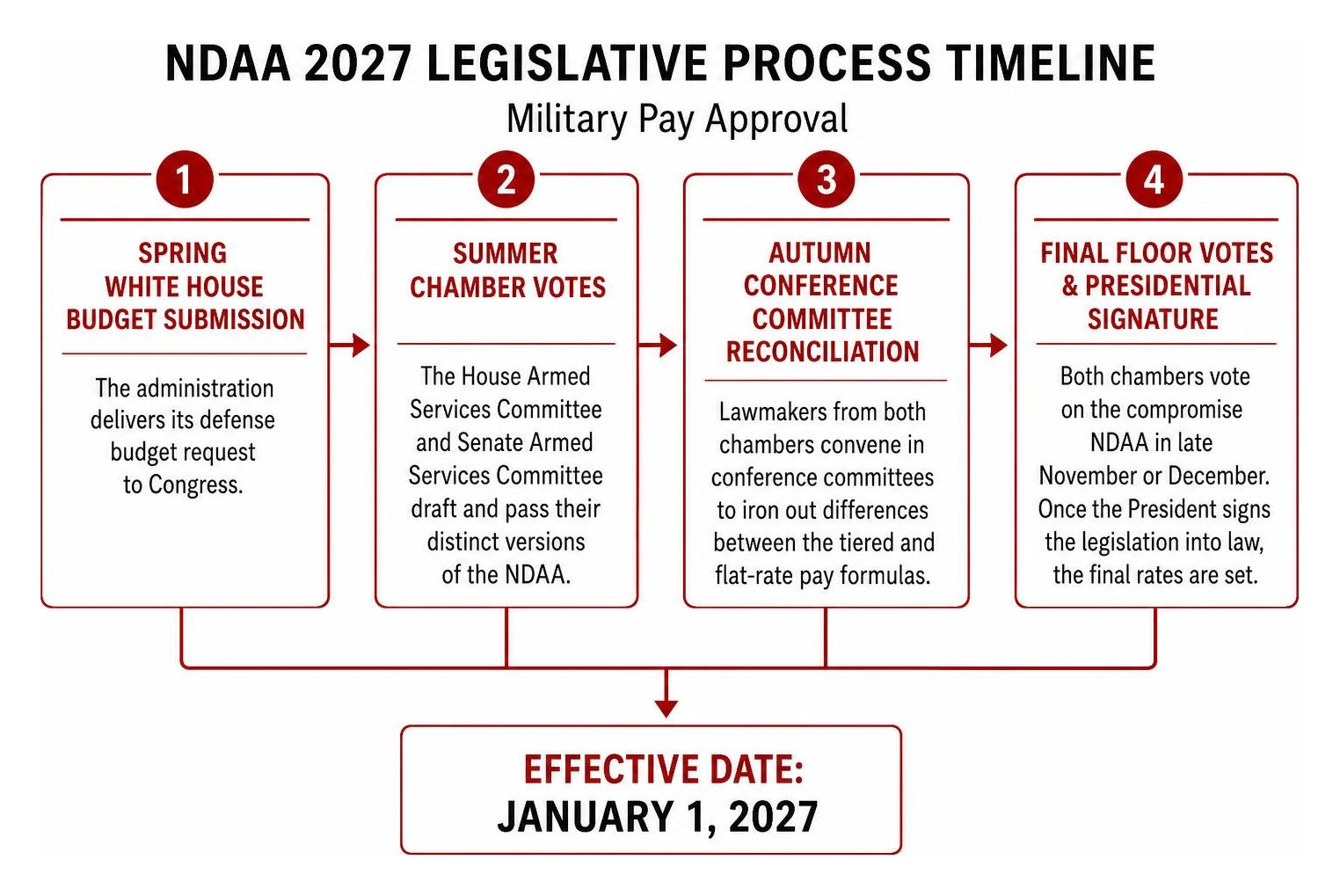
- Spring White House Budget Submission: The administration delivers its defense budget request to Congress.
- Summer Chamber Votes: The House Armed Services Committee and Senate Armed Services Committee draft and pass their distinct versions of the NDAA.
- Autumn Conference Committee Reconciliation: Lawmakers from both chambers convene in conference committees to iron out differences between the tiered and flat-rate pay formulas.
- Final Floor Votes & Presidential Signature: Both chambers vote on the compromise NDAA in late November or December. Once the President signs the legislation into law, the final rates take effect on January 1, 2027.

An interesting item in the House version of the NDAA is a provision in Section 1091 that proposes renaming the Department of Defense back to its historic title, the Department of War. Whether that provision survives conference negotiations or not, the core economic debate remains centered on compensation and budget allocations.
Impact on Military Retirement, TSP, and Total Compensation
A change in basic pay directly influences your overall compensation package, extending well beyond the monthly check deposited into your bank account.

High-3 and Blended Retirement System (BRS) Calculations
- High-3 System: For service members covered under legacy retirement, pension payments equal 2.5% per year of service multiplied by the average of their highest 36 months of basic pay. A larger raise in 2027 permanently elevates that 36-month baseline.
- Blended Retirement System (BRS): BRS participants receive a 2.0% pension multiplier alongside government matching contributions to the Thrift Savings Plan (TSP). The Department of Defense provides an automatic 1% TSP contribution and matches up to an additional 4% of basic pay. When your base pay increases, the dollar value of the DoD’s 5% maximum matching contribution increases concurrently.
Non-Taxable Allowances: BAH and BAS
Basic pay is taxable, but allowances are exempt from federal and state income taxes. When planning your 2027 household budget, take into account:
- Basic Allowance for Housing (BAH): BAH rates adjust annually based on local civilian rental market surveys across military housing areas (MHAs).
- Basic Allowance for Subsistence (BAS): BAS is a flat monthly food allowance adjusted annually according to the USDA food cost index.
These tax-free allowances represent a substantial portion of regular military compensation (RMC). For example, an E-5 stationed in a moderate-to-high cost-of-living area with dependents can see total gross compensation exceed $7,000 per month when basic pay, BAH, and BAS are combined.
Frequently Asked Questions about 2027 Army Pay
When will the 2027 Army pay raise be finalized?
The 2027 military pay raise will be finalized when Congress passes the compromise National Defense Authorization Act and the President signs it into law. This typically occurs in late December 2026, establishing the rates that take effect on January 1, 2027.
What happens if Congress fails to pass a new pay rate?
If Congress does not enact specific statutory pay language in the NDAA, military pay raises automatically default by law to the Employment Cost Index (ECI) calculated by the Bureau of Labor Statistics. For 2027, this automatic statutory baseline is 3.6%.
How do BAH and BAS factor into 2027 military compensation?
BAH and BAS provide tax-exempt funding for housing and food. While Congress debates basic pay adjustments in the NDAA, BAH and BAS rates are calculated separately by the Department of Defense and take effect alongside basic pay on January 1.
Conclusion
Understanding the competing proposals for the 2027 pay chart enables military families to plan ahead. Whether Congress approves the House’s tiered 5% to 7% plan or adopts the Senate’s flat 3.6% ECI baseline, active-duty soldiers will receive a salary bump starting January 1, 2027.
To track how rates have changed over time, you can compare current projections against the 2026 military pay chart. As the NDAA moves through conference committees this fall, we will continue providing up-to-date analysis and resources at USMilitary.com to help you manage your career, financial future, and military benefits. For personal inspiration along your military journey, consider reading Dare to Live Greatly.