
Eligibility Criteria for VA National and State Cemeteries

Determining eligibility is the primary step when planning end-of-life honors. The Department of Veterans Affairs provides comprehensive resting places across 157 national cemeteries and 35 soldiers’ lots situated in 44 states and Puerto Rico. Over four million Americans rest with dignity within these hallowed grounds under the meticulous stewardship of the National Cemetery Administration guidelines.
To qualify for interment in a national cemetery, a service member or Veteran must meet specific foundational requirements:
- Active Duty Service: Any Veteran discharged from active military service under conditions other than dishonorable.
- Service Duration: Veterans who enlisted after September 7, 1980, or entered active duty after October 16, 1981, must generally have completed 24 continuous months of service or the full period for which they were called to active duty.
- National Guard and Reserve Members: Members of reserve components who die while on active duty, during active duty for training, or performing inactive duty training qualify. Additionally, reservists and Guard personnel who completed 20 years of service qualifying them for retired pay (or who would have qualified upon reaching eligible age) are entitled to burial.
- Commissioned Officers: Officers of the Public Health Service (PHS) and the National Oceanic and Atmospheric Administration (NOAA) who served during designated qualifying periods.
- Specific Historic Groups: World War II Merchant Mariners, Philippine Armed Forces Veterans who served in the service of the U.S. Armed Forces, and eligible Hmong individuals.
To streamline this process, we recommend that families obtain a Pre-Need Eligibility Determination before the need arises. Submitting military separation documentation (such as a DD Form 214) ahead of time allows the VA to issue a formal determination letter, saving grieving relatives from searching for misplaced military records during a medical crisis.
Qualifying Family Members and Surviving Spouses
The VA recognizes that military service represents a shared sacrifice. Because of this, burial rights extend to eligible family members, even if the service member predeceases them or is buried elsewhere:
- Spouses and Surviving Spouses: A Veteran’s legal spouse is entitled to burial in a national cemetery, which includes shared grave space, opening and closing services, perpetual care, and inscribed name and dates on the Veteran’s headstone. An eligible surviving spouse remains eligible even if they remarried after the Veteran’s passing.
- Minor Children: Unmarried biological, adopted, or stepchildren under 21 years of age (or under 23 if enrolled in a full-time course of instruction at an approved educational institution).
- Disabled Adult Children: Unmarried adult children who became permanently physically or mentally disabled before reaching age 21 (or age 23 if full-time students) and remain incapable of self-support.
Navigating social support after losing a spouse requires coordinated planning. Families can explore broader safety nets by learning about surviving spouse benefits to manage transition costs and secure continuous monthly aid.
Exclusions and Character of Discharge Requirements
Not all service records result in automatic eligibility. The VA adheres to statutory restrictions regarding military conduct and legal history:
- Discharge Characterization: An Honorable or General (Under Honorable Conditions) discharge provides automatic clearance. An Other Than Honorable (OTH), Bad Conduct, or Dishonorable discharge bars standard entry. However, if a Veteran received an OTH discharge, families can request a VA Character of Discharge review or seek a military discharge upgrade from the respective military branch review board.
- Capital Crime Convictions: Individuals convicted of federal or state capital crimes (sentenced to death or life imprisonment without parole) are strictly barred from national and state veterans cemeteries.
- Tier III Sex Offenders: Any person convicted of a Tier III sex offense and sentenced to a minimum term of imprisonment is prohibited from receiving burial honors or space.
Financial Allowances and VA Veteran Burial Benefits
When an eligible Veteran is not buried in a national cemetery, the VA offers cash reimbursements known as burial allowances. These cash payments help offset funeral fees, burial plot purchases, transportation logistics, and interment expenses.
Understanding the distinct rate tiers based on service connection prevents unexpected expenses for families handling arrangements:
| Benefit Category | Service-Connected Death | Non-Service-Connected Death (Oct 1, 2025 & After) | Non-Service-Connected Death (Prior to Oct 1, 2025) |
|---|---|---|---|
| Burial / Funeral Expense | Up to $2,000 | Up to $1,002 | Up to $978 |
| Plot / Interment Allowance | Included in Base | Up to $1,002 (Private/State plot) | Up to $978 (Private/State plot) |
| Headstone / Marker Allowance | No Charge (Gov-issued) | Up to $441 (if privately bought) | Up to $441 (or standard tier) |
| Filing Deadline | No Time Limit | 2 Years from Burial Date | 2 Years from Burial Date |
| Transportation Reimbursement | Yes (to nearest national site) | Yes (if died in VA facility) | Yes (if died in VA facility) |
Families can confirm specific regulatory updates and sub-tier payment charts directly through official VA burial allowance rates.
Service-Connected Death Reimbursements
If a Veteran died as a result of a service-connected disability, injury sustained in the line of duty, or while undergoing active treatment for an established service-connected condition, the VA provides maximum monetary support:
- Deaths on or after September 11, 2001: Up to a $2,000 burial allowance.
- Deaths prior to September 11, 2001: Up to a $1,500 burial allowance.
- Transportation Reimbursements: If the Veteran is interred in a VA national cemetery, the VA will reimburse some or all of the transportation costs for moving the remains (by ground hearse or rail/air transport).
- No Deadline: Claims for service-connected burial expenses carry no filing deadline. You may file at any time after the Veteran’s passing.
How to Claim Non-Service-Connected Veteran Burial Benefits
For deaths unrelated to military service, financial eligibility requires meeting at least one clinical or legal circumstance at the time of death:
- The Veteran was receiving VA disability compensation or VA pension.
- The Veteran had a pending claim for VA compensation or pension that would have been approved.
- The Veteran died while admitted to a VA medical facility, under authorized VA contracted hospital care, or while residing at an approved state Veterans nursing home.
- The Veteran died while traveling under authorized VA travel orders for medical care or examination.
For non-service-connected deaths occurring on or after October 1, 2025, the VA pays up to $1,002 for burial and funeral expenses, plus an additional $1,002 plot-interment allowance if the Veteran is laid to rest in a private, non-government cemetery. If a surviving spouse is already recorded on the Veteran’s VA profile, the VA often pays this benefit automatically upon receipt of the death certificate without requiring a separate formal claim form.
If filing manually, survivors should review how to navigate the VA burial benefits claim process to avoid document rejections.
Free Memorial Items, Military Funeral Honors, and Grave Markers
Every eligible Veteran, regardless of where they are laid to rest, is entitled to enduring symbols of national gratitude at zero cost to their surviving family.

Government-Furnished Headstones, Markers, and Medallions
The VA delivers headstones, flat markers, niche markers, or medallions worldwide to mark the grave of an eligible Veteran.
- National and State Cemeteries: The cemetery coordinates headstone placement automatically. Upright marble, granite, or flat bronze designs are provided to match existing section standards.
- Private Cemeteries: Families ordering for a private resting place must submit VA Form 40-1330 (Claim for Standard Government Headstone or Marker).
- Medallions for Existing Markers: If a family purchased a private monument, they may request an official bronze medallion (VA Form 40-1330M) to adhere directly to the existing headstone. Medallions are available in multiple sizes and signify branch of service, with distinctive editions honoring Medal of Honor recipients.
Presidential Memorial Certificates (PMC)
A Presidential Memorial Certificate is an engraved paper certificate signed by the current sitting President, paying tribute to the Veteran’s honorable service. Established under President John F. Kennedy in 1962, these certificates are automatically generated for Veterans interred in national cemeteries. For private burials, families can request certificates by submitting VA Form 40-0247 alongside proof of military service. Multiple copies can be requested for children, grandchildren, and immediate family.
Burial Flags
A United States flag is provided at no charge to drape over the casket or accompany the urn of a deceased Veteran. After the committal service, the flag is traditionally folded and presented to the next of kin. Funeral directors routinely secure these flags from local U.S. Post Offices or regional VA offices by filing VA Form 27-2008 (Application for United States Flag for Burial Purposes).
Arranging Military Funeral Honors Detail
Under Department of Defense guidelines, every eligible Veteran is entitled to a formal Military Funeral Honors ceremony. Funeral directors coordinate this by calling the DoD central contact number (1-877-MIL-HONR) or reaching out directly to the casualty assistance office of the Veteran’s branch of service.
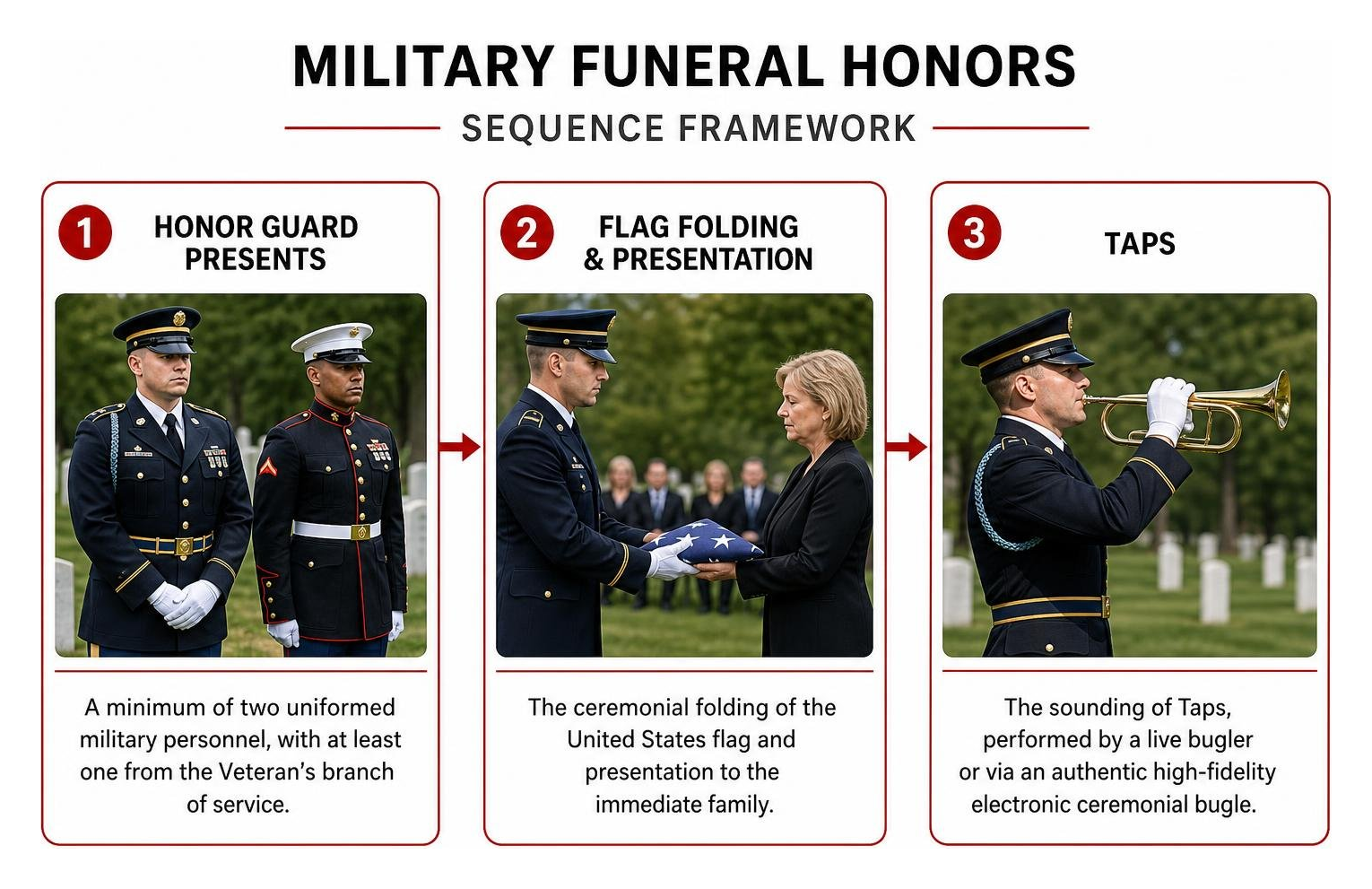
A standard ceremony consists of:
- A minimum of two uniformed military personnel (with at least one representative from the Veteran’s specific branch of service).
- The ceremonial folding and presentation of the United States flag to the immediate family.
- The sounding of Taps, performed by a live bugler or via an authentic high-fidelity electronic ceremonial bugle.
For an in-depth breakdown of active service tributes, review the official standards for Army and military memorial services.
Step-by-Step Guide: How to Apply for VA Burial Reimbursements and Memorials
Filing for burial allowances and physical markers requires organized documentation. Following this clear workflow ensures fast processing through the VA Pension Management Center:
1. Gather Required Paperwork
Before logging on or visiting an office, assemble these core records:
- Veteran’s military separation document (DD Form 214 or equivalent discharge paperwork displaying character of service).
- Certified copy of the official Death Certificate.
- Itemized funeral receipts or an official Statement of Account from the funeral home, showing the total charges, credits, and who made payments.
- Itemized receipts for transportation expenses (if seeking reimbursement for transit to a national cemetery).
2. Complete the Application Forms
- Burial Allowance: Complete VA Form 21P-530EZ (Application for Burial Benefits).
- Headstone/Marker/Medallion: Complete VA Form 40-1330 or VA Form 40-1330M.
- Burial Flag: File VA Form 27-2008 (usually completed by the funeral home).
3. Submit Documents Through Approved Channels
- Online via QuickSubmit: Upload your completed forms directly through the VA’s digital portal for rapid indexing.
- By Mail: Send hard copies to:
> Department of Veterans Affairs
> Pension Intake Center
> P.O. Box 5365
> Janesville, WI 53547-5365 - In-Person or via VSO: Work directly with an accredited Veterans Service Officer (VSO) or submit documents at your nearest VA Regional Benefits Office.
Life insurance coverage can also serve as an emergency safety net for funeral down payments while claims are processed. We encourage military families to review how VA life insurance fits into their overall estate planning.
State-Level Veteran Burial Benefits and Cemeteries
In addition to federal cemeteries, states operate their own dedicated Veterans cemeteries built with VA grant support and maintained under strict National Cemetery Administration standards. For example, the Tennessee Department of Veterans Services operates five distinct state veterans cemeteries (two in Knoxville, one in Nashville, one in Memphis, and one in Parkers Crossroads).
State cemeteries offer:
- Free burial, opening/closing, grave liners, and ongoing care for qualifying Veterans and their spouses.
- Specific local floral policies designed to maintain grounds while honoring holidays.
- Dedicated protocols for handling unclaimed indigent Veteran remains, ensuring no Veteran is buried without full military dignity.
Survivor Pensions and Long-Term Family Support
Burial benefits address immediate interment costs, but the VA provides continued monthly financial assistance to surviving spouses and dependent children with limited income. Surviving spouses can verify their eligibility parameters through our guide on VA Survivors Pension eligibility.
If your spouse served during a recognized wartime period (such as World War II, the Korean War, Vietnam, or the Gulf War), review our overview of wartime veteran spouse pensions to secure long-term stability.
Additionally, surviving families can access no-cost Bereavement Counseling through community-based VA Vet Centers across the nation, providing compassionate transition and grief support after the loss of a loved one.
Frequently Asked Questions About VA Memorial Services
What is the deadline to file a claim for VA burial expenses?
For non-service-connected deaths, families must submit VA Form 21P-530EZ within two years of the Veteran’s burial or cremation. There is no time limit to file if the death was service-connected, if the Veteran died while under authorized VA hospital care, or if the claim is filed by a state or tribal organization for plot reimbursement.
Can a veteran receive free burial in a private cemetery?
The VA does not pay for private cemetery plots or commercial burial packages in full. However, when a Veteran is buried in a private cemetery, the VA will provide a free government headstone, marker, or medallion, a burial flag, a Presidential Memorial Certificate, and provide up to $1,002 in plot allowance and $1,002 in burial allowance (for qualifying non-service-connected deaths on or after October 1, 2025). Private cemetery installation fees remain the responsibility of the family.
Does the VA cover cremation, burial at sea, and anatomical donation?
Yes. VA burial allowances apply equally to all legal forms of disposition, including traditional ground burial, direct cremation, columbarium entombment, whole-body donation to an accredited medical school, and military burial at sea coordinated through the U.S. Navy and Coast Guard. In addition, select VA national cemeteries now provide dedicated sections for green burials utilizing biodegradable caskets and natural shrouds.
Final Honors and Family Preparedness
Securing military honors is a lasting expression of our nation’s gratitude. By organizing discharge records, preparing pre-need applications, and understanding reimbursement rates, military families can navigate end-of-life logistics without unneeded stress or financial strain.
For continued updates on compensation scales, survivor pensions, military loans, and comprehensive transition resources, access our trusted military benefits guidance on USMilitary.com to protect your family’s future.