
What the 2027 US Army Pay Chart Could Mean for Your Pay

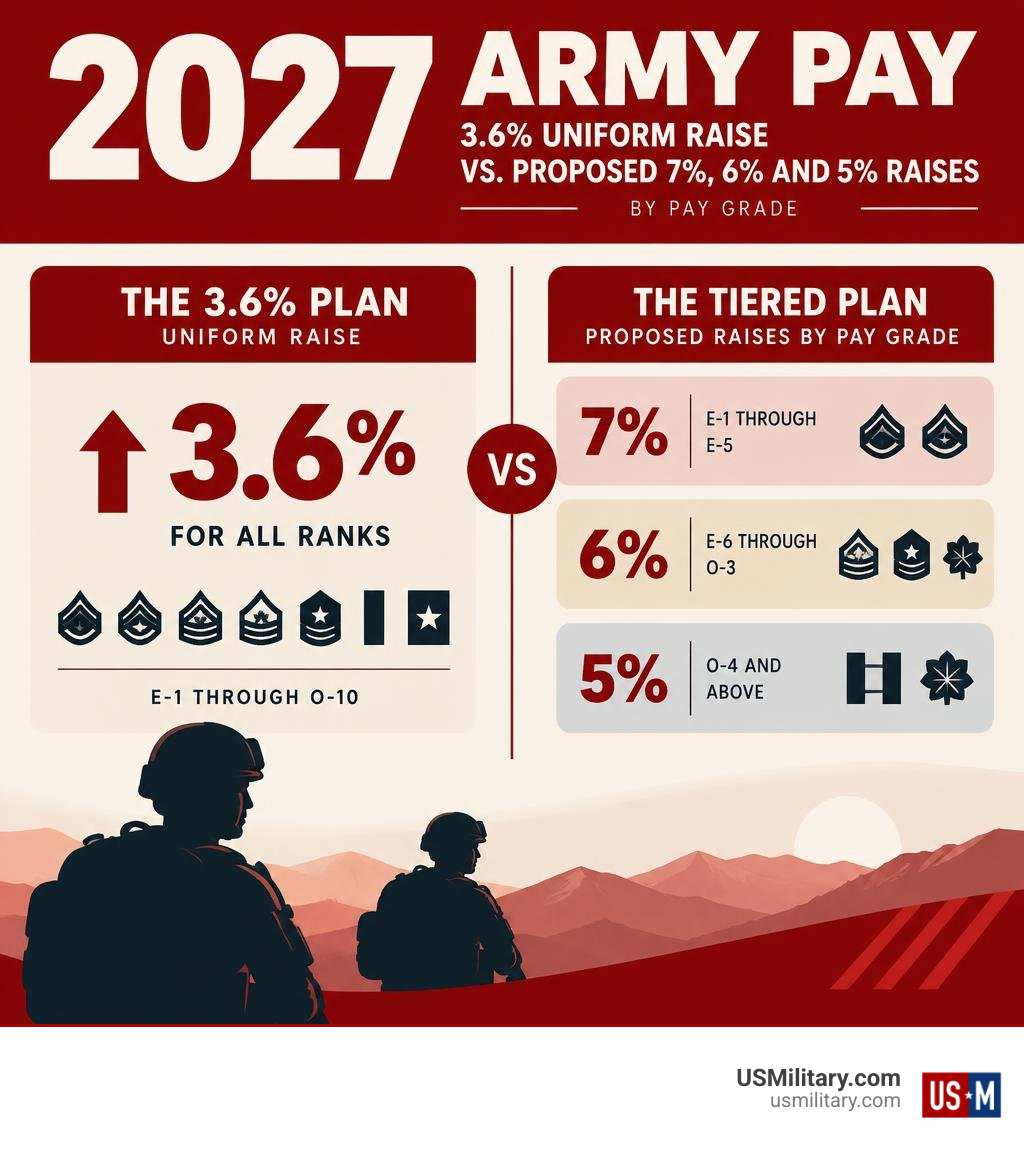
The 2027 US Army pay chart is not final as of October 2026. One plan would raise monthly basic pay by 3.6% across all ranks. A competing proposal would give E-1 through E-5 a 7% raise, E-6 through O-3 a 6% raise, and O-4 and above a 5% raise. Your rate will depend on your pay grade and years of service.
The 3.6% figure follows the pay-adjustment formula in Title 37, Section 1009. The House has passed its version of the 2027 defense bill, but Congress has not settled the final raise. For now, use both plans to budget, and remember that basic pay does not include housing allowances, special pay, or bonuses.
I’m Larry Fowler, publisher of USArmy.com and the privately owned USMilitary.com Network, which has covered military and veteran topics since 2007. I’ll help you use the US Army Pay Chart 2027 proposals to plan without mistaking an estimate for a final paycheck.
Understanding the US Army Pay Chart 2027 Proposals: 3.6% vs. Tiered Plan
Military basic pay is calculated using specific statutory guidelines, but Congress and the White House frequently adjust these numbers based on broader economic pressures. Under Title 37 U.S.C. §1009, automatic annual military pay raises are pegged to the Employment Cost Index (ECI) calculated by the Department of Labor. The ECI data measured for this cycle indicates an automatic statutory raise of 3.6% across all uniform ranks starting January 1, 2027.
However, the President’s FY 2027 Budget Request submitted an alternative proposal designed to inject more capital directly into the pockets of junior and mid-grade personnel. Instead of a flat increase, the White House proposed a tiered pay structure:
- 7% increase for junior enlisted personnel (pay grades E-1 through E-5)
- 6% increase for mid-level enlisted soldiers, warrant officers, and junior officers (grades E-6 through O-3, including W-1 to W-5)
- 5% increase for senior officers (pay grades O-4 through O-10)
If you have been keeping an eye on an early look at the 2027 military pay chart guide, you know this debate is central to military household budgeting. While a uniform 3.6% raise ensures steady upward movement tied to civilian wage growth, the tiered proposal actively addresses quality-of-life challenges caused by cost-of-living increases. Knowing how much you will earn on active duty in 2026 gives you a clear baseline to compare how each legislative option reshapes monthly take-home compensation.
| Pay Grade Band | Statutory ECI Raise Plan | Proposed Tiered Raise Plan | Key Impact Area |
|---|---|---|---|
| E-1 to E-5 | 3.6% across all years of service | 7.0% across all years of service | Maximum inflation relief for junior soldiers |
| E-6 to O-3 (includes W-1 to W-5) | 3.6% across all years of service | 6.0% across all years of service | Mid-career retention and NCO compensation |
| O-4 to O-10 | 3.6% across all years of service | 5.0% across all years of service | Senior leadership pay growth adjusted for caps |
Legislative Status of the FY 2027 NDAA (H.R. 8800)
The path from a budget proposal to your Leave and Earnings Statement (LES) runs directly through the National Defense Authorization Act (NDAA). On July 22, 2026, the House of Representatives passed its version of the FY 2027 defense authorization bill, designated as H.R. 8800. The House bill embraced the tiered 7%/6%/5% pay increase to bolster troop welfare.
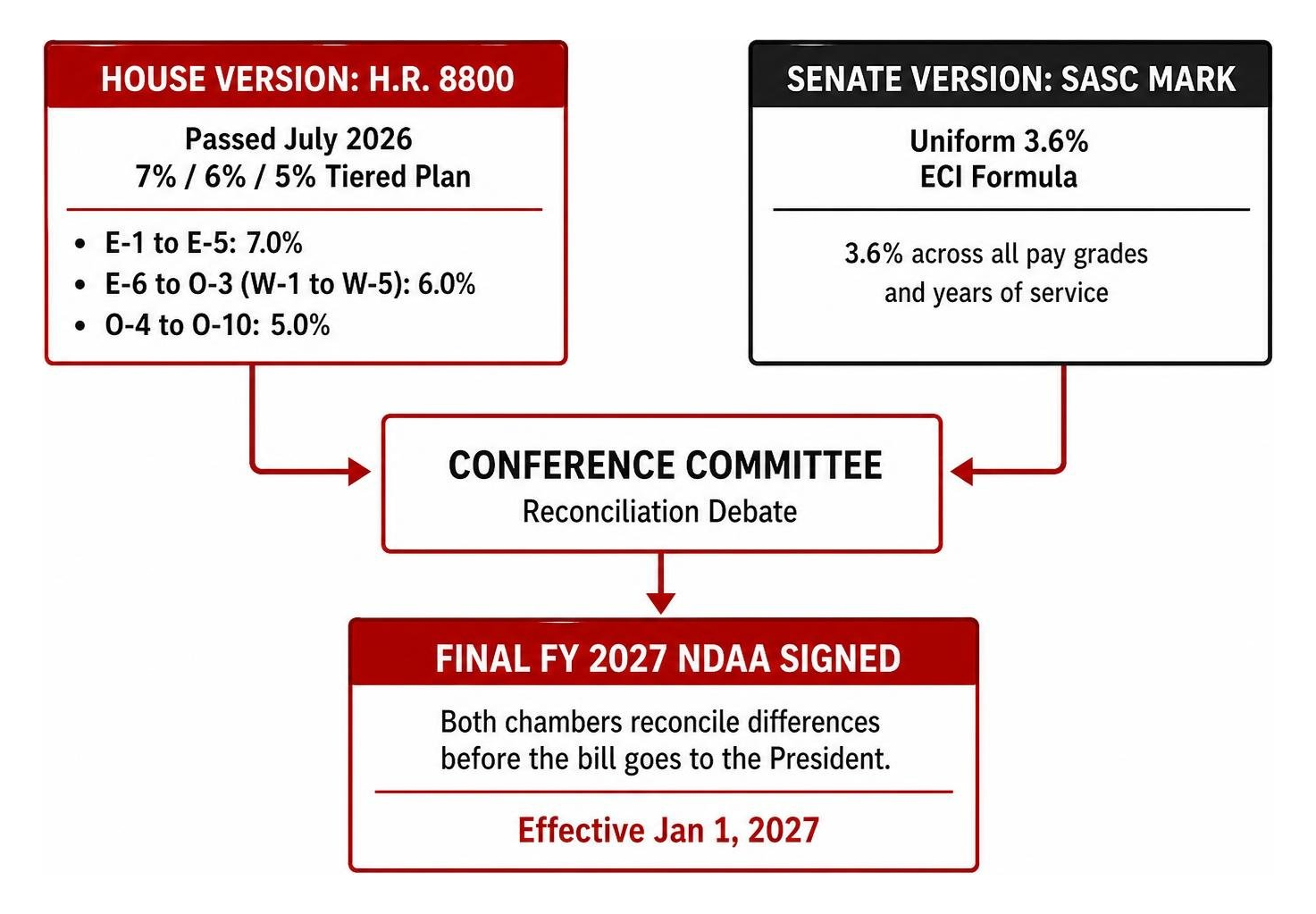
Conversely, the Senate Armed Services Committee opted to maintain the statutory 3.6% uniform pay raise. Furthermore, while the House passed H.R. 8800, the bill currently lacks an explicit waiver to 37 U.S.C. §1009, which is necessary to legally override the default ECI formula with targeted percentages.
Our ongoing coverage of marching toward fairer pay with military pay equity in 2026 highlights how these House and Senate conference negotiations decide whether service members receive a uniform cost-of-living bump or a structurally weighted boost. Both chambers must reconcile these differences before the final defense bill heads to the President’s desk for signature ahead of the January 1, 2027 effective date.
Strategic Defense Priorities and the Department of War Rebranding
The compensation debates surrounding the 2027 defense budget are deeply intertwined with overarching national security objectives. The 2026 National Defense Strategy outlines aggressive measures focused on “rebuilding our military” and “reviving the warrior ethos.” To achieve this, the Administration requested a record $1.5 trillion topline budget for the defense enterprise, up significantly from $1 trillion in FY 2026.
Beyond funding levels, the FY 2027 NDAA introduces historic symbolic changes. Under Section 1091 of the proposed legislation, the Department of Defense would formally revert to its historic title: the Department of War. Advocates argue this rebranding reinforces combat lethality and sharpens operational readiness. Whether examining broad structural reforms or looking from E-1 to O-4, a deep dive into active duty military pay and benefits shows that modern military compensation is increasingly recognized as a cornerstone of national defense readiness.
Detailed Salary Breakdown Across Enlisted, Warrant, and Officer Ranks
To understand how these competing plans affect actual paychecks, let’s look at the numbers. Monthly basic pay forms the taxable foundation of military earnings, stepping upward with each promotion and time-in-service milestone. Official figures recorded by the Defense Finance and Accounting Service provide the baseline from which all 2027 calculations stem.
Breakdown of Enlisted Ranks Under the US Army Pay Chart 2027
Enlisted soldiers represent the backbone of the Army. Under the House’s 7% proposal for E-1 through E-5 and 6% for E-6 through E-9, junior enlisted personnel see substantial dollar increases compared to the standard 3.6% baseline.
- An E-1 with under 4 months of service earns $2,306.00 monthly under the 3.6% uniform plan, compared to $2,381.00 under the 7% tiered plan.
- An E-5 with over 6 years of service receives $4,257.90 monthly under the 3.6% plan, jumping to $4,532.00 under the 7% model—an increase of more than $274 each month.
- A senior E-9 with over 26 years of service earns $9,601.50 under the 3.6% uniform raise, versus $9,824.00 under the 5% tier.
Building on the benchmarks established in our 2026 military pay chart enlisted guide, the table below illustrates key monthly pay comparisons across typical enlisted career points.
| Grade & Time in Service | 2026 Baseline Pay | 2027 Projected (3.6% Uniform) | 2027 Proposed (Tiered Plan) | Monthly Difference |
|---|---|---|---|---|
| E-1 (< 4 months) | $2,225.87 | $2,306.00 | $2,381.00 | +$75.00 |
| E-2 (> 2 years) | $2,578.18 | $2,671.00 | $2,758.60 | +$87.60 |
| E-3 (> 3 years) | $2,874.52 | $2,978.00 | $3,075.70 | +$97.70 |
| E-4 (> 4 years) | $3,330.12 | $3,450.00 | $3,563.20 | +$113.20 |
| E-5 (> 6 years) | $4,110.00 | $4,257.90 | $4,532.00 | +$274.10 |
| E-6 (> 10 years) | $4,785.60 | $4,957.90 | $5,072.70 | +$114.80 |
| E-7 (> 14 years) | $5,739.00 | $5,945.60 | $6,083.30 | +$137.70 |
| E-8 (> 18 years) | $6,712.50 | $6,954.20 | $7,115.30 | +$161.10 |
| E-9 (> 26 years) | $9,267.86 | $9,601.50 | $9,824.00 | +$222.50 |
For more extensive historical cross-references and granular breakdowns, you can consult the 2027 military pay chart 3.6 & 5-7% (all pay grades) or review the 2027 estimated military pay chart | 30-year chart.
Officer and Warrant Officer Pay Scales in the US Army Pay Chart 2027
Commissioned and warrant officers shoulder extensive operational, technical, and tactical responsibilities. Whether leading standard company elements or serving in specialized units where your Ranger paycheck breaks down active duty compensation with hazard and jump pay, base salary rates reflect these distinct career milestones.
- A W-5 with over 20 years of service earns $10,535.80 monthly under the 3.6% plan, compared to $10,780.00 under the 6% tier.
- A Captain (O-3) with over 6 years of service receives $8,015.40 per month under the 3.6% plan, or $8,201.00 under the 6% proposal.
- A Colonel (O-6) with over 20 years of service earns $14,246.10 under the 3.6% statutory rate, or $14,438.00 under the 5% tier.
- General officers at the O-10 level remain capped by federal law at Executive Schedule Level II ($19,683.80 monthly).
| Grade & Time in Service | 2026 Baseline Pay | 2027 Projected (3.6% Uniform) | 2027 Proposed (Tiered Plan) | Monthly Difference |
|---|---|---|---|---|
| W-1 (> 2 years) | $4,124.52 | $4,273.00 | $4,372.00 | +$99.00 |
| W-3 (> 10 years) | $6,532.82 | $6,768.00 | $6,924.80 | +$156.80 |
| W-5 (> 20 years) | $10,169.69 | $10,535.80 | $10,780.00 | +$244.20 |
| O-1 (< 2 years) | $3,826.25 | $3,964.00 | $4,055.80 | +$91.80 |
| O-2 (> 4 years) | $5,679.54 | $5,884.00 | $6,020.30 | +$136.30 |
| O-3 (> 6 years) | $7,736.87 | $8,015.40 | $8,201.00 | +$185.60 |
| O-4 (> 12 years) | $9,864.00 | $10,219.10 | $10,357.20 | +$138.10 |
| O-5 (> 16 years) | $11,540.00 | $11,955.40 | $12,117.00 | +$161.60 |
| O-6 (> 20 years) | $13,751.06 | $14,246.10 | $14,438.00 | +$191.90 |
| O-10 (Senior General) | $19,683.80 | $19,683.80 | $19,683.80 | $0.00 (Statutory Cap) |
To study expanded career timelines across several decades of service, check the 2027 estimated military pay chart | 40-year extended chart as well as the printable 2027 military pay chart PDF reference.
Special Rates, Locality Adjustments, and Geographic Allowances

Your monthly base salary is only one part of total military compensation. Depending on your duty station, additional geographical adjustments and non-taxable allowances significantly impact take-home pay.
For service members and dual-status technicians stationed in remote or non-foreign OCONUS areas, special rate schedules apply. For instance, the Office of Personnel Management (OPM) Special Rate Table 422A incorporates adjustments for unique geographical challenges. Service personnel in non-foreign areas like Alaska receive Non-Foreign Area Retirement Equity Assurance Act (NAREAA) locality adjustments. In Alaska, this locality adjustment reaches 32.36%, offsetting higher regional costs for heating, groceries, and transportation.
When planning your personal budget, basic pay is paired with non-taxable allowances:
- Basic Allowance for Housing (BAH): Rates adjust annually based on local civilian housing markets; keep up with 2024 BAH rates to see how allowances fluctuate across duty stations.
- Basic Allowance for Subsistence (BAS): A fixed monthly allowance intended to offset meal costs for active-duty soldiers.
- Cost-of-Living Allowance (COLA): Paid to service members stationed in high-cost areas within the continental U.S. (CONUS) or overseas (OCONUS).
Structuring your household budget with disciplined military pay allotments allows you to automatically channel these allowances and base pay increases toward high-yield savings, investments, and mortgage payments.
Essential Benefits, Educational Grants, and Military Discounts for 2027
Beyond standard salary increases, active-duty soldiers and their families have access to educational, consumer, and transition programs designed to maximize financial security.
- Heroes’ Legacy Scholarship: Administered through the Fisher House Foundation, this program honors service members who have fallen or become disabled post-9/11. For the 2026–2027 academic year, the program awards 500 scholarships valued at $2,000 each to eligible military dependents pursuing undergraduate degrees.
- Automotive Discounts and Rebates: Major manufacturers provide military incentive programs. For example, automotive brands routinely offer $500 cash rebates to active-duty personnel, reservists, retirees, and Gold Star families when purchasing or leasing qualifying new vehicles.
- Recruitment and Educational Partnerships: Leading academic institutions like the Rochester Institute of Technology (RIT) offer dedicated military recruitment portals, tuition assistance alignments, and career transition pathways to support active service members and veterans entering the civilian workforce.
Taking full advantage of these opportunities, along with understanding the ultimate guide to Army pension eligibility and retirement pay, ensures you are maximizing the benefits of military service throughout your active-duty career and beyond.
Frequently Asked Questions About 2027 Military Pay
When will the final 2027 military pay raise be enacted?
The final military pay raise is enacted when Congress passes the reconciled National Defense Authorization Act (NDAA) and the President signs it into law, typically in late November or December. Once signed, the Defense Finance and Accounting Service (DFAS) updates its systems so the new rates take effect on January 1, 2027, appearing on mid-month January paychecks.
How does the tiered pay raise benefit junior enlisted soldiers compared to standard ECI raises?
The tiered pay proposal provides a 7% raise to pay grades E-1 through E-5, nearly double the default statutory ECI raise of 3.6%. This targeted increase is intended to help junior enlisted soldiers handle inflation in essential expenses such as off-base food, utility bills, and personal transportation.
How do special locality adjustments like OPM Table 422A affect Army pay in non-foreign areas?
OPM Special Rate Table 422A governs civilian and dual-status military technician pay tables in high-cost, non-foreign locations like Alaska. It integrates the general schedule base pay with a 32.36% NAREAA locality rate, ensuring base compensation remains competitive with elevated regional living costs.
Conclusion
As we move through the final months of 2026, the 2027 military pay outlook highlights a clear commitment to improving troop compensation. Whether Congress enacts the uniform 3.6% raise or adopts the House’s ambitious 7%/6%/5% tiered proposal, Army service members will see higher base pay starting January 1, 2027.
At USMilitary.com, we will continue tracking every development in the FY 2027 NDAA conference debate to bring you accurate updates. If you are comparing career paths or looking at service compensation across the armed forces, explore our guide on Army vs Navy vs Air Force elite special forces to see how training, incentives, and specialized missions align across branches.