
Pros, Cons, & Risks of Joining Army Delta Force at a Glance
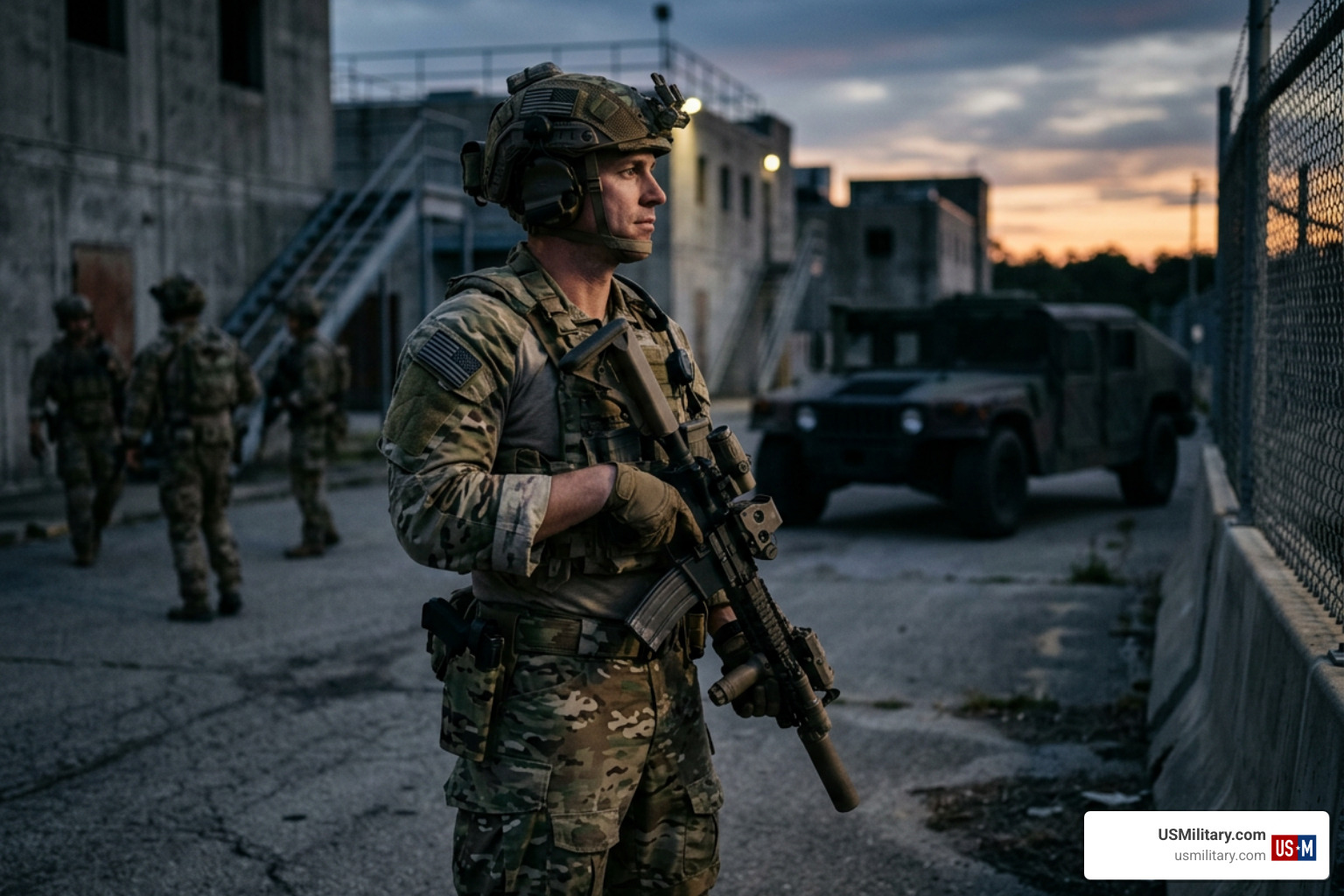
The Pros and Cons of Becoming an US Army Delta Force Operator come down to exceptional opportunity and exceptional cost. Operators can gain advanced skills, trusted teammates, and a chance to serve on high-stakes missions. In return, they face a demanding selection process, injury and combat risks, time away from family, and a career that can be hard to explain to civilian employers.
I am L.C. Fowler, a Navy veteran and BUD/S Class 89 graduate who leads USArmy.com and USMilitary.com Network. My special forces training background and training with Army special forces helps me examine the Pros and Cons of Becoming an Army Delta Force Operator, though I have not served in Delta Force.
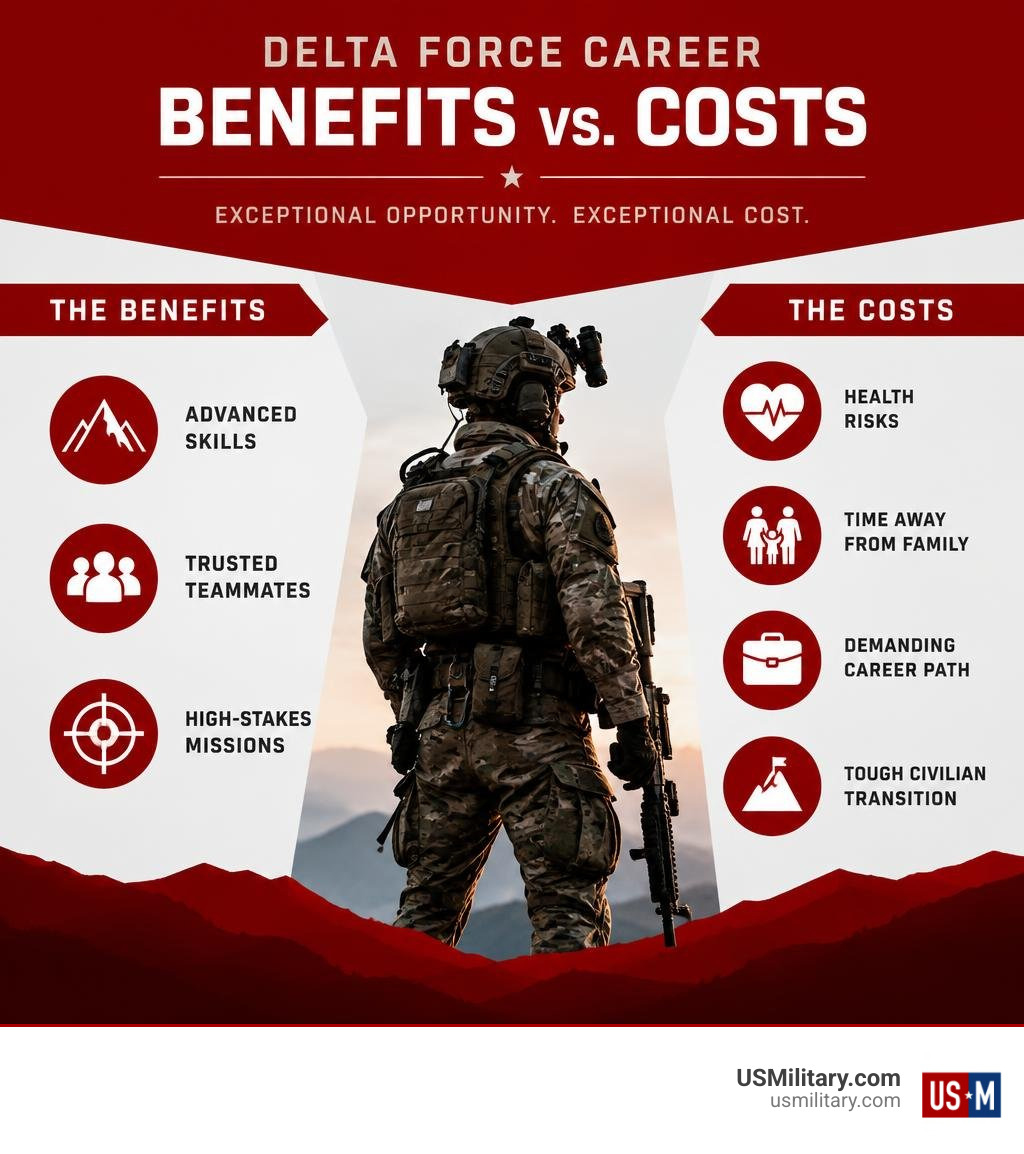
Pros and Cons of Becoming an Army Delta Force Operator definitions:
Introduction
Officially designated as the 1st Special Forces Operational Detachment-Delta (1st SFOD-D), Delta Force is the United States Army’s premier Tier 1 Special Mission Unit. Operating under the Joint Special Operations Command (JSOC), Delta Force is tasked with the nation’s most sensitive, high-stakes missions, ranging from counter-terrorism and hostage rescue to covert direct action and executive protection.
Founded in 1977 by Colonel Charles Beckwith—who drew heavily on his exchange experience with the British Special Air Service (SAS)—the unit was created to fill a critical void in American surgical strike capabilities. While only 1% of all military service members ever step into the special operations community, a mere fraction of that 1% possess the physical stamina, intellectual agility, and psychological resilience required to earn a spot in the unit. Serving as a Delta operator represents the pinnacle of military tactical achievement, but it demands sacrifices that permanently alter an individual’s personal life, physical health, and long-term career trajectory.
Comprehensive Breakdown: Pros and Cons of Becoming an Army Delta Force Operator
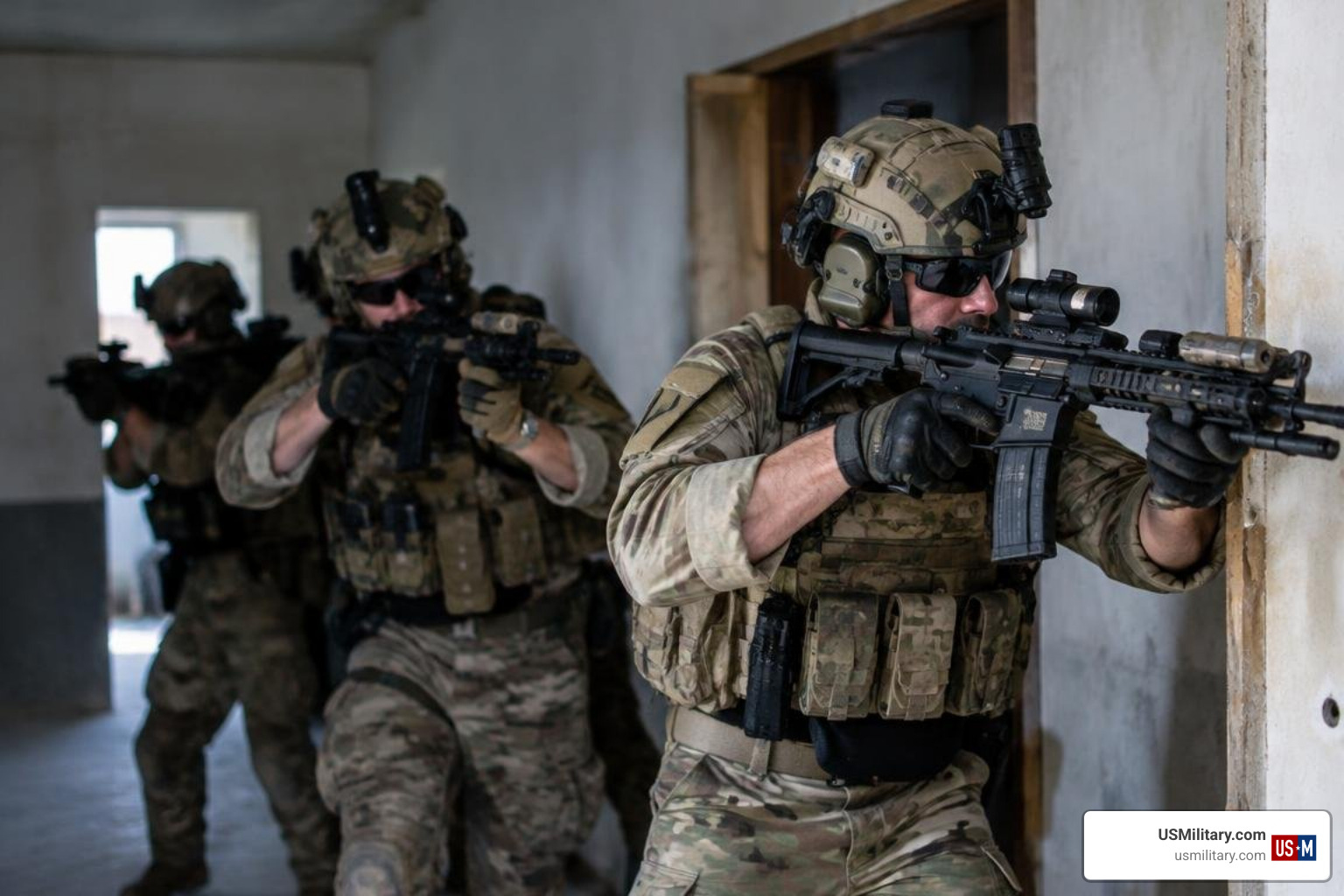
Evaluating a career in 1st SFOD-D requires balancing extraordinary professional mastery against immense physical and personal tolls.
| Category | Career Advantages (Pros) | Operational Costs (Cons) |
|---|---|---|
| Tactical Capability | Unmatched mastery in CQB, advanced shooting, and tradecraft | Extreme wear and tear; high operational tempo |
| Resources & Funding | Top-tier gear, customized weaponry, and dedicated aviation | Severe mission compartmentalization and classified stress |
| Autonomy & Culture | Flat hierarchy, mutual trust, and high mission ownership | Rigid mission focus with limited conventional promotion paths |
| Compensation | Maximum special duty pays, hazardous duty, and skill bonuses | High risk of acute physical trauma, blast injury, and TBI |
| Personal Life | Deep lifelong brotherhood and elite professional network | 9+ months deployed or training per year; high family strain |
Professional and Personal Pros of Becoming an Army Delta Force Operator
Serving inside the unit provides an operational environment unlike any other in the Department of Defense. Operators function in small, highly autonomous elements where micromanagement is nonexistent. Rank matters, but competence and character dictate respect.
- Unrivaled Operational Autonomy and Trust: Tactical decisions on target are made by operators on the ground rather than distant command elements.
- Cutting-Edge Equipment and Resources: Operators receive tailored access to the world’s most advanced firearms, night-vision devices, and gear suites, as outlined in our look at Delta Force’s essential equipment.
- Dedicated Strategic Assets: Missions are directly supported by premier units like the 160th Special Operations Aviation Regiment (Night Stalkers), ensuring world-class insertion and exfiltration capabilities.
- Enhanced Compensation: Operators maximize their military earnings through special duty assignment pay, language pay, demolition pay, and halo jump incentives. You can review how these stack up in our special operations duty and hazardous pay scales guide.
- Mastery of Combat Skills: Daily training regimens develop world-class precision marksmanship, explosive breaching, advanced tactical driving, and close-quarters battle (CQB) instincts.
Physical, Mental, and Family Cons of Becoming an Army Delta Force Operator

The elite operational tempo comes with profound personal and biological costs. Operating at the tip of the spear requires service members to endure extreme risks:
- Severe Domestic Strain: Deployments and specialized training cycles can keep an operator away from home for more than nine months a year. The secrecy required creates emotional distance, a dynamic explored further in our guide to family life dynamics of special operations families.
- Blast Overpressure and Traumatic Brain Injury (TBI): Thousands of hours spent firing heavy calibers and breaching doors expose operators to continuous blast waves, leading to chronic cognitive fatigue and sleep disorders.
- Musculoskeletal Breakdown: Carrying 45- to 80-pound loads across decades of service causes premature degeneration of the knees, hips, and lumbar spine.
- Psychological Burden: The chronic stress of life-or-death missions combined with operational secrecy can lead to hypervigilance, combat fatigue, and post-traumatic stress.
Unique Tier-One Capabilities and Advanced Tactical Skill Sets
Delta Force differs fundamentally from Tier 2 units like the conventional Green Berets. While Special Forces detachments focus on foreign internal defense and unconventional warfare, Delta operators specialize in surgical direct action and sensitive counter-terrorism operations.

Operators master specialized tradecraft, including executive protection in hostile territories, covert surveillance, and clandestine infiltration. These capabilities enable operators to coordinate directly with national intelligence agencies during critical national security events.
Selection Realities, Career Progression, and the Civilian Transition
Joining Delta Force is not an entry-level enlistment option. It is a mid-career assessment designed for proven soldiers.
Most candidates serve 5 to 10 years in elite organizations like the 75th Ranger Regiment or Special Forces before attempting assessment. In fact, approximately 50 to 70 percent of Delta operators previously served in the 75th Ranger Regiment. When classes of over 100 seasoned soldiers arrive at selection, attrition frequently exceeds 90%, leaving only a small handful selected for advanced training.
The Pipeline: Assessment, OTC, and Long-Term Health Risks
Delta Force selection occurs in the rugged terrain of the Appalachian Mountains, centered around Camp Dawson, West Virginia. The month-long assessment tests candidates through solitary land navigation under heavy loads.
Candidates are given map coordinates and must navigate through dense forests and steep mountain ridges without performance feedback or time standards. The phase culminates in the “Long Walk”—a grueling 40-mile march carrying a 45-pound ruck over unknown terrain with an undisclosed time limit.
Those who pass the psychological board enter the six-month Operator Training Course (OTC). There, soldiers learn:
- Advanced combat marksmanship
- Breaching and demolitions
- High-threat executive protection
- Counter-surveillance and technical tradecraft
- Precision driving and evasive maneuvers
This continuous physical punishment requires long-term planning for physical recovery and VA disability healthcare management upon retirement.
Career Progression Limitations and Post-Service Transition
While tactical life in Delta is unparalleled, it presents unique career challenges:
- Military Rank Ceilings: Highly specialized senior Non-Commissioned Officers (NCOs) often face limited advancement opportunities unless they return to the conventional Army, where their specialized Tier 1 skills are less utilized.
- Officer Career Windows: Commissioned officers (Captains and Majors) generally serve limited tactical tours before being rotated back to broader staff and command positions to stay competitive for promotion.
- Civilian Transition Hurdles: Because missions and specific operational achievements remain classified, translating daily work experience onto a standard civilian resume can be difficult.
Former operators often transition into defense consulting, government contracting, executive security, or entrepreneurial leadership roles where their decision-making under extreme pressure proves invaluable.
Navigating Your Elite SOF Career Decision
Choosing to pursue Tier 1 special operations requires honest self-assessment and direct conversations with your family. If you are an active-duty service member weighing your options, you should compare Tier 1 pathways between Delta Force and SEALs to determine which service culture aligns with your professional strengths and personal values.
At USArmy.com and USMilitary.com, we provide active-duty personnel and veterans with clear information regarding service paths, VA benefits, and military transition planning. Pursuing the quiet professional path of an Army Delta Force operator demands exceptional drive, unwavering integrity, and a willingness to operate at peak capacity when no one is watching.
Authored by L.C. Fowler, Navy Veteran, BUD/S Class 89 Graduate, and Founder of USArmy.com, NavySeal.com, & USMilitary.com.