
Do Army Special Forces Reenlist More Often Than Navy SEALs?
Do the Army Special Forces have more reenlistments than Navy SEALs? Public data does not establish which group has more reenlistments or a higher reenlistment rate. Historical Army and Navy figures cover entire services, not just Green Berets and SEALs. Staffing shortfalls and bonus offers show where leaders wanted to keep skilled operators, but neither proves which group stayed longer.
The distinction matters: a reenlistment count depends partly on how many people serve, while a rate measures how many eligible members choose to stay. A fair comparison needs both groups’ figures for the same years and career stages.
I’m Larry Fowler, a Navy veteran and graduate of BUD/S Class 89. As publisher of NavySEAL.com and the USMilitary.com Network, I bring that background to the question, “Does The Army Special Forces Have More Reenlistments Than Navy SEALs?”
Does The Army Special Forces Have More Reenlistments Than Navy SEALs? terms to know:
- Army Ranger vs Green Beret
- Green Beret vs Navy SEAL
- Should I join the Marines or the Army Special Forces
Does The Army Special Forces Have More Reenlistments Than Navy SEALs?
When we look strictly at total manpower numbers, the United States Army Special Forces (Green Berets) maintains a larger overall footprint—roughly 14,000 personnel across active duty and National Guard units, compared to approximately 8,000 active and reserve personnel across the Navy SEAL teams. Because the raw population of Green Berets is significantly larger, Army Special Forces naturally records a higher absolute number of contract renewals each fiscal year.
However, whether they maintain a higher percentage reenlistment rate is an entirely different operational question. To evaluate retention accurately across services, military analysts evaluate cohorts through specific zones: Zone A (up to 6 years of service), Zone B (6 to 10 years of service), and Zone C (10 to 14 years of service).
| Retention Metric | U.S. Army Special Forces (Green Berets) | U.S. Navy SEALs | Key Takeaway |
|---|---|---|---|
| Total Community Size | ~14,000 (Active & Guard) | ~8,000 (Active & Reserve) | Army has higher raw counts |
| Primary Assessment Pipeline | SFAS & SFQC (1.5 to 2.5 years) | BUD/S & SQT (1 to 1.5 years) | Pipeline length shifts contract timing |
| Average Initial Enlistment Commitment | 5 to 6 years (e.g., 18X contracts) | 4 to 6 years (SO contract) | Reenlistment windows open at similar tenures |
| Maximum Retention Bonus Available | Up to $150,000 for critical senior tiers | Up to $150,000 for critical senior tiers | USSOCOM aligns major financial levers equally |
| Career Longevity Dynamics | NCO-centric; high 15+ year retention | High initial mid-tier turnover; senior stabilization | Exploring the ins and outs of Green Beret vs Navy SEAL careers reveals distinct culture drivers |
While raw contract totals tilt toward the Army due to force structure size, both communities work within standardized retention tracking frameworks managed by the Department of Defense. Methodological frameworks, such as those evaluated by the CNA Corporation’s OSD retention study, demonstrate that special operations retention must be measured across long-term continuation curves rather than simple single-year snapshots.
Historical Retention: Does the Army Special Forces Have More Reenlistments Than Navy SEALs?

Historical retention benchmarks from major conflict periods reveal how service branches handled troop stability under operational strain. Between fiscal years 2000 and 2004, the Army consistently met or exceeded 100% of its overall retention goals across initial, midcareer, and career soldier categories. In contrast, Navy wide figures showed challenges in early-career retention, missing its Zone A reenlistment goal in FY 2001 (56.9% actual vs. 57.0% goal) and FY 2004 (54.1% actual vs. 56.0% goal).
Because these overarching branch metrics aggregate all military occupational specialties, we have to look deeper into econometric retention modeling. As documented in technical studies on United States Army reenlistment estimation models, the Department of Defense relies heavily on Selective Reenlistment Bonus (SRB) multipliers to stabilize numbers when operational demands escalate. When asking, “Does the Army Special Forces have more reenlistments than Navy SEALs during surge periods?”, the historical evidence indicates that both services used aggressive bonus interventions to keep seasoned operators from departing for the commercial security sector.
Hard-to-Fill Special Operations Occupations and Staffing Shortfalls
Retention issues within Special Operations Forces (SOF) rarely affect every job specialty equally. Both the Army Special Forces and the Navy SEAL community have dealt with persistent shortages in hyper-specialized sub-disciplines:
- 18D Special Operations Medical Sergeant: The Army’s premier combat medical specialist faces one of the longest, most intellectually demanding training pipelines in the military. Historical Defense Department data recorded this critical occupation underfilled by 139 personnel, operating with only 630 assigned soldiers against an authorized strength of 769.
- Navy Special Warfare Diver & Combat Support: Essential maritime combat diving ratings supporting SEAL tactical deployments saw historical shortfalls of 1,101 personnel, with 2,187 assigned against an authorized 3,288.
- Special Operations Combat Medic / Corpsman: Naval Special Warfare medical support experienced severe fill challenges, at times operating with only 54 personnel against an authorized target of 101.
These staffing shortfalls underscore that retaining skilled combat leaders requires targeted branch incentives.
Financial Incentives, Selective Reenlistment Bonuses, and Career Pay
To keep elite operators in uniform, the Department of Defense utilizes targeted financial incentives under the guidance of U.S. Special Operations Command (USSOCOM). When looking at the comprehensive breakdown of Navy SEALs vs Delta Force pay structures, base pay remains standardized across all military branches based on paygrade and time in service. However, special duty incentives make a substantial difference in an operator’s annual earnings.
Special Operations personnel can receive up to $375 per month in Special Duty Assignment Pay (SDAP), hazardous duty pay, and parachute and dive incentive pays. To retain senior leadership, USSOCOM introduced Critical Skills Retention Bonuses (CSRB) reaching up to $150,000 for senior noncommissioned officers, petty officers, and warrant officers with 19 or more years of service who commit to an additional six years. Additionally, personnel with over 25 years of service can receive Assignment Incentive Pay of up to $750 per month, as detailed in reports from DVIDS highlighting efforts to retain seasoned operators.
Impact of Training Pipeline Attrition on Downstream Reenlistment
A key driver of reenlistment eligibility is the front-end training pipeline. Before an operator ever faces a reenlistment decision, they must survive selection crucibles with exceptionally high attrition rates.
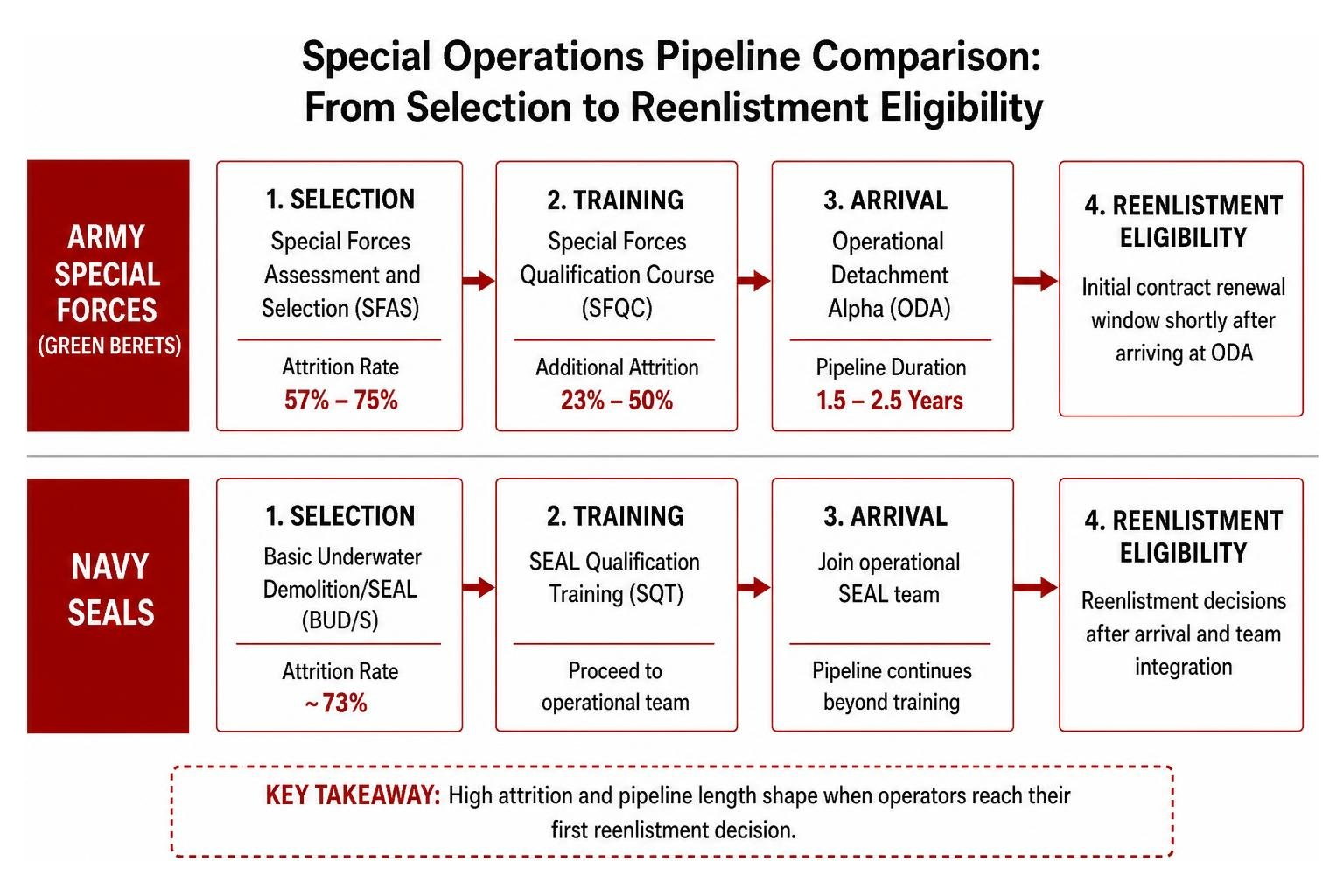
According to historical data published in Tier Three Tactical’s special operations attrition report, Basic Underwater Demolition/SEAL (BUD/S) training experiences an average attrition rate of roughly 73%. Candidates who survive BUD/S proceed through SEAL Qualification Training (SQT) before arriving at an operational team.
By comparison, the Special Forces Assessment and Selection (SFAS) phase carries an attrition rate between 57% and 75%, followed by the Special Forces Qualification Course (SFQC), which experiences an additional 23% to 50% attrition. As documented by Army National Guard SFQC selection data, only about 23 to 28 out of every 100 initial candidates complete the entire Green Beret pipeline. Because the Special Forces pipeline takes 1.5 to 2.5 years, a soldier often approaches their initial contract renewal window shortly after arriving at their Operational Detachment Alpha (ODA), fundamentally shaping their first reenlistment decision.
Operational Tempo, Mission Profiles, and Lifestyle Factors Driving Retention
Beyond bonuses, day-to-day mission profiles heavily impact whether an operator decides to reenlist or separate. Army Special Forces focus predominantly on Unconventional Warfare (UW) and Foreign Internal Defense (FID). A deep dive into Special Forces life and missions reveals that Green Berets spend extensive deployments embedded with indigenous allied forces, requiring advanced foreign language proficiency and regional cultural expertise.
Conversely, a typical day in the life of a Navy SEAL operator revolves around maritime operations, direct action raids, and counterterrorism missions. The physical wear on the human body from high-speed maritime insertions, combat diving, and intense jump schedules creates cumulative orthopedic strain. Furthermore, the sustained operational tempo and recurring overseas deployments take a heavy toll on family life, leading many operators to transition to civilian careers or federal government agencies.
How Green Beret and SEAL Retention Compares to Other Elite Units
Retention dynamics across USSOCOM extend beyond Green Berets and SEALs. Analyzing other elite units provides useful context:
- 75th Ranger Regiment: As explored in our breakdown of Army Rangers compared to Green Berets, the 75th Ranger Regiment serves as the military’s premier direct-action raid force. Its younger force structure sees higher initial turnover as junior Rangers complete their first enlistments and either transition to Special Forces or return to the civilian sector.
- Air Force Pararescue (PJs) & Combat Control (CCT): When evaluating Air Force PJs compared to Navy SEALs, Air Force rescue and air-ground integration specialists face similar retention pressures due to extreme training investments and specialized medical capabilities.
- Marine Corps Forces Special Operations Command (MARSOC): Marine Raiders draw candidates strictly from experienced, active-duty Marines. As noted in research from SOF Support’s comparative analysis, this prior-service requirement creates a naturally higher baseline continuation rate through early career checkpoints.
For candidates evaluating their military options, joining the broader special operations community requires matching personal career goals with each service branch’s operational tempo and retention culture.
Frequently Asked Questions About SOF Retention
Does the Army Special Forces have more reenlistments than Navy SEALs overall?
In terms of raw headcount, the Army Special Forces executes more reenlistments each year simply because the Green Beret enterprise is nearly twice the size of the Navy SEAL community. In terms of percentage reenlistment rates, both units maintain comparable retention in senior noncommissioned officer tiers due to matched USSOCOM bonus structures.
How did historical Stop-Loss policies affect Special Forces and SEAL reenlistment statistics?
During major combat surges in Iraq and Afghanistan, the Department of Defense utilized involuntary retention measures, commonly called Stop-Loss, to retain critical combat skills beyond scheduled contract expiration dates. While these policies ensured unit stability during active deployments, they temporarily masked natural market-driven reenlistment rates until the policies were rescinded.
What are the main reasons seasoned operators choose to leave the military?
The most common factors cited by separating operators include cumulative physical injuries, prolonged time away from families, and lucrative private sector or government contracting opportunities where their specialized security, logistics, and medical skills command top market compensation.
Conclusion
Understanding reenlistment and retention across elite military units reveals that raw contract numbers and retention percentages tell two different stories. While the Army Special Forces records more reenlistments due to its larger force structure, both Green Berets and Navy SEALs benefit from similar financial incentives, career milestone bonuses, and specialized pays designed to keep combat experience in uniform.
Whether you are currently serving and planning your next career milestone, or preparing for your initial enlistment pipeline, understanding these long-term military paths is essential. To learn more about elite tier-one units and selection paths, explore our side-by-side comparison of Army Delta Force vs. Navy SEALs to find the right direction for your military journey.