
What It Really Takes to Survive Army Ranger School

If you want 10 hot tips to survive Army Ranger School, here they are at a glance:
- Exceed the physical minimums – aim for 80-100 push-ups, not just 49
- Nail your paperwork and medical requirements before Day 1
- Master Ranger Stakes tasks – weapons, radios, and Claymores cold
- Practice land navigation until it’s second nature
- Know your OPORDs and patrol tasks before you arrive
- Build mental toughness with the “quit tomorrow” mindset
- Be a team player – find your niche and own it
- Prepare phase by phase – Darby, Mountains, and Florida each have unique demands
- Protect your feet and prevent injuries from day one
- Treat recycling as a learning opportunity, not a failure
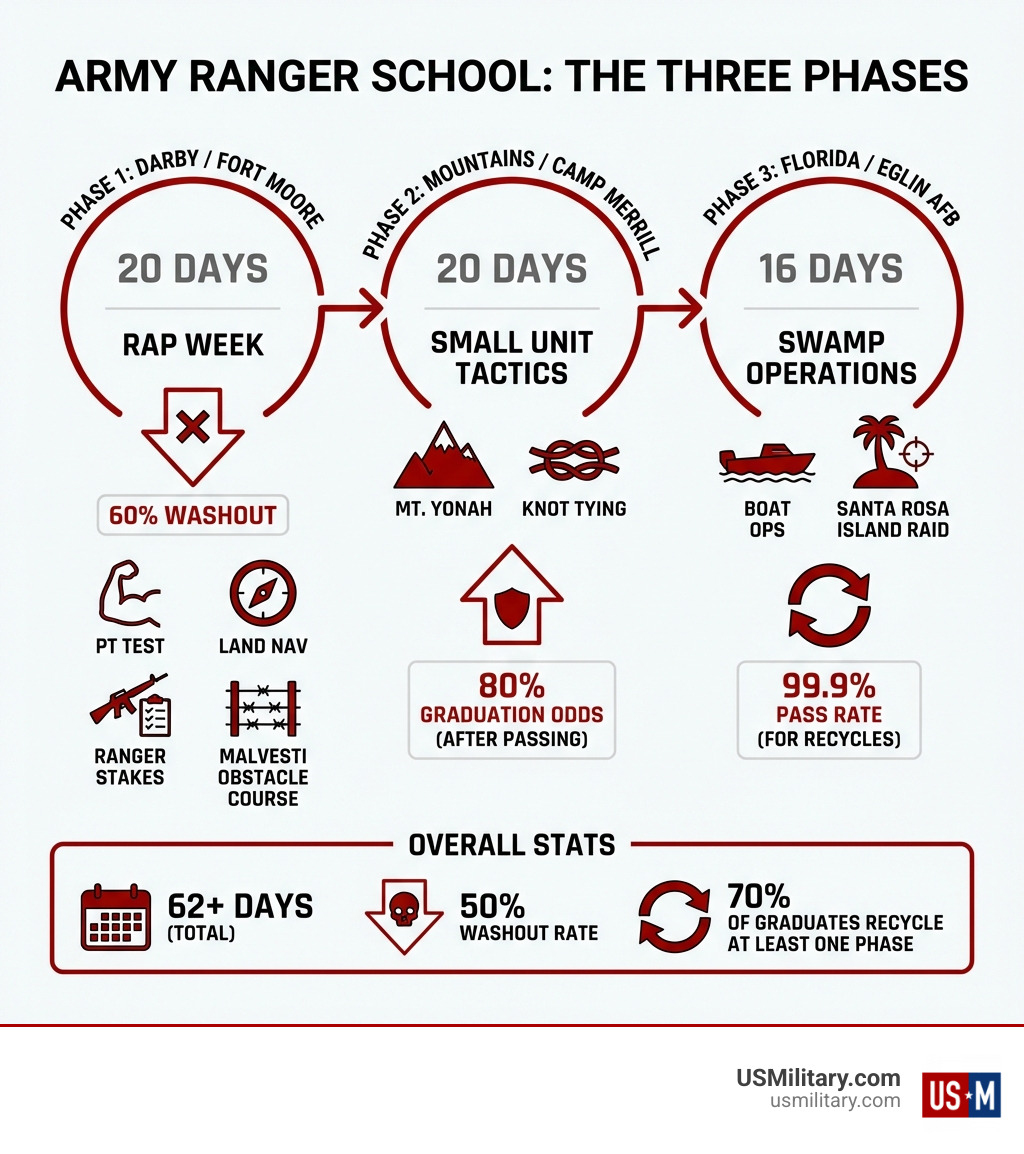
Army Ranger School is one of the most demanding military leadership courses in the world. It runs for a minimum of 62 days across three phases at Fort Moore, the Mountains, and Florida. It pushes soldiers to their absolute limits through sleep deprivation, hunger, exhaustion, and high-stakes leadership evaluations.
The numbers say it all. Roughly 50% of students wash out. About 60% of those drops happen in RAP Week alone – the very first phase. As one Vietnam veteran colonel put it: “Compared to Ranger School, combat was easy.”
But here’s the thing: survival is possible with the right preparation. Once you get through RAP Week, your odds of graduating jump to 70%. Pass Darby Phase, and that climbs to 80%. Make it through Mountains, and you’re looking at 90%.
This isn’t just a physical test. It’s a leadership selection course designed to identify soldiers who can perform under extreme stress. The tab isn’t given – it’s earned.
I’m Larry Fowler, publisher of USMilitary.com, and through years of connecting servicemembers with trusted military resources and preparation guides, I’ve helped countless soldiers navigate exactly this kind of critical career decision – including finding the right 10 hot tips to survive Army Ranger School. Read on for a complete, phase-by-phase breakdown of everything you need to know before you step foot on that grinder.
Learn more about 10 hot tips to survive Army Ranger School:
Master the Physical Standards and RAP Week

The Ranger Assessment Phase, better known as RAP Week, is where the herd is thinned. Statistically, 60% of those who fail Ranger School do so right here. It is a four-day gauntlet designed to see if you have the baseline physical and mental capacity to even begin the course.
The standards are clear, but the grading is famously “Ranger strict.” You will face the Ranger Physical Assessment (RPA), which currently requires:
- 49 push-ups (perfect form, chest to the ground)
- 59 sit-ups
- 5-mile run in 40 minutes or less
- 6 chin-ups (dead hang, no kipping)
Following these, you’ll tackle the Combat Water Survival Test, the Malvesti obstacle course (home of the “Worm Pit”), and the 12-mile ruck march with a 60lb pack, which must be completed in under three hours.
One of the best ways to prepare is to bank your sleep. Scientific evidence on sleep banking suggests that getting extra rest in the 5-10 days before the course can help stave off the initial shock of exhaustion.
Don’t let administrative errors end your journey before it starts. Scrutinize your paperwork, medical records, and dental x-rays. Ensure your packing list is 100% accurate; even missing a small item can result in “spot reports” or minuses that haunt you later. For more on the transition from civilian to elite, check out Beyond basic training: unpacking the challenges of becoming an Army Ranger.
10 hot tips to survive Army Ranger School: Exceed the Minimums
If you show up aiming for 49 push-ups, you will fail. Under the stress of sleep deprivation and the watchful eye of a Ranger Instructor (RI) who doesn’t count “half-reps,” your numbers will drop. We recommend aiming for a “buffer zone” of 80-100 push-ups and sit-ups in your home training.
When it comes to the 5-mile run, a 40-minute pace is the bare minimum. You should be able to cruise at a 38-minute pace or faster to account for the Georgia heat and humidity. Ask yourself, Do you have what it takes to be an Army grunt or better yet an elite Army Ranger? If the answer is yes, you need to be rucking twice a week with loads up to 65-100 lbs to make that 12-mile march feel like a “light” day.
Strategies for Ranger Stakes and Land Nav
Ranger Stakes tests your technical proficiency on Skill Level 1 tasks. You must be able to assemble, disassemble, and perform functions checks on the M249 SAW, M240B, and M4, as well as operate radios and set up a Claymore mine. Stay in the back of the line during demonstrations so you can watch your peers and learn from their mistakes before it’s your turn.
Land Navigation is the other “big killer” in RAP Week. You will be dropped in the woods at night and expected to find points using only a compass, map, and pace count.
- Terrain Association: Don’t just follow a heading; look at the draws, spurs, and ridges.
- Dead Reckoning: Trust your compass, but use USGS topographic maps during your prep to understand how contour lines translate to real-world hills.
- Light Discipline: Use your red lens sparingly. RIs are like ninjas in the woods; if they see a white light, you’re done.
Tactical Proficiency and the Graded Patrol
Once you survive RAP Week, you move into the patrolling phases. This is where you are graded on your ability to lead a platoon through missions. You’ll need to master the Ranger Handbook and execute Troop Leading Procedures (TLPs) while your brain is foggy from hunger.
You will be evaluated on your ability to issue an Operations Order (OPORD), establish a patrol base, and execute Battle Drills 1-4 (React to Contact, Platoon Assault, etc.). You’ll also need to be a pro at technical tasks like drawing range cards, sector sketches, and tying complex knots. If you’re wondering how this compares to other elite units, see Army Ranger vs Green Beret: Who is tougher?.
Phase-Specific Survival: Darby, Mountains, and Florida
Each phase has its own “flavor” of misery:
- Darby Phase (Fort Moore): This is the “tactical foundation.” Expect heavy rucking and strict grading on your ambush and reconnaissance patrols.
- Mountain Phase (Camp Merrill): The mantra here is “Get high, stay high.” Use the terrain to your advantage. You’ll tackle Mt. Yonah and learn mountaineering. The cold and the steep inclines are your biggest enemies.
- Florida Phase (Camp Rudder): The swamp. You will be wet for days. Fratricide avoidance is key here; use chem lights and strict noise discipline during swamp crossings. Boat operations and the Santa Rosa Island raid are highlights, but the exhaustion is at its peak.
Knowing that Army Ranger careers date back to World War II service can provide some historical motivation when you’re waist-deep in a Florida swamp.
10 hot tips to survive Army Ranger School: Mental Toughness and Teamwork
The secret to Ranger School isn’t just big muscles—it’s a mind that refuses to quit. When the RIs are screaming and you haven’t slept in 48 hours, use the “Quit Tomorrow” mantra. Tell yourself you can leave after breakfast tomorrow. By the time breakfast rolls around, you’ll have the fuel to keep going for another day.
Peer reviews are the “silent killer.” Your fellow students will rate you. If you are a “blue-cord” hero who only works when the RI is looking, your peers will sniff it out and vote you out. Be the guy who carries the extra M240B ammo, the guy who stays awake on security so others can sleep, and the guy who makes a joke when everyone is miserable.
Techniques like box breathing, popularized by experts like Mark Divine in Unbeatable Mind, can help you stay calm during a chaotic OPORD. If you’re interested in how other elite selections handle this, read How does Delta Force selection work?.
10 hot tips to survive Army Ranger School: Packing for Success
Your gear is your life. We recommend treating your boots and socks as your most important investment.
- Boots: Rocky S2V or Garmont T8 NFS are favorites. Break them in months before you go.
- Socks: FoxRiver Fatigue Fighter socks are legendary for preventing blisters even when wet.
- Insoles: SuperFeet insoles provide the arch support needed for 100lb rucks.
- Waterproofing: Use heavy-duty contractor bags to line your ruck. A wet sleeping bag in the mountains can lead to hypothermia.
- Maintenance: Treat your uniforms with Permethrin to keep the Georgia ticks and Florida mosquitoes at bay.
Managing Injuries and the Reality of Recycling
Injuries happen. Blisters, “rubber neck” (weak neck muscles failing under the weight of the helmet/ruck), and twisted ankles are common. Don’t self-select out. Let a medic tell you that you’re done. If you can still walk, you can still lead.
Recycling is not a failure—it’s a reality for 70% of Ranger graduates. Whether it’s due to a “No-Go” on a patrol, poor peer reviews, or a medical issue, a recycle is just more time to master the craft. In Florida, for example, the pass rate for recycles is nearly 99.9%. They know you have the heart; they just want to make sure you have the skill. For a look at what to expect in earlier stages of training, see What should you expect from military basic training?.
Frequently Asked Questions about Ranger School
What is the success rate of Ranger School?
The historical success rate is approximately 50%. However, if you pass RAP Week, your chances of graduating increase significantly. Most drops occur in the first week due to physical standards or land navigation.
How do I handle recycling a phase?
Stay positive. Use the “layover” time to eat, sleep, and help the new students. You will be seen as a subject matter expert by the incoming class, which can help your peer reviews.
What are the most common reasons for failing RAP week?
The “Big Three” are the RPA (specifically push-up form), Land Navigation, and the 12-mile ruck march. Many soldiers also fail due to paperwork errors or medical disqualifications that could have been fixed beforehand.
Conclusion
Surviving Ranger School is about more than just a tab on your shoulder; it’s about becoming the leader your soldiers deserve. It requires a blend of physical dominance, tactical expertise, and an unbreakable spirit. By following these 10 hot tips to survive Army Ranger School, you are setting yourself up to join the ranks of the elite.
At USMilitary.com, we are dedicated to providing you with the resources you need to succeed in your military career. Whether you are just starting out or looking to advance into special operations, we are your central hub for guidance. For more in-depth preparation, check out The Ultimate Guide to Joining the Army’s Toughest.
Remember the Ranger Creed: “Recognizing that I volunteered as a Ranger, fully knowing the hazards of my chosen profession, I will always endeavor to uphold the prestige, honor, and high esprit de corps of my Ranger Regiment.”
Rangers Lead the Way!