
Protect Your VA Disability Benefits Before a Red Flag Becomes a Cut

Army veterans can face a VA disability payment reduction or suspension when they miss a required C&P exam without good cause, a re-exam shows sustained improvement, they are incarcerated for a felony, the VA finds fraud, or a new claim leads the VA to review existing ratings. The key is simple: read every VA notice, attend or promptly reschedule exams, report required changes, and keep medical evidence current.
These are the 5 Red Flags That Army Veterans May Lose Their VA Disability Benefits. They do not always mean benefits end. In many cases, VA must send a proposed-reduction notice and give the veteran time to submit evidence or request a hearing. But ignoring that notice can turn a fixable issue into a lower monthly payment.
Do You Deserve a Higher VA Disability Rating? Talk With An Expert. Free Call. Click Here To See If You Qualify.
Federal VA compensation also affects some state programs. For example, an Army veteran who moves out of Texas may keep federal VA disability compensation, but may no longer qualify for Texas residency-based benefits such as a homestead property-tax exemption or Hazlewood education benefits.
I am LARRY FOWLER, publisher of the USMilitary.com Network since 2007, where I have followed VA disability trends, Aid and Attendance, and benefit changes affecting military families. This guide to 5 Red Flags That Army Veterans May Lose Their VA Disability Benefits will help you spot risks early and take the next right step.
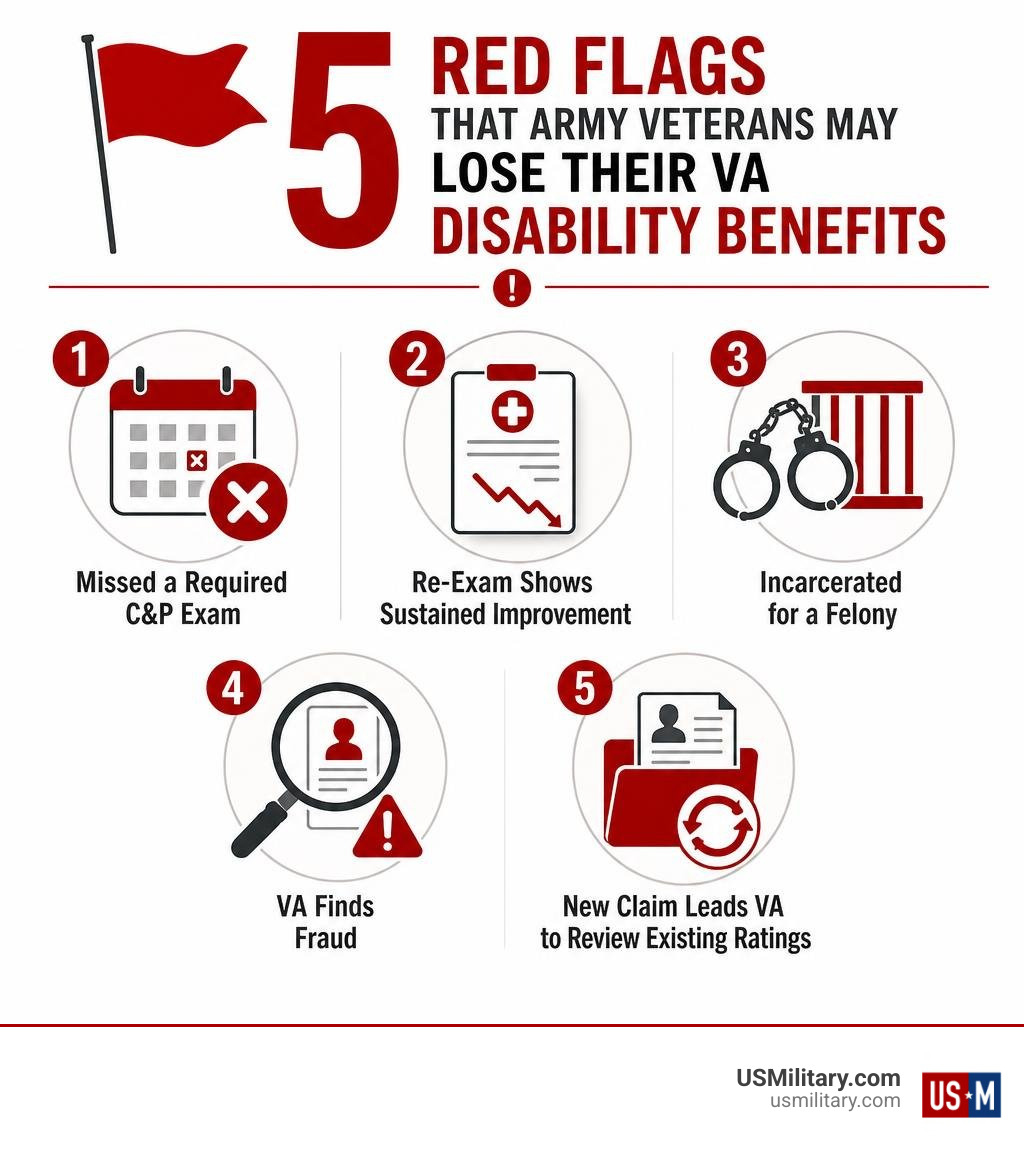
5 Red Flags That Army Veterans May Lose Their VA Disability Benefits
Receiving monthly service-connected compensation is a vital lifeline for countless soldiers who transitioned out of uniform. Yet, contrary to a common myth, these monthly payments are not an untouched lifetime subscription unless you stay on top of the administrative requirements.
Understanding what VA disability compensation benefits entail also means knowing what keeps them secure. The Department of Veterans Affairs operates under strict legal mandates. When procedural non-compliance or significant life events occur, the system generates red flags that lead directly to pre-termination or proposed reduction notices.

To help keep your hard-earned financial support intact, here is how to maintain your VA disability rating in 5 easy to follow steps, starting with the five major triggers that cause rating reductions or total benefit terminations.
Why Missing C&P Exams Counts Among the 5 Red Flags That Army Veterans May Lose Their VA Disability Benefits
One of the fastest ways an Army veteran can trigger a benefit reduction is by simply failing to show up for a scheduled Compensation and Pension (C&P) exam. When the VA orders a re-examination to evaluate the current severity of a condition, your attendance is mandatory unless you establish “good cause” for absence.
If an appointment is missed without notifying the contractor or regional office beforehand, the VA assumes your condition has improved or that you are unwilling to cooperate. This administrative failure allows the VA to issue a pre-determination notice to lower or completely terminate payments for that specific condition.
You May Be Able To Increase Your VA Disability Pay. Talk With An Expert. Free Call. Click Here.
If scheduling conflicts, illness, or transportation issues arise:
- Contact the VA or the contracted examination provider immediately to reschedule.
- Submit a formal written “good cause” statement explaining why the appointment was missed.
- Request a pre-determination hearing within 30 days if a reduction proposal has already arrived in your mailbox.
Demonstrating Sustained Medical Improvement During Re-examinations
Unless a disability is categorized as permanent, the VA frequently schedules routine future exams (often set at two- to five-year intervals). If a medical review documents clear, material progress across your everyday life, the VA may initiate a rating reduction.
However, the VA cannot legally cut a rating based on a single temporary good day. Under federal law, the agency must review your complete medical history and demonstrate sustained improvement under the ordinary conditions of life and employment. Our VA lowers disability rating complete guide outlines how to defend your medical record against unjustified downward adjustments.
| Evaluation Category | Action Trigger | Standard of Proof Required | Veteran Recourse Window |
|---|---|---|---|
| Routine Future Exam (RFE) | Scheduled check on non-static conditions | Documented material, sustained improvement | 60 days to submit new evidence; 30 days for hearing |
| Rating Reduction Proposal | Medical progress or missed C&P exam | Preponderance of medical evidence showing daily improvement | 60-day response window before final decision takes effect |
| Severance of Service Connection | Clear and unmistakable error (CUE) or fraud | Irrefutable proof condition was never service-connected | Full appellate review; mandatory procedural hearing |
Incarceration and Criminal Records: 5 Red Flags That Army Veterans May Lose Their VA Disability Benefits
A serious legal misstep can directly impact your monthly compensation checks. Federal law requires the VA to reduce disability compensation for veterans incarcerated following a felony conviction.

The key legal rules governing criminal records and benefits include:
- The 60-Day Incarceration Rule: Compensation remains normal for the first 60 days of post-conviction incarceration. Payments are reduced beginning on the 61st day.
- The 10% Payment Cap: Veterans rated 20% or higher have their compensation capped at the 10% disability rate. Veterans with a 10% rating have their monthly payment halved to 5%.
- Fugitive Felon Status: Veterans with active felony warrants face an immediate and total suspension of all VA benefits until the warrant is cleared.
- Dependent Apportionment: An incarcerated veteran can request that their withheld compensation be apportioned to their spouse, children, or dependent parents to prevent family hardship.
Once released from prison or transferred to a halfway house, benefits do not automatically revert back; the veteran must promptly notify the VA with official release paperwork.
Overlooking Separation Pay Recoupment and Double-Dipping Rules
Many soldiers who exited the military received separation pay, severance pay, or early retirement incentives. By federal statute, a veteran cannot receive both separation pay and VA disability compensation for the exact same period of service without an offset.
When a veteran applies for disability compensation years or decades later, the VA conducts an audit. If separation pay was never recouped, the VA will withhold monthly disability checks until the entire separation amount is fully repaid. Thousands of veterans face surprise benefit freezes every year due to this statutory recoupment rule. Fully disclosing past separation payments on all VA documentation helps prevent sudden debt notices.
Filing Unprepared New Claims That Trigger File Re-evaluations
Filing for a secondary condition or requesting a rating increase can be a great way to ensure you receive proper compensation. However, submitting an unprepared claim opens your entire claims file to scrutiny.
When you ask the VA to look at a new issue—such as sleep apnea secondary to PTSD or knee pain secondary to back trauma—the rating officer has the authority to review all your existing service-connected disabilities. If your medical records do not strongly support your current percentages, you run the risk of having an existing rating reduced while trying to gain a new one. Reviewing a VA disability rating increase expert guide prior to filing ensures your medical evidence is ironclad.
Protected Rating Rules That Safeguard Your Compensation
The VA disability system includes statutory safeguards designed to protect disabled veterans from arbitrary cuts. These rules establish higher burdens of proof on the VA the longer a rating remains in effect.
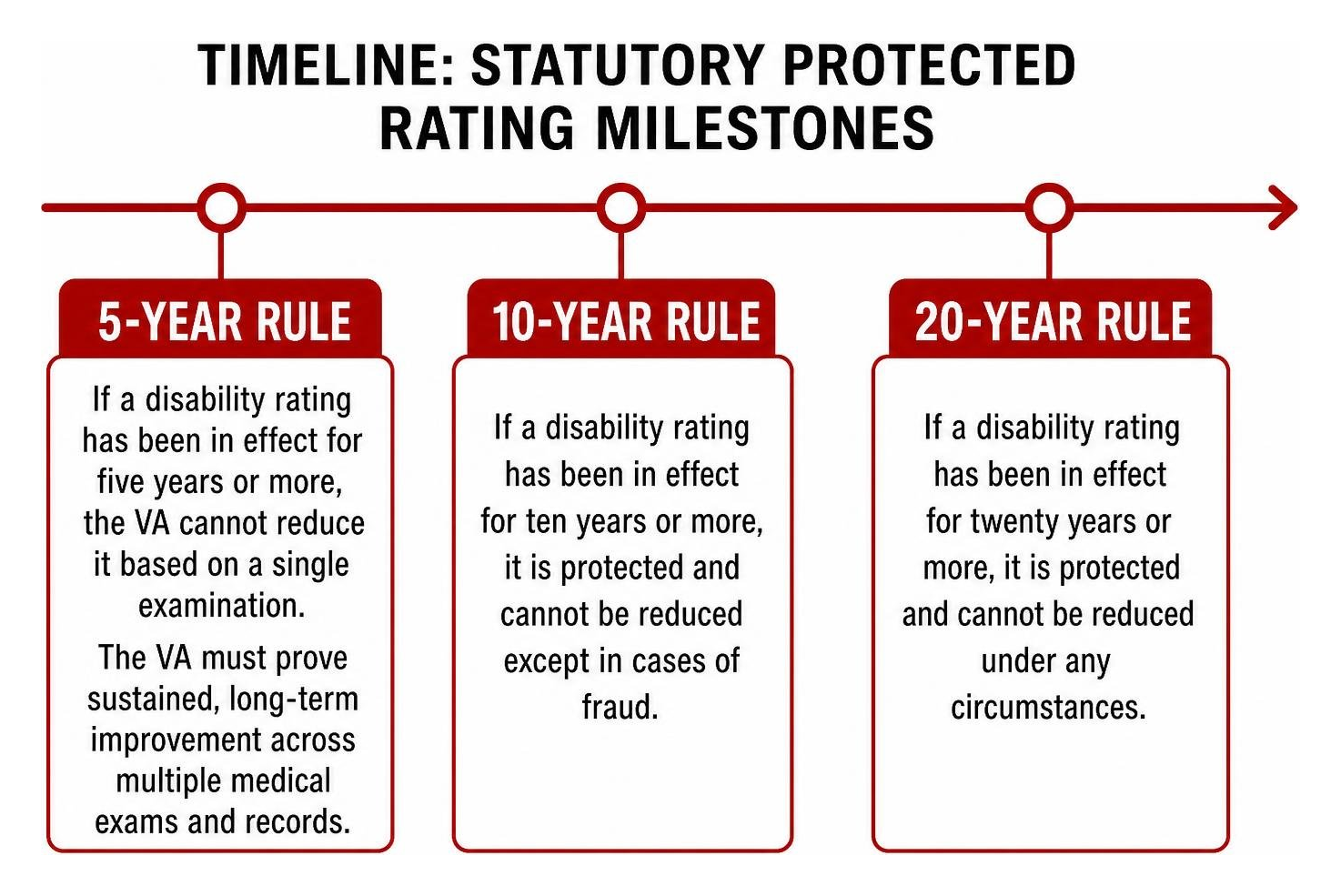
Understanding the 5-Year, 10-Year, and 20-Year Rules
These three milestones represent the most critical legal protections in the veteran benefits code:
- The 5-Year Rule: If a disability rating has been in effect for five years or more, the VA cannot reduce it based on a single examination. The VA must prove sustained, long-term improvement across multiple medical exams and records. Read everything you need to know about the 5-year rule for VA disability to understand how this evidentiary standard works.
- The 10-Year Rule: Once a service connection has been established for ten consecutive years, the VA cannot sever service connection unless there is clear proof of original fraud or lack of military service. The rating percentage itself can still be adjusted if the condition improves, but the service-connected status is locked.
- The 20-Year Rule (Continuous Rating): If a condition has been rated at or above a specific percentage for twenty consecutive years, that rating cannot be reduced below that level for any reason other than fraud.
The 100% P&T and Age 55 Exceptions
In addition to the time-based rules, specific status categories protect veterans from future routine re-examinations:
- Permanent and Total (P&T) Status: Veterans granted 100% P&T or Total Disability Individual Unemployability (TDIU) marked permanent are exempt from routine future examinations. Their conditions are classified as static.
- The Age 55 Exemption: The VA generally ceases scheduling routine future medical re-examinations once a veteran turns 55 years old, except in rare circumstances or where mandated by specific diagnostic codes (such as active malignancies).
If you receive an unexpected reduction proposal despite meeting these criteria, discovering how to turn your VA denial into a winning appeal will help you challenge the agency’s procedural errors.
How Relocation and State Benefit Changes Impact Disabled Army Veterans
Federal VA disability payments remain identical regardless of which state you live in. However, state-level benefits tied to your VA rating vary widely across state lines. Moving out of state can instantly forfeit valuable local perks.
Texas Property Tax Exemptions and the Hazlewood Act
Texas provides some of the most comprehensive state veteran benefits in the country, but they require active Texas residency:
- Homestead Property Tax Exemptions: Veterans with a 100% P&T disability rating receive a complete 100% property tax exemption on their primary homestead. Partially disabled veterans receive tiered deductions ($5,000 deduction for 10–29% ratings; $7,500 for 30–49%; $10,000 for 50–69%; and $12,000 for 70–99%).
- The Hazlewood Act: This state benefit provides up to 150 credit hours of tuition-free education at public Texas colleges. Qualifying veterans can also transfer unused hours to dependent children through the Hazlewood Legacy program.
Leaving Texas permanently means immediate forfeiture of these tax exemptions and tuition transfers.
Safeguarding State-Level Disabled Veteran Advantages
When relocating, Army veterans must take proactive administrative steps:
- Notify your local County Appraisal District immediately when selling a primary residence to avoid retroactive tax reassessments.
- Check the veteran benefits offered in your new state, such as disabled veteran license plate privileges, state park fee waivers, and state-funded veteran home programs.
- Update your physical and mailing address with the VA promptly so critical re-examination notices and official letters are never lost in transit.
Frequently Asked Questions About Losing VA Disability Compensation
Can the VA reduce benefits without advance notice?
No. By law, the VA must issue a Notice of Proposed Reduction before lowering or terminating non-protected disability benefits. Veterans have a 60-day window to submit new medical records proving their condition has not improved, and a 30-day window from the date of the notice to request a formal pre-determination hearing. Monthly compensation payments remain unchanged while the hearing process is pending.
What happens to disability checks during felony incarceration?
Disability compensation is adjusted on the 61st day of incarceration following a felony conviction. Payments for veterans rated 20% or higher are capped at the standard 10% disability pay rate, while ratings of 10% are reduced to 5%. Dependents can apply for an apportionment of the withheld compensation to cover basic living expenses during the veteran’s incarceration period.
How do state benefits change if an Army veteran moves out of Texas?
While federal monthly VA disability checks follow you anywhere in the world, Texas-specific entitlements cease when you abandon state residency. You will lose your Texas homestead property tax exemption, and your dependents will lose access to unused Hazlewood Act tuition exemption hours at Texas state universities. You must establish residency in your new state and apply for whatever veteran benefits that specific state provides.
Conclusion
Guarding your service-connected compensation requires vigilance, open communication with the VA, and proactive file management. Whether it involves tracking C&P exam mailings, monitoring statutory protected milestones, or understanding the financial interplay of military separation pay, staying informed prevents devastating financial surprises.
To review current compensation figures and ensure your monthly benefit matches your rating level, consult the latest VA disability pay tables and keep your medical records up to date.