
What Are the Age Requirements for the Army & All Military Branches?

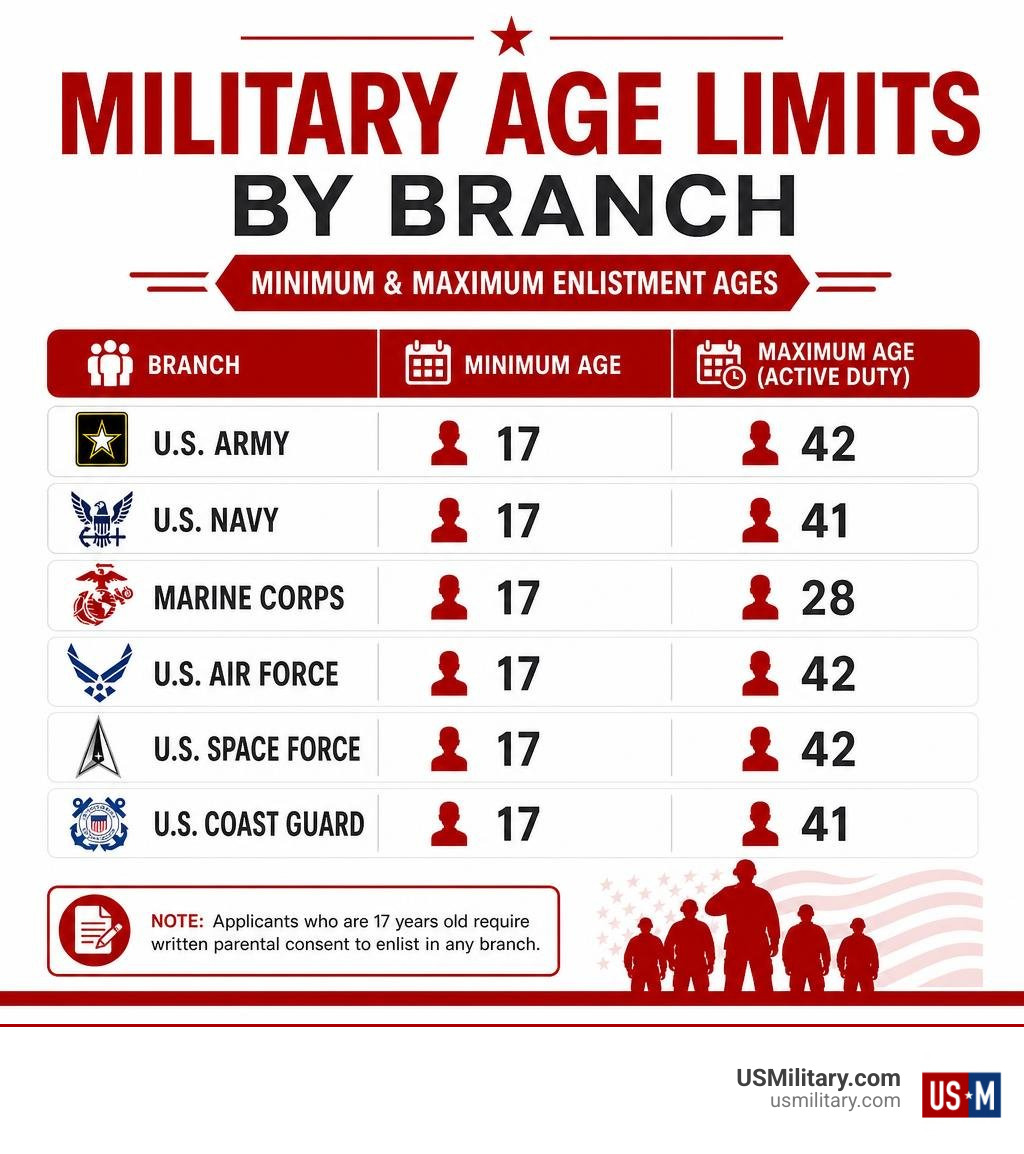
The age requirements for the Army and all military branches in the U.S. vary depending on which branch you want to join and whether you’re pursuing active duty, reserve, or guard service. Here’s a quick look at the current limits:
| Branch | Minimum Age | Maximum Age (Active Duty) |
|---|---|---|
| Army | 17 | 42 |
| Navy | 17 | 41 |
| Marine Corps | 17 | 28 |
| Air Force | 17 | 42 |
| Space Force | 17 | 42 |
| Coast Guard | 17 | 41 |
Note: Applicants who are 17 years old require written parental consent to enlist in any branch.
These numbers matter more than most people realize. Join too young, and you need a parent’s signature. Wait too long and some doors close permanently — especially for the Marine Corps, which cuts off at 28.
But age limits aren’t always the final word. Waivers exist. Prior service can adjust your eligibility. And some specialized roles push the ceiling even higher.
This guide breaks it all down so you know exactly where you stand — and what options you have if you’re cutting it close.
I’m Larry Fowler, publisher of the USArmy.com and USMilitary.com Network, and since 2007 I’ve helped hundreds of thousands of people navigate the age requirements for military branches and other enlistment criteria across every service component. Whether you’re a first-time applicant or a veteran considering reenlistment, what follows is drawn from nearly two decades of working directly with recruiters and service members across the Army, Navy, Air Force Reserve, National Guard, and Coast Guard.
Age requirements for military branches terms to know:
Federal Law and Age Requirements for Military Branches
Before we look at individual branch policies, it is helpful to understand the legal foundation that governs military service in the United States. Federal law, specifically U.S.C. Title 10 – ARMED FORCES, sets the broad boundaries for enlistment across all branches.
Under Title 10, the statutory minimum age for enlistment in the regular components of the United States military is 17, and the statutory maximum enlistment age is 42. This means that by federal statute, no military branch can accept an applicant younger than 17 or older than 42 for a standard, initial enlistment without special legal provisions.
While federal law sets the absolute ceiling at 42, the Department of Defense grants individual branches the authority to set their own lower maximum age limits based on operational needs, physical demands, and training pipelines. For example, while the Army allows enlistment up to age 42, the Marine Corps maintains a much lower maximum age of 28.
Additionally, federal law mandates that any applicant who is 17 years old must obtain written parental consent before they can formally enlist. Once an applicant turns 18, they are legally considered an adult and can sign enlistment contracts on their own. For those researching the historical and legal contexts of age limits, including draft eligibility, our guide on An Essential Guide to Military Age Limits offers a deep dive into how these laws have evolved over time.
Branch-by-Branch Breakdown of Military Age Limits
To help you compare your options, we have compiled a comprehensive breakdown of the minimum and maximum age limits for each branch of the U.S. military. These limits apply to active duty, reserve components, and the National Guard as of July 2026.
| Military Branch | Active Duty Max Age | Reserve Component Max Age | National Guard Max Age |
|---|---|---|---|
| U.S. Army | 42 | 42 | 42 |
| U.S. Navy | 41 | 41 | N/A |
| U.S. Marine Corps | 28 | 28 | N/A |
| U.S. Air Force | 42 | 42 | 42 |
| U.S. Space Force | 42 | N/A | N/A |
| U.S. Coast Guard | 41 | 40 | N/A |
Note: The Navy, Marine Corps, Space Force, and Coast Guard do not have dedicated National Guard components; those duties are handled by the Army National Guard and Air National Guard.
In recent years, several military branches have faced significant recruiting shortfalls. To combat this and expand the pool of eligible applicants, several services have actively adjusted their maximum age policies upward. This ensures that healthy, motivated older patriotic citizens have the opportunity to serve. To review the core criteria beyond age, you can consult the official Requirements to join the U.S. military | USAGov page.
Army Age Requirements for Military Branches
The United States Army is currently one of the most accessible branches for older recruits. For those seeking Army enlistment, the maximum age to join is 42 for active duty, the Army Reserve, and the Army National Guard.
This generous age ceiling of 42 was established to ensure the Army can attract mature, experienced professionals who bring valuable life skills to the force. Whether you are looking to serve full-time or part-time, the Army welcomes older applicants, provided they can meet the rigorous physical and medical standards required of all soldiers. If you are planning your enlistment path, make sure to read Joining the Army in 2026: Check the Age Requirements First to understand how this limit applies to your specific situation.
Navy and Marine Corps Age Requirements for Military Branches
The Navy and the Marine Corps take very different approaches to age limits.
For Navy enlistment, the maximum age is 41 for both active duty and the Navy Reserve. The Navy raised its maximum enlistment age in recent years to align with other services and broaden its recruiting base, allowing older individuals with technical or administrative skills to transition into naval careers. You can read more about these standards on the official Requirements to Join the Navy | Navy.com portal.
Conversely, the Marine Corps remains the strictest service regarding age. The maximum age for Marine Corps enlistment is 28 for both active duty and the Marine Corps Reserve. The Marines emphasize youth and extreme physical endurance, keeping their entry window relatively narrow. If you are approaching your late twenties and want to earn the title of Marine, you must act quickly. For a detailed breakdown of options and potential waivers, read our analysis on Can You Join the Marines in 2026? Age Requirements and Limits.
Air Force, Space Force, and Coast Guard Standards
The remaining branches have also updated their policies to maximize enlistment opportunities:
- U.S. Air Force: In a major policy shift, the Air Force raised its maximum enlistment age. The limit is now 42 for active duty, the Air Force Reserve, and the Air National Guard.
- U.S. Space Force: As the newest branch of the armed forces, the Space Force accepts enlisted recruits up to the age of 42 to secure high-tech talent in cybersecurity, engineering, and space operations.
- U.S. Coast Guard: The Coast Guard allows active-duty enlistments up to age 41, while the Coast Guard Reserve component maintains a maximum age limit of 40.
These policy changes across the Air Force, Space Force, and Coast Guard highlight a growing military-wide recognition that older recruits bring maturity, stability, and highly specialized civilian work experience to the modern battlefield.
Enlisted vs. Officer Paths and Service Academies

The age requirements for military branches can differ substantially depending on whether you choose to enlist or pursue a commission as an officer.
While enlisted personnel can join up to age 41 or 42 in most branches, officer commissioning programs generally have lower age ceilings. This is because the military expects officers to complete a full career path, which involves years of progressive leadership training and assignments.
- Direct Commissioning: For standard officer paths, the age limits vary by branch. For example, in the Army, officer candidates must generally accept their commission before reaching age 31, though waivers are common for high-demand careers.
- ROTC Programs: Reserve Officers’ Training Corps (ROTC) scholarship applicants must typically be under age 31 by the time they graduate and commission.
- Service Academies: The military service academies (such as West Point, the Naval Academy, and the Air Force Academy) have strict, non-negotiable age limits. Applicants must be at least 17 but not have passed their 23rd birthday on July 1 of the year they enter the academy.
- Warrant Officers: Warrant officer programs, which focus on technical expertise (such as Army helicopter pilots), have unique age windows. For instance, Army flight warrant officer applicants must typically submit their fast-track applications before turning 32, though non-aviation warrant roles may accept older applicants with extensive prior enlisted experience.
Understanding these distinctions is crucial when planning your career. For an in-depth analysis of how age affects your choice of service path, check out The Age Game: What You Need to Know Before You Enlist.
How to Beat the Clock: Age Waivers and Prior Service Adjustments

If you are older than the standard maximum enlistment age for your chosen branch, do not lose hope. There are two primary mechanisms that can help you “beat the clock”: age waivers and prior service adjustments.
Age Waivers
An age waiver is an official exception to policy approved by a branch’s recruiting command. The military grants these on a case-by-case basis. Your chances of securing an age waiver increase dramatically if you possess:
- Specialized Skills: The military has a constant need for healthcare professionals (doctors, nurses, dentists), chaplains, cyber specialists, and bilingual linguists. These professional fields routinely grant age waivers, sometimes allowing individuals in their late 40s or early 50s to commission.
- Outstanding Qualifications: High ASVAB scores, excellent physical fitness results, and a clean legal record make you a highly attractive candidate, making recruiters more willing to do the paperwork for a waiver.
Prior Service Adjustments
If you have previously served in the U.S. military, your prior service can be used to subtract years from your current age to meet enlistment standards. This is known as the adjusted age calculation.
For example, if you are 45 years old and have 6 years of active-duty military service, some branches will subtract those 6 years from your physical age. For enlistment eligibility purposes, your adjusted age would be 39. This puts you safely under the maximum age limit for branches like the Army, Navy, Air Force, and Coast Guard. To learn more about serving in the reserve or guard components later in life, read Beyond Active Duty: Age Limits for Joining the National Guard & Reserves.
How Age Interacts with Other Enlistment Requirements
Your age does not exist in a vacuum; it directly impacts and interacts with several other military entrance requirements. When you walk into a recruiting office, you must meet the full spectrum of eligibility criteria:
- ASVAB Testing: The Armed Services Vocational Aptitude Battery (ASVAB) measures your academic and technical aptitude. Older recruits often perform well on the ASVAB due to civilian work experience and higher education, which can make them eligible for high-tech roles that look favorably on age waivers.
- Physical Fitness and Medical Exams: Let’s be honest — basic training is physically punishing. Older recruits must pass the exact same medical screening at the Military Entrance Processing Station (MEPS) as 18-year-olds. Chronic joint issues, cardiovascular health, and past surgeries are scrutinized closely as we age.
- Citizenship Requirements: To enlist, you must be a U.S. citizen or a legal permanent resident (Green Card holder). While age limits remain the same, older non-citizens often have a more established residency history, which can streamline the background check process.
- Education Credentials: You must have a high school diploma or a GED. The military prefers a high school diploma; those with a GED may face stricter limits on enlistment slots unless they have college credits. Older applicants who have earned college degrees or professional certifications often qualify for higher initial enlistment ranks (such as E-3 or E-4).
For a complete breakdown of how these factors combine to determine your eligibility, read the official guide on Military Requirements for Joining.
Frequently Asked Questions About Military Age Limits
Can I join the military at age 40?
Yes! You can absolutely join the military at age 40. The Army, Navy, Air Force, Space Force, and Coast Guard all have maximum age limits of 41 or 42, making you fully eligible for enlistment. Only the Marine Corps (cutoff at 28) is closed to you without an exceptional waiver. If you are curious about draft laws and older age groups, check out Can You Be Drafted at Age 40?.
What is the absolute oldest age you can enlist?
Under federal law, the absolute maximum age to enlist in the regular military components is 42. However, certain professional direct commissions (such as military doctors or chaplains) can bypass this limit via specialized age waivers, sometimes allowing entry up to age 48 or older. For more details on these cutoffs, read Age Limit to Join the Military.
How does prior service affect the maximum age limit?
Prior service allows you to subtract your years of active service from your physical age. This adjusted age is then compared against the branch’s maximum enlistment age, allowing many veterans in their 40s to re-enter military service.
Conclusion
Navigating the age requirements for military branches is the first step toward a rewarding career of service. Whether you are a 17-year-old seeking parental consent or a 40-year-old professional looking for a meaningful second career, the doors to the U.S. military are open wider today than they have been in decades.
Do not let your birthday hold you back. If you are close to the age limit or need advice on securing an age waiver, your next step is to speak directly with a local recruiter. They can look at your health, education, and skills to help you construct a winning application.
For detailed steps on preparing your application, check out our comprehensive USMilitary.com Army Requirements Guide and let us help you launch your military journey today!