

Are Suicides a Growing Concern In Navy and Army Special Forces Communities — yes, and the data makes that clear.
Quick Answer:
- Suicide is now the second-leading cause of death among U.S. military personnel
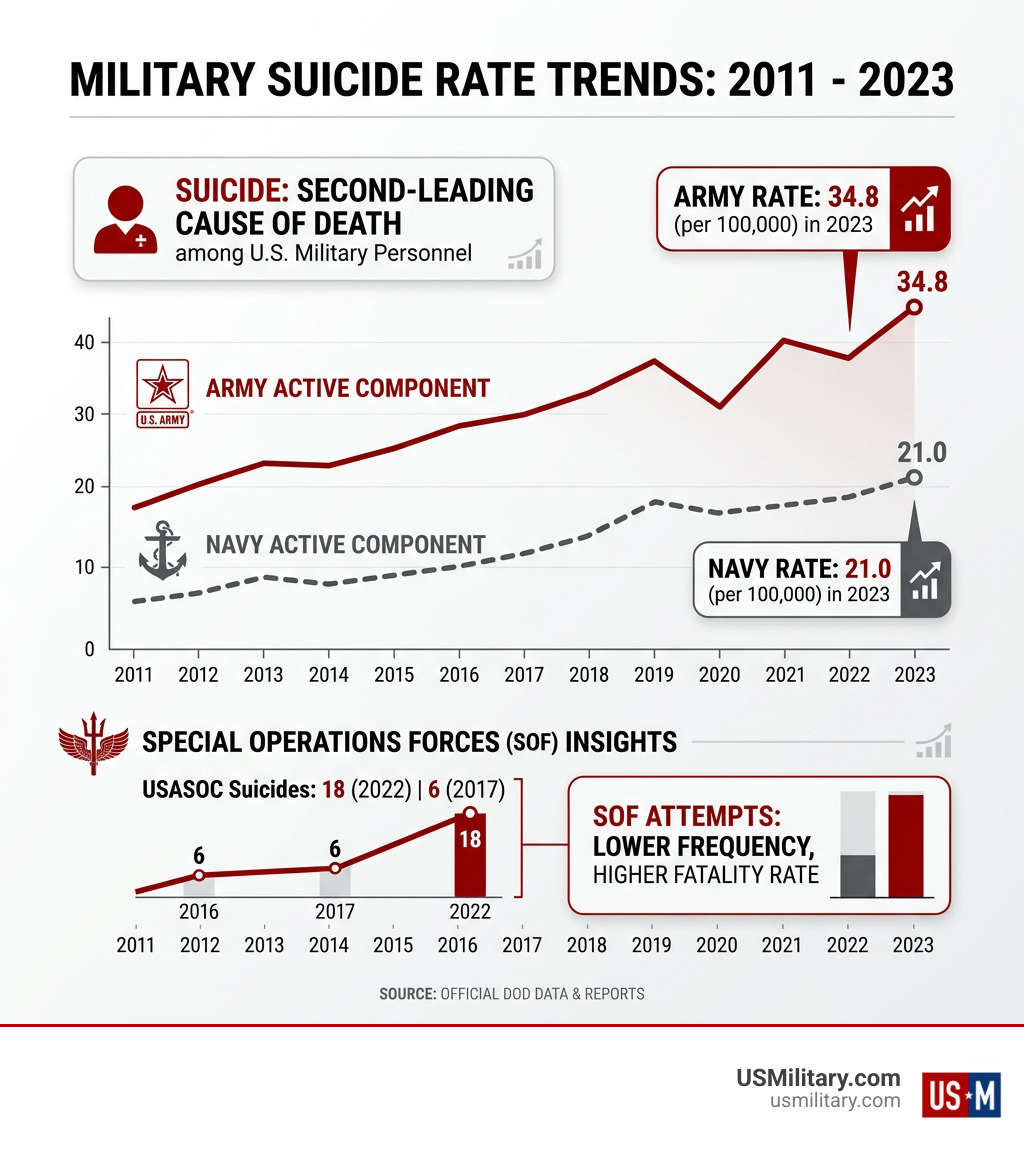
- The Army Active Component rate hit 34.8 per 100,000 in 2023 — up from 28.9 in 2022
- The Navy Active Component rate rose to 21.0 per 100,000 in 2023
- Active Component rates have gradually increased from 2011 to 2023 across all services
- Army Special Operations Command recorded 18 suicides in 2022, up from just 6 in 2017
- SOF operators attempt suicide less often than regular soldiers — but their attempts are far more likely to be fatal
Since 2001, more than 30,000 active duty personnel and post-9/11 veterans have died by suicide. That’s more than four times the roughly 7,000 killed in combat over the same period. In Special Forces communities, the picture is even more complex — elite operators face unique pressures that make this crisis harder to see and harder to stop.
I’m Larry Fowler, publisher of USMilitary.com since 2007, and I’ve spent nearly two decades tracking trends that affect active service members and veterans — including the growing alarm over Are Suicides a Growing Concern In Navy and Army Special Forces Communities. Understanding this issue is clear for anyone connected to military life, whether you’re serving, enlisting, or supporting someone who is.
Quick look at Are Suicides a Growing Concern In Navy and Army Special Forces Communities:
- Navy SEALs
- Navy SEAL Training
- SEAL Team Six
When we look at the hard numbers, it is impossible to ignore that Are Suicides a Growing Concern In Navy and Army Special Forces Communities. In the 2023 calendar year, the Army Active Component suicide rate climbed to 34.8 per 100,000, representing 158 tragic deaths. This is a significant jump from the 28.9 per 100,000 recorded only a year prior.
The Navy has seen similar upward pressure. In 2023, the Navy Active Component rate reached 21.0 per 100,000, continuing a gradual increase from previous years. When we step back and look at the long-term data from 2011 to 2023, the trend line for the Active Component across all services shows a statistically significant rise.

According to the Annual Report on Suicide in the Military CY 2023, there were 523 total force suicides in 2023. While the numbers fluctuate year to year, the decade-long climb tells us that the stressors facing our modern force are not going away. The demographic most affected remains young, enlisted males under the age of 30, who account for roughly 61% of these deaths. However, within the elite echelons of the Army Special Forces (Green Berets) and Navy SEALs, the “why” behind these numbers often differs from the general population.
Unique Risks Facing Navy SEALs and Army Special Forces
Special Operations Forces (SOF) are the tip of the spear. They undergo the most rigorous selection processes in the world, designed to weed out anyone who isn’t mentally and physically “bulletproof.” Ironically, this very selection process creates a unique set of risks when it comes to mental health.
One of the most startling findings in recent years involves the “lethality” of attempts. Research on Suicidal Behavior in US Army Special Operations Forces indicates that while SOF operators are actually 70% to 90% less likely to report suicidal ideation or make non-fatal attempts than regular soldiers, their death rates are nearly identical.
This is because when an elite operator decides to act, they are often more “successful” in their attempt. The attempt-to-death ratio for regular soldiers is about 15:1. For SOF operators, it is a staggering 2:1. They are trained to be efficient, they have high access to firearms, and they are psychologically conditioned to push through pain and fear—traits that are life-saving in combat but incredibly dangerous during a mental health crisis.
Other unique risks include:
- Traumatic Brain Injury (TBI): Some reports suggest up to 85% of Special Forces operators experience TBI from training alone, often due to “breaching” (using explosives to enter buildings) or firing heavy weaponry.
- Identity Loss: For a SEAL or a Green Beret, being an operator isn’t just a job; it is their entire identity.
- The “Flashlight Battery” Effect: Some advocates argue that elite soldiers are treated like high-performance batteries—used until they are drained and then discarded into a VA system that may not understand their specific trauma.
Why Suicides are a Growing Concern In Navy and Army Special Forces Communities Post-Separation
The transition from elite service to civilian life is where many of our “quiet professionals” struggle the most. Using Maslow’s hierarchy of needs as a guide, we can see that SOF units provide an intense sense of belonging and esteem. When that is removed—especially through involuntary discharge or medical retirement—it creates a “fractured brotherhood.”
Loneliness is one of the strongest predictors of suicidal ideation. When an operator leaves the unit, they lose the only group of people who truly understand what they have been through. This community severance leads to high PHQ-9 scores (a measure of depression) and a profound sense of moral injury. They may feel they have lost their purpose, leading to a psychological void that civilian life struggles to fill.
Identifying Risk Factors and Warning Signs in Elite Units
Identifying who is at risk in a community that prides itself on “suffering in silence” is a massive challenge. We have to look past the surface-level toughness to see the underlying stressors.
Key risk factors identified in the research include:
- Firearm Access: Over 90% of military suicides among males under 35 involve a firearm. In SOF communities, firearms are a constant presence.
- Relationship Stressors: 44% of service members who died by suicide experienced relationship problems in the weeks or months prior.
- Commander Influence: In some cases, commanders may inadvertently pressure embedded mental health providers to keep soldiers “deployable,” leading to minimized diagnoses.
- Stigma: The fear of being “long-tabbed” or losing a security clearance prevents many from seeking help.
We also see specific risks for female operators. While they make up a small portion of the SOF community, research shows they face 7.4 times higher odds of suicide attempts than their male counterparts, likely due to the added pressures of isolation and sex-based bias in high-stress roles. For more info about the impact of suicide on military members, we must look at how these internal pressures boil over.
Warning Signs that Suicides are a Growing Concern In Navy and Army Special Forces Communities
Warning signs in elite units can be subtle. Because these individuals are trained to hide weakness, we have to look for changes in behavior rather than overt cries for help:
- Insomnia and Agitation: Chronic lack of sleep is a major red flag.
- Burdensomeness: Making comments like “the team would be better off without me.”
- Hopelessness: A belief that things will never change, regardless of the mission’s outcome.
- Withdrawal: Pulling away from the “team room” culture or social gatherings.
- Preparatory Behaviors: Giving away prized gear or cleaning and organizing personal affairs unexpectedly.
Prevention Strategies and Ongoing DoD Initiatives
The Department of Defense (DoD) is not sitting idly by. We are seeing a massive shift in how the military approaches suicide prevention, moving from “check-the-box” online training to evidence-based clinical interventions.
One of the most effective tools we have is Brief Cognitive Behavioral Therapy (CBT). Research shows that suicide-focused CBT can reduce future attempts by up to 50%. The DoD is also leaning heavily into Lethal Means Safety. This isn’t about taking guns away; it’s about putting “time and space” between a suicidal thought and a lethal action through the use of gun locks and secure storage.
Other vital initiatives include:
- The Brandon Act: This allows service members to seek mental health evaluations confidentially and outside their immediate chain of command.
- SafeTalk Training: Empowering peers to recognize warning signs and connect their teammates to professional help.
- USO Warrior Centers: These centers provide therapeutic environments—including art, music, and animal therapy—for wounded and ill service members.
- SPRIRC Recommendations: The Suicide Prevention and Response Independent Review Committee has laid out 83 actions, including improving schedule predictability and hiring more mental health professionals.
We also encourage following the CDC strategies to prevent suicide, which emphasize creating protective environments and promoting social connectedness.
Frequently Asked Questions about Military Suicide
How do military suicide rates compare to the civilian population?
When adjusted for age and sex, military suicide rates are generally higher than the civilian population. While the raw numbers might look similar, the military population is overwhelmingly young and male—the two groups at the highest risk for suicide. Additionally, military personnel use firearms in their attempts at a much higher rate (over 65%) than civilians (around 50%), leading to higher death counts even if the number of “attempts” is similar.
Does combat exposure directly cause higher suicide rates?
This is a common myth. In reality, less than half of military personnel who die by suicide have ever been deployed to a combat zone. While combat exposure can contribute to PTSD and depression, the primary drivers of suicide are often found in “home station” stressors: relationship failures, financial legal troubles, and a sense of isolation. Combat is a factor, but it is rarely the only factor.
Will seeking mental health treatment hurt a Special Forces career?
Statistically, the answer is no. Over 95% of military personnel who voluntarily seek mental health treatment experience no negative impact on their career, promotions, or security clearances. In fact, seeking help early is often seen as a sign of “tactical maturity.” The real career-killer is waiting until a crisis occurs, which can lead to administrative or legal issues that do impact your standing in the unit.
Conclusion
At USMilitary.com, we believe that the strength of our military lies not just in our weaponry, but in our people. The fact that Are Suicides a Growing Concern In Navy and Army Special Forces Communities is a reality we must face with radical transparency and a commitment to change.
We need a cultural transformation that prioritizes rehabilitation over punitive separation. Our elite warriors deserve a system that views help-seeking as a strength and provides a “warm handoff” when they transition back to civilian life. By fostering peer support networks and investing in restorative justice, we can ensure that those who have sacrificed so much for us are not left to fight their darkest battles alone.
For those looking to understand more about the elite paths our sailors take, you can find more info about Navy SEALs career paths on our site. If you or someone you know is struggling, please dial 988 and press 1 to reach the Military Crisis Line. You matter, and help is available.