
What You Need to Know About Army Basic Training Camp Locations
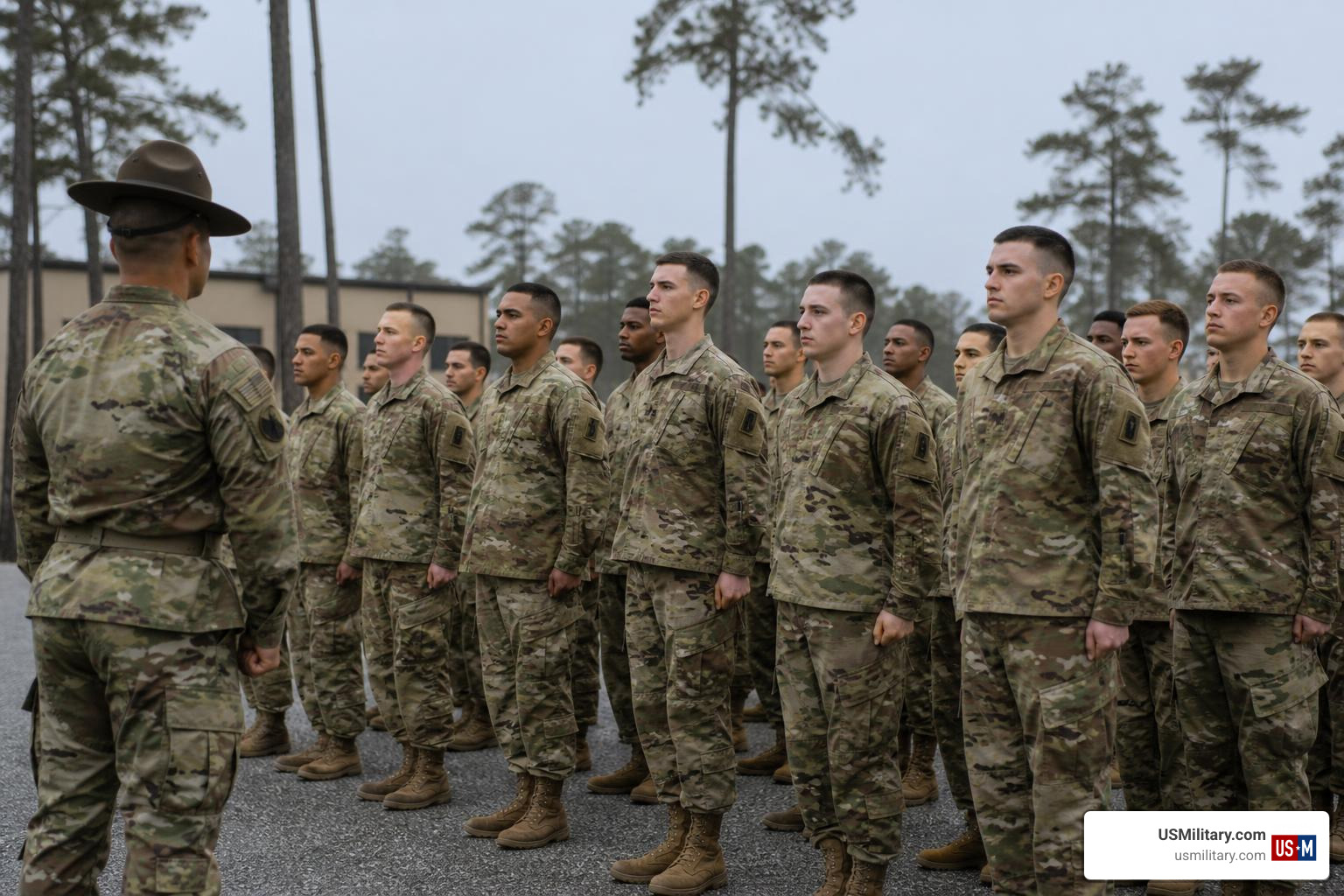
The U.S. Army conducts army basic training camp training at four locations across the country:
| Installation | Location | Notable Role |
|---|---|---|
| Fort Moore (formerly Fort Benning) | Columbus, Georgia | Home of the Infantry; Armor training |
| Fort Jackson | Columbia, South Carolina | Trains ~50% of all recruits; ~60% of women |
| Fort Leonard Wood | Waynesville, Missouri | Chemical, Military Police, Engineer training |
| Fort Sill | Lawton, Oklahoma | Field Artillery; Air Defense Artillery |
All four sites run the same 10-week Basic Combat Training (BCT) program. Your assignment depends on your Military Occupational Specialty (MOS) — not personal preference.
Army basic training is the first real test of whether you have what it takes to serve. It pushes you physically, mentally, and emotionally — all before you ever set foot in your actual Army job. Whether you’re weighing enlistment options or trying to figure out where you’ll spend your first ten weeks in uniform, knowing where training happens and why it matters is a smart first step.
I’m Larry Fowler, publisher of the USMilitary.com Network since 2007 and a longtime resource for recruits navigating army basic training camp locations and military career decisions. My network has connected hundreds of thousands of service members with the information they need to make confident choices about their military journey.
The Four Primary Army Basic Training Camp Locations

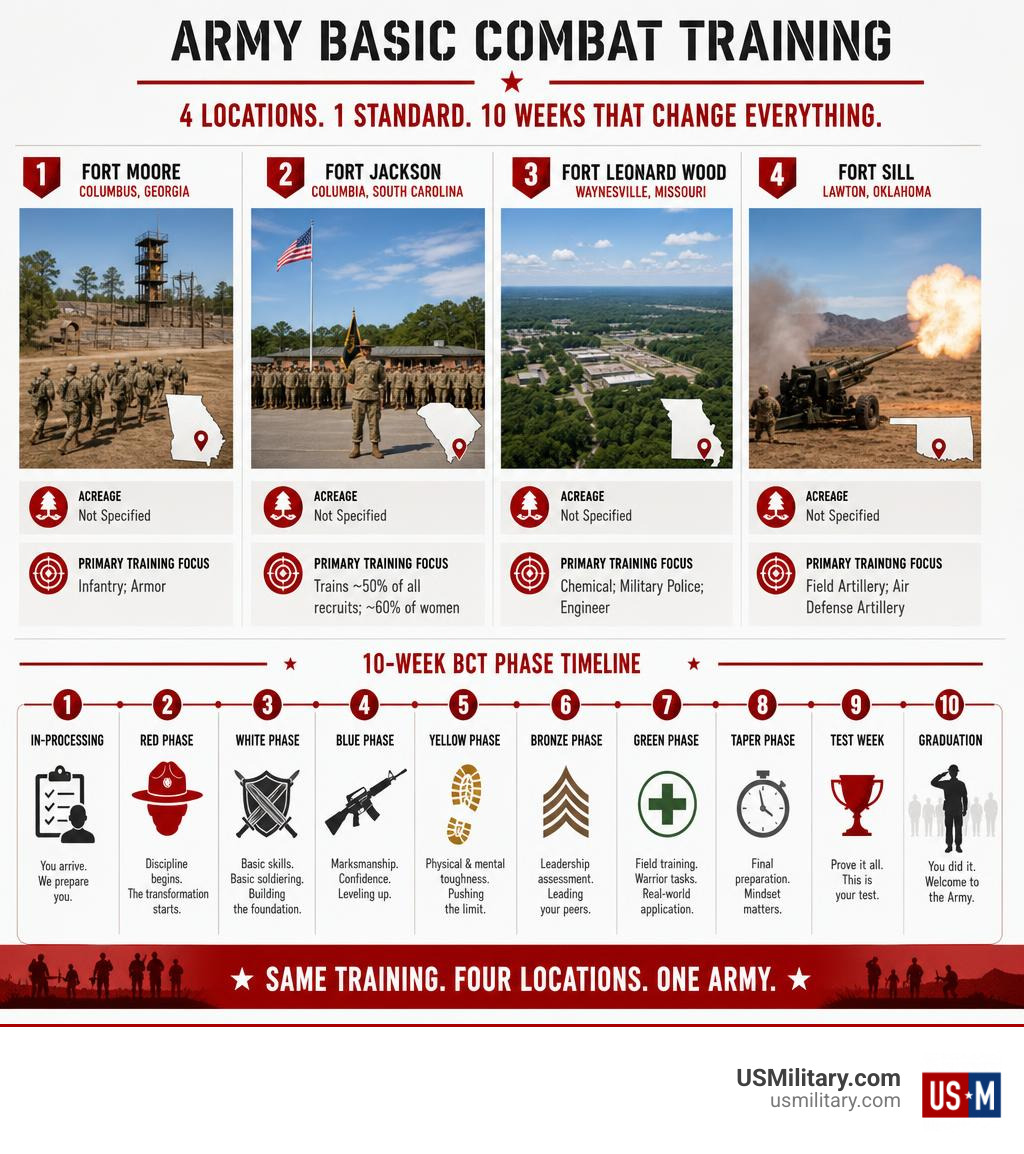
As of May 2026, the Army uses four primary Basic Combat Training locations in the United States:
- Fort Moore, Georgia
- Fort Jackson, South Carolina
- Fort Leonard Wood, Missouri
- Fort Sill, Oklahoma
These are the main army basic training camp locations for enlisted Soldiers entering the Army, Army Reserve, and Army National Guard. The curriculum is standardized across the Army, meaning a recruit at Fort Sill is expected to meet the same core graduation standards as a recruit at Fort Jackson or Fort Leonard Wood.
That said, each installation has its own climate, history, training environment, and follow-on schools. Those differences are often what make one location feel more difficult than another.
For a broad overview of Army basic training history and structure, the United States Army Basic Training – Wikipedia page gives useful background, but we will keep this guide focused on what recruits and families actually need to know.
| BCT Location | State | Known For | Approx. Size | Common Training Connection |
|---|---|---|---|---|
| Fort Moore | Georgia | Infantry, Armor, Maneuver Center of Excellence | 182,000+ acres | Infantry and Armor OSUT |
| Fort Jackson | South Carolina | Largest BCT production center | About 53,000 acres | High volume of new Soldiers |
| Fort Leonard Wood | Missouri | Engineers, Military Police, Chemical Corps | 63,000 acres | MP, Engineer, CBRN training |
| Fort Sill | Oklahoma | Field Artillery and Air Defense Artillery | 93,633 acres | Fires training pipeline |
Fort Moore, Georgia (Formerly Fort Benning)
Fort Moore, still widely recognized by many as Fort Benning, sits near Columbus, Georgia, along the Georgia-Alabama border. It is closely associated with the Infantry, Armor, and the broader Maneuver Center of Excellence.
This installation is massive: more than 182,000 acres. It supports a large military community and trains thousands of Soldiers across Initial Military Training, functional courses, and advanced Army schools. Its official installation information is available through the Army at Agencies & Services.
Fort Moore is often the location people think of when they imagine the “hardest” Army training because of its combat arms reputation. Infantry and Armor trainees may complete One Station Unit Training here, which combines basic training and job training into one longer course.
Key points:
- Location: Columbus, Georgia area
- Known for: Infantry, Armor, Airborne, Ranger-related training culture
- Climate: Hot and humid summers
- Common perception: Tough because of combat arms training
- Reality: BCT standards are still Army-wide and standardized
If your MOS is Infantry or Armor, Fort Moore is especially important because your training path may not stop after 10 weeks of BCT. You may remain there for OSUT.
Fort Jackson, South Carolina
Fort Jackson is located in Columbia, South Carolina, and is often described as the Army’s largest and most active Initial Entry Training center.
It trains a huge share of new Soldiers. Research from official installation information shows Fort Jackson trains roughly half of all Soldiers entering the Army each year and more than 60 percent of women entering the Army. That makes it one of the most common destinations for recruits and families searching for army basic training camp locations.
Fort Jackson is not “easy.” Let’s get that out of the way. It may have a reputation as being less combat-arms focused than Fort Moore, but recruits still complete physical training, marksmanship, field training, tactical movement, drill and ceremony, classroom instruction, and graduation requirements.
Key points:
- Location: Columbia, South Carolina
- Known for: High-volume Basic Combat Training
- Trains: Roughly 50 percent of Army recruits and more than 60 percent of women entering the Army
- Climate: Hot and humid summers, mild to cool winters
- Common perception: More administrative or support MOS-heavy
- Reality: Same BCT standards as every other location
Fort Jackson is where many Soldiers begin their Army story, especially those whose follow-on Advanced Individual Training is at another installation.
Fort Leonard Wood, Missouri
Fort Leonard Wood is located near Waynesville, Missouri, in the Ozarks. The installation covers about 63,000 acres and is known for three major Army communities:
- Engineer
- Military Police
- Chemical, Biological, Radiological, and Nuclear, often called CBRN
This location can surprise recruits. Missouri weather can be unforgiving. Summers can be hot and humid, while winters can be cold, icy, and windy. If you train at Fort Leonard Wood, your toughest opponent may not be your drill sergeant. It may be Missouri mud.
Fort Leonard Wood is also a major AIT location. That means some Soldiers complete BCT and then move directly into their job training on the same installation.
Key points:
- Location: Waynesville, Missouri
- Known for: Engineers, Military Police, Chemical Corps
- Size: About 63,000 acres
- Climate: Four-season weather with cold winters
- Common perception: Physically challenging terrain and weather
- Reality: Same Army BCT curriculum, with strong MOS school connections
In recent years, the Army has also expanded training capacity at Fort Leonard Wood and Fort Sill. According to reporting on Army training capacity, Fort Sill and Fort Leonard Wood to add 4 basic training companies, the Army planned additional companies to help meet recruiting and training demand.
Fort Sill, Oklahoma
Fort Sill is located in Lawton, Oklahoma, and covers about 93,633 acres. It is best known as the home of Field Artillery and Air Defense Artillery.
If Fort Leonard Wood has mud, Fort Sill has wind. Oklahoma weather can shift quickly. Recruits may deal with heat, cold, wind, storms, and wide-open training areas. It is a strong location for Soldiers entering artillery-related career fields, though not every recruit at Fort Sill is headed into artillery.
Key points:
- Location: Lawton, Oklahoma
- Known for: Field Artillery and Air Defense Artillery
- Size: 93,633 acres
- Climate: Hot summers, windy conditions, variable weather
- Common perception: Demanding because of weather and open terrain
- Reality: Same 10-week BCT model as the other locations
Fort Sill remains a major Army training post and continues to support both Basic Combat Training and follow-on schools for the Fires community.
How the Army Assigns Your Training Site

The Army does not assign basic training locations randomly, but it also does not let most recruits simply pick their favorite spot. Your training site is usually determined by a combination of:
- Your MOS
- Whether your MOS uses OSUT
- Where your AIT is located
- Available training seats
- Gender-integrated training capacity
- Army operational needs
- Shipping date and training cycle timing
A recruiter can help you understand the likely training pipeline for your chosen job, but the final assignment comes through official Army processing. For more on preparation and requirements, see our guide to Army Boot Camp Requirements and Locations.
Can You Choose Your Army Basic Training Camp Locations?
Usually, no.
This is one of the biggest misconceptions about army basic training camp locations. Recruits generally do not get to say, “I would like Fort Jackson because my cousin lives nearby,” or “Please send me to Fort Sill because I enjoy windburn.”
The Army assigns you based on what it needs and what makes sense for your training pipeline.
However, your MOS can strongly influence where you go. For example:
- Infantry and Armor recruits are commonly tied to Fort Moore because of OSUT.
- Military Police, Engineer, and CBRN-related training often connects to Fort Leonard Wood.
- Field Artillery and Air Defense Artillery training often connects to Fort Sill.
- Many other MOS paths may begin at Fort Jackson or another BCT location before moving to AIT elsewhere.
The Army also prefers efficiency when possible. If your BCT and AIT can be located on the same post, that may reduce travel and simplify the process. But that does not mean it is guaranteed.
Gender Integration Across Army Basic Training Camp Locations
Female recruits attend Army basic training at gender-integrated training locations. Fort Jackson trains the largest share of women entering the Army, with research showing it trains more than 60 percent of female entrants each year.
Fort Leonard Wood and Fort Sill also support gender-integrated training. Fort Moore has expanded integrated training in combat arms pipelines as the Army has opened and integrated more specialties over time.
Important points for female recruits:
- Women attend the same 10-week BCT program.
- Graduation standards are Army standards, not “easier” location standards.
- Assignment still depends on MOS, training availability, and Army requirements.
- Fort Jackson is the most common location for female recruits, but it is not the only one.
The practical answer: female recruits can expect to train where the Army has the right company, MOS pipeline, and available seat.
BCT vs. OSUT: Understanding the Training Pipelines
Before you can understand your location, you need to understand your training path. Most enlisted Soldiers follow one of two pipelines:
- Basic Combat Training followed by Advanced Individual Training
- One Station Unit Training, known as OSUT
Both paths begin by turning civilians into Soldiers. The difference is what happens after the basic Soldier skills portion.
For a closer look at infantry-style training, see our article on a Day in the Life of Army Infantry Training.
The Standard 10-Week BCT Path
Most recruits attend 10 weeks of Basic Combat Training. After graduation, they move to Advanced Individual Training, or AIT, where they learn their specific Army job.
The standard path looks like this:
| Step | What Happens |
|---|---|
| Reception | In-processing, medical checks, gear issue, paperwork |
| BCT | 10 weeks of basic Soldier training |
| Graduation | Family day or graduation ceremony, depending on unit schedule |
| AIT | MOS-specific job training |
| First unit | Assignment to a permanent duty station, Reserve unit, or Guard unit |
AIT length varies widely. Some MOS schools are only several weeks. Others can last several months. Medical, technical, intelligence, language, aviation, cyber, and maintenance fields may involve longer and more specialized training.
If you want to understand what comes after the first graduation, we explain the next step here: What Comes After Military Boot Camp?.
The OSUT Path for Combat Arms
OSUT stands for One Station Unit Training. In OSUT, recruits complete basic training and job training at the same installation, often with the same drill sergeants and training company.
This is common for certain combat arms MOSs, especially Infantry and Armor at Fort Moore. Other MOSs may also use OSUT-style pipelines depending on Army policy and training structure.
The biggest difference is that OSUT does not feel like a clean break after 10 weeks. You do not graduate BCT, pack up, and move to a different AIT school in the same way most Soldiers do. Instead, training continues and becomes more MOS-specific.
OSUT may include:
- More weapons training
- Tactical movement
- Live-fire exercises
- Vehicle or platform training for Armor
- Infantry battle drills
- Longer field training events
- Continued drill sergeant supervision
In simple terms:
- BCT plus AIT: Basic training first, then job school, often at another post.
- OSUT: Basic training and job school combined at one post.
What to Expect: Phases of Army Basic Combat Training
Army Basic Combat Training is 10 weeks long, not counting every possible travel delay or administrative hold. The Army’s current model is often described in four phases:
- Yellow Phase
- Red Phase
- White Phase
- Blue Phase
You may also hear older or simplified references to Red, White, and Blue phases. Some units use terms like Hammer, Anvil, and Forge to describe major training events or progression points. The names can vary, but the goal is the same: build discipline, fitness, Soldier skills, and confidence.
For National Guard recruits, the experience is similar, though some may use split training options depending on school schedules and enlistment timing. We cover that in What to Expect at National Guard Basic Combat Training.
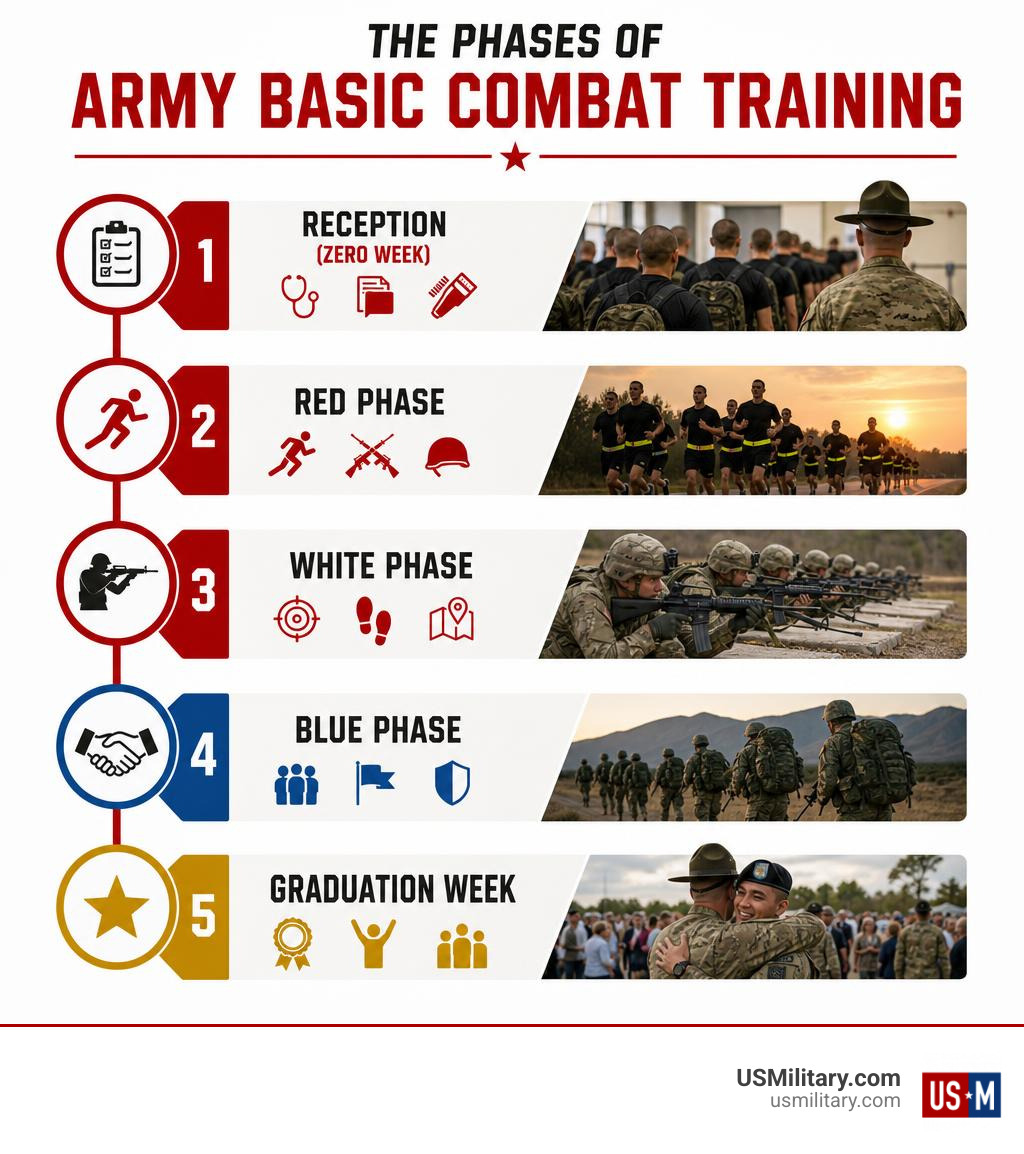
Reception Battalion (Zero Week)
Reception Battalion is the first stop. It is not the glamorous part of basic training. It is more like a military version of the DMV, a doctor’s office, a warehouse, and a haircut shop all merged into one experience.
During Reception, recruits typically complete:
- Administrative paperwork
- Medical and dental screening
- Immunizations
- Uniform issue
- Initial gear issue
- ID card and records processing
- Direct deposit setup
- Haircuts
- Initial briefings
- Waiting in lines, then waiting in different lines
Reception can last several days, though timing varies by installation and training cycle. Recruits may be tired, confused, and wondering when “real basic” starts. That is normal.
This period also introduces recruits to military rules, accountability, formations, and the reality that the Army really does care if your socks, paperwork, and water source are in the right place.
Red, White, and Blue Phases
The main training phases build on each other.
| Phase | Typical Timing | Main Focus |
|---|---|---|
| Yellow Phase | Early training period | Initial discipline, Army values, teamwork, basic movement |
| Red Phase | Early weeks | Physical conditioning, drill and ceremony, first Soldier skills |
| White Phase | Middle weeks | Marksmanship, rifle training, confidence development |
| Blue Phase | Later weeks | Tactical skills, field training, final requirements |
| Graduation Week | Week 10 | Final events, recovery, ceremonies, transition |
During these phases, recruits learn and practice:
- Army Values
- Drill and ceremony
- Physical readiness training
- Rifle marksmanship
- Weapons safety
- Land navigation
- First aid
- Tactical movement
- Field craft
- Communication basics
- Obstacle courses
- Teamwork and leadership
- CBRN confidence training
- Ruck marching
Some locations have famous events or landmarks, such as confidence courses or towers. Fort Moore, for example, is known for training culture tied to Infantry and maneuver skills. Other installations emphasize their own terrain and training areas.
The final part of BCT often includes a culminating field training exercise. Many Soldiers know this final test as The Forge. It combines fatigue, field conditions, teamwork, tactical tasks, and mental toughness. It is designed to make recruits prove they can perform under pressure.
Is Army basic training easier today than it used to be? That question comes up often. We look at that debate in Is Army Basic Training Too Easy Today?. The short version: standards, methods, and training culture change over time, but basic training is still meant to challenge you.
Frequently Asked Questions About Army Basic Training
Which Army basic training location is considered the toughest?
Fort Moore is often considered the toughest because of its Infantry and Armor reputation. Many recruits associate it with combat arms, long field days, heat, ruck marches, and a more intense training culture.
But here is the honest answer: there is no official “toughest” BCT location.
All four locations follow Army training standards. A recruit at Fort Jackson must still pass required events. A recruit at Fort Leonard Wood still has to deal with physical training, field conditions, drill sergeants, and graduation requirements. A recruit at Fort Sill still has to perform under stress.
What makes a location feel tougher can depend on:
- Weather
- Terrain
- Drill sergeant style
- Your fitness level
- Your attitude
- Your MOS pipeline
- Time of year
- Whether you are in BCT or OSUT
Examples:
- Fort Moore may feel tougher because of combat arms culture.
- Fort Leonard Wood may feel tougher in winter or muddy field conditions.
- Fort Sill may feel tougher because of heat, wind, and open terrain.
- Fort Jackson may feel tough simply because it trains so many recruits at a fast pace.
The better question is not “Which one is easiest?” The better question is “Am I prepared to meet the Army standard wherever I go?”
What happens if you fail the ACFT or basic training requirements?
The Army Combat Fitness Test, or ACFT, is a major fitness assessment. Recruits are trained and coached throughout BCT to improve. If a recruit struggles, drill sergeants and cadre usually provide additional instruction, remedial physical training, and chances to improve before graduation.
The ACFT includes events designed to test strength, power, endurance, and mobility. Recruits should arrive already training. Basic training will improve fitness, but it is not a magic reset button. Showing up out of shape makes everything harder.
If a recruit fails fitness or other graduation requirements, possible outcomes include:
- Extra coaching
- Retesting
- Remedial training
- Recycling to another training company
- Placement in a fitness-focused training environment
- Medical evaluation, if injury is involved
- Administrative separation in serious or repeated cases
Yes, it is possible to fail Army basic training. Most recruits complete it, with research commonly showing around a 90 percent completion rate, but some do not graduate with their original class. Reasons can include:
- Medical issues
- Injury
- Failure to adapt
- Repeated fitness failure
- Conduct problems
- Refusal to train
- Administrative or legal issues
A recruit separated early may receive an Entry Level Separation if they are still within the early period of service. This is not the same as retiring from the Army after a long career, obviously, and it can affect future enlistment options. Anyone facing separation should ask questions, understand the paperwork, and work through the chain of command.
Do recruits get paid during basic training?
Yes. Recruits are paid during basic training.
Pay is based on rank and time in service. Most new enlisted recruits enter as E-1, but some may enter at a higher rank based on college credits, JROTC, referrals, prior service-related programs, or enlistment incentives.
Recruits are usually paid by direct deposit on the regular military pay schedule, commonly the 1st and 15th of the month. Because processing takes time, the first payment may not feel instant. That does not mean the Army forgot about you. It means finance paperwork is doing finance paperwork things.
During basic training, recruits may also receive:
- Base pay
- Food and housing provided in training
- Uniform and equipment issue
- Medical and dental care
- Access to military benefits once eligible
Before shipping, recruits should make sure they have correct banking information, required documents, and a plan for any bills back home. Basic training is not the best place to discover your car payment is due and your password reset code goes to a phone locked in storage.
Conclusion
The Army currently conducts Basic Combat Training at four primary locations: Fort Moore, Fort Jackson, Fort Leonard Wood, and Fort Sill. While each post has its own personality, weather, terrain, and MOS connections, the core mission is the same everywhere: transform civilians into Soldiers.
You usually do not choose your basic training location. The Army assigns it based on MOS, training capacity, gender-integrated company availability, AIT location, OSUT requirements, and operational needs.
Here is the bottom line:
- There are four main Army BCT locations.
- BCT lasts 10 weeks.
- Fort Jackson trains the largest share of recruits.
- Fort Moore is strongly tied to Infantry and Armor OSUT.
- Fort Leonard Wood is known for Engineer, MP, and Chemical training.
- Fort Sill is known for Field Artillery and Air Defense Artillery.
- Female recruits train in integrated environments, with Fort Jackson handling the largest share.
- All locations follow Army standards.
- The “toughest” location is usually the one you arrive at unprepared.
At USMilitary.com, we help future Soldiers, families, veterans, and military members make sense of the process before decisions become orders. If you are preparing to enlist, start with our full guide to Army Basic Training and keep learning before you ship.
The Army will tell you where to go. Your job is to show up ready.