
What You Need to Know About Army Basic Training Locations
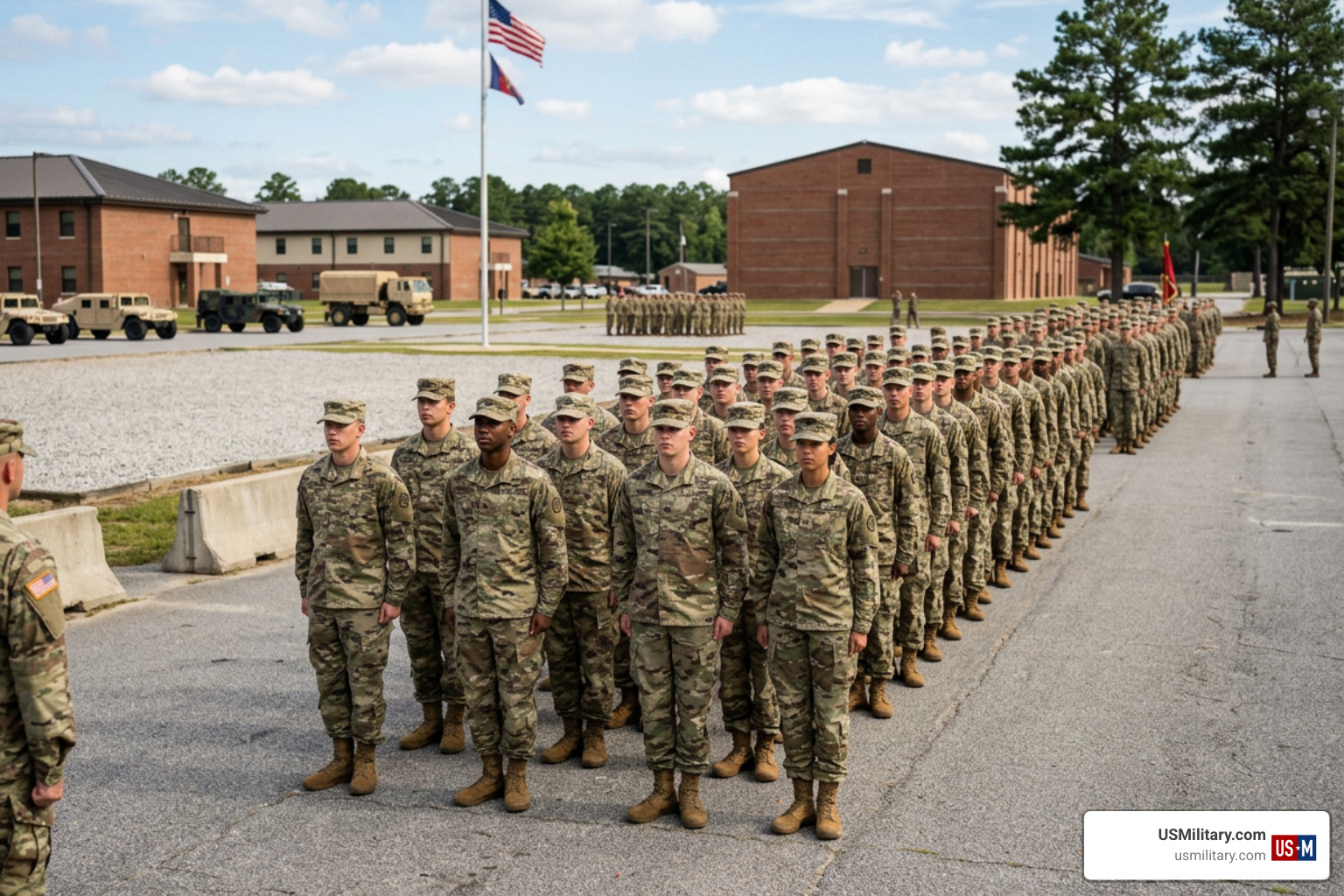
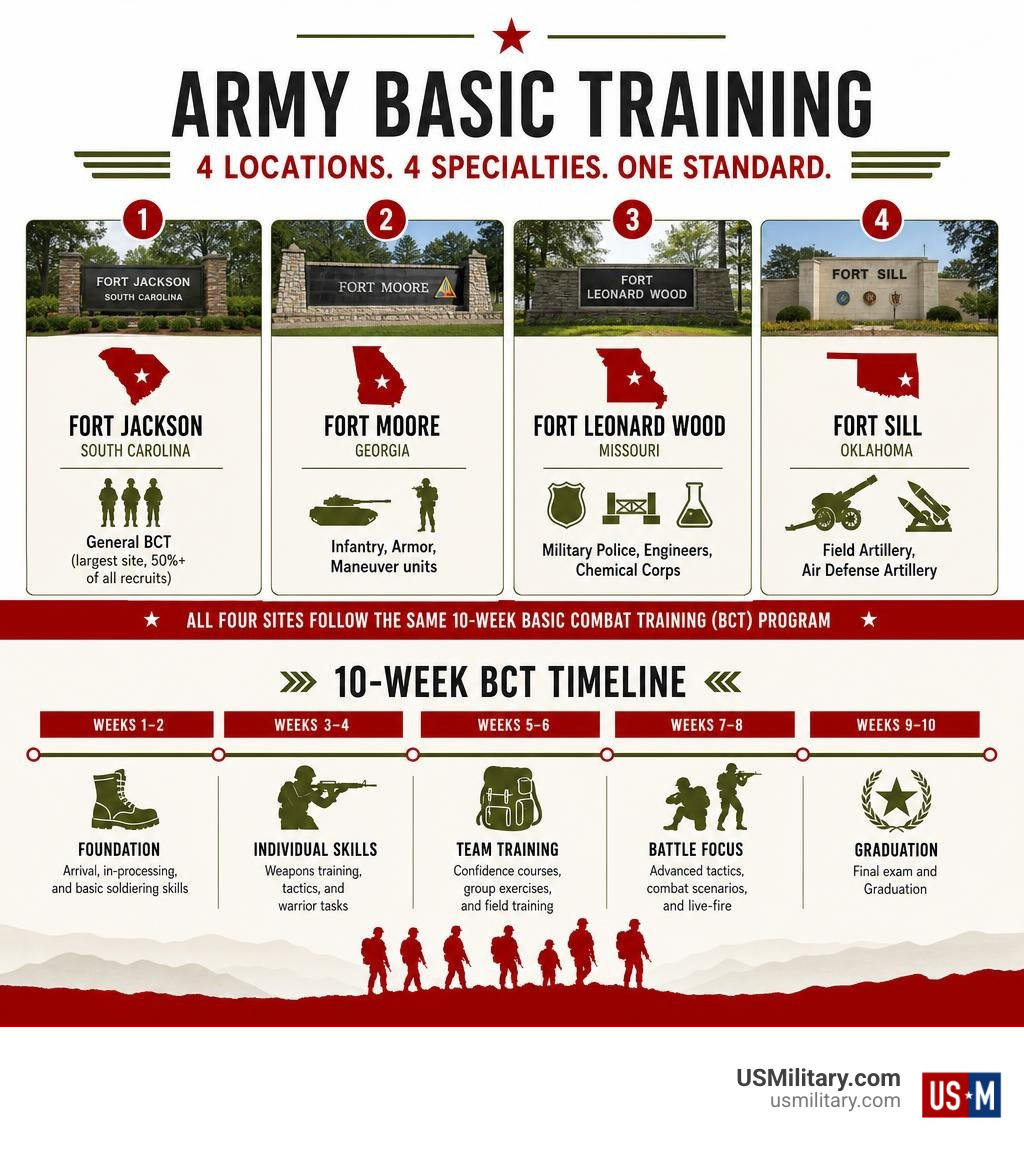
The four army basic training locations are:
| Installation | State | Primary Training Focus |
|---|---|---|
| Fort Jackson | South Carolina | General BCT (largest site, 50%+ of all recruits) |
| Fort Moore | Georgia | Infantry, Armor, Maneuver units |
| Fort Leonard Wood | Missouri | Military Police, Engineers, Chemical Corps |
| Fort Sill | Oklahoma | Field Artillery, Air Defense Artillery |
All four sites run the same 10-week Basic Combat Training (BCT) program. The Army assigns you to a location based on your Military Occupational Specialty (MOS) — you don’t get to choose.
Every year, tens of thousands of civilians report to one of these four installations to begin their transformation into U.S. Army Soldiers. It’s a process that tests you physically and mentally, starting the moment you step off the bus. About 90% of recruits who begin BCT successfully complete it — but knowing what to expect before you arrive makes a real difference.
Whether you’re weighing enlistment options or already have your ship date, understanding where you’ll train — and why you’re sent there — helps you prepare smarter.
I’m Larry Fowler, publisher of USMilitary.com, and since 2007 I’ve helped hundreds of thousands of recruits and their families navigate the enlistment process — including understanding army basic training locations and what each one means for your military career. Read on for everything you need to know before you ship out.
The Official Army Basic Training Locations
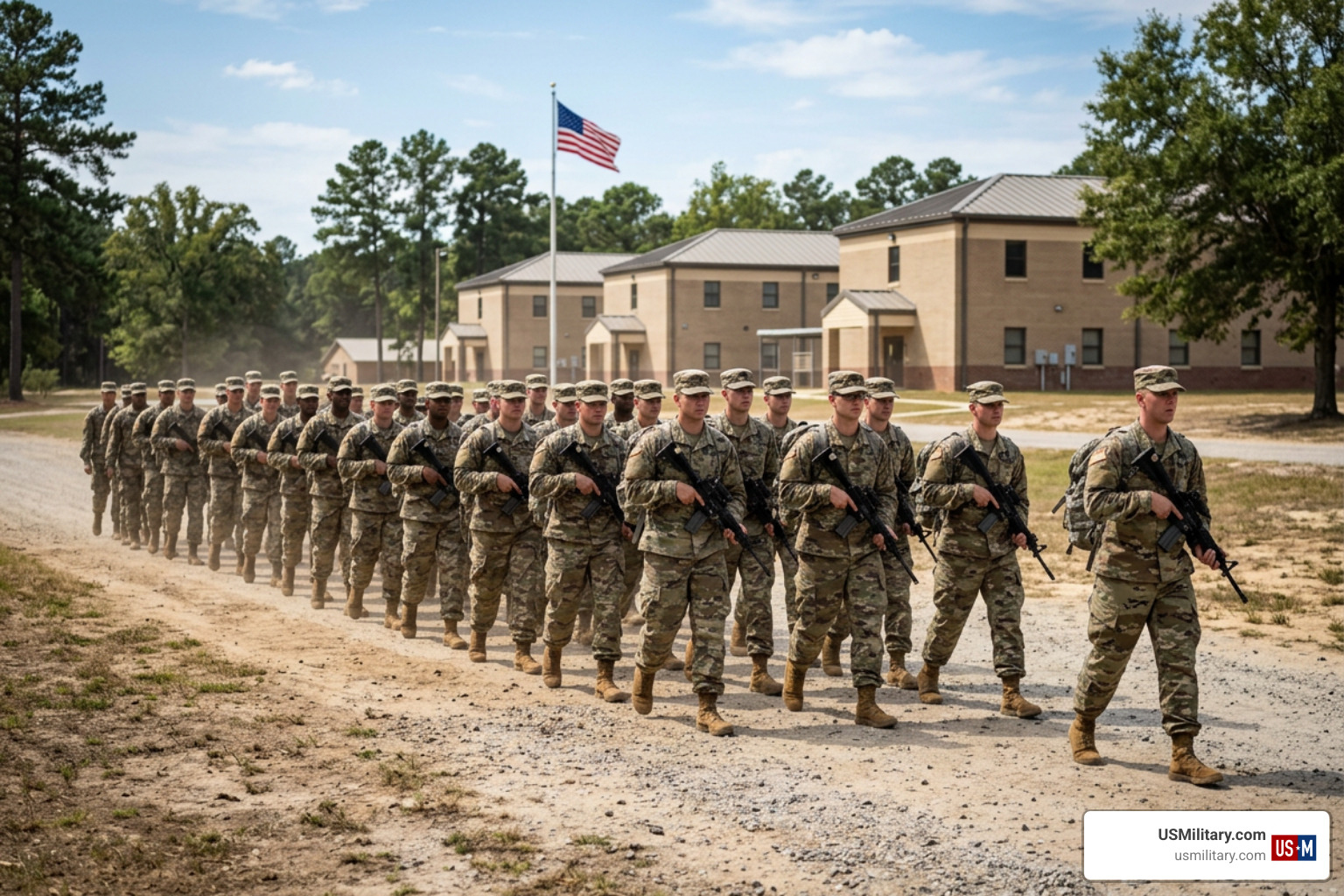
When you enlist in the United States Army, you do not get to pick where you go for boot camp. Instead, the Army assigns you to one of four active army basic training locations based on your chosen career path, gender integration needs, and class availability. While every site teaches the exact same foundational soldiering skills and holds recruits to the same high standards, each installation has its own unique history, climate, and specialized training focus.
To help you understand where you might spend your 10 weeks, we have compiled a comprehensive breakdown of the active installations. If you are preparing to ship out, reviewing our detailed Army Basic Training Locations guide is an excellent starting point to get your bearings.
Fort Jackson (South Carolina)
Located in Columbia, South Carolina, Fort Jackson is the undisputed giant of Initial Entry Training. Established in 1917, it is the largest and most active basic training center in the entire U.S. Army.
Fort Jackson trains more than 50% of all incoming soldiers and nearly 60% of all female recruits entering the service each year. Because of its massive throughput, it is highly optimized for general Basic Combat Training (BCT). Recruits who complete their 10 weeks here typically transition to another installation for their Advanced Individual Training (AIT). If you want to dive deeper into what makes this base tick, check out our Army Basic Training Locations Guide.
Fort Moore (Georgia)
For decades, this historic base in Columbus, Georgia, was known as Fort Benning. Rebranded as Fort Moore to honor Lt. Gen. Hal Moore and his wife, Julia Compton Moore, this installation is widely celebrated as the “Home of the Infantry.”
Fort Moore is home to the Maneuver Center of Excellence, which includes the Infantry School and the Armor School. It is also where legendary programs like the Ranger Course and Sniper Course are held. Because it trains the Army’s frontline combat units, the environment here is notoriously intense. Most infantry and armor recruits undergo One Station Unit Training (OSUT) at Fort Moore, meaning they stay here for both basic and advanced training. You can read more about its legacy in the General Overview of Fort Benning or visit the official Fort Moore portal.
Fort Leonard Wood (Missouri)
Nestled in the beautiful but weather-dynamic Ozarks of Waynesville, Missouri, Fort Leonard Wood was established in 1940. This post is the primary training hub for several specialized branches, including the Military Police, Combat Engineers, and the Chemical Corps.
Fort Leonard Wood is known for its extreme seasonal weather — scorching, humid summers and freezing, snowy winters. Recruits assigned here will experience a rigorous training schedule that takes advantage of the rugged Missouri terrain. To learn more about the physical preparation required for this installation, read our guide on Army Boot Camp Requirements and Locations.
Fort Sill (Oklahoma)
Located in Lawton, Oklahoma, Fort Sill is the only active Army installation on the South Plains built during the Indian Wars, having been established in 1869. Today, its mission is to train artillery soldiers day and night to put “steel on target.”
Fort Sill is home to the Field Artillery School and the Air Defense Artillery School. Recruits training here must prepare for wide-open plains, high winds, and intense heat or biting cold depending on the season. If you or a family member are heading to the Oklahoma plains, you can find official administrative details in this Basic Training Information command letter.
How Recruits Are Assigned to Training Sites

One of the most common misconceptions among Future Soldiers is that they can request their preferred training base. In reality, the assignment process is entirely systemic. The Army uses a logistical framework to decide where you will go, prioritizing cost-saving measures, operational efficiency, and training continuity. To understand how these rules apply to you, read our resource on Army Boot Camp Requirements and Locations.
MOS and Gender Integration at Army Basic Training Locations
The primary factor determining your training site is your Military Occupational Specialty (MOS). Because certain jobs require specialized equipment and ranges, the Army co-locates basic training with the technical schools designed for those roles.
Gender integration also plays a major role. While all four installations support gender-integrated training, Fort Jackson, Fort Leonard Wood, and Fort Sill handle the vast majority of co-ed general BCT units. Fort Moore historically focused on combat arms, but it also hosts gender-integrated units for infantry and armor specialties. You can research how your specific job aligns with these bases by reading the Army Basic Training Locations guide and exploring the Army Basic Training Locations 2026 | By MOS & Females breakdown.
Co-Location with AIT at Army Basic Training Locations
To minimize travel costs and ease the transition for new soldiers, the Army heavily favors co-location. If your MOS holds its Advanced Individual Training (AIT) at Fort Leonard Wood, the Army will make every effort to send you there for BCT as well.
For combat roles, this is formalized as One Station Unit Training (OSUT). OSUT combines basic training and advanced training into one continuous program under the same drill sergeants at a single installation. For example, infantry recruits complete a 22-week OSUT program entirely at Fort Moore, while Military Police and Combat Engineers complete their OSUT at Fort Leonard Wood.
The 10-Week Journey: Reception and Training Phases
Regardless of which of the army basic training locations you are assigned to, your transformation from civilian to soldier is a structured, 10-week journey (excluding your time in the Reception Battalion). The program is designed to progressively build your discipline, physical fitness, and tactical proficiency. To prepare mentally for this transition, we highly recommend reading about Having Realistic Expectations for Military Basic Training.
The Reception Battalion Process (Week 0)
Before you meet your actual drill sergeants, you will spend 4 to 10 days at the Reception Battalion (often called Week 0). This is a purely administrative phase where the Army processes your entry. During reception, you will undergo:
- Comprehensive medical and dental screenings
- Initial physical fitness assessments
- Haircuts (for male recruits) and grooming standardizations
- The issuance of your military uniforms and personal gear
- Necessary immunizations and vaccinations
Reception is widely considered one of the most tedious parts of the process, as you adjust to a lack of sleep and a highly controlled environment before the physical training even begins.
The Four Color-Coded Phases of BCT
Once you clear reception, you “ship” to your training unit and begin the official phases of United States Army Basic Training:
- Yellow Phase (Weeks 1-2): The orientation phase. You are introduced to Army values, history, military customs, courtesies, and basic first aid. This is where the shock of the drill sergeant’s voice is loudest.
- Red Phase (Weeks 3-4): The foundation of soldiering. You will learn the Warrior Ethos, hand-to-hand combat (combatives), gas chamber survival training, and start intensive physical conditioning.
- White Phase (Weeks 5-7): The marksmanship phase. You will spend long days on the weapon ranges learning to handle, maintain, and shoot your M4 carbine rifle, culminating in your rifle qualification test.
- Blue Phase (Weeks 8-10): The tactical phase. You will learn advanced infantry tactics, navigate night infiltration courses, and complete “The Forge” — a grueling, multi-day field training exercise that serves as your final test.
Daily Life, Fitness Standards, and Graduation Requirements
Life at boot camp is governed by the bugle and the clock. Every hour of your day is scheduled to maximize training efficiency. To get an idea of what your body will go through, take a look at our comprehensive guide on Army Boot Camp.
Physical Fitness and the Army Combat Fitness Test (ACFT)
Physical fitness is not optional. To graduate, you must pass the Army Combat Fitness Test (ACFT). The ACFT is a six-event assessment designed to measure your physical readiness for combat:
- 3-Repetition Maximum Deadlift: Measures lower-body strength.
- Standing Power Throw: Measures explosive power.
- Hand-Release Push-Ups: Measures upper-body endurance.
- Sprint-Drag-Carry: Measures anaerobic capacity and agility.
- Plank: Measures core strength.
- 2-Mile Run: Measures aerobic endurance.
Recruits train daily, starting with physical training (PT) at 5:00 AM.
What Happens If You Struggle or Fail?
The Army’s goal is to build you up, not break you down. If you struggle to pass the initial physical assessment at the Reception Battalion, you won’t be sent home immediately. Instead, you will be placed in the Fitness Training Company (FTC). Here, specialized instructors work with you to improve your strength and conditioning. You will get up to two chances per week to pass; those who fail to meet the standard after eight attempts may receive an Entry Level Separation (ELS) discharge.
Similarly, if you suffer a physical injury during training, you will be transferred to the Physical Therapy and Rehabilitation Program (PTRP) to recover before resuming training. Thanks to these safety nets, about 90% of recruits successfully graduate.
Preparing for BCT: Packing Lists and Family Support
Arriving prepared is half the battle. Bringing the right gear — and leaving contraband behind — ensures you start your training on the right foot. For a complete look at preparation resources, visit the Military Basic Training Resources page.
What to Bring and Prohibited Items
We recommend packing light. The Army will provide almost everything you need. Your packing list should focus on:
- Required Documents: Social Security card, government-issued photo ID, birth certificate, high school diploma, and enlistment orders.
- Basic Toiletries: Toothbrush, toothpaste, deodorant, and shaving supplies (non-aerosol).
- Comfortable Clothing: One set of casual civilian clothes and a durable pair of running shoes.
Strictly Prohibited Items: Weapons of any kind, tobacco products (including vapes and lighters), alcohol-based products, non-prescription drugs, expensive jewelry, and food or snacks.
Supporting Families and Future Soldiers
Basic training is a major transition for families, too. The Army supports spouses and parents through the Family Information Center, which helps register dependents in DEERS and sets up TriCare health benefits.
During BCT, traditional mail is your primary lifeline. Writing encouraging letters is the best way to support your recruit. In case of family emergencies, families should contact the local Red Cross, which can officially verify emergencies and coordinate communication with the unit command.
Frequently Asked Questions about Army Basic Training
What is the difference between enlisted BCT and Officer training (BOLC)?
Enlisted recruits attend the 10-week Basic Combat Training to learn foundational tactical skills. Commissioned Officers, however, must first complete Officer Candidate School (OCS) or ROTC, followed by the Basic Officer Leader Course (BOLC). BOLC focuses heavily on leadership development, tactical planning, and platoon management rather than basic soldiering drills.
Can you request a specific basic training location?
No. The Army assigns training locations based entirely on your MOS, class seat availability, and logistical cost-efficiency. Recruit preference is not factored into the assignment system.
What happens immediately after BCT graduation?
Immediately following your graduation ceremony and Family Day, you will transition to your next phase. If you are in an OSUT program, you will stay put and begin advanced training. If you have a separate AIT, you will board a bus or flight to your new installation to begin your job-specific technical training.
Conclusion
Taking the first step toward becoming a U.S. Army Soldier is a monumental decision. While the physical and mental demands of army basic training locations are designed to challenge you, they are also designed to help you succeed.
At USMilitary.com, we are committed to providing you with the resources, financial planning guidance, and career insights you need to thrive before, during, and after your military service.
Ready to begin your military career? Prepare for your Army journey with USMilitary.com and discover how to maximize your benefits, secure VA loans, and find the perfect path for your future. If you want further inspiration on discipline and faith during hard times, consider reading Dare to Live Greatly as you prepare to take the leap. Visit our homepage at USMilitary.com for more expert military resources.