
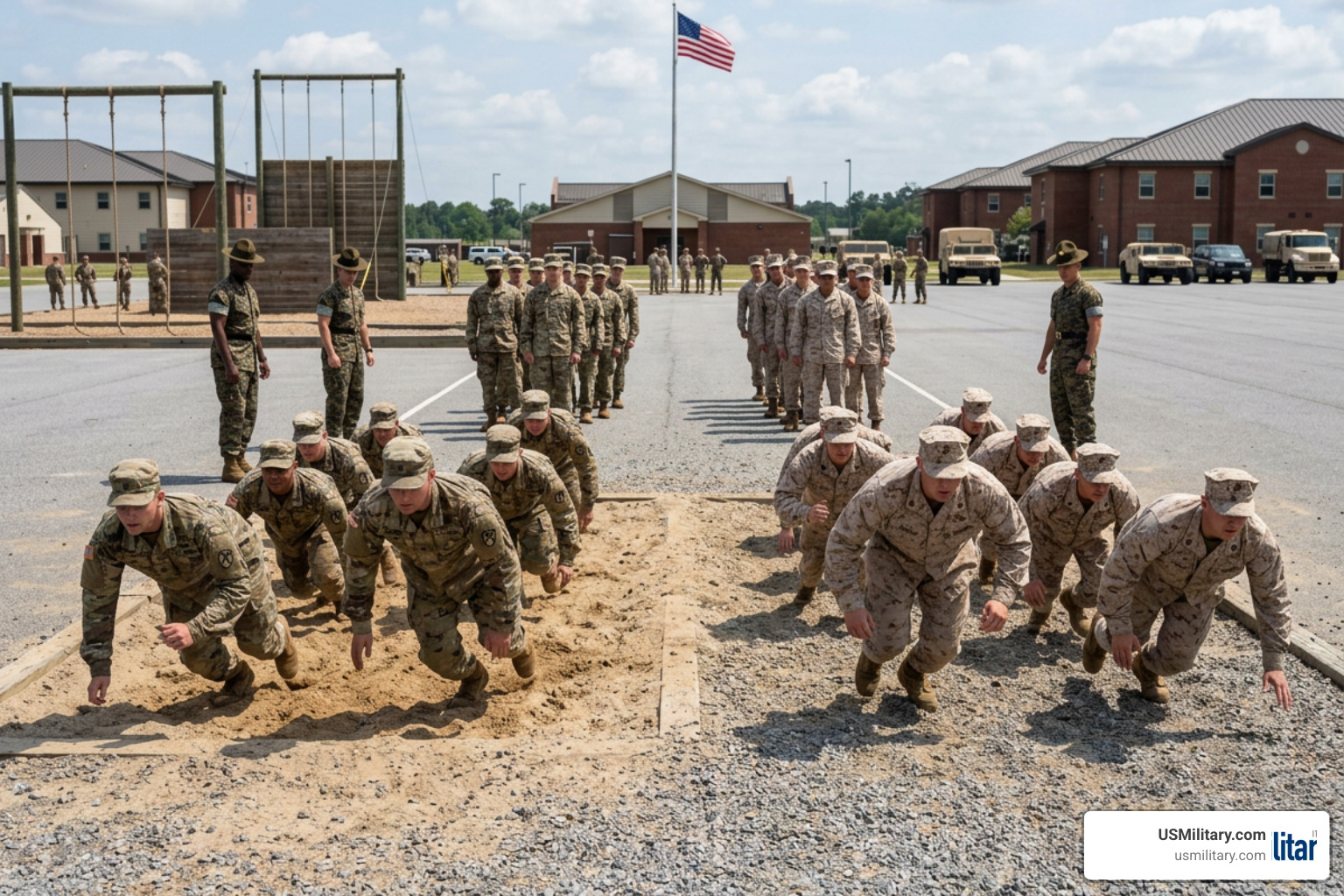
When it comes to Army vs Marines: whose boot camp is tougher, most veterans, recruiters, and military experts point to the same answer: Marine Corps Recruit Training is generally considered harder — but the gap may surprise you.
Here’s a quick breakdown:
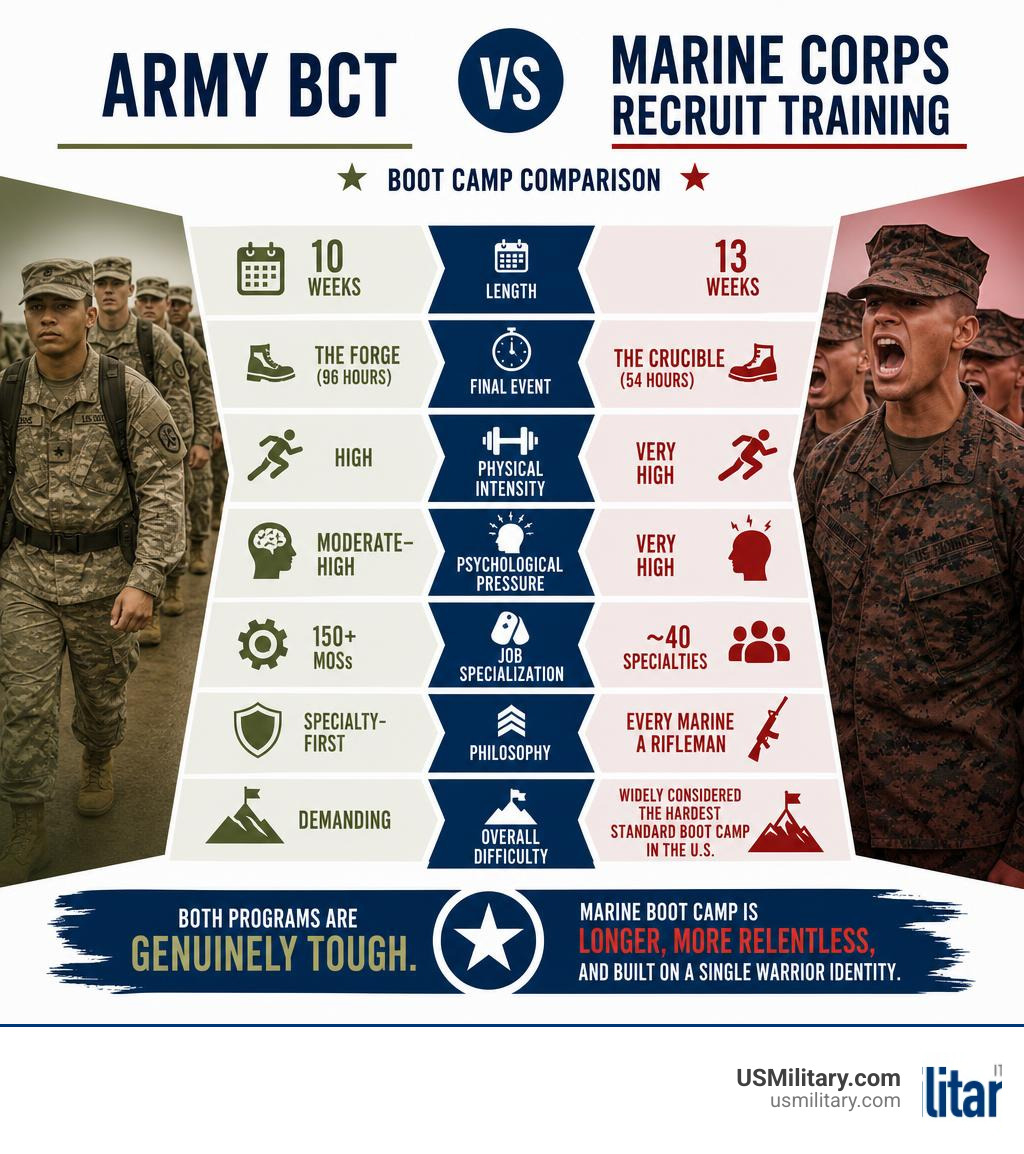
| Factor | Army BCT | Marine Corps Recruit Training |
|---|---|---|
| Length | 10 weeks | 13 weeks |
| Final Event | The Forge (96 hours) | The Crucible (54 hours) |
| Physical Intensity | High | Very High |
| Psychological Pressure | Moderate–High | Very High |
| Job Specialization | 150+ MOSs | ~40 specialties |
| Philosophy | Specialty-first | Every Marine a rifleman |
| Overall Difficulty | Demanding | Widely considered the hardest standard boot camp in the U.S. |
Both programs are genuinely tough. But Marine boot camp is longer, more psychologically relentless, and built around a single warrior identity that Army training simply doesn’t replicate.
That said, the right choice depends on your goals — not just which program sounds harder.
I’m Larry Fowler, publisher of USMilitary.com and a longtime resource for service members navigating military career decisions since 2007. Having helped connect thousands of recruits with Army, Navy, Air Force Reserve, National Guard, and Coast Guard opportunities, I’ve seen how the Army vs Marines: whose boot camp is tougher question shapes enlistment decisions. Let’s break it all down so you can make the most informed choice for your future.
Comparing the Basics: Length, Structure, and Daily Routines
To understand the core differences between these two legendary training programs, we have to start with the baseline structure. When comparing Marines vs Army, the most obvious differentiator is time.
Army Boot Camp—officially known as Basic Combat Training (BCT)—lasts 10 weeks. It is divided into three distinct phases (Red, White, and Blue) designed to transition civilians into disciplined soldiers. The training takes place at one of four Army Basic Training Locations: Fort Moore (Georgia), Fort Jackson (South Carolina), Fort Sill (Oklahoma), or Fort Leonard Wood (Missouri).
In contrast, United States Marine Corps Recruit Training lasts a grueling 13 weeks. This makes it the longest standard basic training program among all U.S. military branches. According to the Ranking of hardest military boot camps: What’s the scoop? , the Marine Corps consistently lands at the number-one spot because of this extended duration and its relentless daily schedule. Marine recruits train at either Marine Corps Recruit Depot (MCRD) Parris Island in South Carolina or MCRD San Diego in California.
The daily routine in both branches starts before dawn, usually around 0400 or 0500, and is packed with physical conditioning, classroom instruction, and field drills. However, the structural philosophy of each branch diverges significantly:
- The Army’s Specialty-First Approach: The Army focuses heavily on preparing you for your specific Military Occupational Specialty (MOS). With over 150 jobs available, your BCT is designed to build a baseline of soldiering skills before sending you to Advanced Individual Training (AIT) to master your technical craft.
- The Marine Corps “Every Marine a Rifleman” Philosophy: Regardless of whether a Marine recruit’s future job is in logistics, aviation mechanics, or administration, they must first master infantry tactics. This “every Marine a rifleman” ethos means that every recruit undergoes extensive combat arms training.
This difference in philosophy directly impacts what happens after graduation. While Army soldiers head to AIT, Marines must complete either Marine Combat Training (MCT) for non-infantry roles or the School of Infantry (SOI) for combat arms, ensuring that the tactical intensity remains high long after boot camp graduation.
Physical Demands: Fitness Standards, Rucking, and Water Survival
When evaluating the physical toll of these programs, both branches demand exceptional endurance, but they test it in different ways.
In Army Basic Training, physical readiness is measured by the Army Combat Fitness Test (ACFT). The ACFT is a modern, six-event fitness assessment that has shifted the Army away from simple bodyweight exercises toward functional strength. Recruits are tested on:
- Maximum Deadlift (MDL)
- Standing Power Throw (SPT)
- Hand-Release Push-Up (HRP)
- Sprint-Drag-Carry (SDC)
- Plank (PLK)
- Two-Mile Run (2MR)
The Marine Corps utilizes two separate physical assessments: the Physical Fitness Test (PFT) and the Combat Fitness Test (CFT). The USMC PFT consists of pull-ups or push-ups, a plank, and a three-mile run. The CFT, conducted in boots and utility uniforms, measures functional combat fitness through events like an 880-yard run, ammo can lifts, and a maneuver-under-fire drill.
If you want to know if Do You Have What It Takes to Be in the Marine Corps Infantry, you must be prepared for extreme rucking and load-bearing demands. While the Army requires significant rucking, Marines regularly carry heavier loads over steeper terrain, particularly during the hilly hikes of MCRD San Diego’s Camp Pendleton phase.
The tables below highlight how these fitness and water training requirements compare, drawing on insights from our Is Navy Boot Camp Harder Than Army? A Clear, Honest Comparison – Paul H. D’Anna analysis.
Physical Fitness and Swim Standards Comparison
| Physical Event | Army BCT Requirements | Marine Corps Recruit Training Requirements |
|---|---|---|
| Primary Run | 2-Mile Run (ACFT) | 3-Mile Run (PFT) & 880-Yard Combat Run (CFT) |
| Upper Body | Hand-Release Push-Ups | Pull-ups (highly emphasized) or Push-ups |
| Core Strength | Plank | Plank |
| Water Survival | Basic water confidence (not a primary graduation barrier) | Marine Corps Water Survival Training (MCWST) – strict graduation requirement |
| Rucking Loads | Up to 35-50 lbs | Up to 50-70+ lbs |
Water survival is a major point of divergence. Because the Marine Corps is an amphibious force operating under the Department of the Navy, water survival is non-negotiable. Recruits must pass the Marine Corps Water Survival Training (MCWST), which includes swimming in full utility uniforms, shedding heavy gear underwater, and treading water. While not quite as swim-heavy as Navy or Coast Guard training, it is vastly more demanding than the Army’s basic water safety demonstrations.
Army vs Marines: Whose Boot Camp Is Tougher?
To truly answer the question of Army vs Marines: whose boot camp is tougher, we must look beyond the physical exercises and examine the psychological environment.
If you are looking for Which Military Branch Have the Easiest Bootcamp, neither of these will make your list. However, when comparing Marines vs Army 2, the psychological pressure of Marine boot camp is widely considered a class of its own.
Drill Instructors vs. Drill Sergeants
Historically, both branches relied on high-volume, high-stress instruction. However, as of June 2026, the Army has modernized its basic training communication. The traditional, aggressive “shark attack” reception has been replaced by a first-day orientation that acts more like a strict athletic coaching staff. Army drill sergeants now focus heavily on mentoring, proper weightlifting form, and technical skills.
Marine Drill Instructors (DIs), on the other hand, maintain an intense, unyielding “psychological siege.” The shouting, immediate corrections, and strict discipline remain a constant pressure from the moment recruits step onto the famous yellow footprints.
The Culminating Events: The Forge vs. The Crucible
Both boot camps end with a brutal field exercise, but they differ in scope and intensity:
- The Army’s “The Forge”: A 96-hour cumulative field training exercise. Recruits march about 40 miles, complete night infiltration courses, practice tactical combat casualty care, and face sleep deprivation while operating in a simulated combat environment.
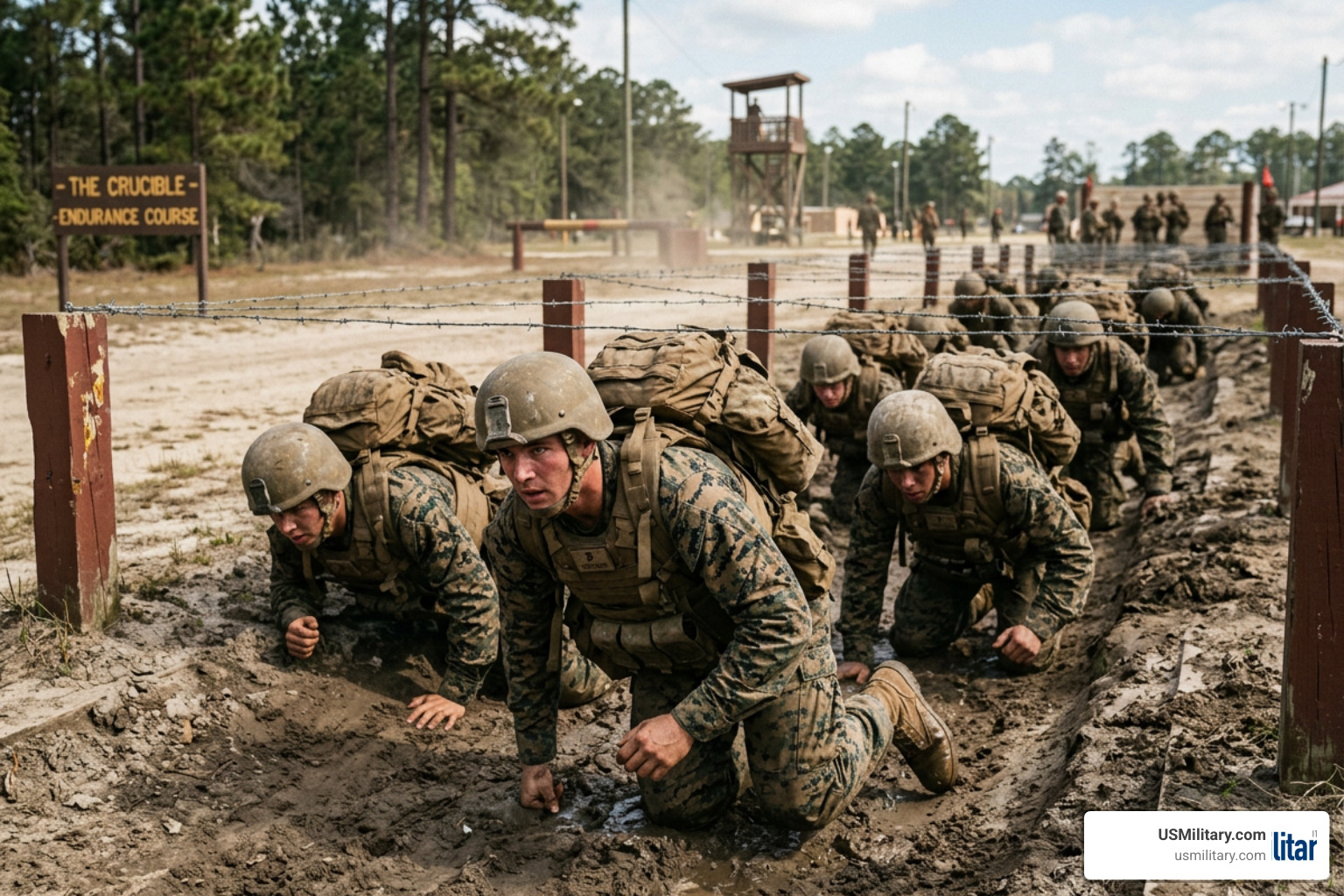
- The Marines’ “The Crucible”: A 54-hour test of physical and mental endurance. Recruits march over 40 miles with heavy gear, solve complex team obstacles, and sleep for less than eight hours total over the three days. Food is strictly rationed. At the end of this event, recruits receive their Eagle, Globe, and Anchor (EGA) and are officially called “Marines” for the first time.
According to veteran perspectives found in the Who is tougher Marines or Army? resource, this intense focus on earning the title creates a powerful, lifelong cultural identity.
Attrition Rates and Failure Reasons
The Marine Corps Dominates Hardest U.S. Military Training Debate because of its demanding standards. While elite pipelines like Marine Recon training have attrition rates of 25-50%, standard Marine boot camp also sees a significant number of dropouts. The primary reasons for failure in both branches are medical injuries (like stress fractures) and “Failure to Adapt” to the extreme psychological stress. However, the Marine Corps’ longer duration and relentless physical grind naturally expose recruits to a higher risk of overuse injuries.
As noted in various service member discussions, including the Airman shares his thoughts on who has the hardest bootcamp in the … , the Marine Corps is unique in its focus on breaking down a recruit’s individual identity and completely rebuilding it as part of a collective, elite team.
The Verdict: Army vs Marines: Whose Boot Camp Is Tougher?
Taking all data points into account, Marine Corps Recruit Training is the tougher boot camp overall.
Its 13-week duration (3 weeks longer than the Army), the demanding water survival requirements, the heavier rucking loads, and the unbroken psychological pressure of the Drill Instructors make it the most challenging standard basic training program in the United States military.
While the Army’s 10-week program is physically punishing and tactically thorough, it offers slightly more opportunities for recovery and transitions more quickly into professional, technical instruction.
How to Choose: Army vs Marines: Whose Boot Camp Is Tougher for You?
The real question isn’t which boot camp is universally harder, but which branch aligns with your personal strengths and long-term career goals. We encourage you to weigh the Pros and Cons of Joining the Military carefully before enlisting.
- Choose the Army if: You want a massive variety of job options (over 150 MOSs), larger enlistment bonuses, technical certifications that translate directly to civilian careers, or pathways to elite units like the Rangers or Special Forces.
- Choose the Marine Corps if: You are driven by the prestige of earning the title of Marine, thrive in highly disciplined, combat-first environments, and want to be part of a tight-knit, amphibious warrior culture.
If you are still on the fence, check out our Top 10 Reasons Not to Join US Military Guide to ensure you are making this life-changing decision for the right reasons.
Frequently Asked Questions About Army and Marine Boot Camps
What is the attrition rate for Marine boot camp vs Army basic training?
While exact numbers fluctuate, standard basic training attrition rates typically hover between 8% and 15% for both branches. The majority of recruits who do not graduate fail due to medical injuries (such as shin splints or fractures) or a “Failure to Adapt” to the military lifestyle, rather than simply failing a physical fitness test.
Do Army drill sergeants scream as much as Marine drill instructors?
No, not anymore. The Army has modernized its basic training tactics to better connect with Gen Z recruits, replacing the high-screaming “shark attack” with a structured, coaching-style reception. Marine Drill Instructors, however, still maintain a highly intense, high-volume psychological approach designed to test emotional control under extreme stress.
Can you fail boot camp for failing the swim test?
In the Marine Corps, yes. Passing water survival training is a strict graduation requirement. Recruits who struggle are given remedial swim training, but if they cannot pass the basic water survival levels, they cannot graduate. In the Army, basic water safety is taught, but it is not a primary hurdle for graduation unless your specific job requires it.
Conclusion
Whether you choose the broad opportunities of the Army or the elite, combat-focused identity of the Marine Corps, both paths require immense dedication and grit. At USMilitary.com, we are committed to providing you with the tools, resources, and unbiased guidance you need to navigate your military journey.
Ready to take the next step toward your future? Explore our comprehensive guide to Army Basic Training or visit USMilitary.com to connect with a recruiter and find the career path that is right for you.