
The Two Most Elite Special Forces in the U.S. Military — And How to Choose Between Them

Army Delta Force or Navy SEAL: Which Military Branch Special Force Is Right For Me is one of the most common questions for anyone serious about pursuing a career in U.S. special operations.
Here’s a quick answer to help you decide:
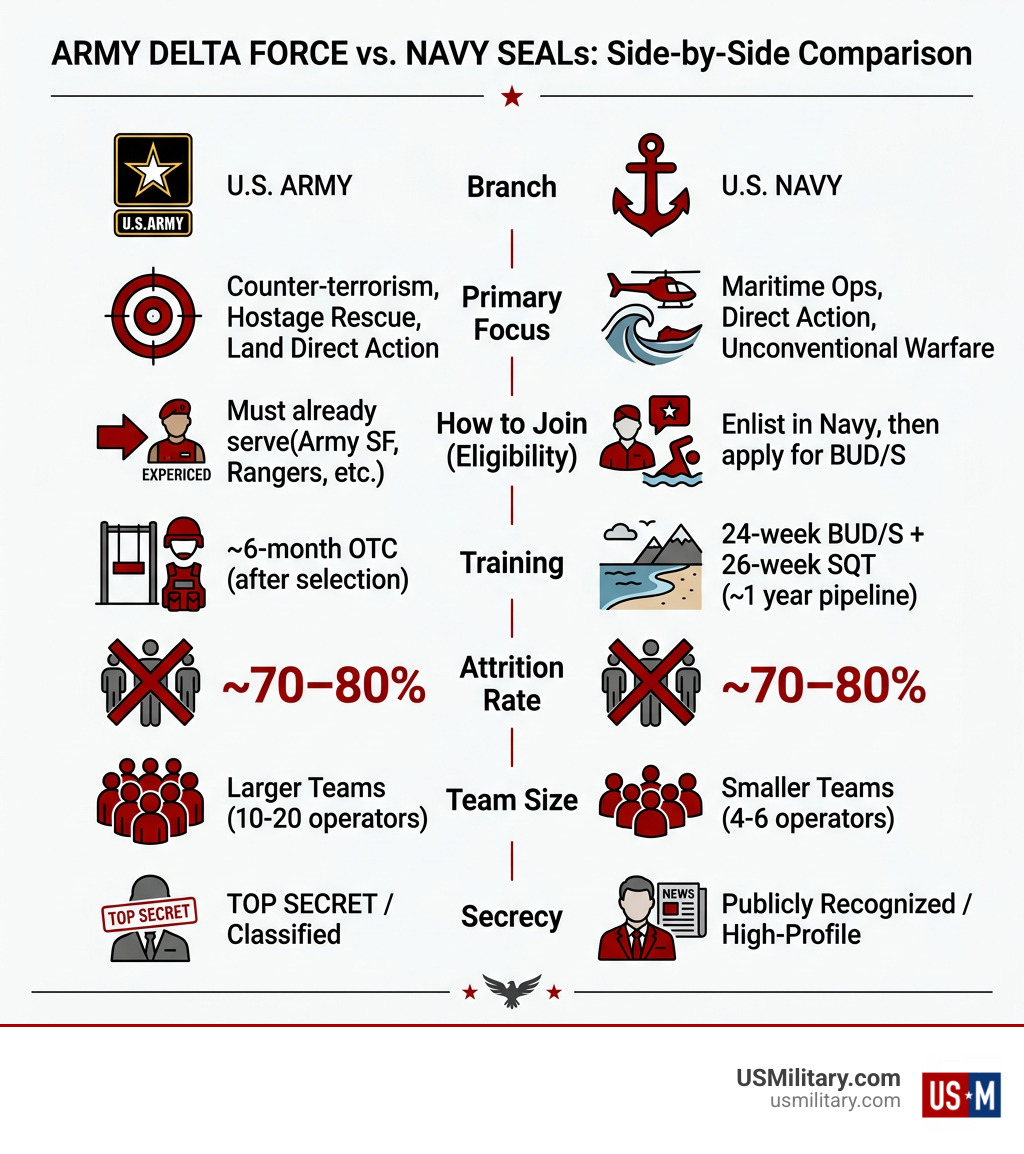
| Factor | Army Delta Force | Navy SEAL |
|---|---|---|
| Branch | U.S. Army | U.S. Navy |
| Primary Focus | Counter-terrorism, hostage rescue, land-based direct action | Maritime ops, direct action, unconventional warfare |
| How to Join | Must already serve in Army SF, Rangers, or similar | Enlist in the Navy, then apply for BUD/S |
| Training Length | ~6-month Operator Training Course (after selection) | 24-week BUD/S + 26-week SQT (~1 year pipeline) |
| Attrition Rate | ~70–80% don’t make it through selection | ~75% don’t graduate BUD/S |
| Team Size | Larger teams (10–20 operators) | Smaller teams (4–6 operators) |
| Best For | Experienced SF/Ranger veterans wanting elite counter-terrorism | Those wanting to start a special ops career from Navy enlistment |
| Secrecy Level | Extremely classified — government barely acknowledges its existence | High-profile, publicly recognized |
Both units are part of the roughly 70,000 U.S. Special Operations Forces — less than 5% of the entire military. They represent the absolute top tier of what American warriors can achieve.
The right choice depends on where you are in your military career, which branch you want to serve in, and what kind of missions drive you.
I’m Larry Fowler, publisher of USMilitary.com since 2007, and I’ve spent nearly two decades helping active-duty members and veterans navigate complex military career decisions — including the question of Army Delta Force or Navy SEAL: Which Military Branch Special Force Is Right For Me. In this guide, I’ll break down everything you need to know to make the right call for your goals and strengths.
Basic Army Delta Force or Navy SEAL: Which Military Branch Special Force Is Right For Me glossary:
Army Delta Force or Navy SEAL: Which Military Branch Special Force Is Right For Me?
When we look at the pinnacle of the U.S. military, we are talking about “Tier 1” Special Missions Units. These units operate under the Joint Special Operations Command (JSOC) and the U.S. Special Operations Command (USSOCOM). While both are elite, their “neighborhoods” are very different.
Navy SEALs (Sea, Air and Land) are the Navy’s primary special operations force. If you choose the navy-seals-2 path, you are looking at a mission set that includes unconventional warfare, direct action, and special reconnaissance. SEALs are famous for their versatility, but their roots are firmly planted in the water.
Army Delta Force (officially 1st SFOD-D) was founded in 1977 by Colonel Charles Beckwith, who was inspired by the British SAS. Delta is the Army’s “black” unit, specializing in high-stakes counter-terrorism and hostage rescue. While SEALs have several teams (Teams 1, 2, 3, etc.), Delta is “The Unit.” The Navy equivalent to Delta is actually SEAL Team 6 (DEVGRU), which is also a Tier 1 unit.
| Mission Area | Army Delta Force (1st SFOD-D) | Navy SEALs (Standard Teams) |
|---|---|---|
| Primary Domain | Land-based, Urban, Desert, Mountain | Sea, Air, and Land (Maritime heavy) |
| Core Mission | Counter-terrorism (CT), Hostage Rescue | Unconventional Warfare, Direct Action |
| Specialty | Surgical precision, high-intensity raids | Amphibious insertion, beach landings |
Army Delta Force or Navy SEAL: Which Military Branch Special Force Is Right For Me for Maritime Interests?
If you grew up in the water and feel more at home in a wetsuit than a rucksack, the naval-special-operations-careers path is likely your calling. Navy SEALs specialize in amphibious assaults, combat diving, and underwater demolition. They are the masters of coastal reconnaissance, often inserting into hostile territory from submarines or high-speed boats.
While Delta Force operators are certainly trained in water operations, it isn’t their primary “office.” For a SEAL, the water is a sanctuary and a tool for stealth. If your interest lies in maritime counter-terrorism, you would eventually aim for SEAL Team 6 (DEVGRU), which handled high-profile water missions like the rescue of Captain Phillips from Somali pirates. It’s also worth noting that Marine Raiders also operate in this space, though they have a different organizational focus.
Operational Focus and Team Dynamics
The way these warriors work on the ground differs significantly. Navy SEALs traditionally operate in small, agile teams of 4 to 6 operators (though they can scale up to 16-man platoons). This allows for extreme stealth and maneuverability in varied environments.
Delta Force, however, often utilizes larger teams of 10 to 20 operators for complex missions. Their structure is built around squadrons rather than the Navy’s “team” format. This larger footprint allows them to bring specialized expertise—like advanced breaching or communications—into a single high-intensity raid. While SEALs focus on “interoperability” (everyone being a jack-of-all-trades), Delta often emphasizes individual surgical precision within a larger specialized group. You can learn more about these branch differences in our army-green-beret-vs-navy-seal comparison.
Selection, Training, and Eligibility Requirements
The road to becoming an operator is paved with sweat, sand, and a lot of “No.” For the Navy, the journey begins with new recruits or active sailors attending the what-is-buds-training (Basic Underwater Demolition/SEAL) program in Coronado, CA.
BUD/S is famous for its 75% attrition rate. If you make it through the 24 weeks of BUD/S (including the infamous Hell Week), you still have 26 weeks of SEAL Qualification Training (SQT).
Army-delta-force selection is a different beast entirely. You don’t just “join” Delta from the street. Almost all Delta candidates come from the Army Rangers of the 75th Ranger Regiment or the Green Berets. They are already elite soldiers with years of experience. Delta’s selection process is highly secretive, focusing on land navigation and “stress inoculation” through vague, grueling tasks. Their Operator Training Course (OTC) lasts about 6 months and focuses on advanced marksmanship and tradecraft.
Basic Requirements:
- Citizenship: Must be a U.S. Citizen for both.
- ASVAB: Usually requires a General Technical (GT) score of 110 or higher.
- Age: SEALs usually must be under 29 (waivers possible); Delta candidates are typically older (average age 29) because of the prior service requirement.
- Security Clearance: Must be eligible for a Secret or Top Secret clearance.
Physical Fitness Demands and Preparation
To even get a contract, you need to be in the top 1% of physical fitness. The Navy SEAL navy-seal-training-program requires passing a Physical Screening Test (PST) that includes a 500-yard swim, push-ups, sit-ups, pull-ups, and a 1.5-mile run.
Delta Force preparation is more about “rucking.” Candidates must be able to perform 10-mile marches carrying a 45-pound rucksack over broken terrain at a blistering pace. Success in Delta selection isn’t just about how many pull-ups you can do; it’s about functional fitness—the ability to carry heavy loads over long distances while your brain is still sharp enough to navigate. Some units, like the Marine Raiders, even offer a free fitness app to help candidates prepare for these rigors.
Success Factors and Attrition Rates
The numbers are staggering. Roughly 75% of BUD/S candidates do not graduate. For Delta, the numbers are even tighter because the “starting pool” is already elite. In some Delta selection classes, out of 120 battle-hardened Rangers and Green Berets, only 12 to 14 might finish—and not all of those will be selected to join the unit.
Success factors include:
- Adaptability: Can you solve a problem when you’re freezing, starving, and haven’t slept in three days?
- Resilience: When the instructors give you a vague task just to see you fail, do you quit or keep going?
- Mental Toughness: This is the “X-factor” we discuss in the navy-seal-training-journey-challenges guide. It’s the ability to stay calm when everything is going wrong.
Culture, Lifestyle, and Real-World Missions
The lifestyle of these operators is one of high operational tempo and frequent deployments. The average SOF operator is 29 years old with 7 years of military service. They aren’t kids; they are professionals with families and long-term careers.
The culture of the units differs in “volume.” Navy SEALs have a higher public profile. Missions like Operation Neptune Spear (the bin Laden raid) brought the SEALs into the global spotlight. This visibility helps with recruitment but can sometimes clash with the “quiet professional” ethos.
Delta Force is the opposite. They are the “ghosts” of the Army. Even when an operator is killed in action, the Army often refuses to disclose their true unit. Their missions, like the capture of Saddam Hussein or the raid on Abu Bakr al-Baghdadi, are often attributed to “U.S. Special Operations” generally to maintain their secrecy. If you want to know more about how they compare to other Army units, check out our green-beret-vs-ranger or army-special-forces-careers resources.
Army Delta Force or Navy SEAL: Which Military Branch Special Force Is Right For Me based on Personality?
Choosing between these units often comes down to your personality.
- The Navy SEAL: Often thrives on intense teamwork and “esprit de corps.” There is a strong “brotherhood” culture centered around the SEAL Ethos. If you value being part of a tight-knit, highly visible team that masters the sea, air, and land, this is for you.
- The Delta Operator: Often values individual expertise and autonomy. Delta operators are given a high degree of independence to solve complex problems. They come from diverse backgrounds (Rangers, SEALs, even Marines) and are expected to be “quiet professionals” who don’t need the spotlight.
We explore these traits further in our navy-seal-vs-army-green-beret and special-operations-education-training guides.
Career Paths and Crossover Opportunities
If you are a civilian, you can enlist in the Navy with a SEAL contract. You cannot do this for Delta. To get to Delta, you generally must join the Army, serve in a unit like the Rangers or Special Forces, and then “try out” once you’ve reached a certain rank (usually E-4 to E-8).
Interestingly, there are crossover opportunities. Delta Force is one of the few units that recruits from all branches. There have been Navy SEALs who have successfully screened for and joined Delta Force. However, it rarely works the other way around. Once you are in the active military, your career path can be flexible if you have the talent and the drive.
Frequently Asked Questions about Special Operations
Can a Navy SEAL join Delta Force?
Yes. Delta Force is a “joint” unit in its recruitment, meaning they accept candidates from any branch of the military. While the vast majority of operators come from the Army (Rangers and Green Berets), highly qualified Navy SEALs can and have successfully completed Delta selection. This is a testament to the JSOC integration where the “best of the best” are pooled together regardless of their original uniform.
Which unit is more secretive, Delta Force or Navy SEALs?
Delta Force is significantly more secretive. While the Navy SEALs have become a household name with movies and books, Delta Force remains a “black” unit. The U.S. government spent decades refusing to even acknowledge Delta’s existence officially. They maintain a much lower public profile and emphasize “quiet professionalism” above all else.
What is the difference between Delta Force and SEAL Team 6?
The main difference is the branch and the recruitment pool. Delta Force is an Army unit that recruits from across the entire military. SEAL Team 6 (DEVGRU) is a Navy unit that recruits almost exclusively from existing Navy SEAL teams. Delta has roughly 1,000 operators, while SEAL Team 6 is smaller, with around 300. While both do counter-terrorism, SEAL Team 6 retains a specialized focus on maritime and amphibious operations.
Conclusion
Deciding on Army Delta Force or Navy SEAL: Which Military Branch Special Force Is Right For Me is a personal journey that requires honest self-assessment. If you want to start your journey today as a recruit and love the water, the Navy SEALs offer a direct path to elite status. If you are already a seasoned soldier looking for the most secretive, surgical counter-terrorism unit in the world, Delta Force is your North Star.
At USMilitary.com, we are here to support your special operations path. Whether you are looking for military career goals or help navigating VA benefits after your service, we are your central hub for military-related guidance. Both units are legends for a reason—the choice of which legend you want to become is up to you.