

Chief Master Sergeant Air Force retirement pay is one of the most valuable financial benefits in the U.S. military — and understanding how it works can make a huge difference in your long-term financial planning.
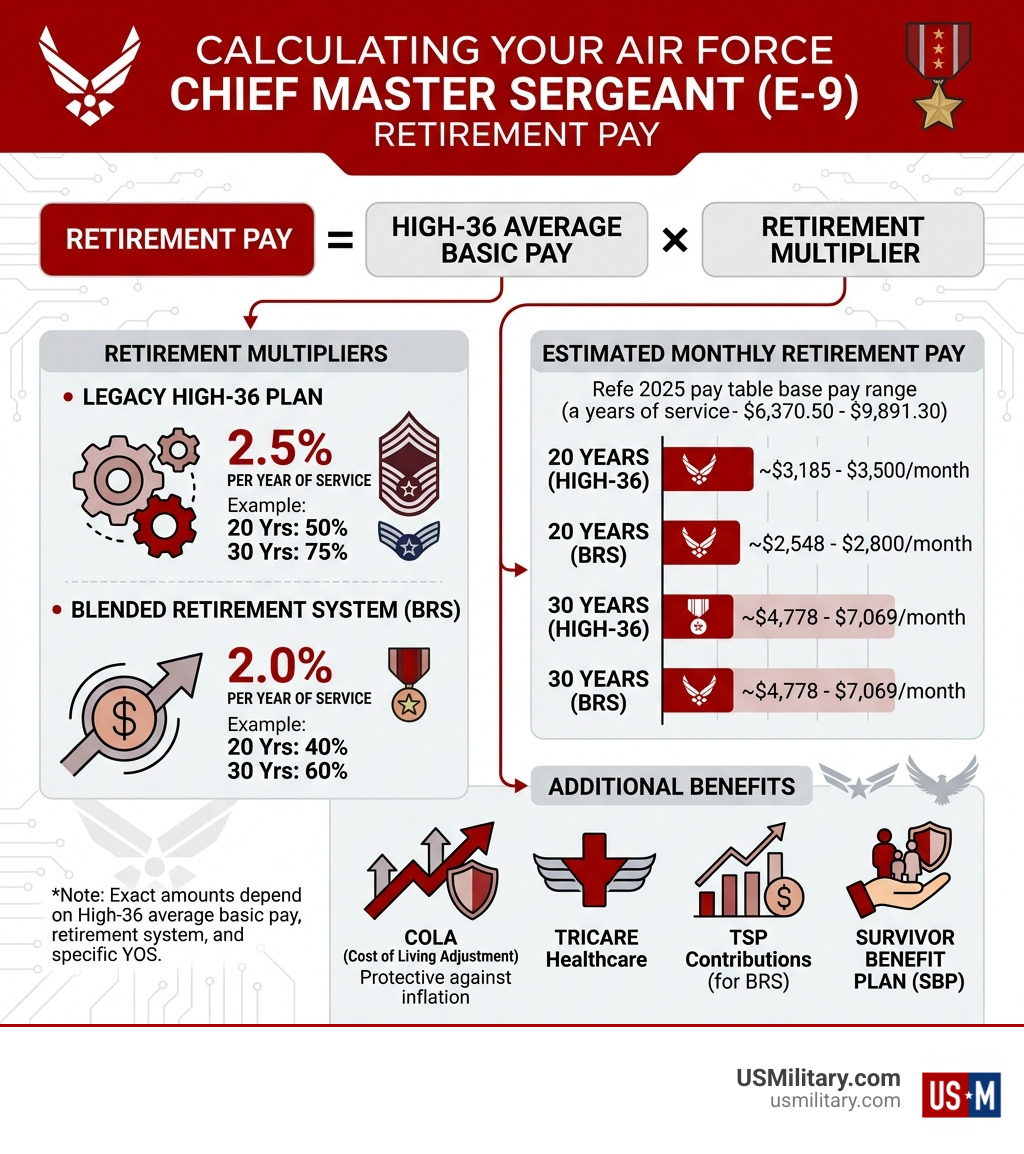
Here’s a quick snapshot of what a retiring Chief Master Sergeant (E-9) can expect:
| Scenario | Estimated Monthly Retirement Pay |
|---|---|
| E-9, 20 years, High-36 | ~$3,185 – $3,500/month (50% of high-36 average) |
| E-9, 30 years, High-36 | ~$4,778 – $7,069/month (75% of high-36 average) |
| E-9, 20 years, BRS | ~$2,548 – $2,800/month (40% of high-36 average) |
| E-9, 30 years, BRS | ~$4,778 – $7,069/month (75% of high-36 average) |
Note: Exact amounts depend on your High-36 average basic pay, retirement system, and years of service. The E-9 monthly base pay range runs from $6,370.50 to $9,891.30 (2025 pay tables).
The core formula is simple:
Retirement Pay = High-36 Average Basic Pay × Retirement Multiplier
- Legacy plans (Final Pay / High-36): 2.5% per year of service (50% at 20 years, 75% at 30 years)
- Blended Retirement System (BRS): 2.0% per year of service (40% at 20 years, 60% at 30 years)
Most Air Force retirees today fall under the High-36 plan or the BRS, depending on when they first entered military service.
The good news? Military retirement pay is protected from inflation by annual Cost of Living Adjustments (COLA), and it comes with powerful companion benefits like TRICARE healthcare, the Survivor Benefit Plan (SBP), and Thrift Savings Plan (TSP) contributions.
I’m Larry Fowler, publisher of USMilitary.com, and I’ve spent nearly two decades helping active duty members, veterans, and their families navigate complex topics like chief master sergeant air force retirement pay — from VA disability to pension planning. Let’s break this down step by step so you can walk away with a clear picture of what your service is worth.
Understanding the Rank: Master Sergeant vs. Chief Master Sergeant Air Force Retirement Pay
Before we dive into the dollars and cents, we need to distinguish between these two heavy-hitting Senior NCO ranks. While both are prestigious, the financial gap in retirement can be significant.
A Master Sergeant (E-7) is often the first “Top 3” rank an Airman hits. They are technical experts and frontline leaders. However, a Chief Master Sergeant (E-9) represents the top 1% of the enlisted force. Chiefs are the strategic advisors to commanders, influencing policy and mission success at the highest levels.
When you look at the 2026 Military Pay Chart, you’ll see the base pay reflects this difference in responsibility. For example, in 2025, an E-7 with over 20 years of service has a base pay of approximately $6,000 to $6,200. Contrast that with an E-9 at the same 20-year mark, whose base pay starts around $6,370.50 and can climb to nearly $10,000 with more years of service.
Because retirement is a percentage of this base pay, reaching E-9 isn’t just a career milestone—it’s a massive boost to your lifelong financial security. Understanding Military Pension Eligibility 101 is the first step in realizing how these rank jumps translate into a bigger monthly check.
Base Pay and the Chief Master Sergeant Air Force Retirement Pay Formula
The “Retired Pay Base” is the foundation of your pension. For almost everyone retiring today, this is calculated using the “High-36” method. We take the average of your highest 36 months of basic pay—usually your last three years of service—and use that as the starting point.
According to Military Compensation and Financial Readiness data, an E-9 retiring with 30 years of service is looking at a significantly higher “High-3” average than an E-7. For a Chief, the 2025 monthly base pay can reach $9,891.30 if they have served over 38 years. Even at the standard 30-year retirement mark, the base pay is roughly $9,300.
Eligibility Requirements for Enlisted Retirement
To collect that chief master sergeant Air Force retirement pay, you generally need to hit the 20-year mark of active duty service. This is known as your Total Active Federal Military Service Date (TAFMSD).
However, it’s not just about hitting 20. We also have to consider High Year Tenure (HYT). For a Chief Master Sergeant, the HYT is typically 30 years. This means you are expected to retire by your 30th year of service unless you receive a waiver for a high-level assignment.
Whether you are Active Duty or Reserve, Military Retirement Requires Long Range Planning For Best Success. You don’t want to reach your 19th year and realize your records are missing a year of creditable service!
Comparing the Four Major Military Retirement Systems
Your “Date of Initial Entry into Military Service” (DIEMS) is the magic date that determines which “bucket” you fall into.
- Final Pay: For those who joined before Sept. 8, 1980. Your pay is based on your literal final month of base pay.
- High-36: For those who joined between Sept. 8, 1980, and July 31, 1986 (or those who joined later but didn’t take the REDUX bonus). This uses the average of your highest 36 months of pay.
- REDUX: A system that offered a $30,000 Career Status Bonus at year 15 in exchange for a lower retirement multiplier (40% at 20 years instead of 50%).
- Blended Retirement System (BRS): The current system for anyone who joined on or after Jan. 1, 2018 (or those who opted in).
You can use the official Retirement Calculator to see how these systems differ based on your specific entry date. If you’re looking for the most recent numbers, check out the 2024 Military Pay Chart to see where your base pay currently stands.
Calculating Chief Master Sergeant Air Force Retirement Pay under BRS vs. Legacy Plans
The biggest difference between the High-36 (Legacy) and BRS is the multiplier.
- High-36: 2.5% x Years of Service. (20 years = 50% of pay).
- BRS: 2.0% x Years of Service. (20 years = 40% of pay).
Wait, 10% less? Why would anyone want that? The BRS compensates for the lower pension by providing government matching to your Thrift Savings Plan (TSP) up to 5% and offering a mid-career “Continuation Pay” bonus.
For a Chief Master Sergeant, the choice (if you were eligible to choose) was a tough one. If you plan on staying for 30 years, the BRS multiplier eventually catches up to the High-36 percentage at the 30-year mark (75% for both). You can read more about these nuances at the Retired Pay for Airmen and Guardians benefit library.
The Impact of Years of Service Beyond 20
Every year you stay past 20 adds to your multiplier. Under the legacy system, staying until 30 years gives you a 75% multiplier (30 years x 2.5%). If you are one of the rare “Super Chiefs” who stays for 40 years, you could theoretically receive 100% of your average base pay in retirement!
The 2023 Pay Chart shows that pay continues to scale up significantly between 20 and 40 years, making those extra years very lucrative for your future pension.
Factors That Influence Your Final Pension Amount

Your gross pay is just the starting point. We have to look at what actually hits your bank account.
- COLA: Every year, the government adjusts your pay based on the Consumer Price Index. This ensures your chief master sergeant air force retirement pay doesn’t lose its “buying power” as the cost of eggs and gas goes up.
- Taxes: Federal taxes are a given, but state taxes vary. Some states (like Florida or Texas) don’t tax military retirement at all, while others do.
- Survivor Benefit Plan (SBP): This is essentially an insurance policy. You pay a small percentage of your retirement pay so that if you pass away, your spouse continues to receive up to 55% of your pension.
- TSP Withdrawals: If you’ve been contributing to your TSP, those withdrawals will eventually add to your monthly income.
Keep an eye on the Military Pay Chart For 2026 to see how upcoming pay raises might impact your High-36 average.
Disability Retirement and VA Compensation
If you are medically retired, your pay is calculated differently. You may receive pay based on your disability rating (up to 75%) or your years of service—whichever is higher.
One of the most common questions we get at USMilitary.com is: Can You Receive 100 VA Disability And Military Retirement Pay? The answer is often “Yes,” thanks to Concurrent Receipt (CRDP) for those with a 50% or higher VA rating and 20+ years of service. For a detailed estimate, the Medical Final Pay Calculator is an essential tool.
Retirement for Air Force Reserve and National Guard Members
Reserve retirement is a different beast. Instead of a simple “20 years and you’re out,” it’s based on a point system. You need 20 “satisfactory years” (years where you earned at least 50 points).
However, you usually can’t start drawing pay until age 60. The time between your retirement and age 60 is known as the “Gray Area.” During this time, you have a retirement ID card and base privileges, but no monthly check.
The 507 ARW Retirement Pamphlet is a fantastic resource for understanding how points translate into dollars. You can also check the Military Pay Chart 2026 to see the current point values for reserve pay.
How to Apply and Manage Your Retired Pay
Applying for retirement isn’t automatic—you have to ask for it! You typically submit your application via the vPC (virtual Personnel Center) between 6 and 12 months before your requested Retirement Effective Date (RED).
Once you’re out, myPay becomes your lifeline. This is where you’ll access your Retiree Account Statement (RAS), which is basically your monthly pay stub. It’s also where you’ll manage your tax withholdings and allotments.
If you are one of the few still eligible for the oldest system, the Final Pay Calculator can help you verify your numbers before you hit the button.
Frequently Asked Questions about Enlisted Retirement
When should I start the application process for retirement?
We recommend starting the formal process 12 months out. This gives you enough time to complete your final physical, attend the Transition Assistance Program (TAP), and ensure your administrative records are flawless.
How does the REDUX Career Status Bonus affect my long-term pay?
The REDUX system gave you $30,000 upfront at year 15 but reduced your 20-year pension to 40% of your High-36. At age 62, the pay “jumps” back up to the 50% level, but for those 42 years in between, you are receiving a smaller check. Most financial experts suggest that unless you are an expert investor, the legacy High-36 is the better long-term deal.
What resources can I use to estimate my specific monthly check?
The best official tool is the Air Force Benefits retirement calculator. It allows you to input your specific “High-3” years and projected retirement date to get a number that is as accurate as possible.
Conclusion
At USMilitary.com, we know that your retirement isn’t just a “paycheck”—it’s the reward for decades of sacrifice, missed birthdays, and long deployments. Whether you are a Master Sergeant looking toward that final stripe or a Chief planning your sunset ceremony, understanding chief master sergeant Air Force retirement pay is vital.
Take the time to use the calculators, check your points, and plan for the “Gray Area” if you’re in the Reserves. Your financial readiness is the final mission of your military career.
For more deep dives into your hard-earned benefits, check out our guide on More info about military retirement benefits. Thank you for your service!