
What Separates Army Green Berets from Delta Force Operators?
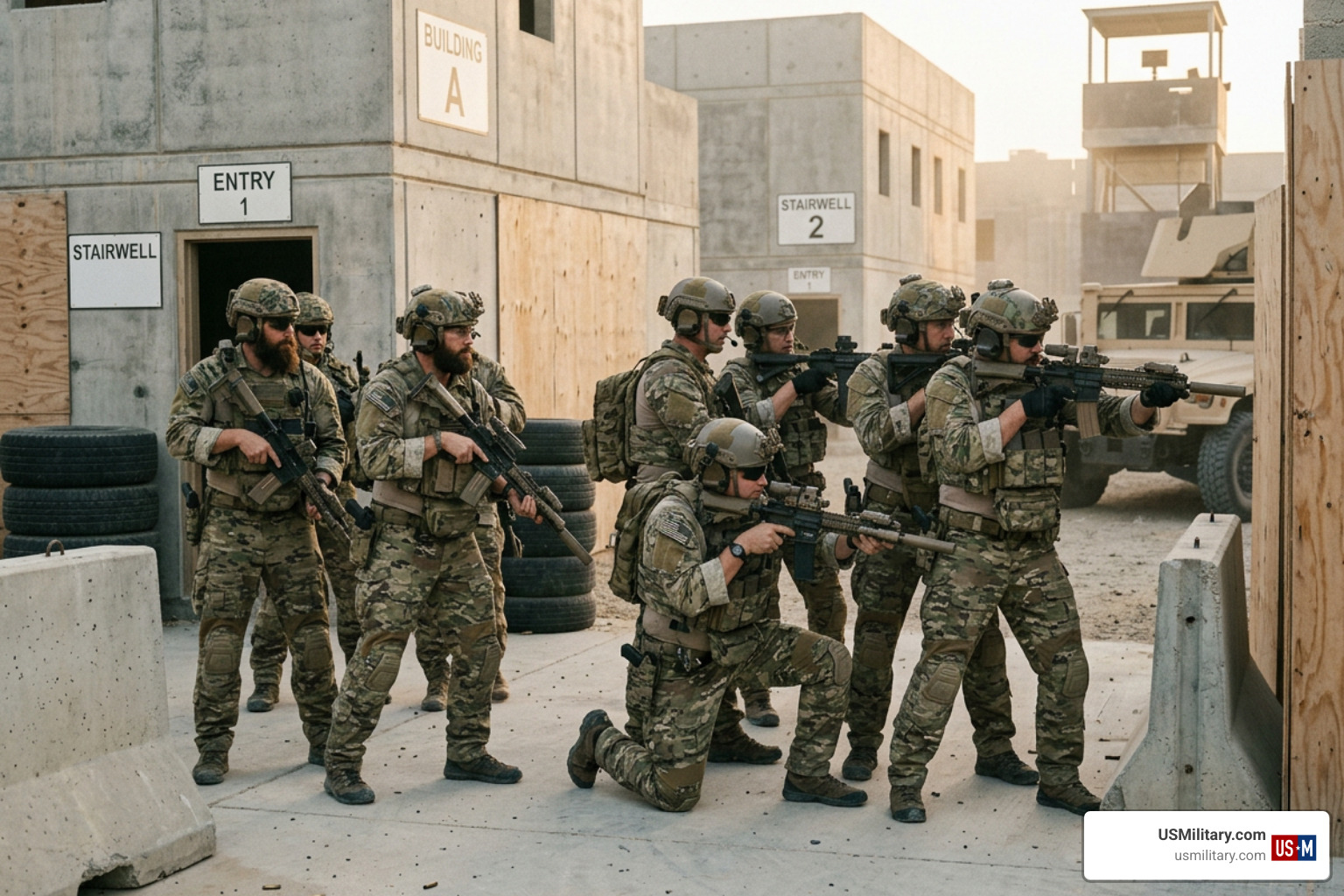
When people ask about Army Green Berets vs Delta Force operators: what are the differences?, the short answer is this: same Army, very different jobs.
Here’s a quick side-by-side to answer that immediately:
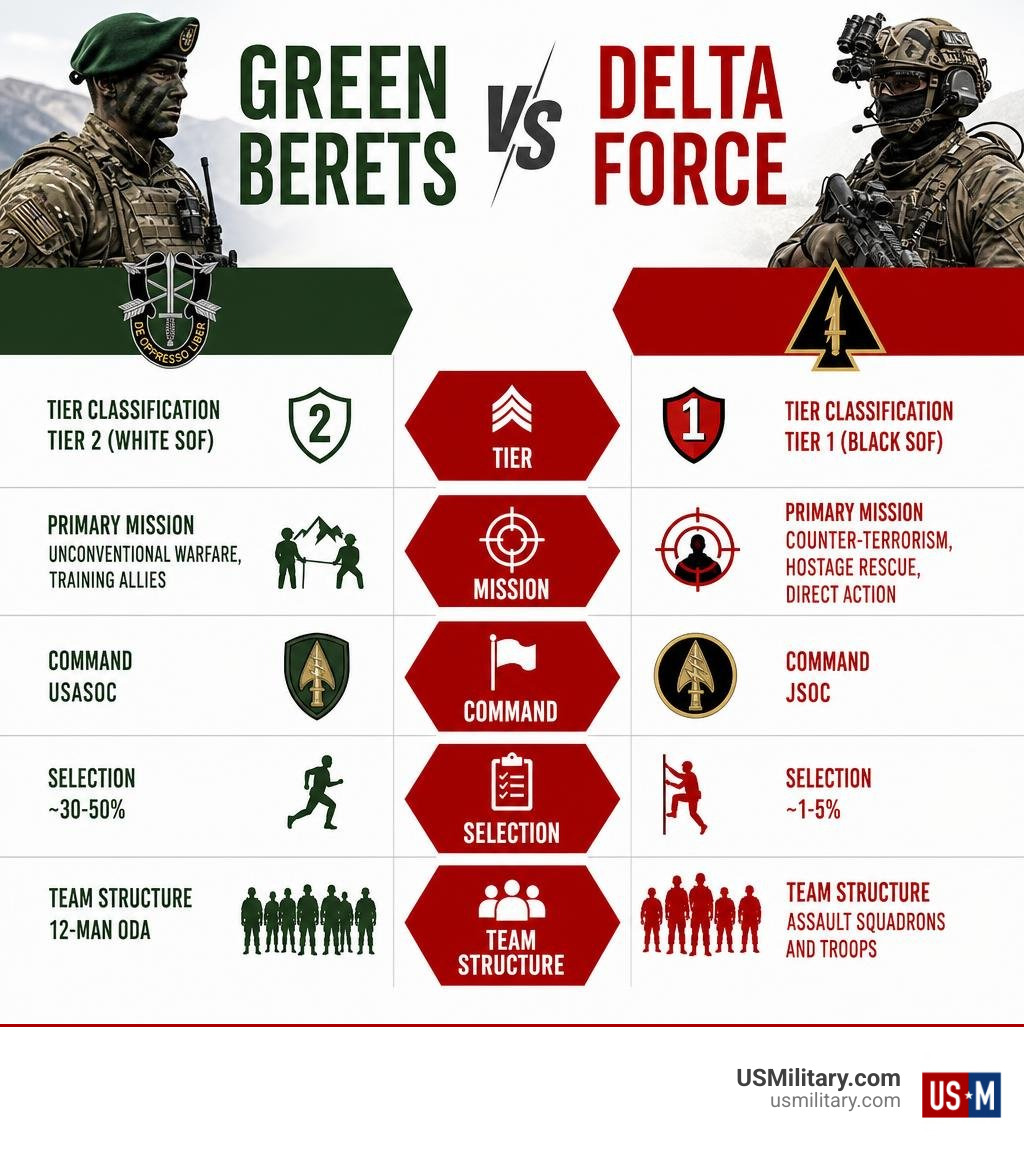
| Factor | Green Berets | Delta Force |
|---|---|---|
| Tier classification | Tier 2 (white SOF) | Tier 1 (black SOF) |
| Primary mission | Unconventional warfare, training allies | Counter-terrorism, hostage rescue, direct action |
| Command | USASOC | JSOC |
| Selection pass rate | ~30-50% | ~1-5% |
| Team size | 12-man ODA | Assault squadrons and troops |
| Civilians can join? | Yes (18X contract) | No — prior service required |
| Public profile | Relatively open | Extremely secretive |
| Global presence | 70+ countries | Classified, global |
Green Berets are soldier-diplomats — they build relationships, train local forces, and work in the shadows of foreign policy. Delta Force operators are surgical strike specialists — called in for the most sensitive, high-stakes missions on the planet.
Neither unit is better. They are built for completely different jobs. Think of it like comparing a teacher to a surgeon — both elite, both essential, just not interchangeable.
I’m Larry Fowler, publisher of USMilitary.com, and through nearly two decades of connecting servicemembers and veterans with reliable military career and benefits information, I’ve helped thousands of readers understand complex topics like Army Green Berets vs Delta Force operators and what the differences mean for real career decisions. Let’s break it all down clearly so you can make an informed choice.
Important Army Green Berets vs Delta Force Operators: What Are The Differences? terms:
- army ranger vs green beret
- Should I join the Marines or the Army Special Forces
- green beret vs navy seal
Army Green Berets vs Delta Force Operators: What Are The Differences?
To understand the core differences between these two legendary units, we have to look at their primary mission sets. While both are elite elements of the United States Army, their daily operational realities could not be more different.
The Green Berets, officially known as U.S. Army Special Forces, are the military’s premier “teachers.” Established in 1952, their primary doctrinal mission is Unconventional Warfare (UW) and Foreign Internal Defense (FID). If a foreign partner nation has an unstable government or needs help training its military to fight off insurgents, the Green Berets are sent in. They embed with local forces, learn their language, eat their food, and train them into a cohesive fighting unit. They play the “long game,” sometimes spending months or years in a single region to build trust and strategic capability.
Conversely, What is Delta Force? Formally known as the 1st Special Forces Operational Detachment-Delta (1st SFOD-D) or Combat Applications Group (CAG), Delta Force was founded in 1977 by Colonel Charles Beckwith. Beckwith modeled the unit after the British Special Air Service (SAS) to fill a critical gap in the U.S. military: a dedicated, specialized counter-terrorism and hostage rescue unit.
Where Green Berets are the teachers, Delta Force operators are the “surgeons.” They do not build local armies. Instead, they execute short-duration, high-intensity direct action raids. When a high-value terrorist target needs to be captured or American hostages are held in an inaccessible stronghold, Delta is called to conduct a lightning-fast, highly violent, and mathematically precise strike.
For a deeper look into how these roles compare on a tactical level, check out this breakdown of Green Beret vs Delta Force .
Army Green Berets vs Delta Force Operators: What Are The Differences in Career Progression?
Because their missions are so distinct, the career paths and “feeder units” for each force look very different.
To become a Delta Force Operator, you cannot simply walk into a recruiting office and sign up. Delta is an invitation-only, mid-career progression unit. The unit primarily recruits seasoned soldiers who already have extensive combat experience. Approximately 70% of Delta Force operators come directly from the 75th Ranger Regiment, with Army Special Forces (Green Berets) serving as the other major feeder pool. However, because Delta is a joint-capable Army unit, they also occasionally recruit elite personnel from other military branches who can pass their grueling selection process.
Green Berets, on the other hand, have a much broader recruitment base. While many active-duty soldiers transition into Special Forces mid-career, the Army also allows qualified civilians to enlist directly into the Special Forces pipeline via the 18X contract.
For those looking at elite Army paths, comparing the Army Ranger vs Green Beret career trajectories is a great place to start, as many young soldiers begin as Rangers, transition to Green Berets, and eventually try out for Delta Force. You can read more about this elite hierarchy in Green Beret vs Delta Force: Who’s More “Elite”? – USAMM .
Army Green Berets vs Delta Force Operators: What Are The Differences in Operational Tempo?
The operational tempo (OPTEMPO) and geographical footprint of these units reflect their strategic roles.
The Green Berets maintain a massive, continuous global presence. At any given moment in 2026, Green Berets are deployed in more than 70 countries. They operate in decentralized, 12-man teams scattered across remote outposts in Africa, South America, Europe, and Asia. Their deployments are frequent, scheduled, and heavily focused on theater-level security cooperation. They are the ultimate “quiet professionals,” quietly deterring aggression and building regional stability.
Delta Force operates on a completely different deployment model. As a Tier 1 Special Mission Unit, Delta’s OPTEMPO is governed by national-level crises. When they deploy, it is typically for highly classified, short-duration missions. They do not maintain long-term, visible presences in foreign villages. Instead, they remain on high alert, ready to deploy anywhere in the world within hours to eliminate a high-value target or rescue hostages. Because of their specialized focus, they are widely recognized as some of The Most Feared Special Forces Operators in the US Military.
The Gauntlet: Selection and Training Pipelines
The selection processes for both units are legendary for their physical and psychological brutality, but they test for entirely different operational traits.
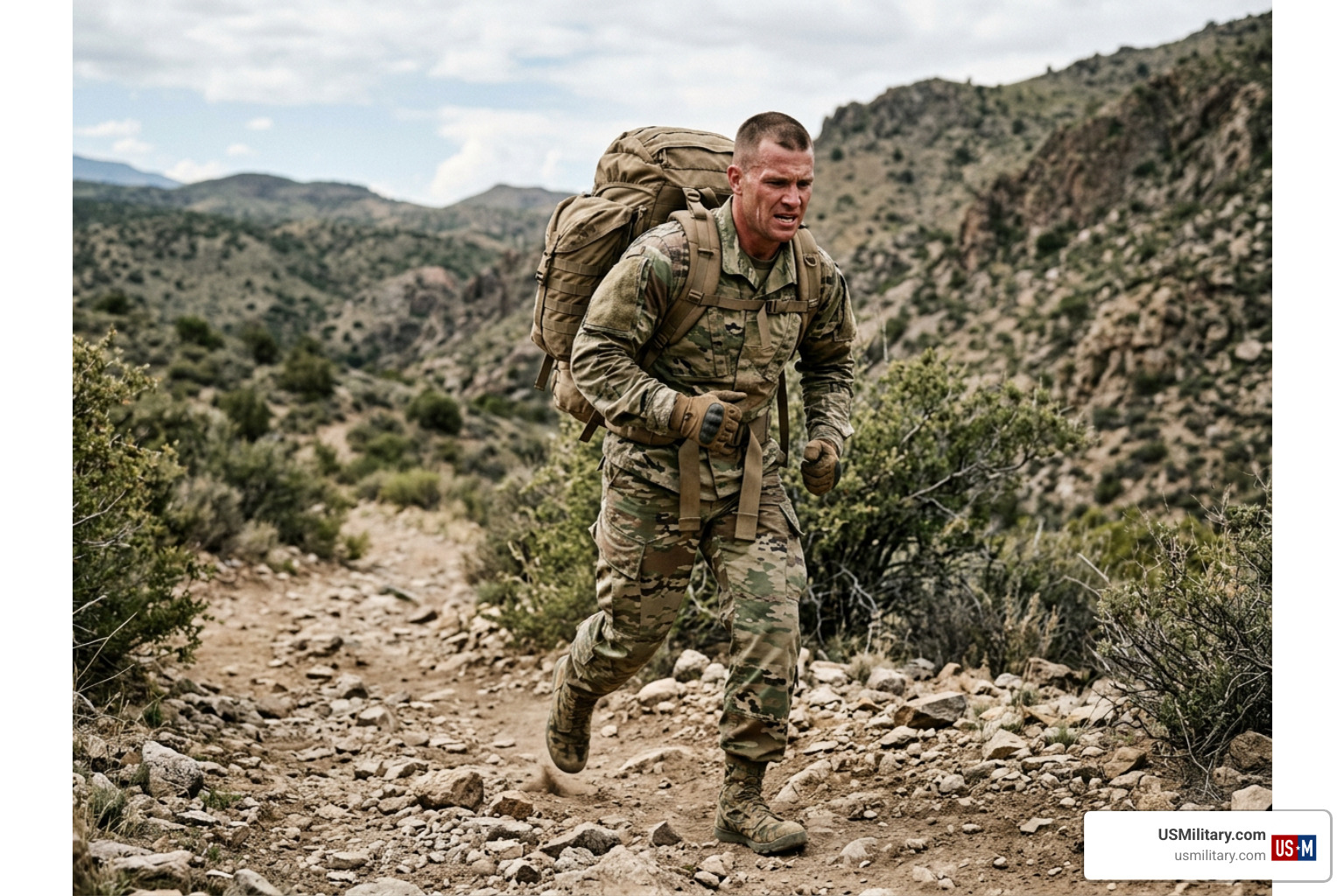
For Special Forces, the journey begins with Special Forces Assessment and Selection (SFAS), a 24-day test of physical endurance, land navigation, and mental toughness. Those who pass SFAS move on to the Special Forces Qualification Course (SFQC), commonly known as the “Q Course.” The Q Course lasts anywhere from 56 to 95 weeks (12 to 24 months), depending on the soldier’s assigned Military Occupational Specialty (MOS) and foreign language requirements.
The Q Course culminates in Robin Sage, a massive, multi-county guerrilla warfare exercise in North Carolina. During Robin Sage, candidates must infiltrate a fictional country called “Pineland,” connect with local dissident forces (played by role-players), train them, and lead them in a simulated rebellion. The focus is heavily on leadership, cross-cultural communication, and adaptability.
The Army Delta Force Selection Process is shrouded in extreme secrecy. Conducted in the rugged mountains of West Virginia, Delta selection is designed to find individuals who can perform flawlessly under extreme isolation. The assessment includes brutal, solo land-navigation courses with vague instructions, forcing candidates to rely entirely on their own resolve.
The selection process culminates in The Long Walk, a 40-mile solo ruck march over mountainous terrain with a 45-pound pack, which must be completed within an undisclosed time limit. Out of a starting class of roughly 120 highly fit, experienced combat veterans, typically only 12 to 16 candidates pass. Those who survive selection enter the six-month Operator Training Course (OTC), where they master advanced marksmanship, demolitions, executive protection, and CIA-style tradecraft.
To understand how these selection philosophies differ, you can read more at Understanding the Differences Between Delta Force and Green Berets .
Recruitment Paths: Can Civilians Join Directly?
One of the most practical differences for anyone considering these career paths is how you actually get your foot in the door.
- Green Berets: Yes, civilians can enlist directly. Through the 18X Special Forces Candidate Program, you can sign a contract that sends you straight from Basic Combat Training and Infantry Advanced Individual Training (AIT) to Airborne School, and then directly into SFAS. If you wash out, however, you are reclassified based on the needs of the Army (usually as an infantryman).
- Delta Force: No, civilians cannot join directly. Delta requires prior military service. To even attend a Delta recruitment briefing, you must typically hold the rank of Sergeant (E-5) through Master Sergeant (E-8) for enlisted personnel, or Captain (O-3) through Major (O-4) for officers. You must also have a clean record, a high General Technical (GT) score, and pass physical and psychological screening before receiving an invitation to selection.
Structure, Command, and Funding in Special Operations
The place each unit occupies within the Department of Defense hierarchy directly impacts their funding, resources, and operational authority.
Green Berets operate under U.S. Army Special Operations Command (USASOC). They are classified as Tier 2 or “White SOF” (Special Operations Forces). While they are highly funded compared to conventional infantry units, their budget is managed through standard Army procurement channels. They are organized regionally into five active-duty and two National Guard Special Forces Groups, each assigned to a specific geographic combatant command (such as CENTCOM or AFRICOM).
Delta Force operates under the Joint Special Operations Command (JSOC), a sub-unified command of USSOCOM. JSOC oversees the nation’s Tier 1 “Black SOF” Special Mission Units. Because Delta reports directly to the President and the Secretary of Defense for national-level missions, they receive priority funding. This allows Army Delta Force to develop, test, and field cutting-edge weaponry, specialized aviation assets, and advanced communications gear long before they trickle down to the rest of the military.
Team Sizes and Equipment in the Field
In the field, the operational footprint of these units looks completely different:
- Green Berets (The ODA): The basic tactical unit of Special Forces is the Operational Detachment Alpha (ODA), or “A-Team.” An ODA is a highly autonomous, 12-man team. It consists of a Captain (Commander), a Warrant Officer, and ten highly specialized non-commissioned officers. Each ODA has two weapons specialists (18B), two engineer specialists (18C), two medical specialists (18D), two communications specialists (18E), and an intelligence sergeant (18F). This structure allows a single, tiny team to operate independently in remote areas for months.
- Delta Force (Squadrons and Troops): Delta is organized into four operational assault squadrons (A, B, C, and D), along with specialized support, aviation, and intelligence squadrons. Instead of the multi-disciplinary ODA, Delta operates in flexible troop and team configurations optimized for rapid, violent entry. Their teams are built around pure assault capabilities, sniper/reconnaissance support, and technical breaching.
When it comes to gear, Delta operators have access to highly customized kits. For an inside look at their specialized weaponry and loadouts, check out Inside the Kit Delta Forces Essential Equipment.
Secrecy, Public Visibility, and Lifestyle Differences
The cultural environments of these two units are night and day.
Green Berets are known as the “Quiet Professionals.” While their missions are often sensitive, they are considered “White SOF,” meaning their operations are frequently unclassified, and they actively engage with foreign militaries and local populations. They wear standard Army uniforms, maintain standard military grooming regulations when in garrison, and their achievements are often highlighted in official military news releases.
Delta Force operators are true “Shadow Warriors.” They operate in the “Black SOF” world, where the government routinely denies or declines to comment on their operations. To maintain operational security, Delta operators are granted “relaxed grooming standards” — they grow long hair and beards to blend into civilian populations.
When deployed, they wear civilian clothing or sterile uniforms with no military patches, name tapes, or rank insignia. Even in their personal lives, they maintain deep cover; neighbors and extended family members are rarely told what they actually do for a living. To learn more about this secretive lifestyle, read The Shadow Warriors Everything You Need to Know About Delta Force.
Frequently Asked Questions about Army Special Operations
Can a Navy SEAL join Delta Force?
Yes. Because Delta Force is a joint-operational unit under JSOC, they recruit from all branches of the military. While the vast majority of candidates come from the Army Rangers and Green Berets, elite operators from other branches—including Navy SEALs, Marine Raiders, and Air Force Pararescuemen—have successfully passed Delta selection.
To compare the cultures and capabilities of these elite branch assets, take a look at our analysis of Army Delta Forces vs Navy Seals and US Navy Seals vs Army Delta Force The Winner Revealed.
What is the difference between Delta Force and SEAL Team 6?
Delta Force and SEAL Team 6 (DEVGRU) are sister Tier 1 units under JSOC. The primary difference lies in their operational heritage and environments. SEAL Team 6 retains its maritime roots, specializing in shipboard hostage rescues, underwater infiltration, and waterborne counter-terrorism. Delta Force maintains its Army heritage, specializing in land-based operations, complex urban hostage rescues, and desert/mountain direct action.
You can read a detailed breakdown of their differences in Delta Force Seal Team 6 and What’s the Difference Between Delta Force and Seals.
Which unit has a higher selection attrition rate?
Delta Force has a significantly higher attrition rate. Delta’s selection process has an attrition rate of approximately 90%, with only about 1% to 5% of applicants ultimately qualifying.
By comparison, the Green Beret selection pass rate is about 30% to 50%. While both are incredibly physically and mentally demanding, Delta’s selection is designed to filter out individuals who are already elite special operators, making it one of the most exclusive groups in the world.
For more on where these pipelines rank globally, check out the Top 5 Most Fierce Military Special Forces and Army Rangers vs Navy Seals Are They the Deadliest Elite Special Forces.
Conclusion
When comparing Army Green Berets vs Delta Force operators: what are the differences?, it all comes down to the tool needed for the job. The Green Berets are the strategic scalpel used to build alliances, train foreign partners, and win wars through influence and unconventional warfare. Delta Force is the tactical hammer used to execute precision counter-terrorism strikes and rescue hostages in the most dangerous corners of the globe.
Both units represent the pinnacle of military service, and both offer rewarding, highly elite career paths.
If you are trying to decide which special operations path fits your personality, goals, and lifestyle, we highly recommend you Compare Army Delta Force vs Navy SEALs to see how the Army’s top tier stacks up against the Navy’s finest.
For more resources on military career paths, VA benefits, and financial planning, visit us at USMilitary.com. And if you are looking for inspiration to push through your own personal gauntlet, check out Dare to Live Greatly for powerful guidance on living a life of purpose and courage.