
What Are the Army Minimum Requirements? (Quick Answer)
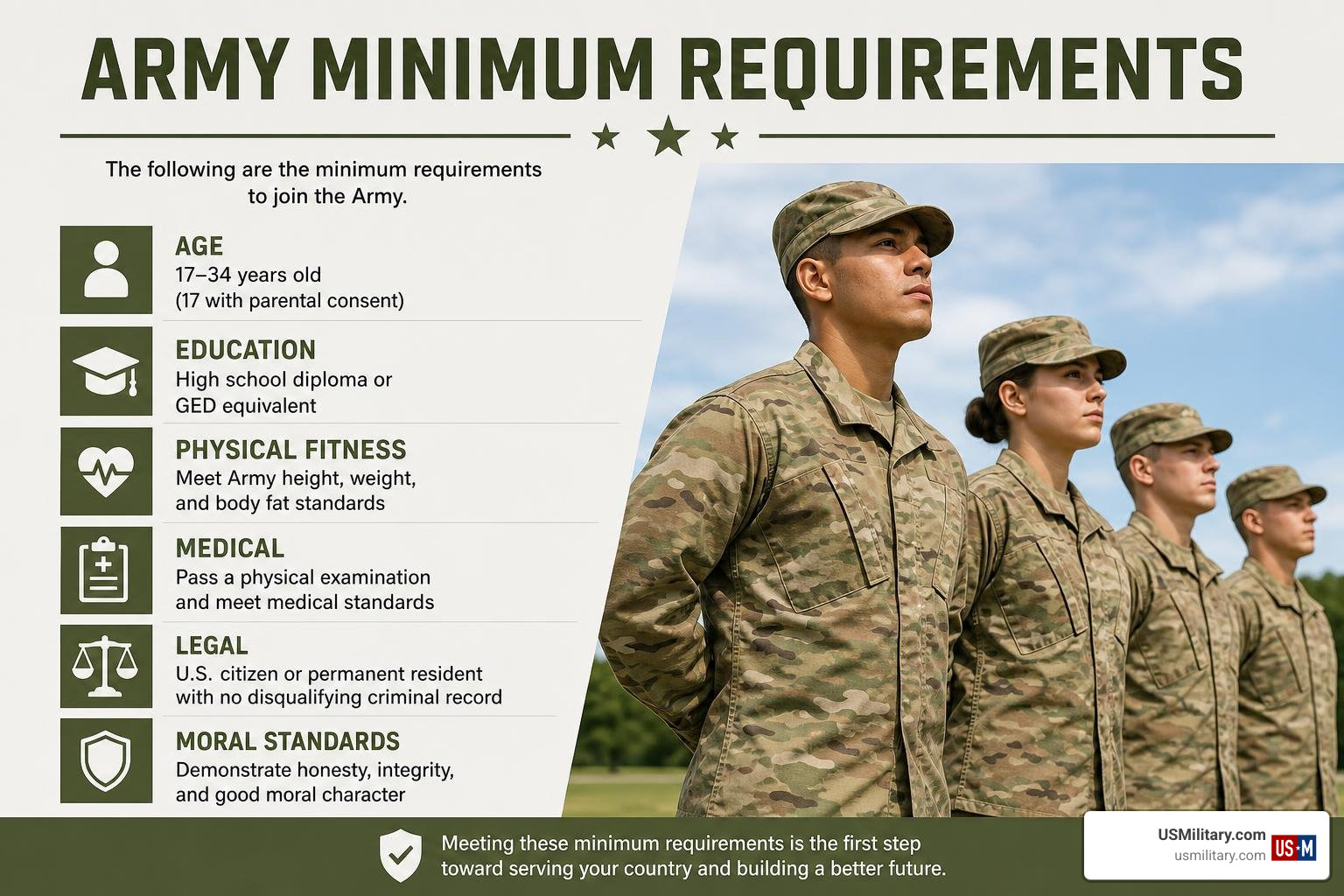
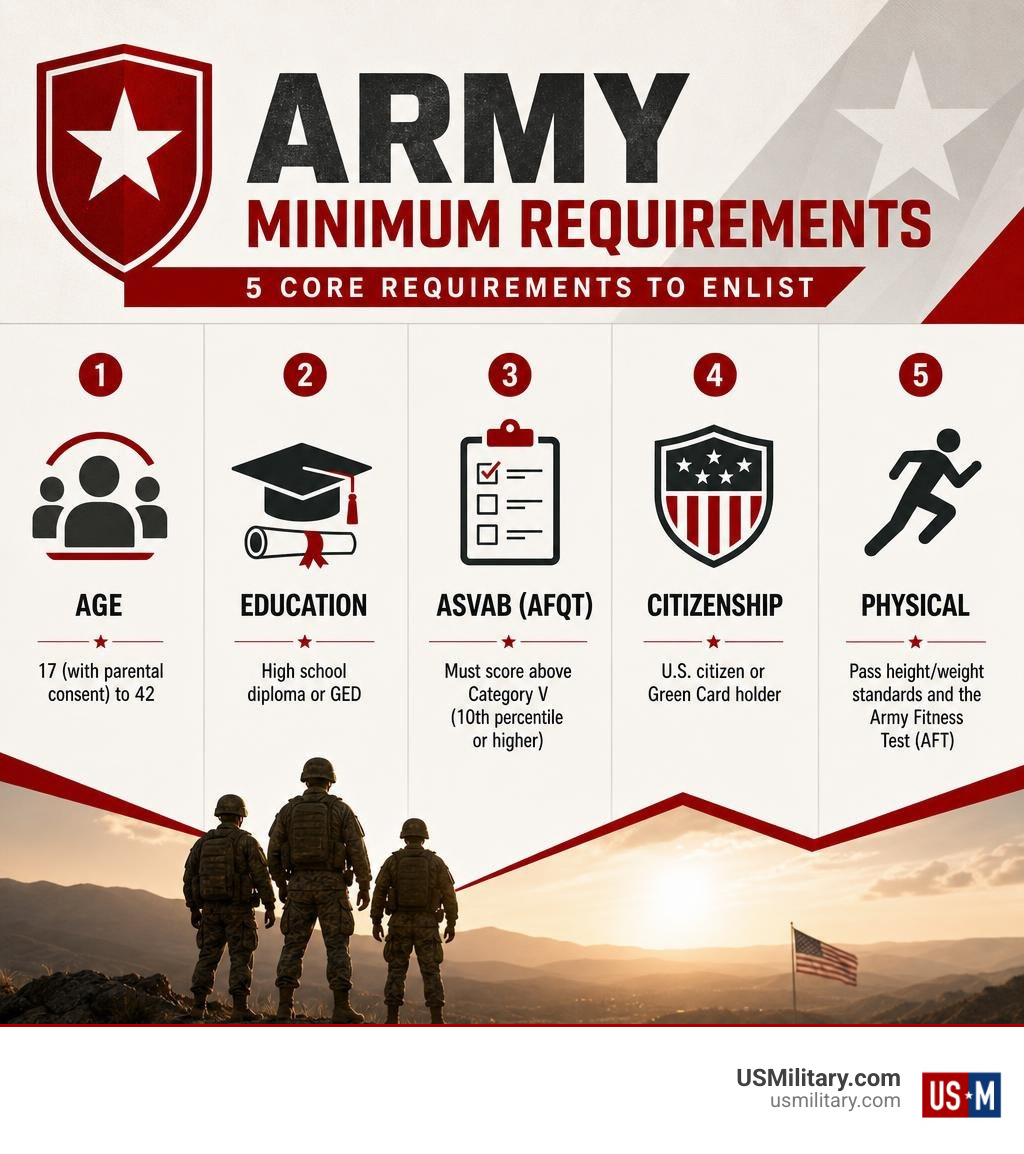
The army’s minimum requirements to join cover five core areas. Here is a fast overview:
| Requirement | Minimum Standard |
|---|---|
| Age | 17 (with parental consent) to 42 |
| Citizenship | U.S. citizen or Green Card holder |
| Education | High school diploma or GED |
| ASVAB (AFQT) | Must score above Category V (10th percentile or higher) |
| Physical | Pass height/weight standards and the Army Fitness Test (AFT) |
Most applicants who fall short on one requirement can still qualify through a waiver or a preparatory program. More on that below.
Joining the Army is one of the biggest decisions you can make. But the process can feel confusing fast. What age do you need to be? What if your ASVAB score is low? What if you have a medical history or a past legal issue?
The good news: the Army has clear standards — and more flexibility than most people expect. Whether you are 17 and just finishing high school or 40 and considering a career change, understanding exactly what is required is the first step.
This guide breaks down every requirement in plain language, so you know exactly where you stand before talking to a recruiter.
I’m Larry Fowler, publisher of USMilitary.com and a longtime resource on army minimum requirements and military enlistment — since 2007, this network has helped connect hundreds of thousands of prospective Soldiers with the information they need to serve. With that background, I’ll walk you through everything you need to know to determine if you qualify and what to do if you don’t quite meet the bar yet.
Handy army minimum requirements to join and terms:
- Army ASVAB minimum
- age limit to join military
- Army DUI waiver
Understanding the Army Minimum Requirements to Join
When we talk about the standard path to becoming a Soldier, we must look at the foundation of eligibility. The Department of Defense establishes baseline policies to ensure that every recruit is mentally, physically, and morally prepared for the rigors of service. However, because the Army is the largest branch of the military, its specific recruiting needs often shape how these rules are applied in real-time.
Whether you are looking at active duty (serving full-time) or looking to leverage prior service to rejoin the ranks in June 2026, the qualification framework remains highly standardized. To get a comprehensive view of how these rules stack up across all branches, you can read our Ultimate Guide: Requirements to Join US Military 2026.
Every standard we discuss is governed by official policies, including the DoD Qualification Standards, which set the baseline for character, conduct, aptitude, and physical fitness across the entire U.S. military.
Age Limits and Army Minimum Requirements
Age is one of the first filters a recruiter will check. For those looking to enlist as an enlisted Soldier, the minimum age is 17 (which requires parental consent). If you do not have parental consent, you must wait until your 18th birthday.
On the upper end, the maximum age to enlist in the Regular Army as an active-duty Soldier is 42. While the standard age limit for active-duty enlistment has historically trended between 17 and 35, the Army has utilized policy updates to allow older applicants to serve up to age 42, provided they can pass the medical and physical examinations.
For those pursuing a path as a commissioned Officer, the timeline is tighter. Officers must accept their commission before reaching age 31. If you are older than these limits, do not lose hope just yet. Age waivers are regularly processed, particularly for applicants who possess high-demand skills or those with prior military service.
To dive deeper into how age limits work and how prior service might extend your eligibility, check out our articles on US Army Enlistment Age Requirements for New Recruits, The Army Age Limit: Can You Still Serve?, and Joining the Army in 2026: Check the Age Requirements First.
Citizenship and Residency Rules
To wear the Army uniform, you must meet strict citizenship and residency requirements. You must be either:
- A United States citizen, or
- A lawful permanent resident who possesses a valid Permanent Resident Card (commonly known as a Green Card).
For non-citizens holding a Green Card, the Army offers an incredible benefit: expedited naturalization. Non-citizen Soldiers can actually begin the naturalization process as early as their first day of Basic Training, effectively reducing the standard multi-year U.S. residency requirement to just a single day of honorable service.
Additionally, all applicants must be able to speak, read, and write English fluently to ensure clear communication during training and operations. For a broader look at how these citizenship rules compare across the entire Department of Defense, you can review the official U.S. Military Requirements.
Education, Aptitude, and the ASVAB
The Army wants to ensure you have the educational foundation to succeed in modern technical roles. Therefore, education and cognitive testing play a massive role in your enlistment options.
The Army categorizes applicants into “Tiers” based on their educational background:
- Tier 1: High school diploma holders. This is the most desirable category, and the vast majority of Army accessions come from Tier 1.
- Tier 2: GED holders, home-school certificates, and alternative credentials. While you can absolutely enlist with a GED, the Army limits the number of Tier 2 slots available each year. GED holders can significantly boost their enlistment chances by scoring higher on the ASVAB or earning at least 15 college credits.
If you don’t initially meet the academic or physical standards, the Army has pioneered the Future Soldier Preparatory Course. This 90-day program features two distinct tracks: an academic track to help you raise your ASVAB score and a fitness track to help you meet body composition standards before shipping to Basic Combat Training.
Education, ASVAB, and Army Minimum Requirements
The Armed Services Vocational Aptitude Battery (ASVAB) is the placement exam that determines not only if you can join, but what jobs (Military Occupational Specialties, or MOS) you qualify for. Your Armed Forces Qualification Test (AFQT) score is the portion of the ASVAB that determines overall enlistment eligibility.
The AFQT scores are divided into categories:
- Category I-III: Highly eligible.
- Category IV: Scores between 10 and 30. The DoD caps Category IV accessions at 20% of the annual total per service.
- Category V: Scores from 1 to 9. Applicants in Category V are completely ineligible to enlist.
The standard minimum AFQT score to enlist in the Regular Army is 31 for high school graduates, though exceptions and academic waivers exist. If you score at least a 21, you may qualify for the academic track of the Future Soldier Preparatory Course to study, retake the exam, and boost your score.
The complete administrative and legal rules governing these education tiers and testing standards are detailed in Army Regulation 601-210, which serves as the ultimate handbook for Army recruiters.
Officer Commissioning Requirements
If your goal is to lead Soldiers as an Officer, the entry bar is higher. You cannot enlist as an Officer with a high school diploma or GED alone; you must hold a four-year baccalaureate college degree from an accredited institution.
There are several pathways to earn a commission:
- Army ROTC (Reserve Officers’ Training Corps): Completed during college.
- OCS (Officer Candidate School): A post-college training program for college graduates or current enlisted Soldiers with degrees.
- The U.S. Military Academy at West Point: The Army’s premier service academy (applicants must be between 17 and 23 years of age as of July 1 of their entry year).
Regardless of the commissioning source, you must accept your commission before your 31st birthday unless you receive an approved age waiver.
Physical Fitness and Medical Standards

To ensure you can handle the physical demands of combat, every applicant must pass a medical screening at the Military Entrance Processing Station (MEPS) and meet strict height and weight limitations.
The physical screening begins with height and weight measurements. The acceptable height range for both men and women is 58 to 80 inches. Your maximum allowable weight is determined by your gender, age, and height. To check the exact limits for your specific height and age, refer to the Army Height and Weight Standards.
To give you an idea of how these limits look, here is a comparison of the maximum weight limits for male and female applicants at the height extremes:
| Height (Inches) | Male Max Weight (Ages 17-20) | Female Max Weight (Ages 17-20) |
|---|---|---|
| 58 inches (4’10”) | 134 lbs | 119 lbs |
| 80 inches (6’8″) | 234 lbs | 227 lbs |
If you exceed these weights, MEPS medical staff will conduct a body fat tape test. If you still do not meet the body fat percentage limits, you may be referred to the fitness track of the Future Soldier Preparatory Course to safely lose weight before starting Basic Training.
The Army Fitness Test (AFT)
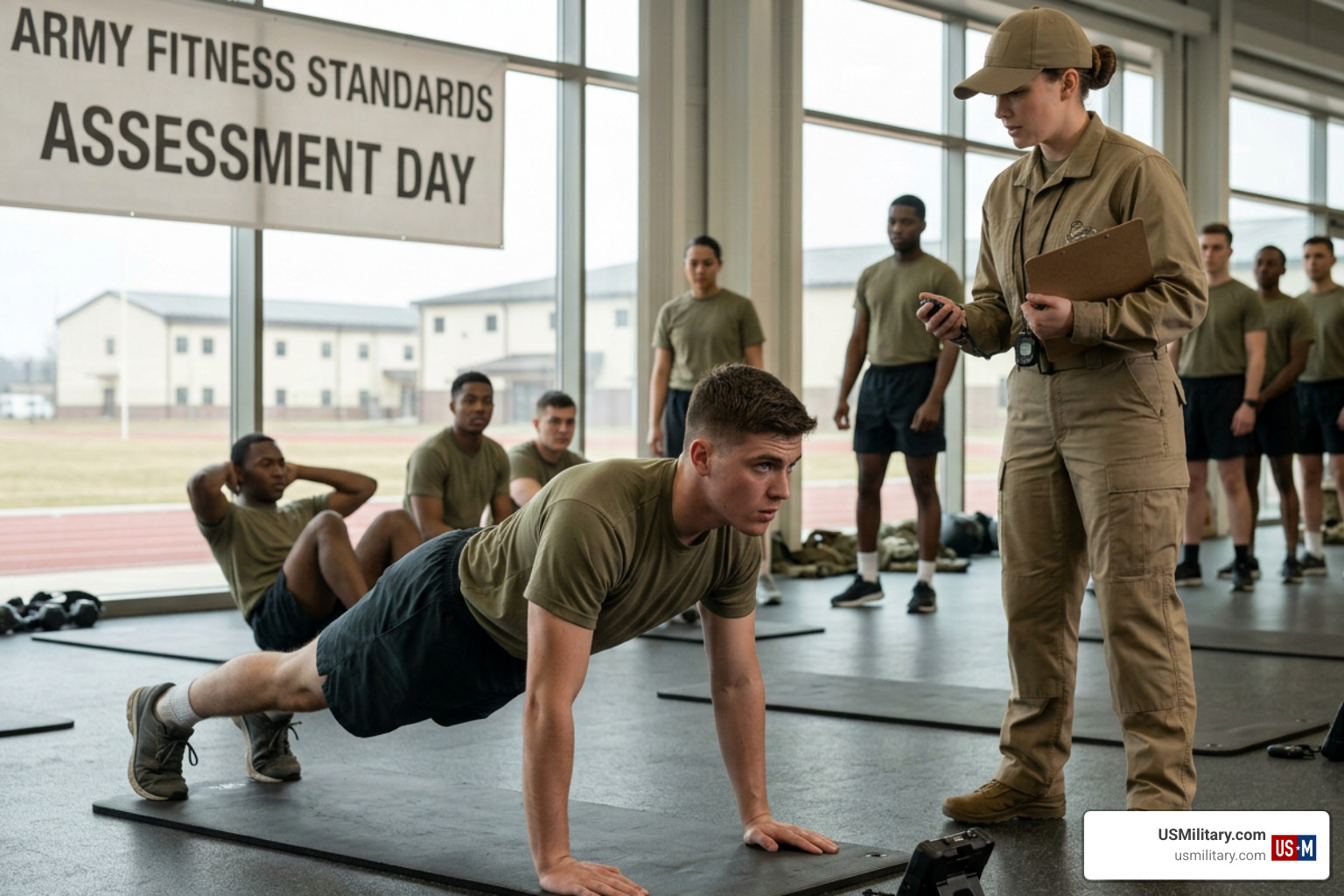
Once you are in the service, your fitness is measured by the official Army Fitness Test (AFT). This is a comprehensive, five-event test designed to evaluate your functional fitness, strength, and endurance.
The five core events of the AFT are:
- 3 Repetition Maximum Deadlift (MDL): Measures lower body strength.
- Hand-Release Push-Up (HRP): Measures upper body endurance.
- Sprint-Drag-Carry (SDC): A high-intensity shuttle run measuring anaerobic capacity and power.
- Plank (PLK): Measures core strength and stability.
- Two-Mile Run (2MR): Measures aerobic endurance.
To pass the AFT, you must score a minimum of 60 points on each of the five events, resulting in a minimum passing score of 300 out of a possible 500 points. The test is administered twice a year for active-duty Soldiers, and once a year for Reserve and National Guard members.
The Army’s modern physical culture is built around the Holistic Health and Fitness (H2F) system, which integrates physical training with sleep, nutrition, and mental health support. If a permanent medical condition prevents you from running, the Army allows alternate events like swimming or walking, but only after you have been fully cleared by a medical board.
For a detailed look at how the Army’s fitness standards stack up against other branches, read The Truth About Army and Marine Corps PT Tests.
Medical Disqualifications and Common Conditions
The MEPS medical exam is thorough, and certain conditions can temporarily or permanently disqualify you from service. However, the Army processes medical waivers on a case-by-case basis. Here is how common conditions are handled:
- Asthma: If you were diagnosed with asthma or used an inhaler after your 13th birthday, it is a disqualifying condition. However, you can request a waiver, which usually involves taking a pulmonary function test to prove your lungs are healthy.
- ADHD: You can generally enlist if you have not required medication or academic accommodations for ADHD within the last 12 months, and you show no obvious signs of cognitive impairment.
- Vision and Hearing: Your vision does not have to be perfect, but it must be correctable to 20/20 in at least one eye. Severe hearing loss is disqualifying, though mild cases may receive waivers.
- Tattoos: The Army has some of the most relaxed tattoo rules in the military. Tattoos are allowed almost anywhere except on your mouth, ears, or eyelids. You are allowed one neck tattoo (under 2 inches) and one ring tattoo on each hand. However, any tattoos that are extremist, racist, sexist, or indecent are strictly prohibited and cannot be waived.
To learn more about specific medical standards, check out the official GoArmy Requirements.
Character, Conduct, and Legal Standards
The Army places an immense value on character. Every applicant must undergo a federal background check. Legal offenses — including felonies, misdemeanors, and drug charges — can affect your ability to join.
While minor traffic tickets rarely cause issues, more serious offenses require a moral waiver. The Army evaluates moral waivers by looking at the “whole person,” considering how much time has passed since the offense, your overall character, and your accomplishments since then.
However, certain conduct offenses are permanently non-waivable under DoD policy:
- Any felony sex offense.
- Any requirement to register as a sex offender.
- Domestic violence convictions (due to federal laws preventing domestic abusers from carrying firearms).
- Multiple severe felony convictions.
Additionally, the military maintains a strict policy regarding drug and alcohol abuse. You will be drug tested at MEPS. Testing positive for illegal substances at MEPS will result in an immediate temporary disqualification, and you will have to wait a mandatory period before you can apply for a waiver to retest.
Comparing the Regular Army, Reserve, and National Guard
While the core army minimum requirements (like citizenship, ASVAB, and physical standards) are identical across all branches of the Army, there are minor structural differences depending on how you choose to serve.
- Regular Army (Active Duty): This is full-time service. You will live on or near a military base and work a full-time military job.
- Army Reserve: This is part-time service (typically one weekend a month and two weeks in the summer). Reserve Soldiers focus on support, logistics, and medical roles, and they report directly to the federal government.
- Army National Guard: Also part-time, but with a dual mission. National Guard Soldiers serve both their state governor (for local emergencies like natural disasters) and the president (for federal deployments).
Because the National Guard is state-administered, some states may offer specific education or age incentives. For example, some states allow original enlistment in the Guard up to age 45 under specific state programs. You can read more about these unique state-level rules on the National Guard Eligibility page.
Frequently Asked Questions About Army Requirements
Can I join the Army with a GED?
Yes! The Army accepts GED holders (classified as Tier 2 candidates). However, because Tier 2 slots are limited, you can make yourself a much stronger applicant by scoring a 31 or higher on the ASVAB, or by taking college classes to earn at least 15 college credits, which elevates you to Tier 1 status.
What is the maximum age to enlist in the Army in 2026?
As of June 2026, the maximum age to enlist in the Regular Army as an active-duty Soldier is 42. You must be able to pass the standard physical and medical screenings. Age waivers are also available on a case-by-case basis for those with prior service or highly specialized skills.
How do medical and moral waivers work?
If you have a disqualifying medical condition or a past legal issue, your recruiter can help you submit a waiver request. This process involves gathering all of your medical records, court documents, and letters of recommendation. The waiver is then reviewed by military medical doctors or senior commanders at MEPS, who make a decision based on your current health, character, and the needs of the Army.
Conclusion
Meeting the army’s minimum requirements to join is the first step on an incredible journey of service, personal growth, and leadership. Whether you meet every standard perfectly or need to work through a waiver or prep course, the Army has built pathways to help determined patriotic citizens succeed.
At USMilitary.com, we are committed to helping you navigate this process. From evaluating your career paths to understanding your future benefits, we are here to support you.
If you are ready to take the next step, check out our detailed guide on the Requirements to Join the Army, or visit our homepage at USMilitary.com to connect with a recruiter in your area today. Your future starts now!